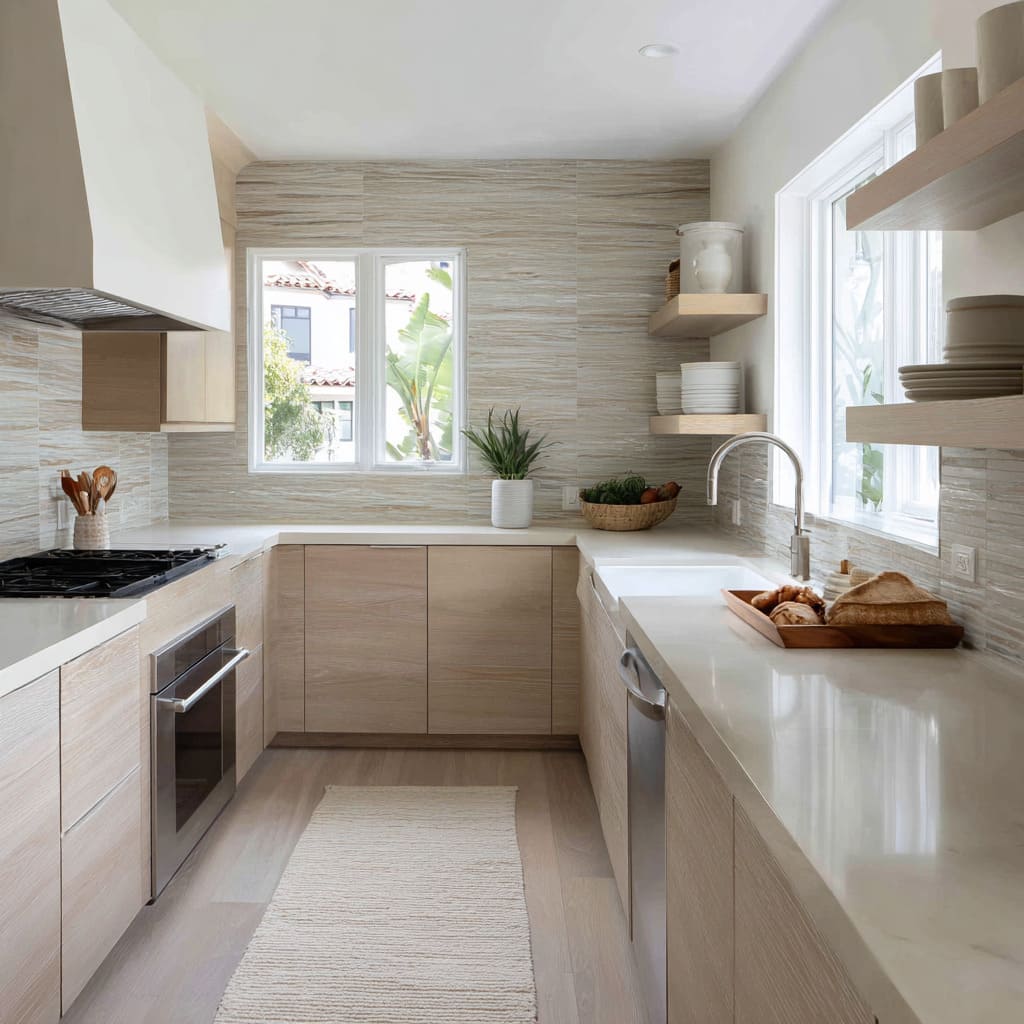
Modern kitchen designs built around sandy hues reveal that this palette is not one note but an entire climate of tones, shifting subtly from warm mushroom cream to cool limestone, from oatstone to silica-beige gloss. What makes such designs compelling is not the presence of a singular beige, but the relationship between undertones, texture scale, and how light interacts with the surfaces.
Often, sand can be treated as an emotional spectrum: creamy sand that feels domestic and calm; cooler mineral sand that introduces urban composure; coastal driftwood sand that hints at an easy, sun-washed mood; and pale linen sand that behaves more like a soft fabric tone than a paint hue. This family of tones becomes especially expressive when all large surfaces—cabinets, floors, counters, and walls—sit close in value, letting texture, grain, gloss, and shadow form the true variation.
Within this kind of palette, even the faintest color shift can carry meaning, turning each kitchen design into a controlled and atmospheric composition rather than a traditional two-tone scheme.
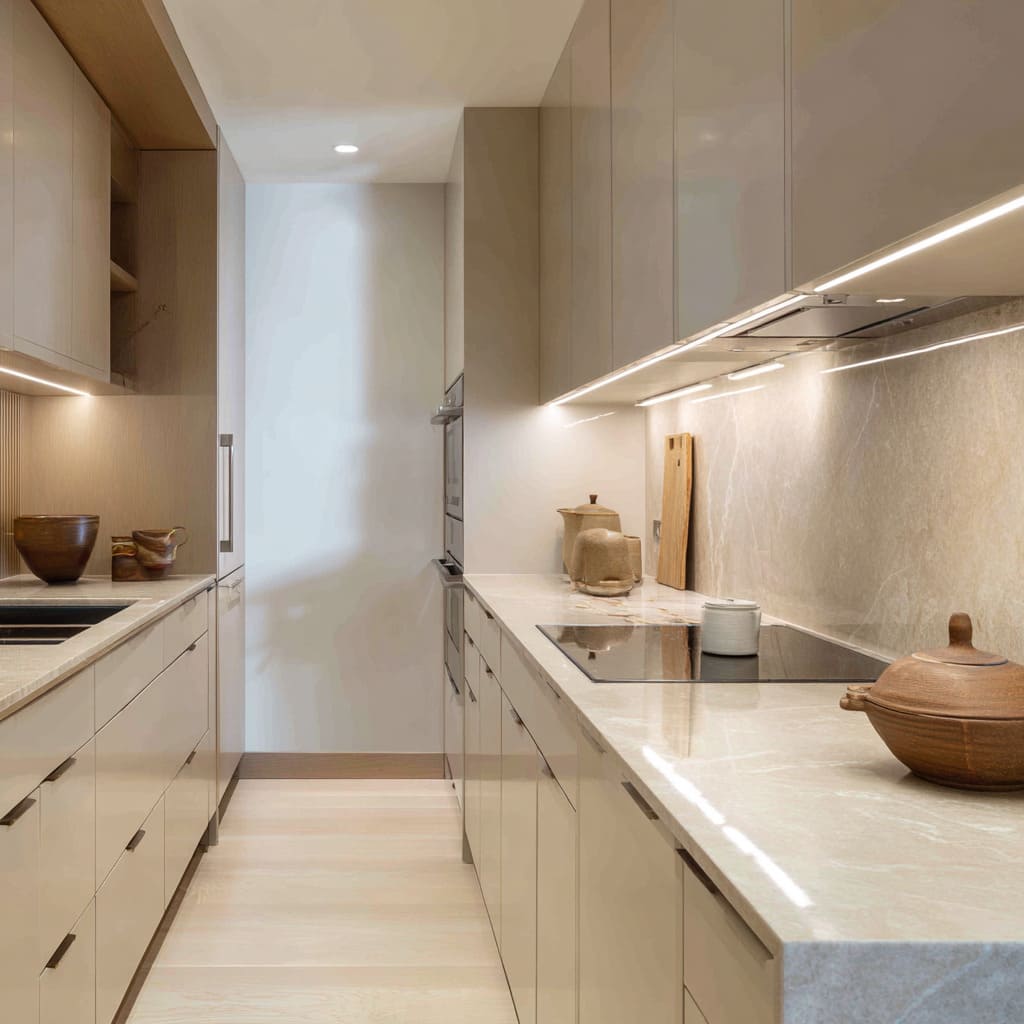
The Sand-Tone Envelope
A defining modern move is the use of a sand-toned envelope, where the majority of permanent surfaces share the same tonal family. This can unfold several ways:
Horizontal Envelope
- Cabinet runs, counters, and low backsplashes all hold a unified sand note.
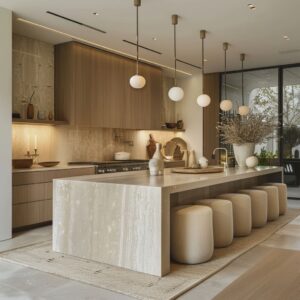
- Islands repeat the same counter and cabinet tone, creating a sand bridge.
Vertical Envelope
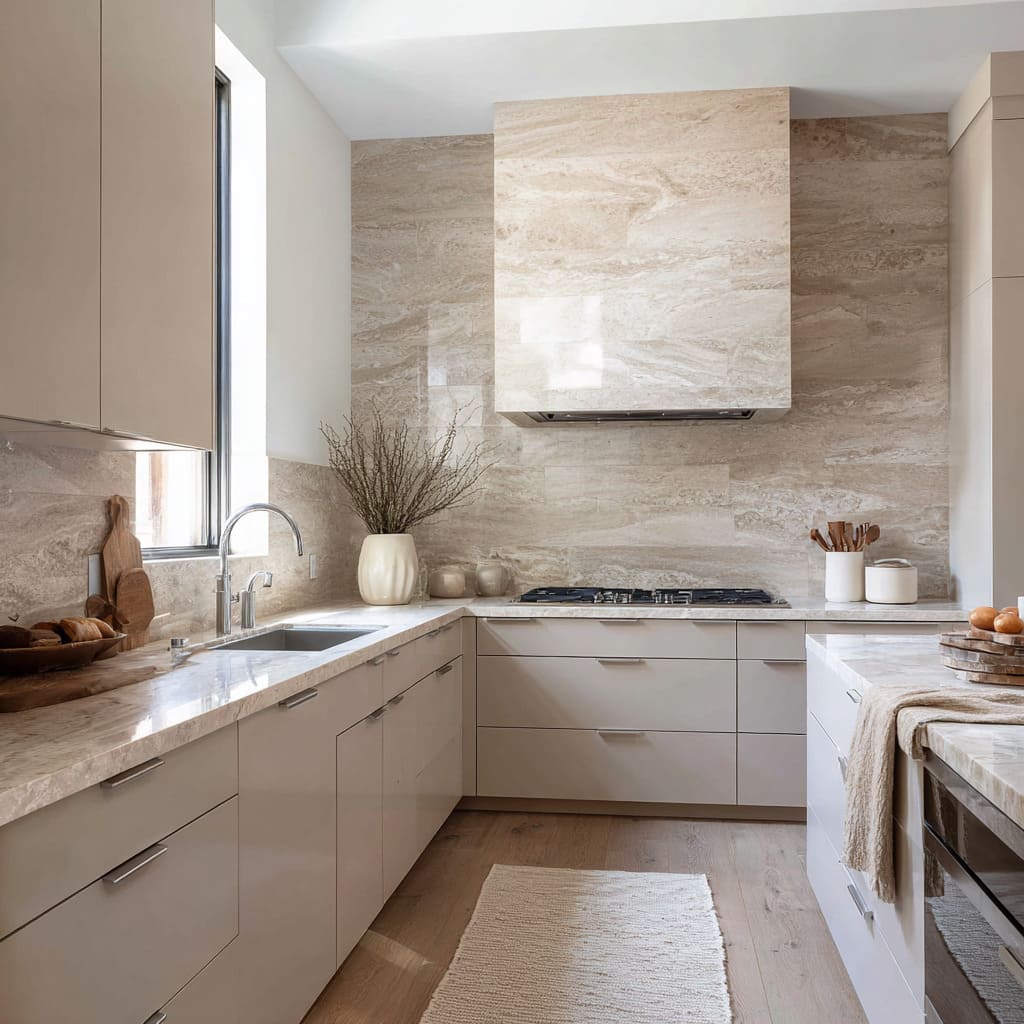
- Stone slabs climb from counter to ceiling, turning the entire cooking wall into a monolithic visual field.
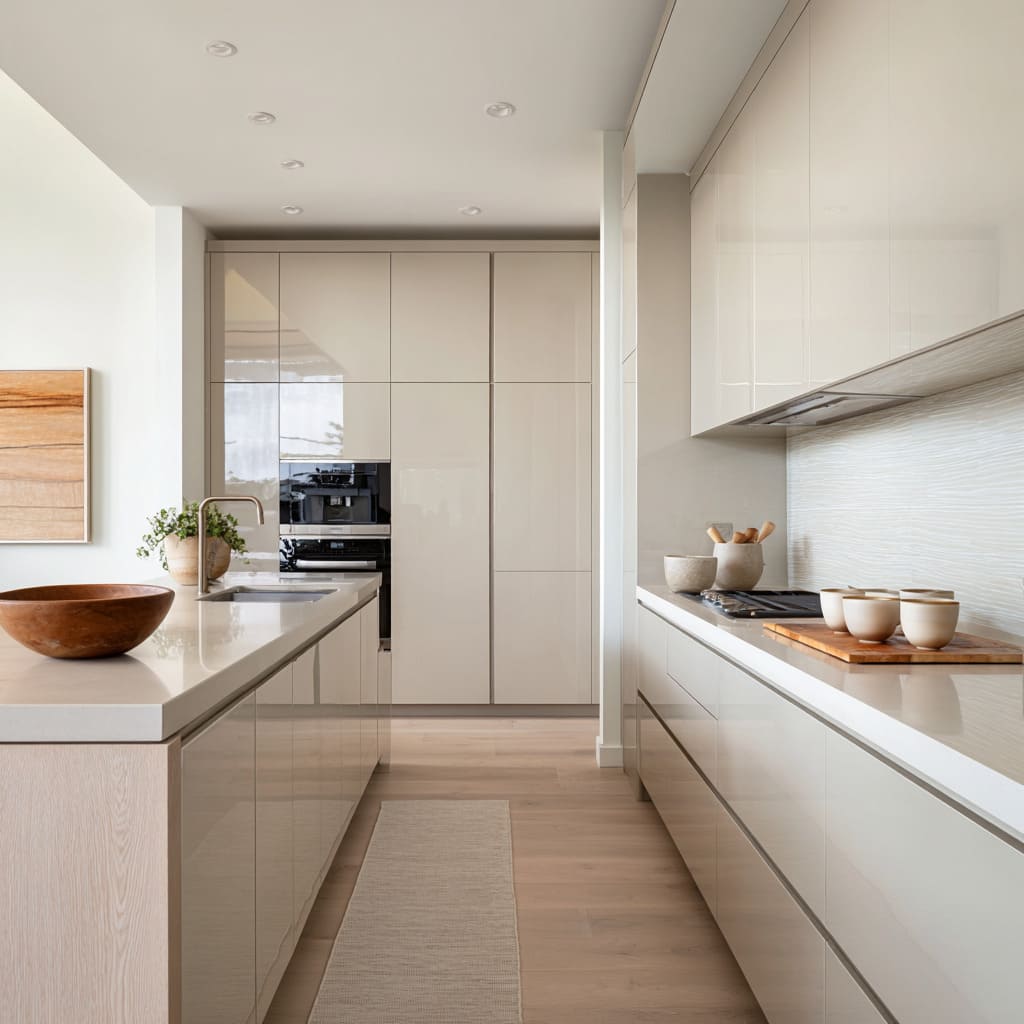
- Glossy sand cabinets stretch from floor to ceiling with uninterrupted planes.
Mixed Envelope
- Sand-painted fronts pairs with pale oak floors and soft stone counters.
- Ribbed tiles form a mid-height horizon that wraps the room.
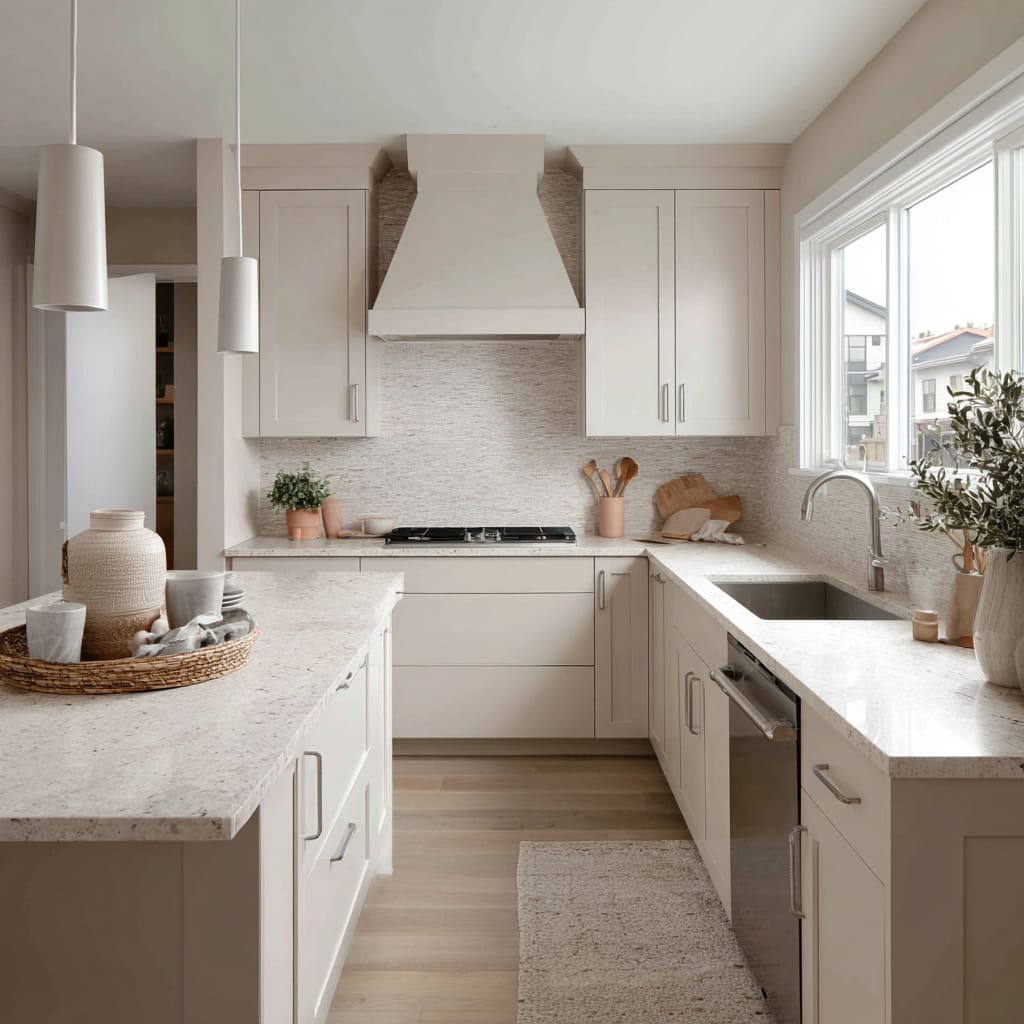
These envelopes soften the contrast between elements, allowing the space to read as a single environment rather than a set of objects. Instead of highlighting the separation between cabinetry, island, wall, and backsplash, the envelope approach blends them into one cohesive skin.
This strategy supports very quiet, steady compositions where even everyday items stand out gently. It is one of the core sand color kitchen ideas used in modern interiors, making calmness the main language.
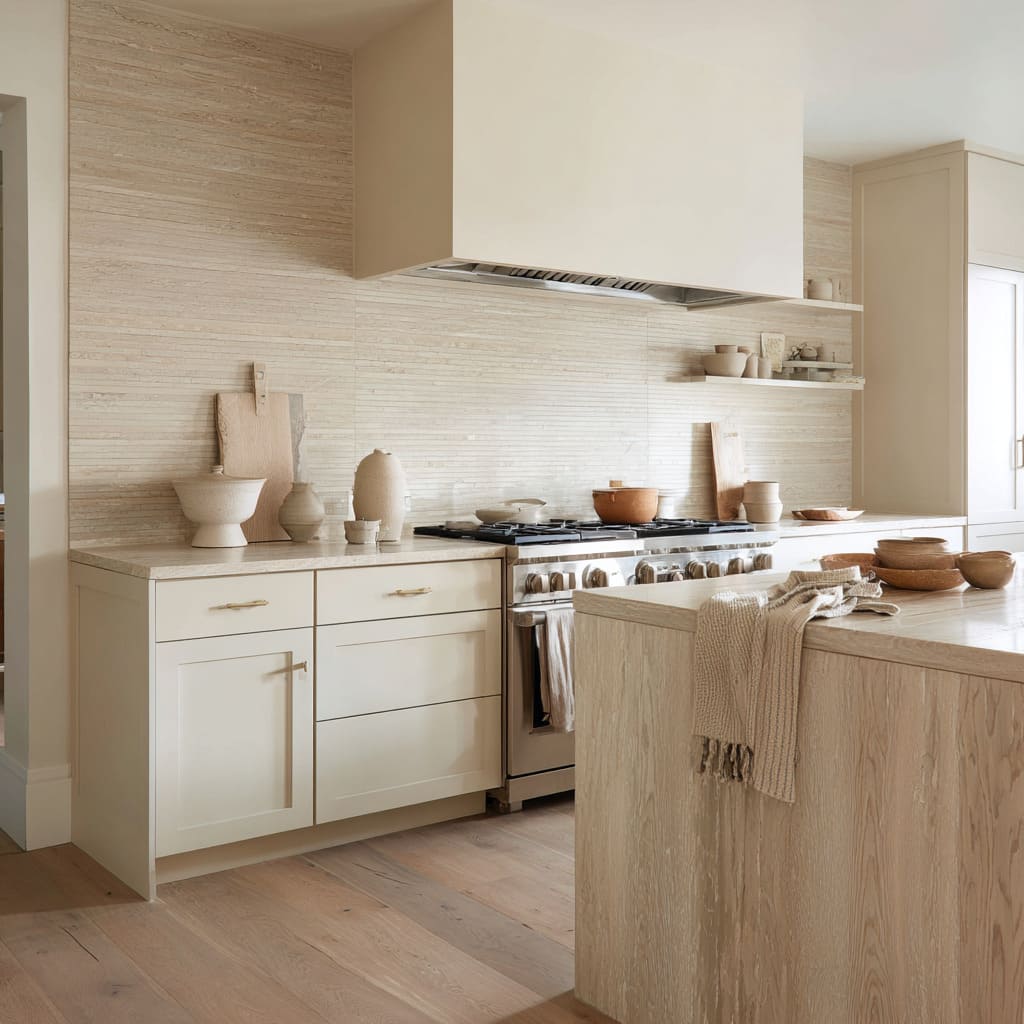
Using Directional Lines to Organize Movement and Emotion
Sand-toned designs often rely on directional lines to give the design its structure. These lines rarely shout—they whisper—but they transform the room’s flow.
Horizontal lines dominate: stone veining that runs lengthwise; tile ridges arranged in thin horizontal bands; long pulls that trace across drawers; under-cabinet light strips that form subtle glowing bars; and wood grain that stretches the space visually. These horizontal elements imply stillness, widen compact layouts, and guide the eye gently across the working zone.
Vertical moves counterbalance them: tall fridge panels with vertical grain, hood blocks that rise above the cooking wall, and vases filled with tall, airy branches. The interplay between horizontal calm and vertical grounding keeps the composition from feeling static.
Without these imperceptible line directions, a tightly tonal palette could become plain; with them, the kitchen develops a delicate visual rhythm.
Micro-Texture as the Real Source of Richness
Within sand-based palettes, variation rarely comes from color contrast. Instead, richness comes from micro-texture—fine lines, tiny ridges, and surface shifts that are felt more than overtly seen.
This subtle texture work can be interesting:
- Backsplash textures: ribbed ceramic strips, tiny cleft tile, narrow stacked stone.
- Cabinet textures: vertical graining on pale oak, thin grooved fronts, matte vs semi-sheen finishes.
- Floor textures: brushed oak planks, slightly washed stone, soft transitions of graining.
- Accessory textures: matte ceramics, woven baskets, knitted textiles, natural-fiber placemats.
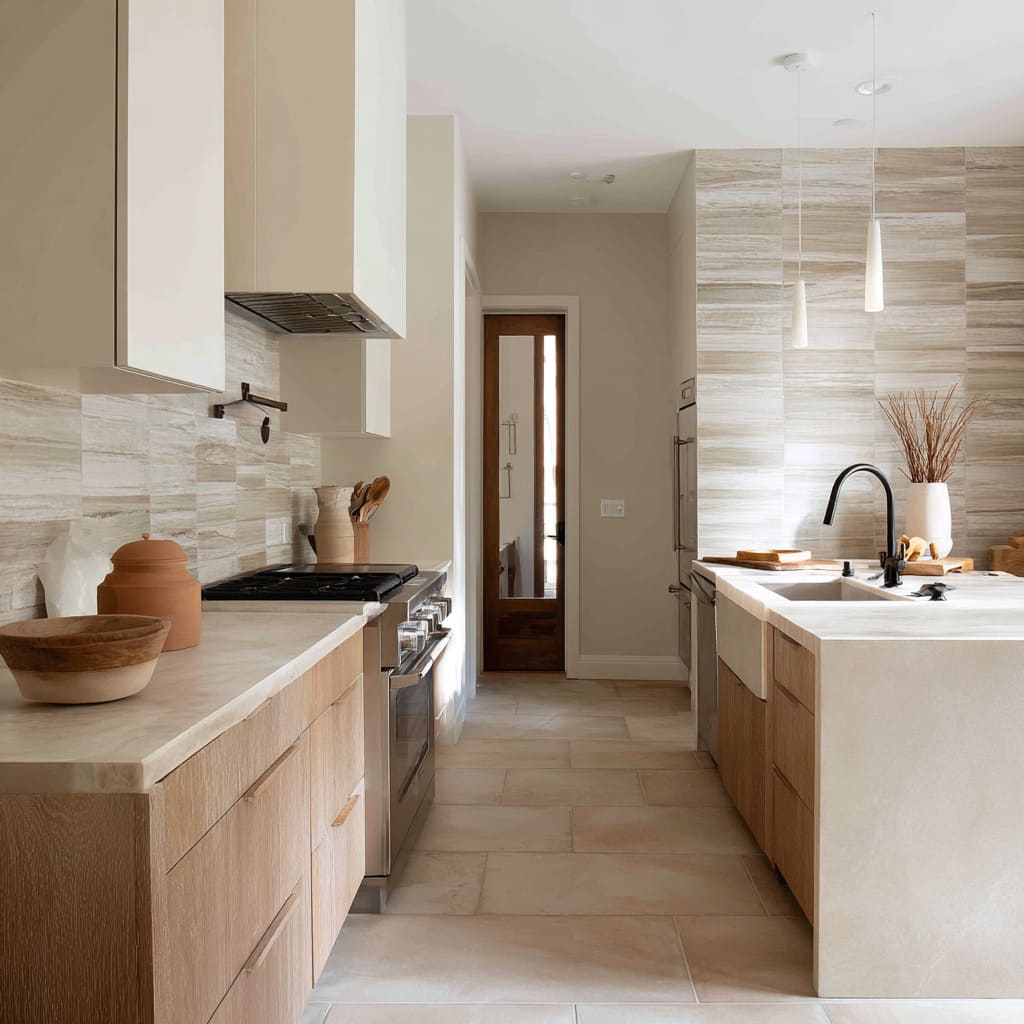
What ties these elements together is the deliberate scale: none of the textures are large, bold, or graphic. They form a repeating pattern of soft stripes and subtle grooves that echo one another across different materials.
Because sand tones are naturally gentle, micro-texture becomes the main way designers insert identity and depth. From the viewpoint of interior composition, the kitchen becomes a quiet landscape of parallel textures, each adding a layer of softness or refinement.
Stone as a Narrative Device
Stone plays a central role in many modern sand-toned kitchens, not as a practical surface but as a narrative element. Often stone can be selected with calm, stretched veining and then orient that veining to support the room’s layout.
Several recurring stone expressions appear:
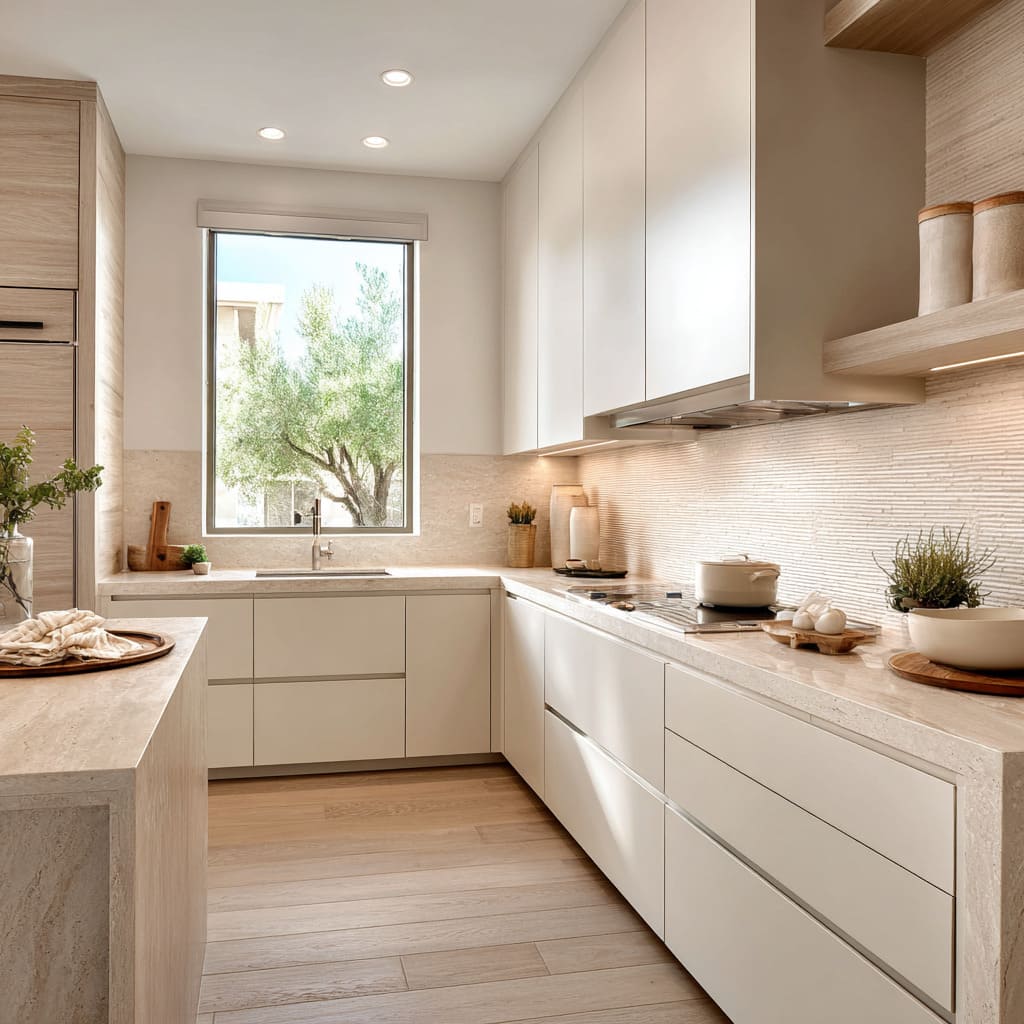
1. Geological Continuity
- The same stone wraps the island, counters, and backsplash.
- Mitred edges create the illusion of slabs folding like pages of a book.
2. Coastal or Water-Inspired Stone
- Striated tiles that imitate tide patterns or shoreline rock layers.
- Pale stones with faint wave-like lines that glow under warm lighting.
3. Warm Limestone and Greige Stone
- Veins in beige, taupe, and muted clay for warmth.
- Subtle cooler undertones to balance wood-heavy designs.
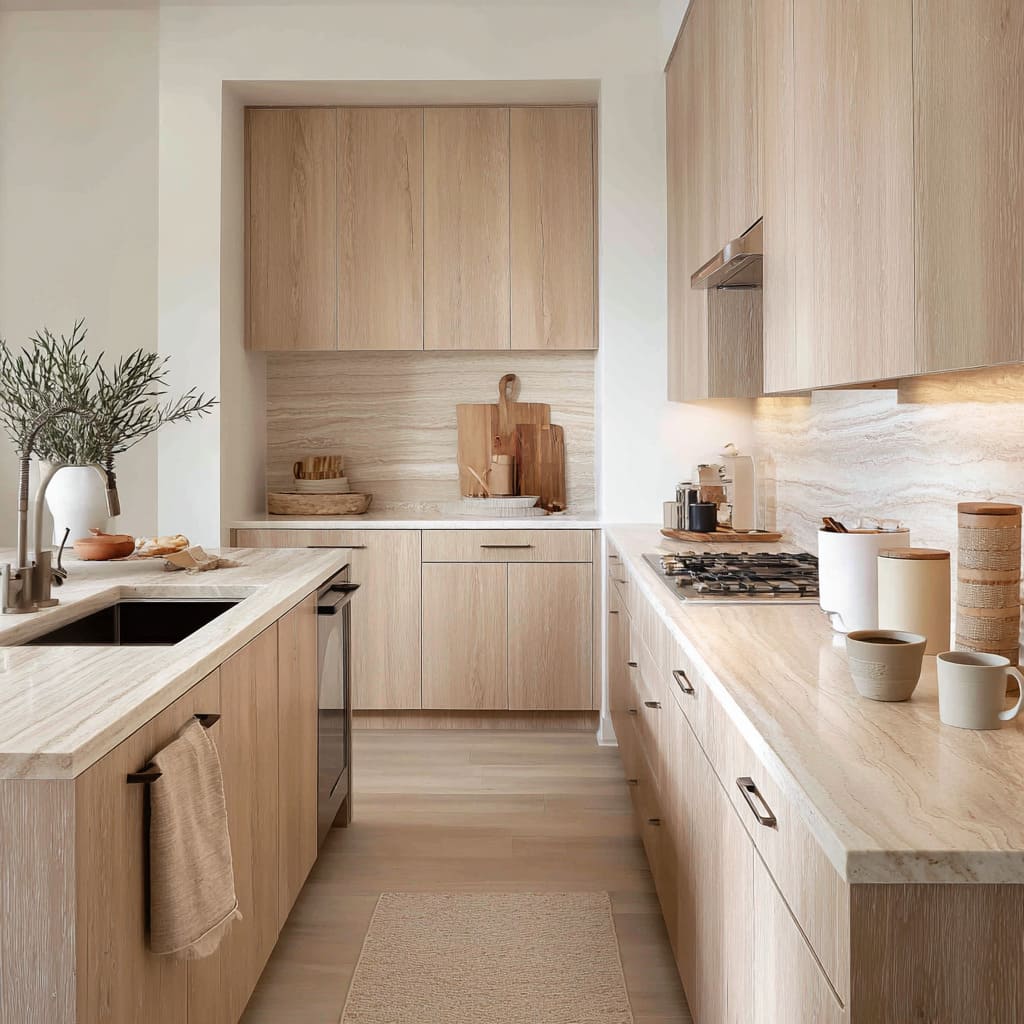
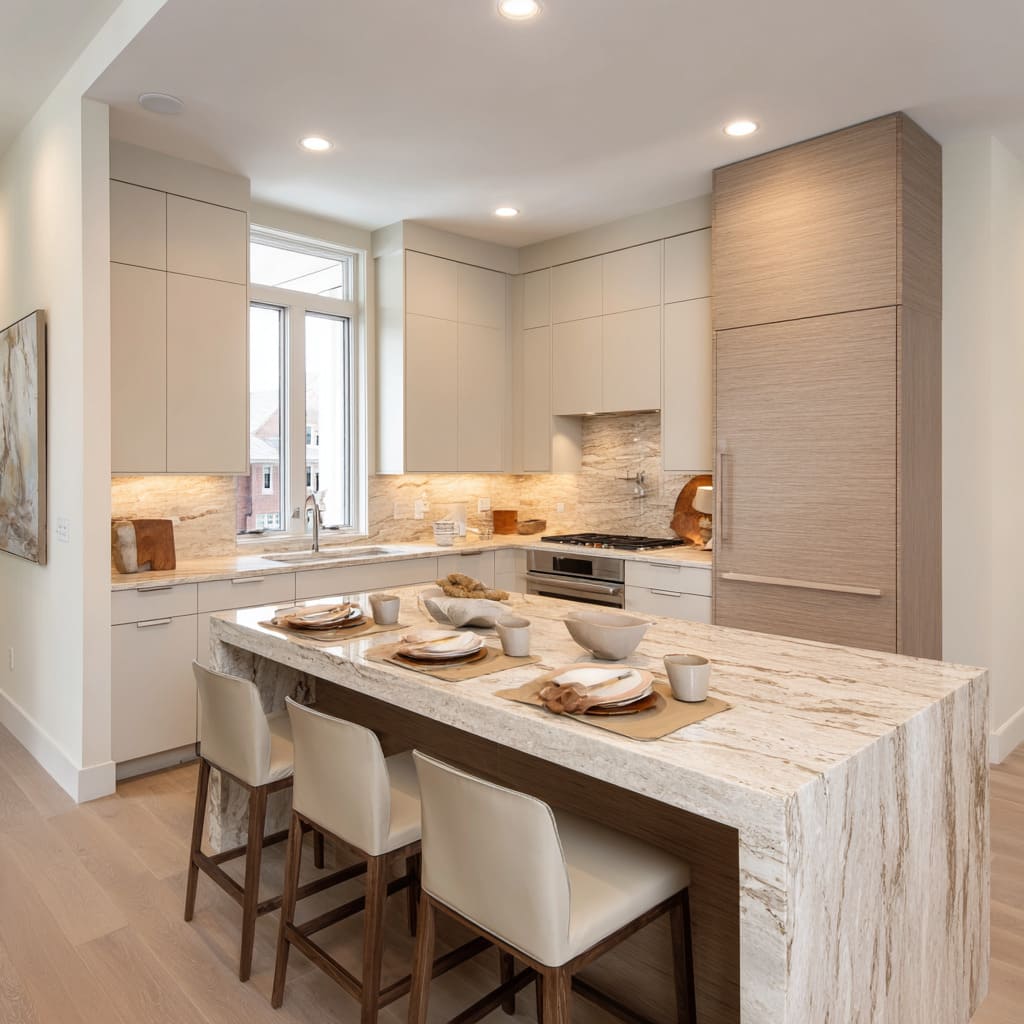
Stone is the expressive partner in such designs: while cabinets stay quiet in sand, stone handles the emotional peaks. A design of pale sand cabinets with a dramatic single-slab island becomes visually anchored by the stone’s movement.
Conversely, a kitchen with minimal veining leans into a spa-like effect. This use of stone is a defining characteristic of sand grey kitchen design, where both warm and cool sand notes blend seamlessly with grey-mineral veining.
Soft Light as an Active Material
Light is treated as part of the materials—not just illumination. Several main lighting behaviors:
Under-Cabinet Glow
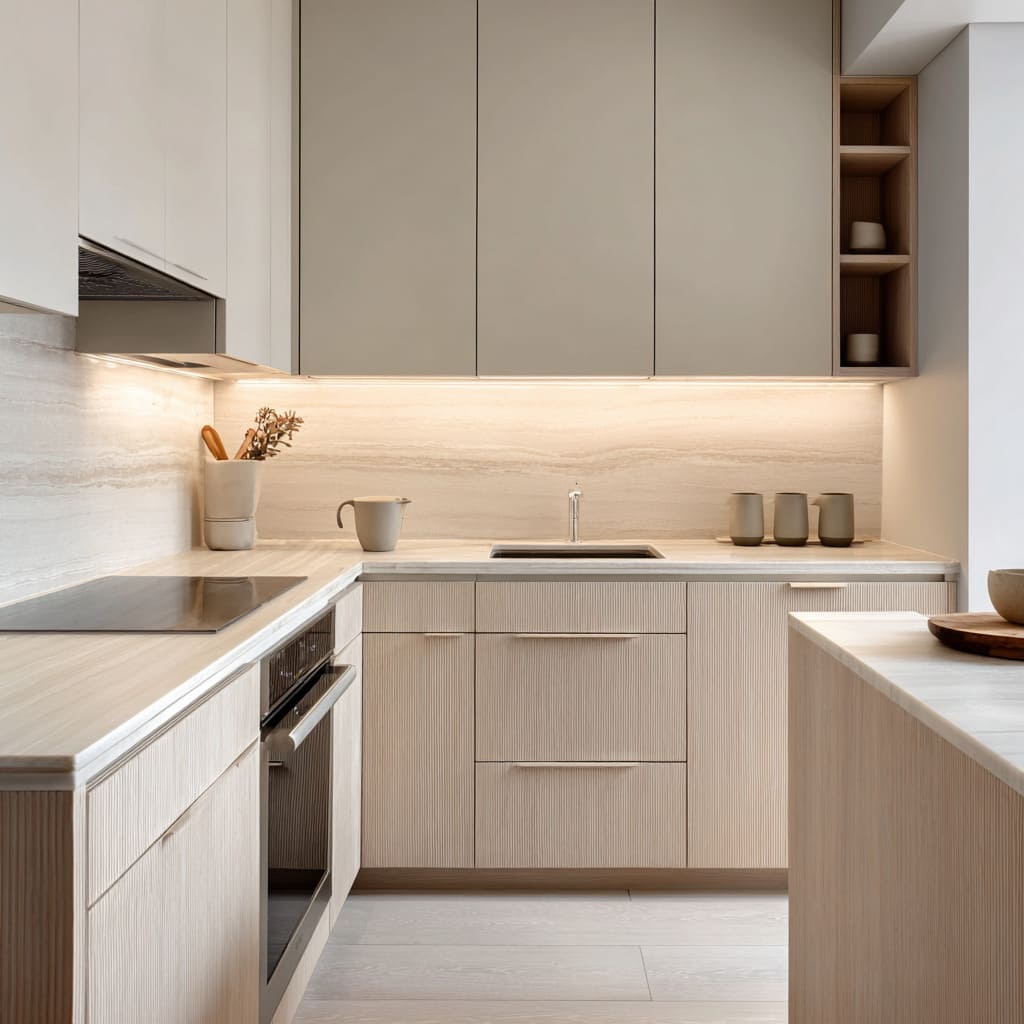
This is the most influential gesture: a continuous light band that glides across stone or ribbed tile, creating a warm horizon line. The glow softens textures, highlights veining, creates depth, and forms a ribbon of warmth beneath upper cabinets.
Indirect Reflection
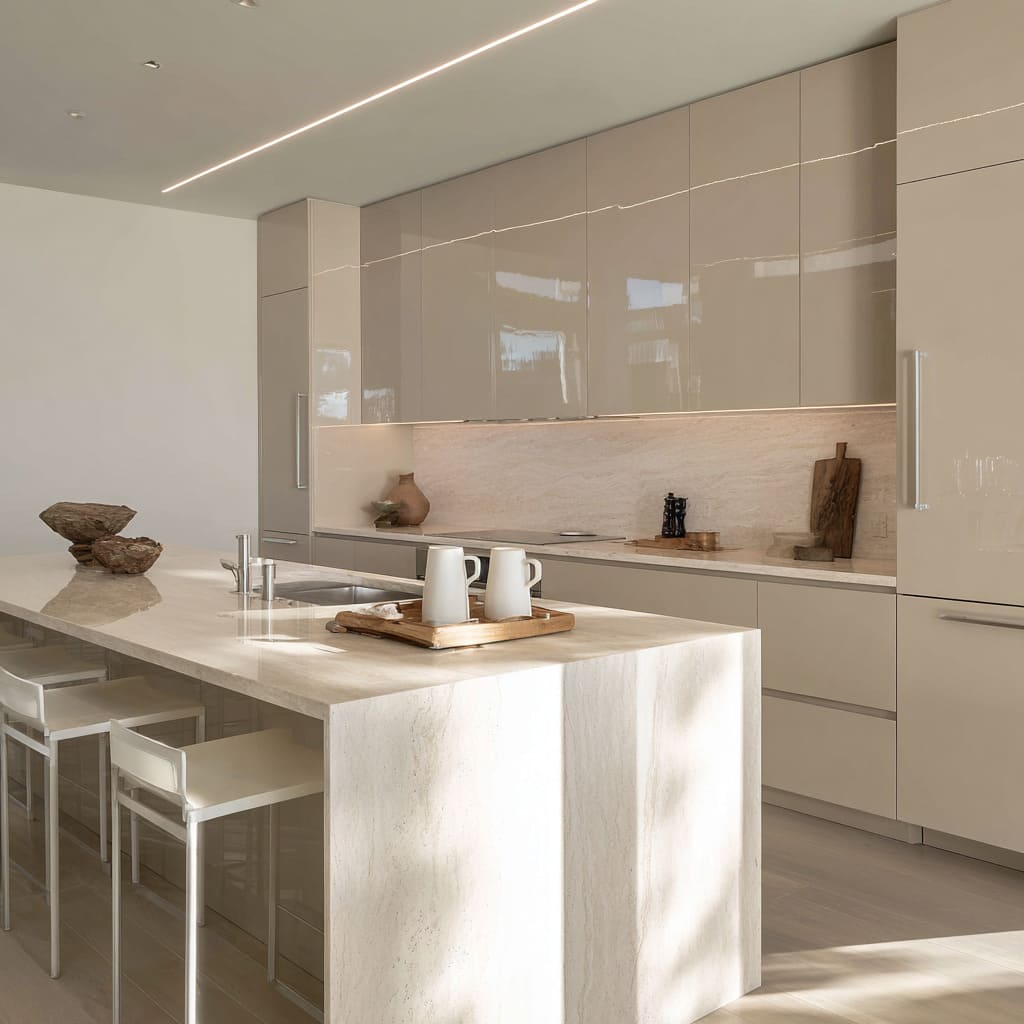
Glossy cabinet fronts, pale stone, and light oak floors all respond differently to daylight:
- Gloss surfaces catch subtle reflections, turning windows and silhouettes into soft patterns.
- Ribbed tiles ripple when light moves across them.
- Matte ceramics absorb light, giving small objects more tactile presence.
Natural Light Framing
Many sand designs place windows strategically:
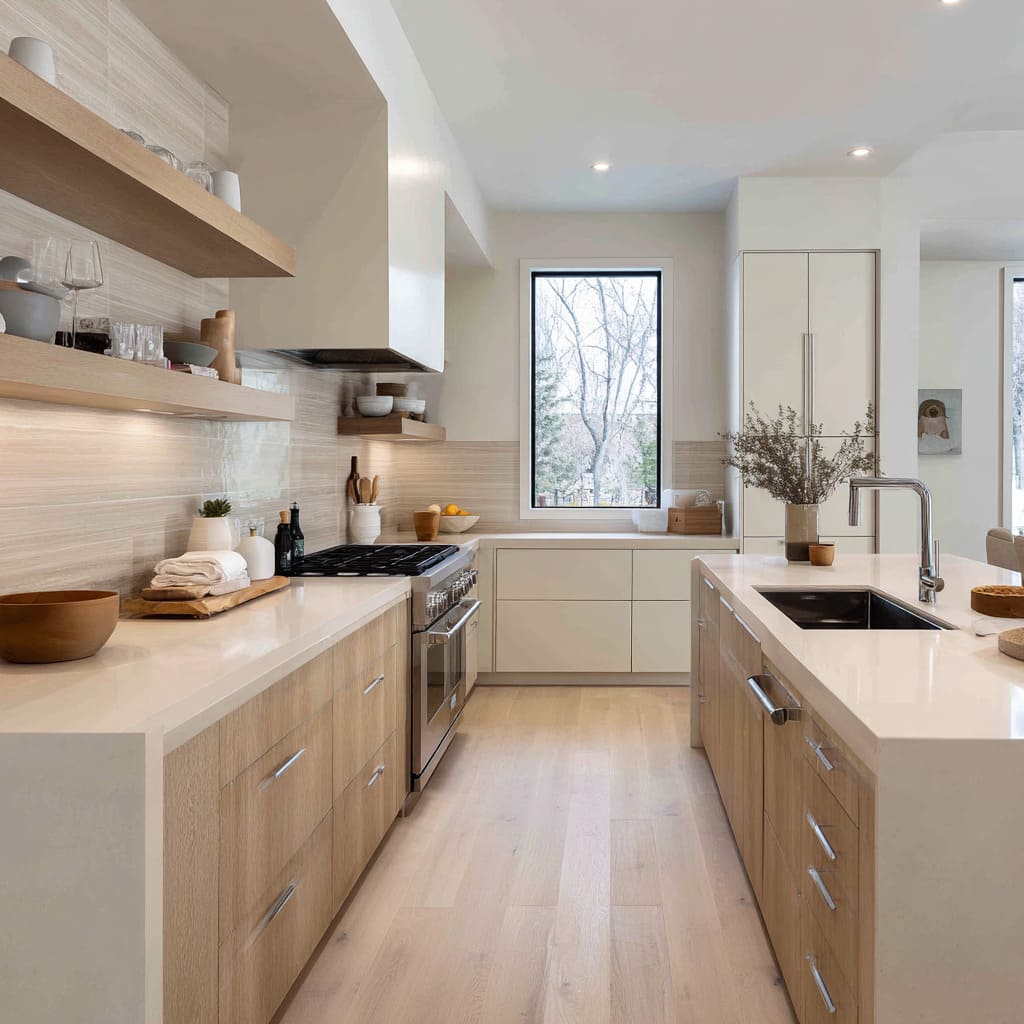
- A window framed in black becomes the main focal contrast.
- A green outdoor view becomes the only strong color presented.
- A daylight wash creates a gentle gradient on pale stone.
This careful choreography of light and tone creates kitchens that feel serene even without direct sun, as though the light is diffused by the sand palette itself.
The Rhythm of Objects
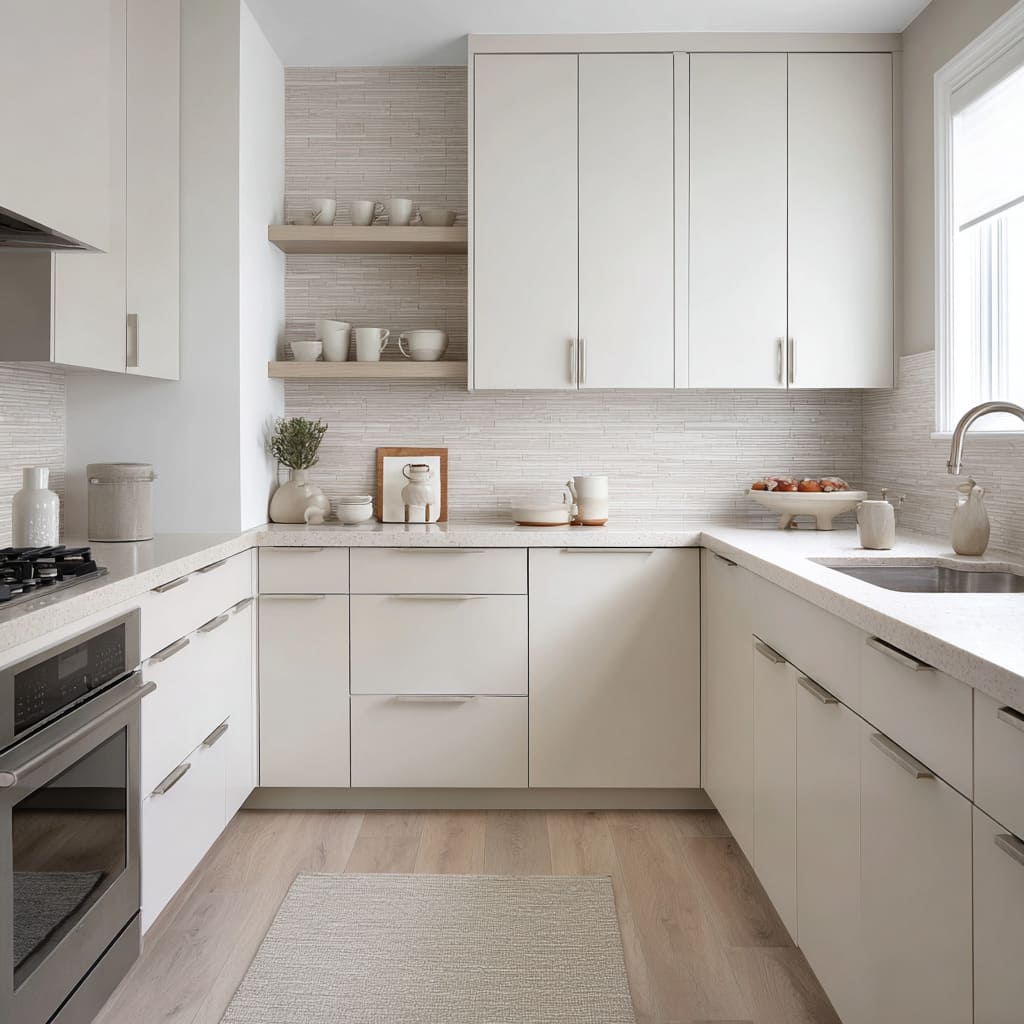
Objects can be selected not to add color but to add softness, volume, or quiet character. This approach creates everyday still-lifes that humanize the calm sand shell.
The selections repeat across many examples:
Ceramics
- Rounded vases, matte pitchers, neutral bowls.
- Off-white and light clay tones that blend into the sand climate.
Wood
- Cutting boards in layered warm tones.
- Bowls and trays in honey or caramel finishes that echo deeper sand streaks.
Greenery
- Dried branches, soft stems, or muted foliage.
- A single plant framed in a window to connect the interior to nature.
Textiles
- Knitted throws on islands.
- Soft runners in tightly woven sand tones.
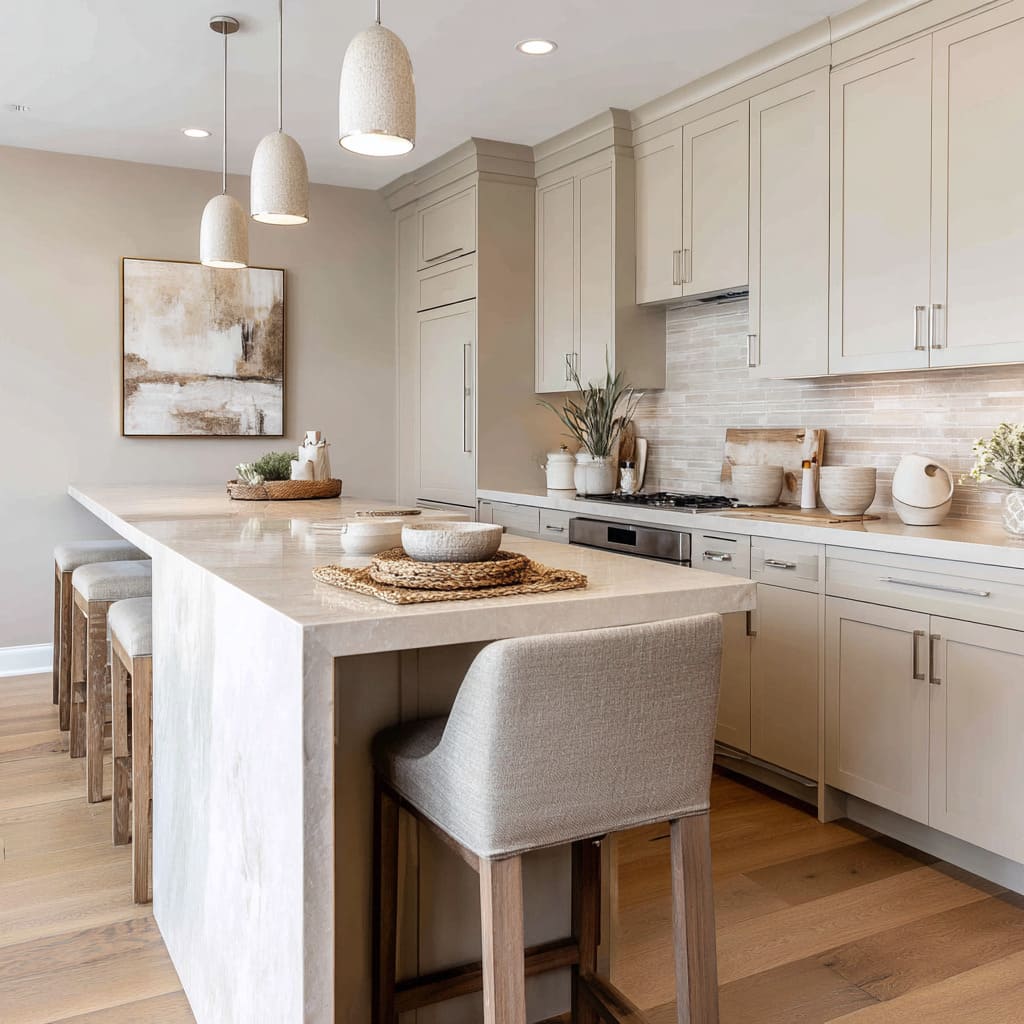
These objects aren’t embellishments; they are the punctuation marks of the composition. A single fruit bowl, one matte vase, or a cutting board leaning casually adds the necessary life without breaking the sand palette’s calm unity.
In rooms where the permanent elements are extremely smooth, these grounded accessories create balance and warmth.
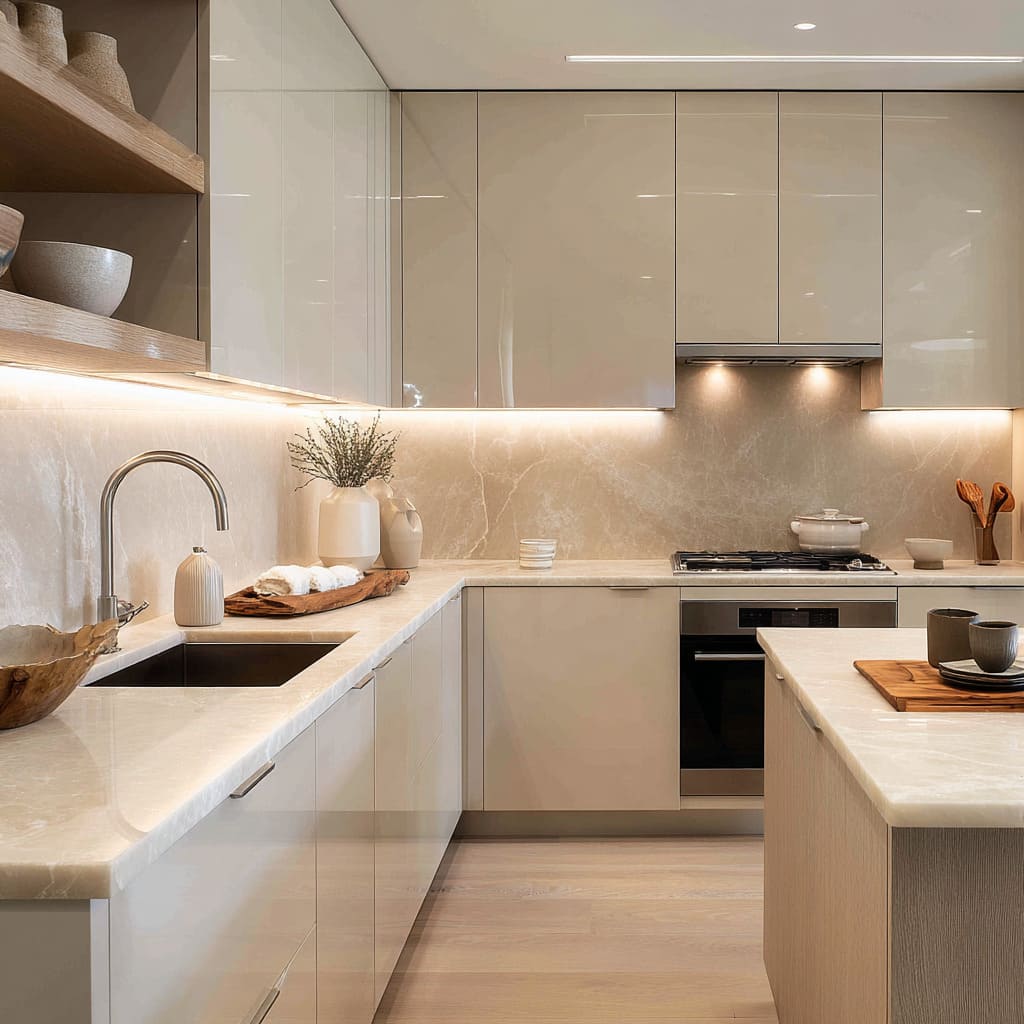
Cool vs Warm Sand Tones and Their Emotional Effects
A crucial part of understanding sand-toned kitchens is recognizing how undertone shifts change the entire atmosphere. Designers use these subtleties as emotional tools:
Warm Sand (cream, oatmeal, wheat)
- Feels familiar, calm, domestic.
- Often paired with oak flooring and creamy stone.
Cool Sand (limestone, greige, pale mineral)
- Feels refined, urban, clean-lined.
- Works well with glossy cabinets and linear stone.
Sun-Kissed Sand (gold-tinted stone)
- Suggests late-afternoon warmth.
- Feels uplifting and luminous.
Coastal Sand (driftwood, wet-sand gray)
- Lightweight and breezy.
- Often supported by striated tile and soft white ceramics.
Linen Sand (pale, almost-white cream)
- Spa-like and fresh.
- Allows the outdoor environment to act as the main color accent.
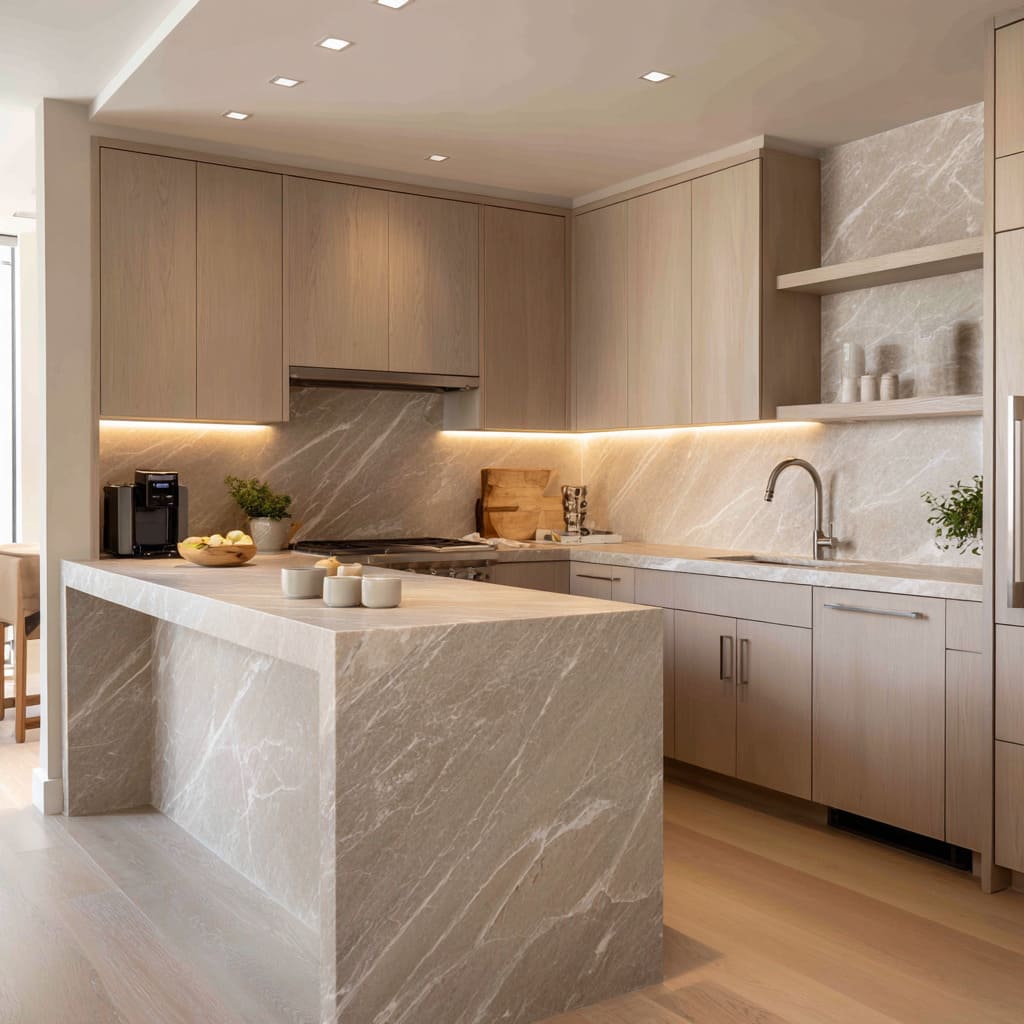
This manipulation of undertone is what gives design ideas with sand color kitchen cabinets so much variety. Two sand kitchens can look completely unrelated simply by shifting from warm to cool, or from mineral to coastal.
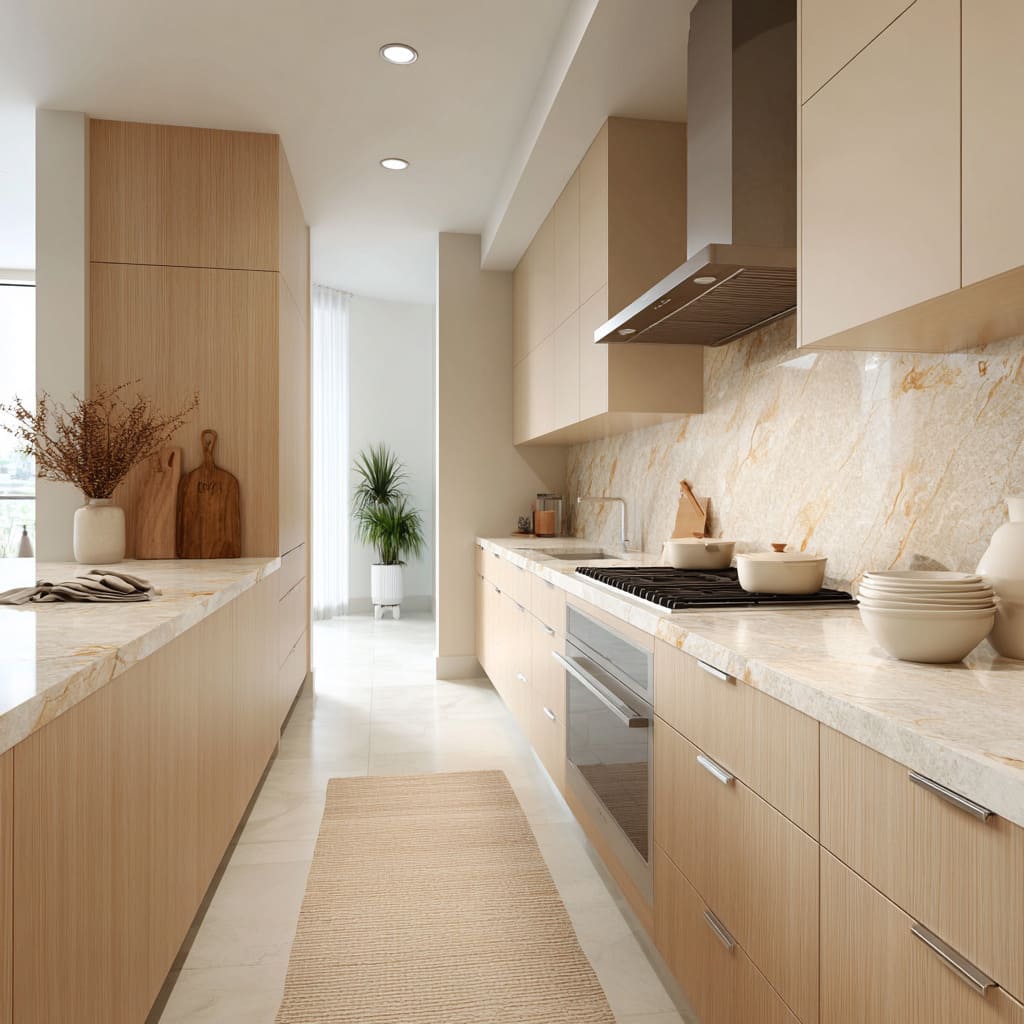
Layout and Sand: Why Form Shapes the Mood
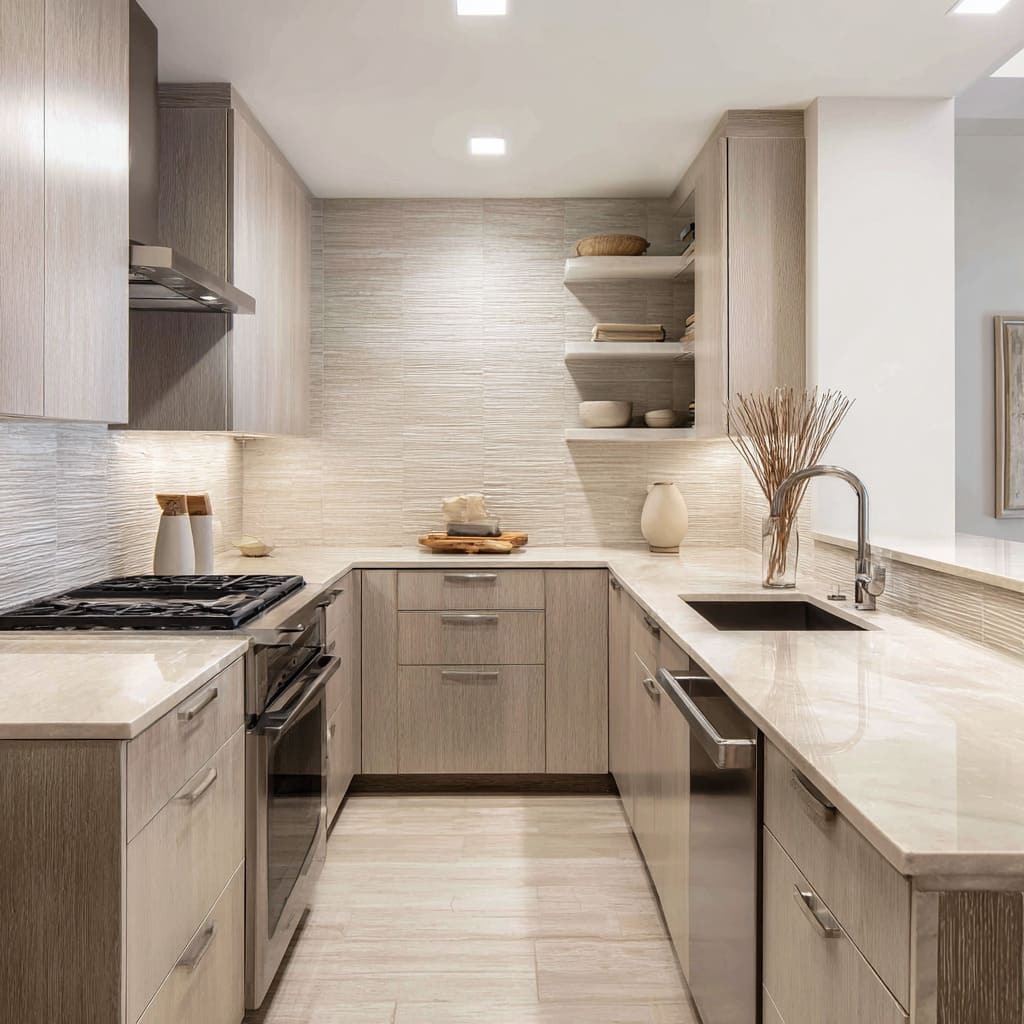
The plan shape plays a major role in how sand tones behave. Even with similar colors, U-shapes, galleys, and long kitchen corridors feel entirely different.
U-Shaped Layouts
- Sand color wraps around the user, forming a gentle bowl.
- A unified sand counter perimeter creates visual continuity.
- Works well for layered linear tile and soft stone tops.
Galley Kitchens
- Sand tones emphasize linearity and rhythm.
- Runners act as central pathways that reinforce the length.
- Glossy sand fronts turn corridors into reflective, luminous spaces.
Long L or Island-Focused Layouts
- Island becomes the centerpiece: either a sand-toned continuation of the perimeter or a stone-wrapped monolith.
- Veining direction enhances the long axis of the room.
- Sand upper cabinets paired with pale floors create a wide, breathable composition.
The palette stays calm, but the spatial structure supplies the emotional orientation—enclosed, open, corridor-like, or sculptural.
The Balance Between Softness and Anchoring
Kitchens in this palette maintain a balance between atmospheric softness and necessary grounding elements. Softness comes from sand’s low contrast and its ability to reduce visual noise; grounding comes from strategically placed deeper tones.
Designers often insert:
- Black sinks or faucets.
- Narrow oven stacks.
- Dark trays for oils and spices.
- A single dark bowl or clay pot.
- Slim black window frames.
These touches act like visual anchors, preventing the sand palette from drifting into uniformity. They are small but essential, creating a sense of depth within a monochromatic arrangement.
Because the overall palette is muted, these darker notes never dominate—they simply add quiet structure.
How Sand Interacts with Wood, Stone, and Ceramics
Sand kitchens rely heavily on material harmony rather than color contrast. Wood, stone, and ceramic elements each shift slightly in tone to produce depth inside a narrow palette:
Wood
- Light oak, brushed oak, bleached driftwood.
- Vertical or horizontal grain that guides the eye.
Stone
- Calm cream slabs with soft veining.
- Limestone-inspired patterns in horizontal lines.
- Stone-treated hoods to blend architectural planes.
Ceramics
- Neutral pieces in matte finishes.
- Small clusters that introduce hand-touched character.
- Echoes of the backsplash texture through ribbing.
These materials work together to build a layered, atmospheric composition where no element overwhelms another. The overall effect is a unified climate that feels calm but visually rich.
The Evolving Identity of Sand Kitchens in Modern Interiors
Sand kitchens have moved far beyond simple beige cabinetry. They now behave like immersive environments shaped by light, texture, stone, and micro-patterns.
Whether expressed through coastal striations, glossy silica reflections, pale-linen envelopes, or mineral greige slabs, sand becomes the language that organizes the design. Modern interiors interpret sand not as a color block but as a full sensory atmosphere—quiet, textured, layered, and filled with carefully placed objects that add depth while maintaining calm.
This design direction embraces softness while allowing stone and wood to speak, creating spaces that feel composed and warm without needing strong contrast. Within this visual universe, the modern sand grey kitchen design sits comfortably as one of the nuanced branches, balancing warm and cool sand tones for deeply controlled, atmospheric interiors.
Related Posts
Harmony Home Design brings 10+ years of residential interior design experience to the ideas shared here. We publish design concepts, layout thinking, and practical styling notes.