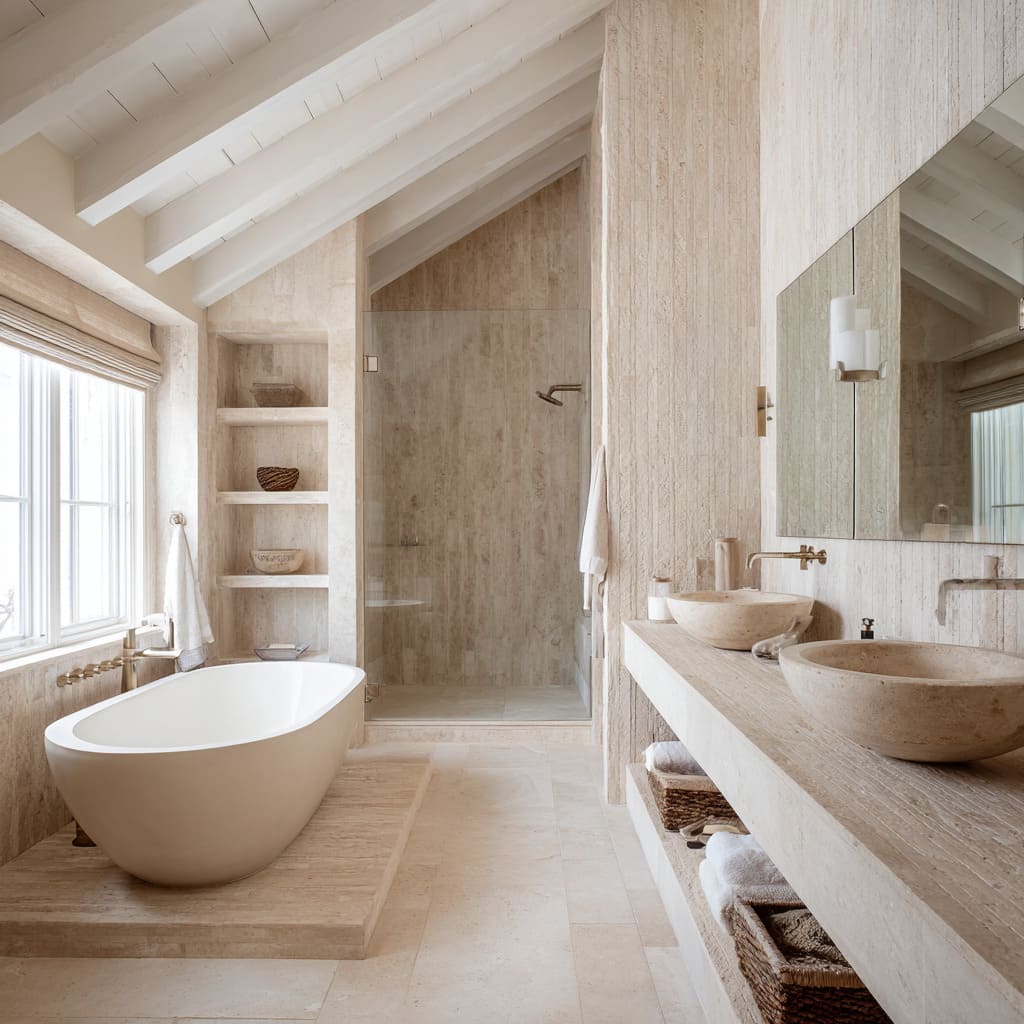
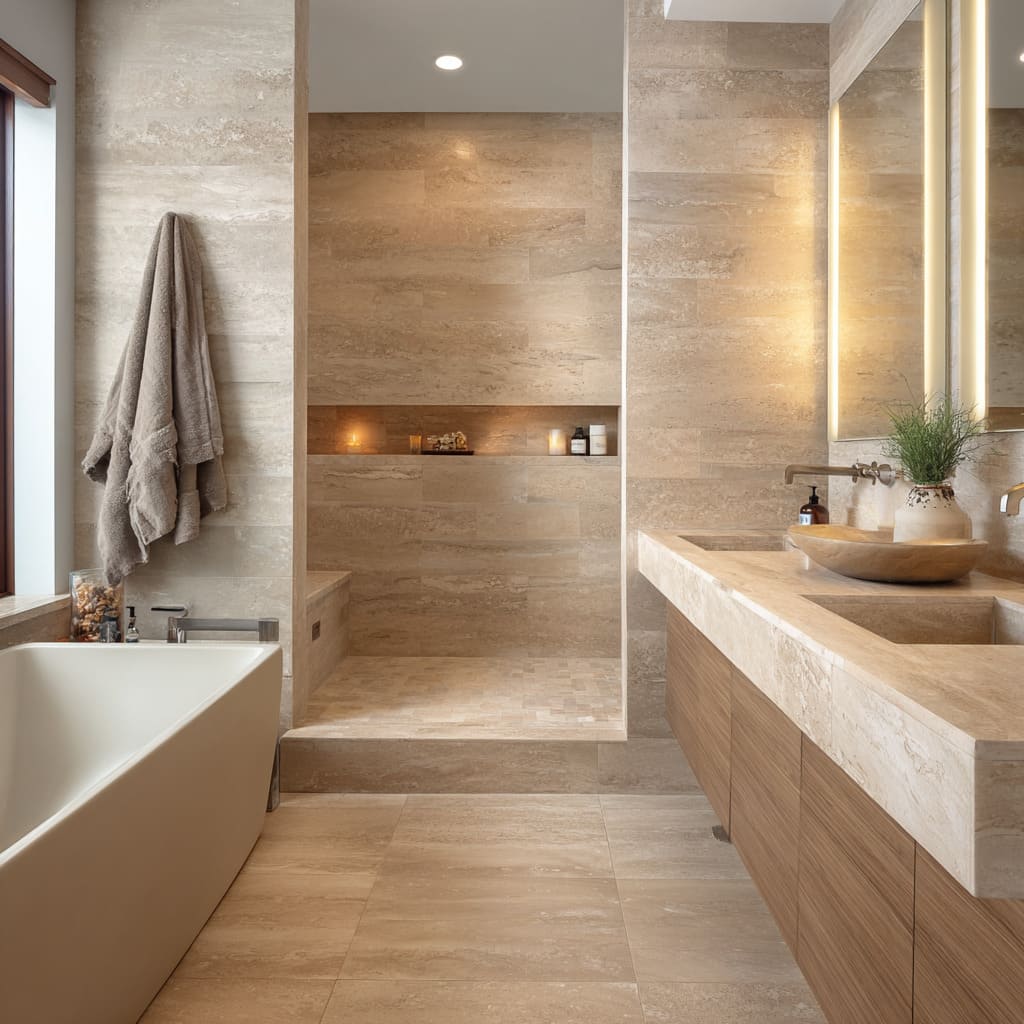
In many modern travertine bathroom designs, the stone is treated less like a surface and more like an architectural shell, wrapping the room in one calm mineral skin. Walls, floors, benches, and even sloped ceilings are often finished in the same family of pale travertine-look tiles so that the eye reads a continuous mass instead of a patchwork of planes.
This is where bathroom travertine tile design ideas become interesting: joints are minimized, grout shades stay close to the stone color, and patterns are subdued, so the space feels carved from one block of compressed sand rather than assembled from separate pieces. Showers that run from floor to ceiling in the same stone, tubs wrapped in matching slabs, steps and platforms that continue the exact veining direction – all of these moves make the design feel like someone sculpted a soft stone grotto and then carefully placed the tub and basin into it.
Even in more traditional rectangular rooms, designers often extend travertine into window reveals, niche interiors, and low parapet walls, which removes the visual “edges” that usually break up a bathroom and replaces them with a gentle sense of continuity. The stone then becomes the main visual story: subtle pores, horizontal bands, and tonal shifts in sand-beige behave like a quiet landscape that wraps the whole interior.
Light Drawing on Stone: Floating Bases, Glowing Niches, and Soft Edges
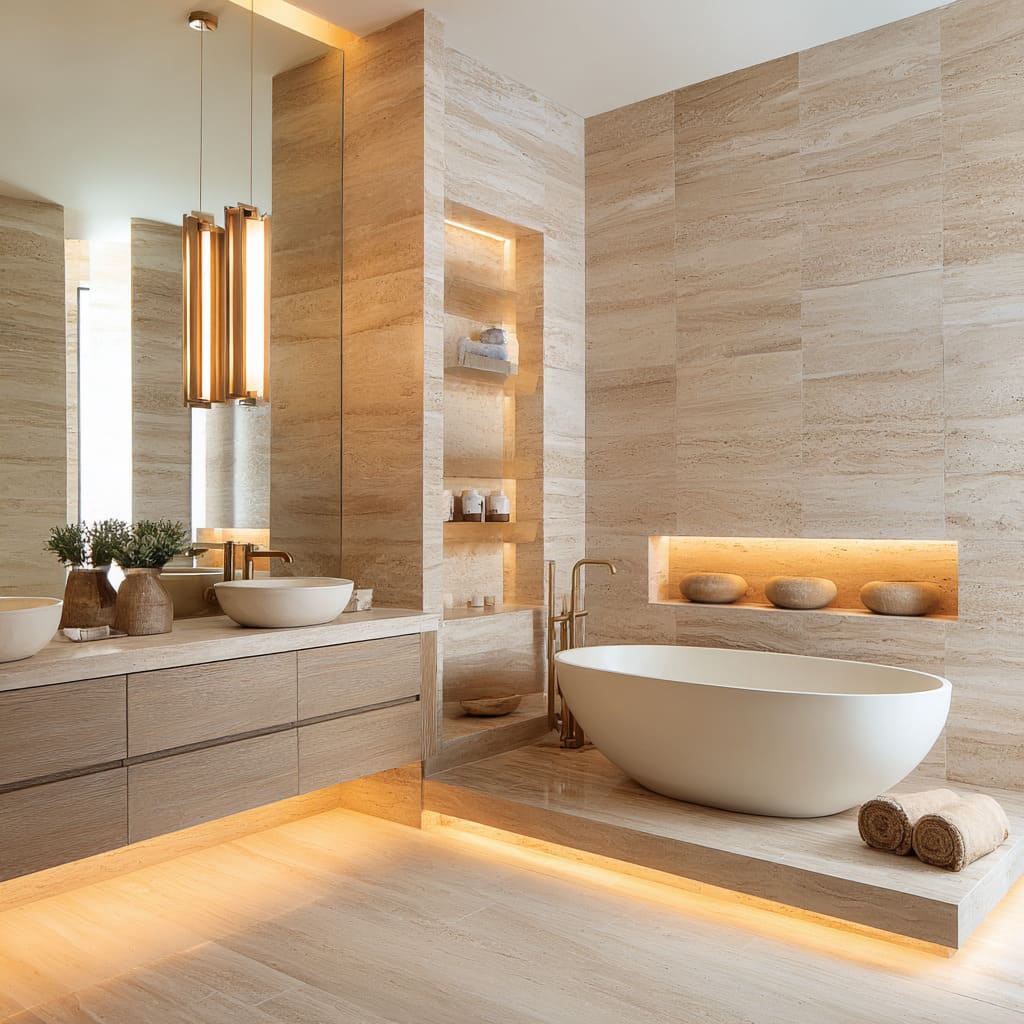
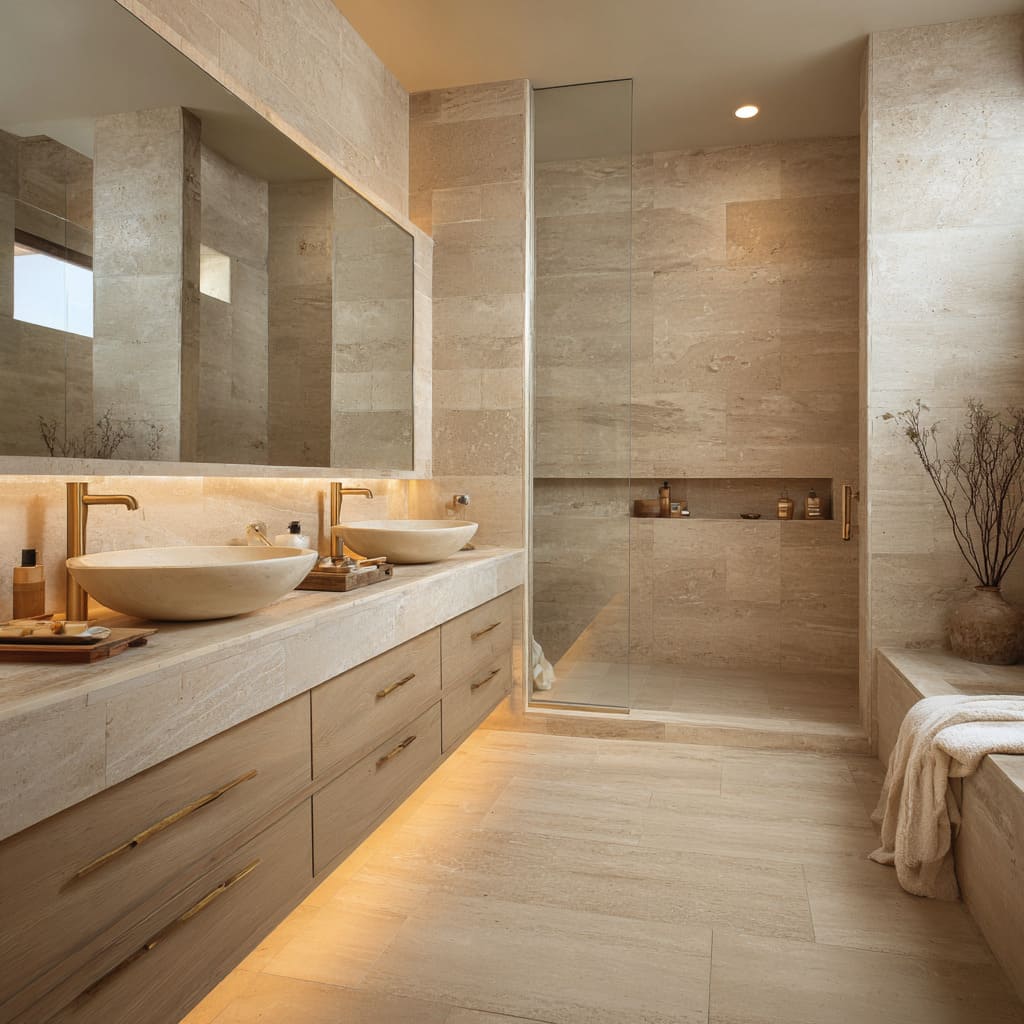
A defining trait of modern travertine bathroom ideas is how light is used almost like a second material that sketches lines on the stone shell. Instead of relying only on downlights, many schemes run warm LED strips along the base of vanities, under tub platforms, or inside niches so that the travertine seems to glow from within.
A tub seated on a stone step with a hidden strip along the underside feels lighter than its weight; the platform appears to hover just slightly above the floor, while the surrounding tile takes on a honeyed fringe where the light spills out. Long vanities gain the same treatment: a pale wood cabinet with a travertine top becomes visually slimmer once a band of light undercuts it and washes the floor in gold.
This kind of lighting also emphasizes alignment – where the underside of a vanity, the base of a stone column, and the front edge of a shower step share the same height, a continuous strip of light quietly ties them into one horizontal datum.
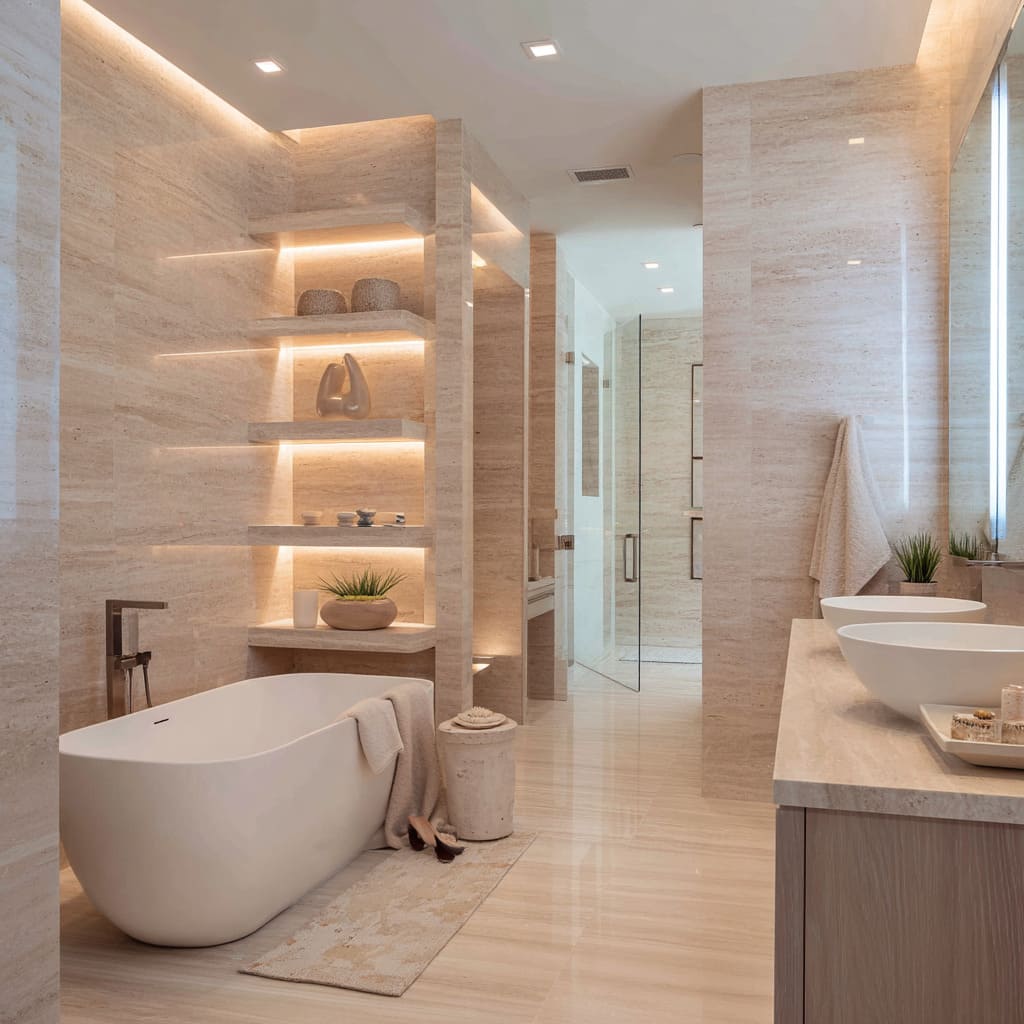
Within that framework, vertical lighting continues the drawing: slim strips beside mirrors, backlit recess towers, and glowing edges around shelving turn certain zones into small stages. A column of niches lined in travertine and lit from above on each shelf becomes a stacked lantern, especially when the objects inside are sparse – one vase here, a group of bottles there, plenty of negative space between them.
Even in compact layouts, a perimeter LED at the ceiling line can give the impression that the stone walls rise higher than they do, because the brightest band sits at the very top. All of this keeps the focus firmly on the relationship between stone and light, which suits a contemporary travertine bathroom design far better than a ceiling full of competing spotlights.
Travertine Palettes as a Climate, Not a Single Color
What reads at first as “beige bathroom” often reveals, on closer look, a very controlled series of micro-tones, where travertine and related finishes create a full climate rather than a single paint choice. Designers move within a narrow spectrum: cool shell-sand with faint gray, latte tones that sit between cream and caramel, or warm honey travertine with deeper golden veining.
Each family behaves differently. Cool misty sand works well with brushed nickel, soft black frames, and the kind of daylight that leans slightly blue, giving spa corridors a fresh, urban feel.
Latte and oat shades balance better with champagne metals, pale oak, and creamy textiles, which suit calmer attic spas and family suites. Honey and caramel tones pair naturally with brass, bronze, and richer woods, creating a more cocooned, resort-like mood.
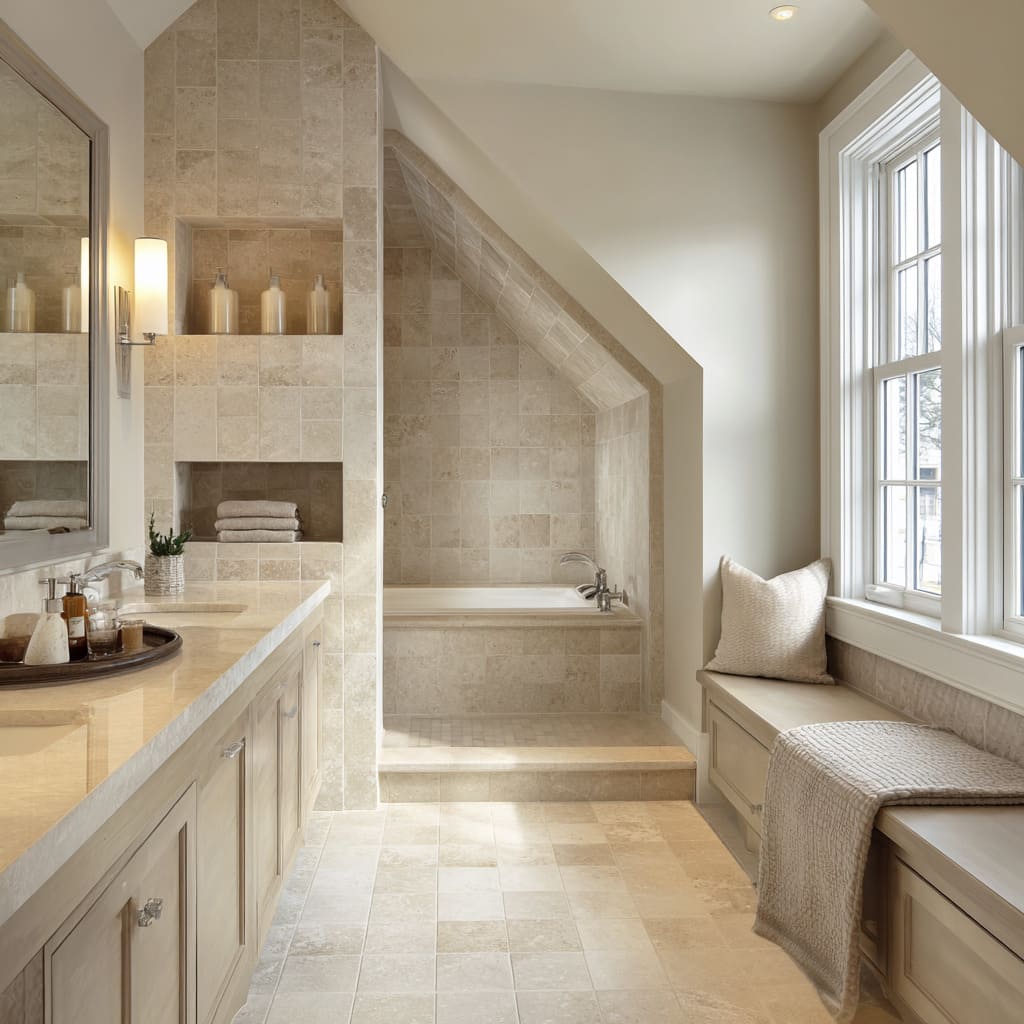
The steps between these values are often tiny, which makes surface texture and gloss levels more important than hue. A matte travertine wall, a slightly more reflective stone floor, a tub in a shade just one notch lighter, and towels in oat or biscuit tones – together they build a layered sand effect without sharp contrast.
In some travertine tile bathroom ideas, the same stone tone is used in different formats: long planks for main walls, narrow ribs for feature zones, small mosaics for shower floors or alcoves. The color stays consistent, while the scale and cut change the way light hits it.
This approach continues into accessories: bottles with sand-colored labels, ceramic jars in biscuit and greige, soap in muted caramel, and woven baskets in straw and natural fiber. The result is that sand is not an accent; it becomes the air of the design, with small shifts in undertone and texture creating slow, almost cinematic mood changes as daylight and artificial light move over it.
Pebbles, Bowls, and Soft Geometry in a Stone Envelope
Inside this stone shell, the most successful compositions treat tubs, basins, and decor as a family of related objects rather than separate fixtures. Many spaces rely on soft oval or boat-shaped tubs – thick-walled, with generously rounded rims that read more like carved pebbles than high-tech bathtubs.
Their forms echo the idea of water-worn stone: sides that swell outward gently, tops that flare just enough to invite leaning back. Basins often repeat that language at a smaller scale: shallow stone bowls on a slab vanity, softly rounded rectangular vessels, or hand-shaped ceramic dishes with irregular rims.
When several of these forms appear in one design – tub, basins, storage bowls, even rounded bottles and vases – the interior builds a rhythm of curves within the rectilinear travertine shell.
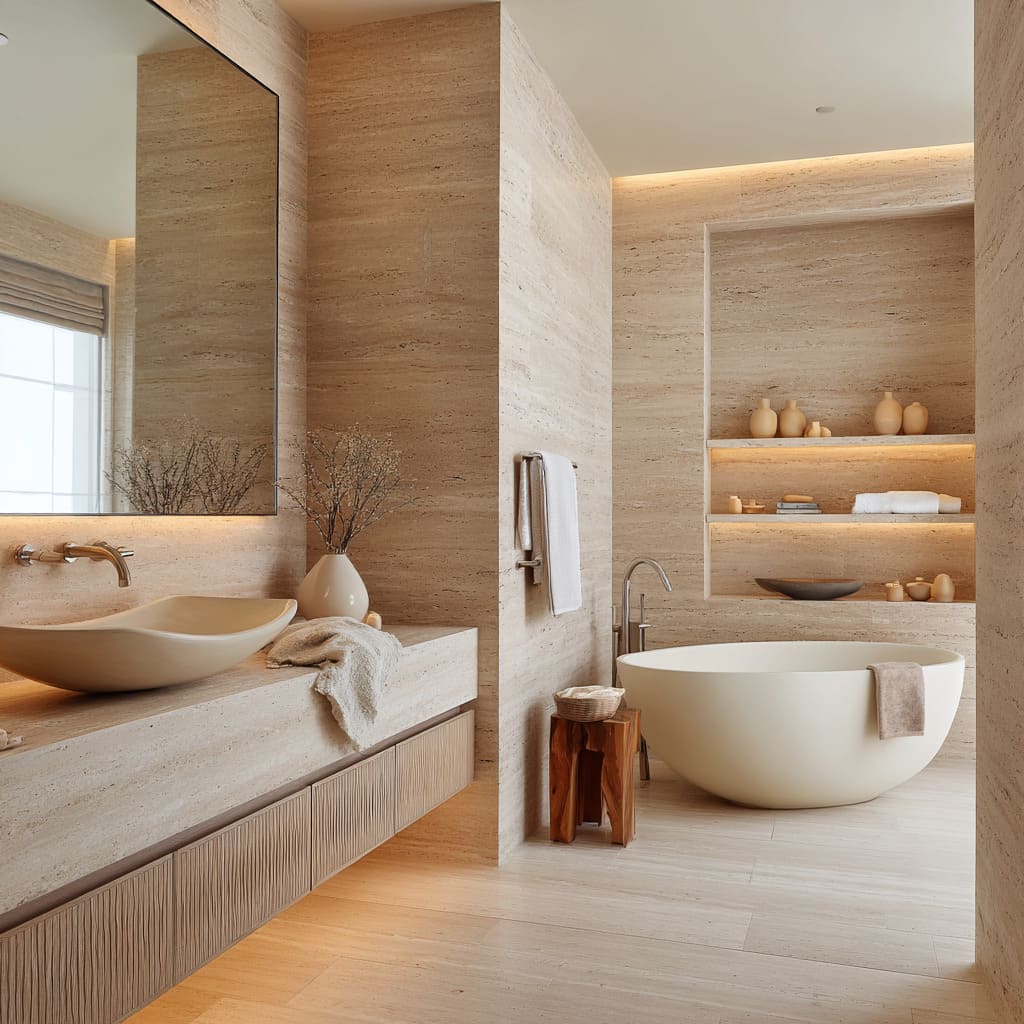
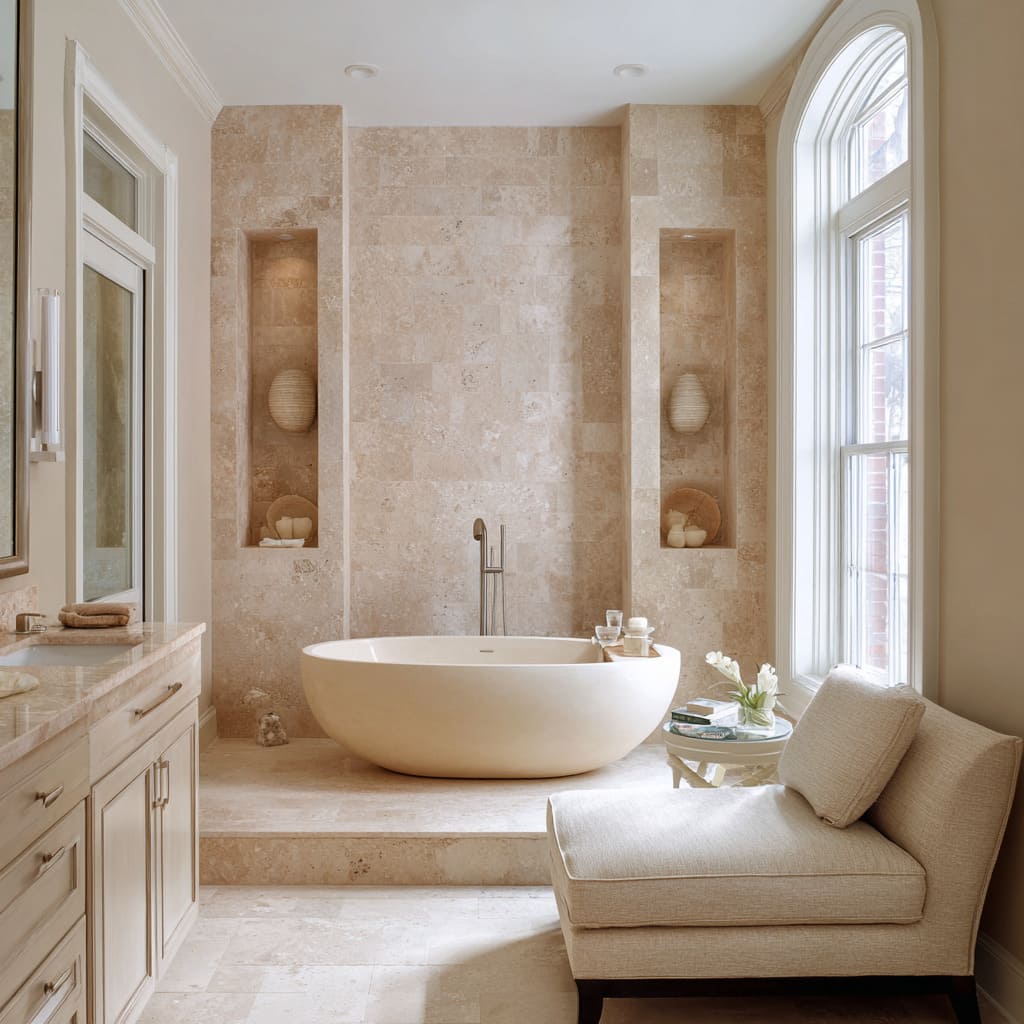
This is particularly clear in spaces that feel like galleries: an oval freestanding tub centered on a low stone platform, flanked by tall niches holding round vessels; a line of river stones placed inside a horizontal niche behind the bath; rolled towels styled as soft cylinders that match the curve of the tub edge. In that context, the stone around them becomes a neutral backdrop for a series of sculptural silhouettes.
The key is restraint: one big pebble-like tub, a couple of bowl basins, a handful of rounded vases and jars, and perhaps a single wooden stool or side table with a thick, solid outline. That lone wood element – a low stool in warm timber, a small pedestal table, or a trunk-like side table – often acts as the one contrasting texture, bringing a sense of warmth and touch without disturbing the sand-based palette.
Together, these objects give a bathroom with travertine ideas a distinctly human, tactile quality, as if each vessel could have been made by hand and placed in the design with deliberate care.
Benches, Lounge Corners, and Bathrooms That Behave Like Living Rooms
Another striking thread in modern bathroom with travertine ideas is how often the layouts borrow behaviors from living spaces. Nearly every concept includes a bench, seat, or lounge corner that has nothing to do with quick washing and everything to do with slow use.
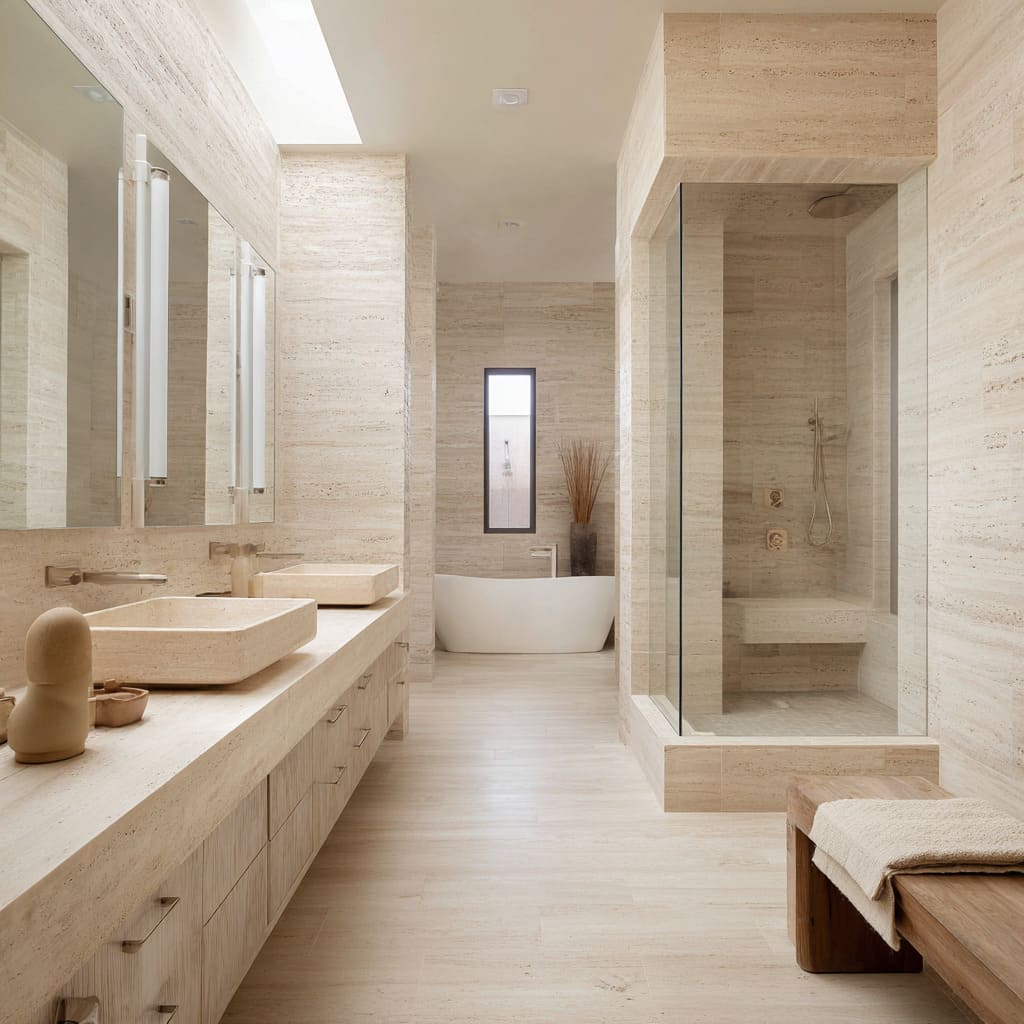
Stone benches carved from travertine run along shower walls or under windows, sometimes as simple thick slabs, sometimes as part of a stepped platform. They double as seating and display, carrying folded towels, candles, and bottles arranged in small groups.
A bench can continue out of the shower and into the dry zone as one continuous element, turning the entire side of the design into a long, low stone ledge that connects bathing and grooming.
Beyond benches, there are true lounge elements: an upholstered window seat under a tall sash with a wide cushion and tufted pillow, a bench under a sloped attic wall with a sand linen cushion, or even a full lounge chair placed near a tub with a side table for books and glasses. These corners are styled like reading nooks rather than utility spots, often with throws, textured cushions, and a view toward either a window or the main stone wall.
The effect is that the bathroom starts to behave like a small spa lounge. A tub platform becomes a stage rather than just a plumbing zone; a shower with a long bench and candle-lit niche resembles a sitting room that happens to have water.
The overall composition turns bathing into one of several activities in the space, alongside resting, reading, cooling down, and simply sitting within a calm mineral environment.
Working With Slopes and Compact Layouts in Attic and Niche Settings
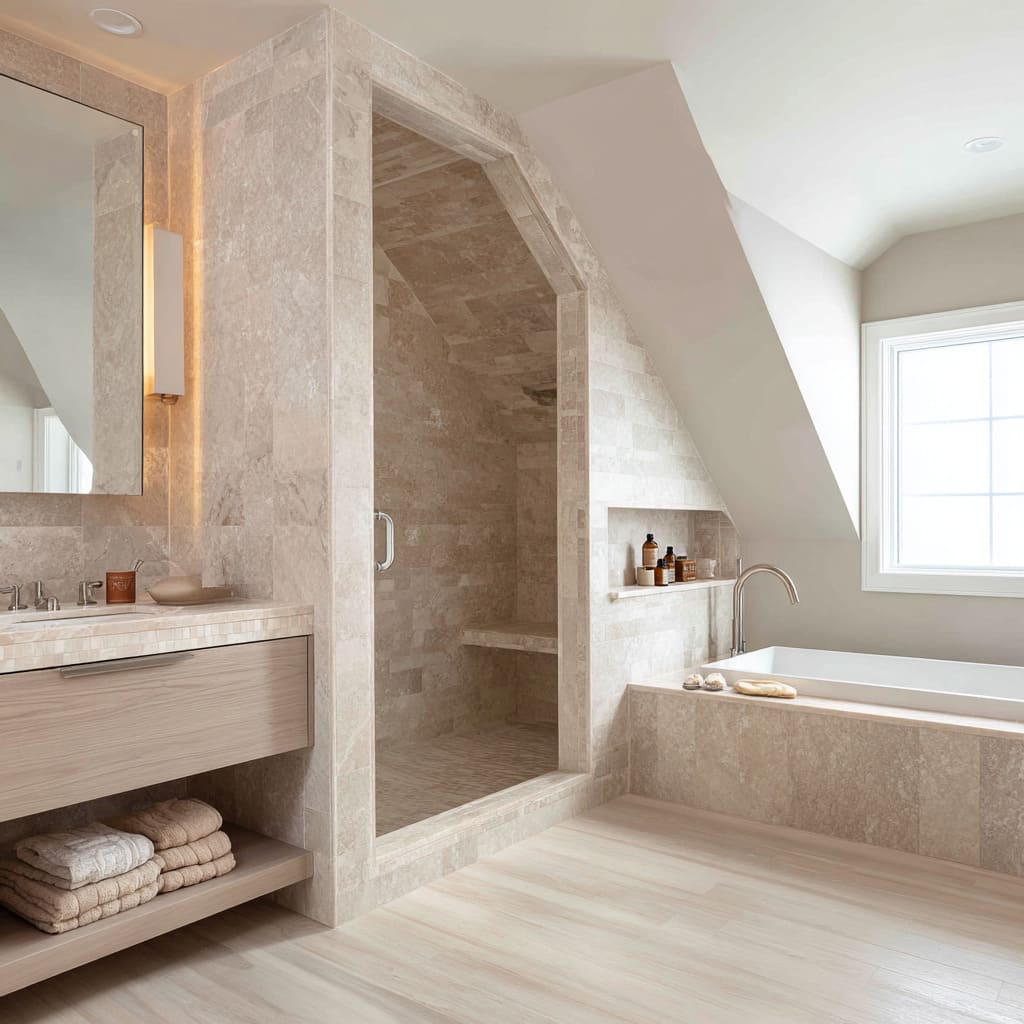
Many of the most atmospheric interiors use tricky geometry – sloped ceilings, small attics, narrow footprints – and allow travertine to make those features feel intentional. Under rooflines, designers often pull the tub or shower right into the deepest part of the slope and then wrap every surface, including the angled ceiling, in the same stone.
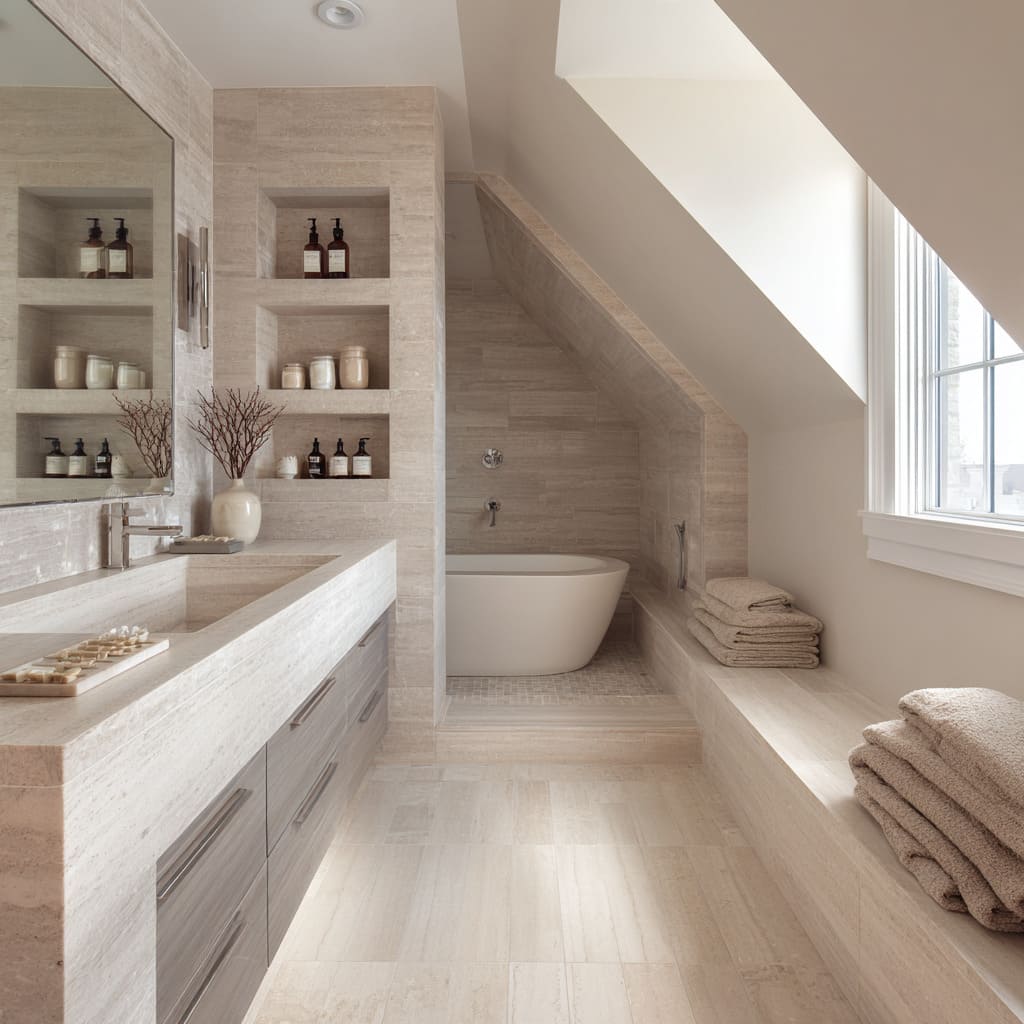
This move turns potentially awkward forms into intimate “caves,” especially once benches, low platforms, or built-in ledges are added. In one kind of scheme, the shower sits in the furthest corner of the attic, with small-format floor tiles and matching wall slabs turning the space into a compact stone chamber; a bench hugs the back wall, turning the steepest point under the roof into a sitting spot.
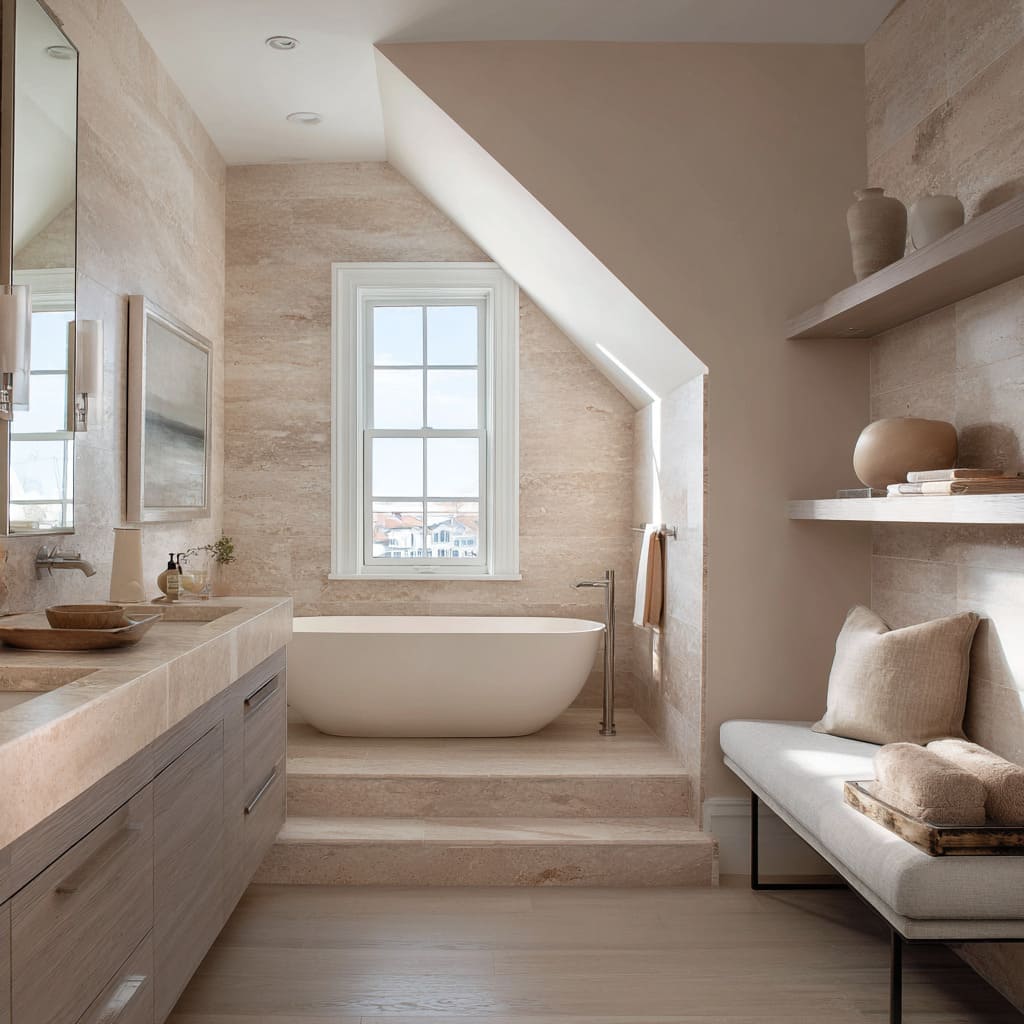
In another variation, a freestanding tub is tucked under the slope on a raised travertine step, giving a slightly elevated view out of a nearby window while the rest of the room opens onto a vanity and lounge corner.
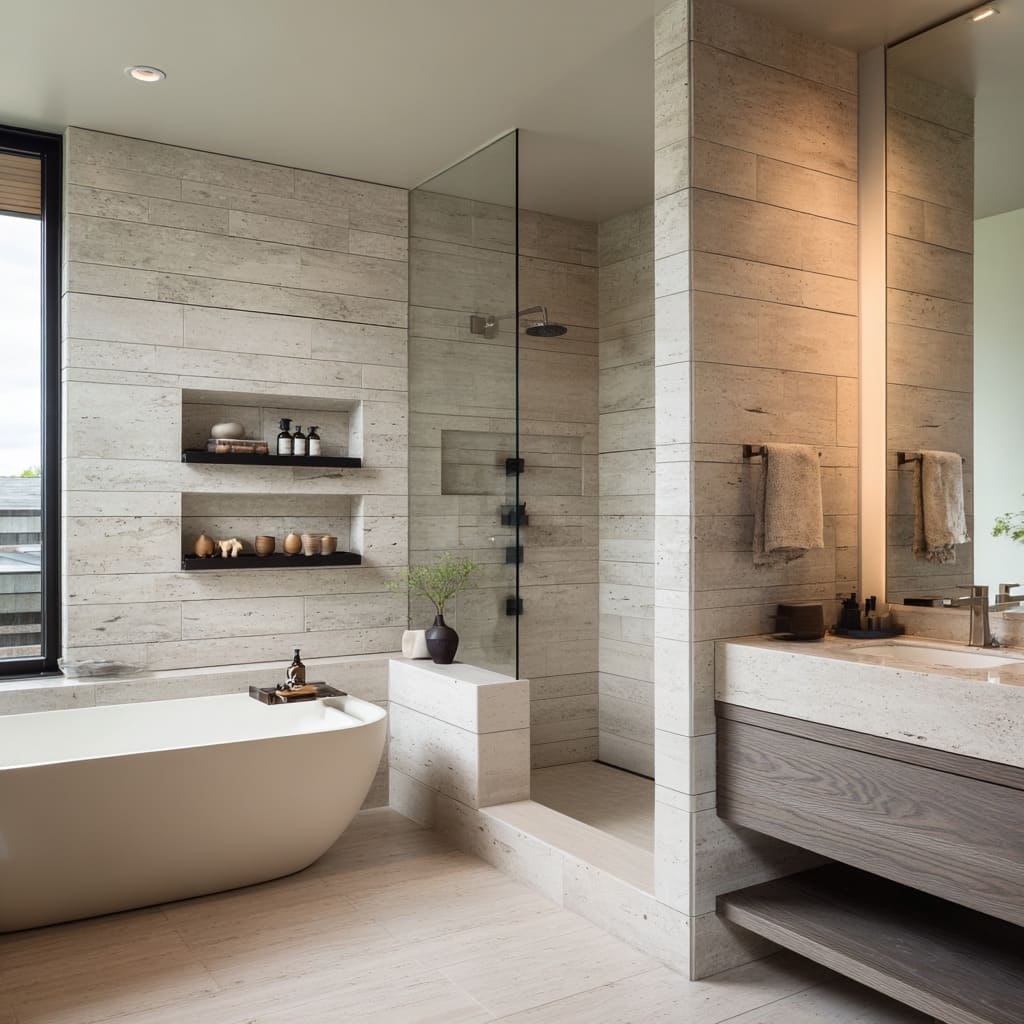
Tile direction plays a quiet supporting role here. Horizontal veining along the walls and floor helps narrow attics feel longer, leading the eye toward the window or the focal bathing niche, while vertical ribs or stacked narrow strips can help the eye read more height than the slope actually allows.
Small mosaics confined to alcoves or shower floors create a micro-grid that signals “special zone” without introducing new colors. These strategies add up to practical travertine shower ideas that are not about hardware or waterproofing, but about turning difficult geometry into desirable spaces by leaning into stone as a unifying skin.
When the same treatment continues over sloped ceilings, down side walls, and into benches, the design stops feeling like a compromise and starts resembling a crafted spa tucked under the roof.
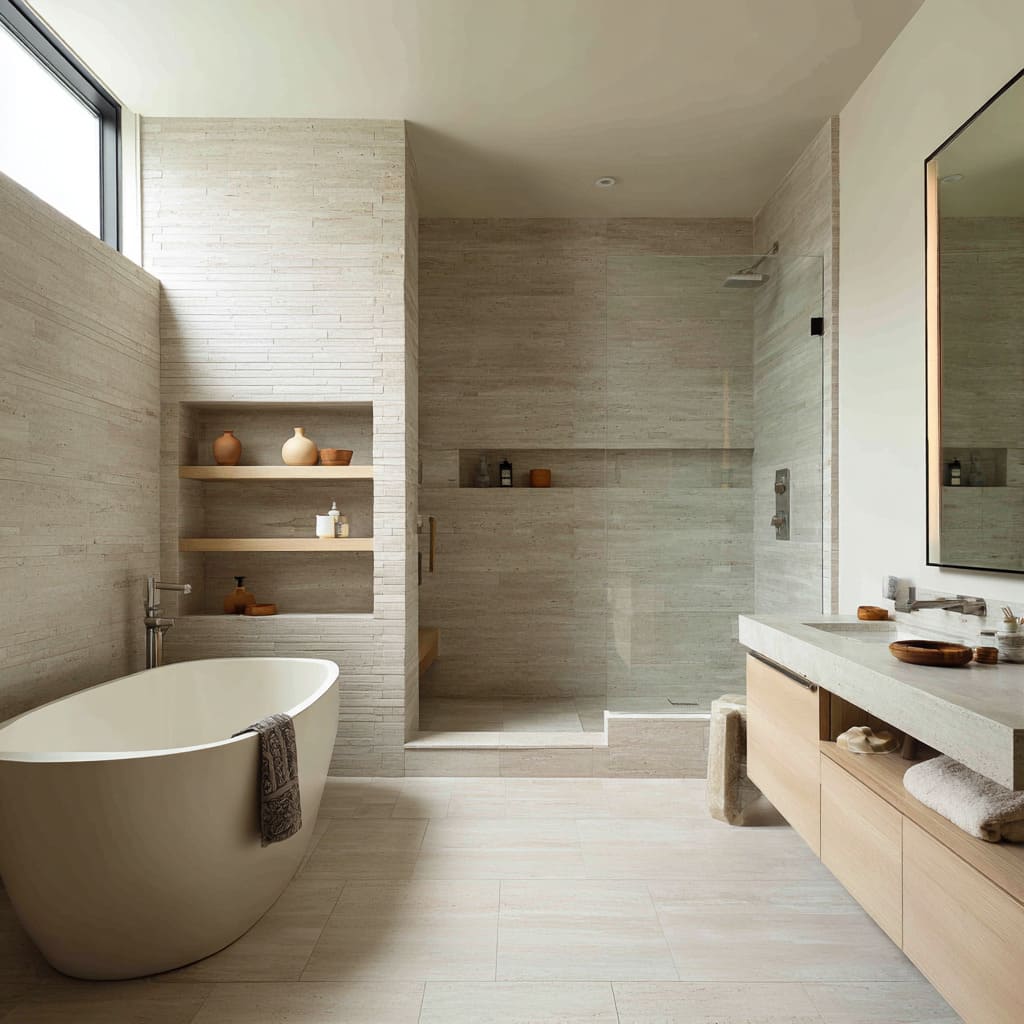
Shelves, Niches, and Quiet Gallery Walls in Travertine
Storage in these schemes rarely looks like storage. Instead, recessed niches and shelving towers in travertine act like miniature gallery walls.
Long horizontal recesses carved into shower walls or behind tubs hold carefully edited lines of bottles, candles, and small objects, always spaced with air around them so the stone remains visible. Vertical stacks of niches, sometimes running from floor to ceiling beside a tub or vanity, work similarly: one shelf holds folded towels, another carries a single sculptural vase, another a group of clear and amber bottles.
Backlighting or small concealed strips along the tops of these recesses turn the interiors into glowing boxes, so that the objects float against the stone rather than sitting in shadow.
That same gallery feel appears in open shelving built out of travertine or paired with wood. An entire wall might be turned into a tall shelving frame with LED strips along the fronts of each shelf; sculptural pieces in concrete, matte ceramics, and light stone sit in pairs or trios, with plenty of breathing space between them.
Toward the vanity, a single deep column of stone with two or three niches can host everyday essentials that still read as composed vignettes. Often, playful elements slip into the scene – a row of small carved wooden animals, for instance, lined up along one shelf in front of a travertine backdrop – proving that travertine tile designs for bathrooms can carry a sense of personality without breaking the calm palette.
The repeated use of negative space, matching label tones, and rounded silhouettes keeps the overall impression refined rather than cluttered, even when storage is fully on show.
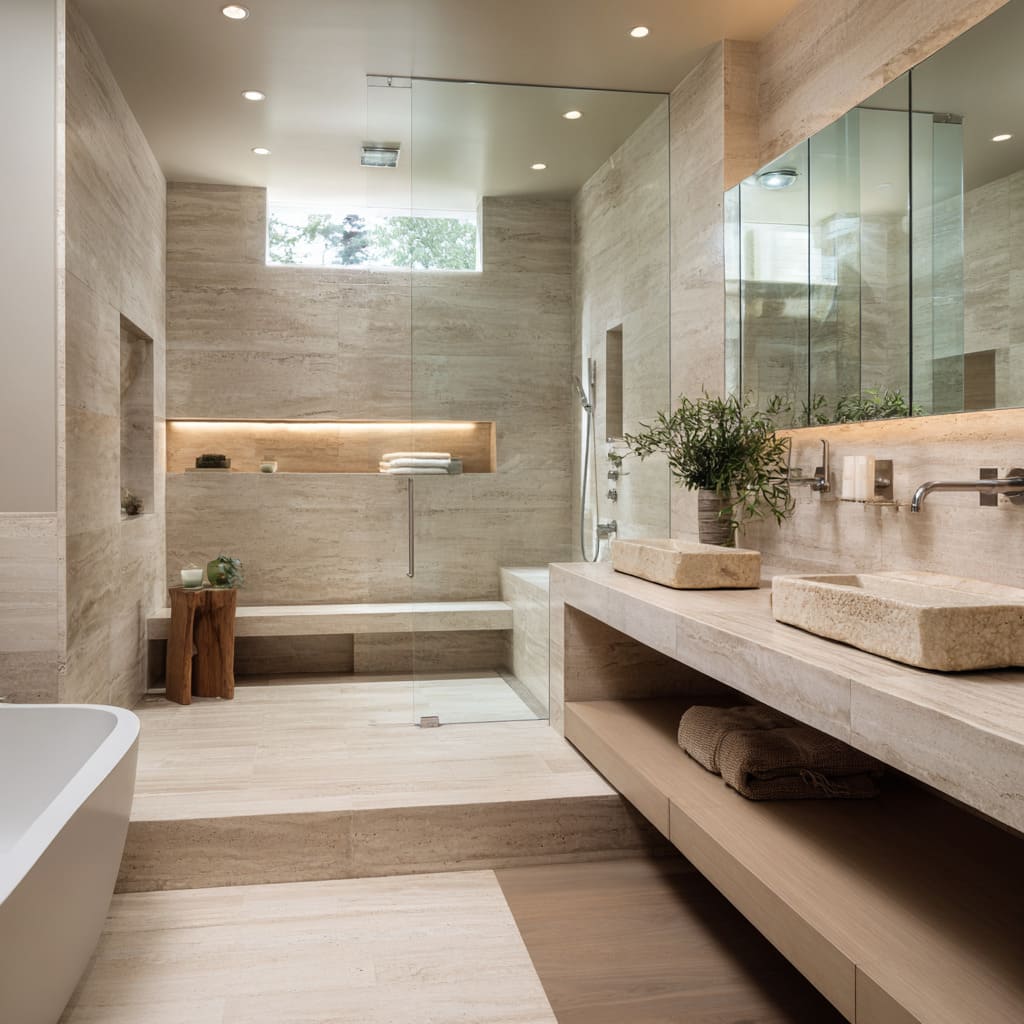
Balancing Stone With Wood, Textiles, and Small Contrasts
Because travertine-look shells can easily become too uniform, many interiors rely on a very disciplined mix of supporting materials to keep them warm and livable. Wood appears in vanities, shelves, stools, and benches, usually in tones that sit squarely inside the sand spectrum: blond oak, nutty walnut, driftwood greige, or pale honey.
Horizontal wood grain on drawer fronts, especially when it runs in the same direction as travertine veining, reinforces the long lines of the room rather than fighting them. Occasionally, vertical ribbing on cabinet fronts adds a textile-like rhythm under a smooth stone slab, which feels particularly rich when paired with a softly glowing under-cabinet strip.
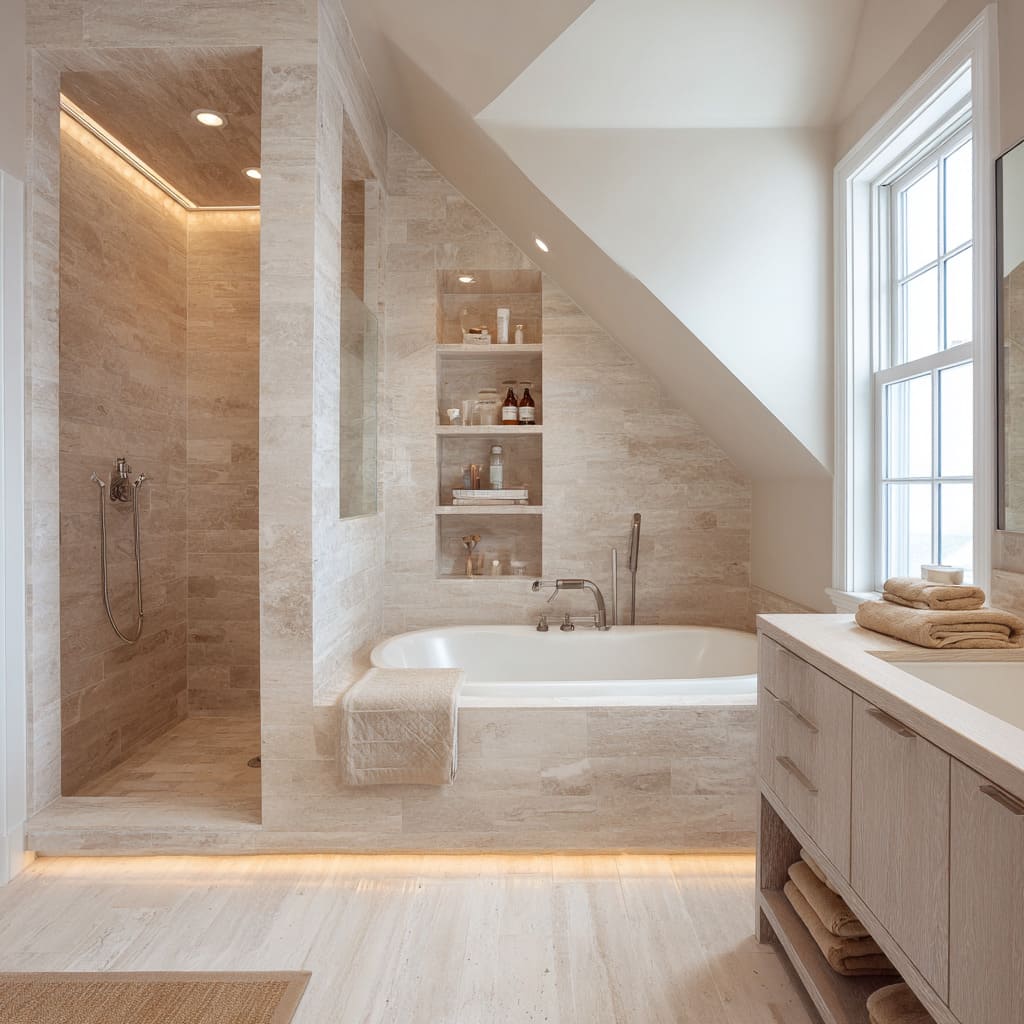
Textiles bring the second layer of softness. Towels in oat, biscuit, or light caramel shades echo the stone palette while adding fuzziness and volume; rolled towels double as decor, stacked in niches or along benches like soft cylinders.
Throws, bench cushions, and lounge chair upholstery introduce thicker weaves – boucle, sand-toned linens, or woolly textures – that contrast nicely with the cool smoothness of travertine. Metal finishes stay close to the stone temperature: brushed nickel and soft black for cooler palettes, champagne and brass for warmer ones.
Glass jars filled with shells, bath salts, or pebbles, along with small ceramic dishes, act as tiny echoes of the larger stone surfaces. Against this quiet base, a single stronger accent – a rust-colored cushion in a lounge chair, a green branch in a vase, a darker patterned towel hanging over a tub – carries a surprising amount of visual weight.
Because everything else remains tuned to sand and wood, that one note feels intentional and grounded rather than loud.
Compositions and Atmospheres: Coastal Attics, Urban Spas, and Nature Retreats
Finally, the same travertine language can support very different atmospheres depending on how space, light, and view are composed. In coastal-influenced attics, for example, sloped ceilings with white beams, pale ribbed travertine, and sand-toned textiles combine with simple windows that hint at rooftops or distant water.
The mood is casual and airy: woven baskets under vanities, rolled white towels, and benches under dormers make such designs feel like bathroom versions of loft sitting rooms. In urban spa-like spaces, the emphasis shifts to precise lines and strong light features: long corridors lined in fine-banded stone, floating vanities with twin stone basins, glass-enclosed steam showers with benches, and continuous LED ribbons under platforms and along shelves.
Here, the travertine shell becomes a backdrop for controlled lighting, curated sculptural accessories, and a stricter geometry.
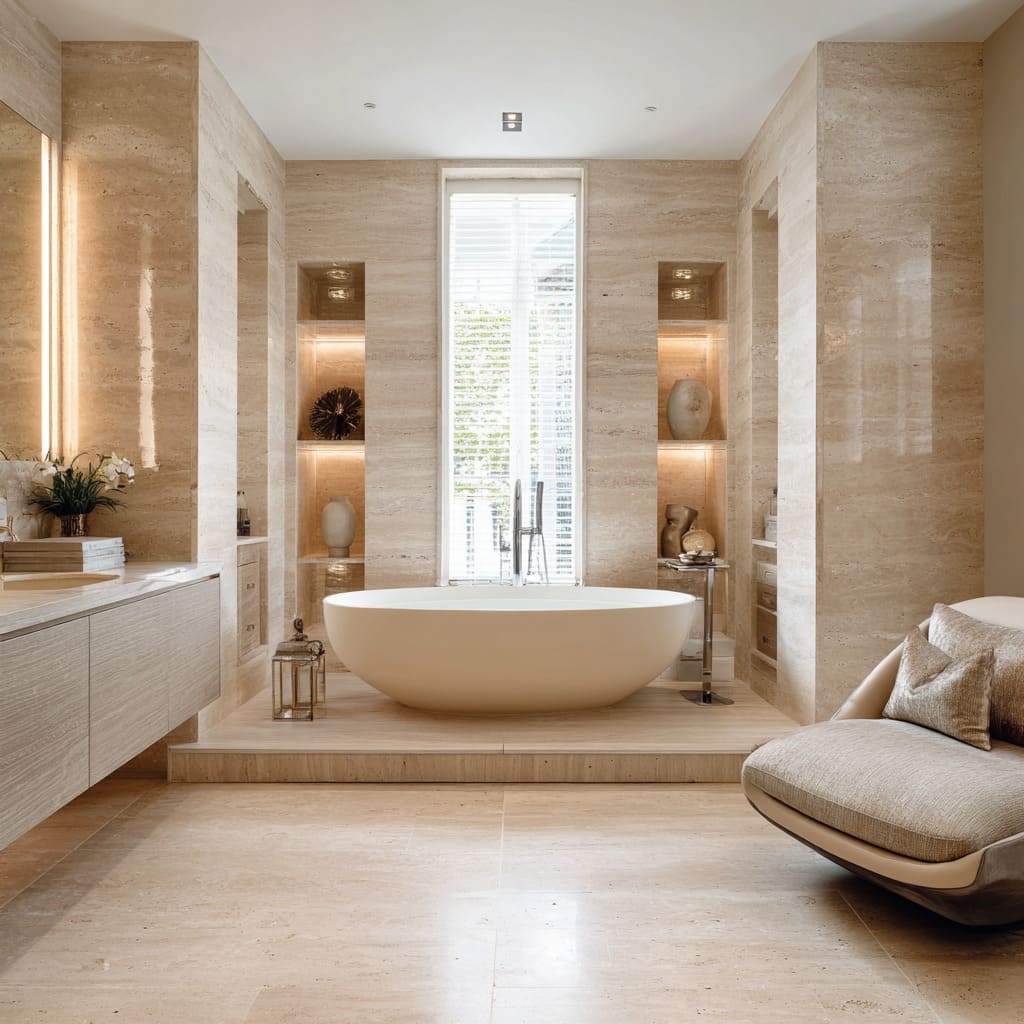
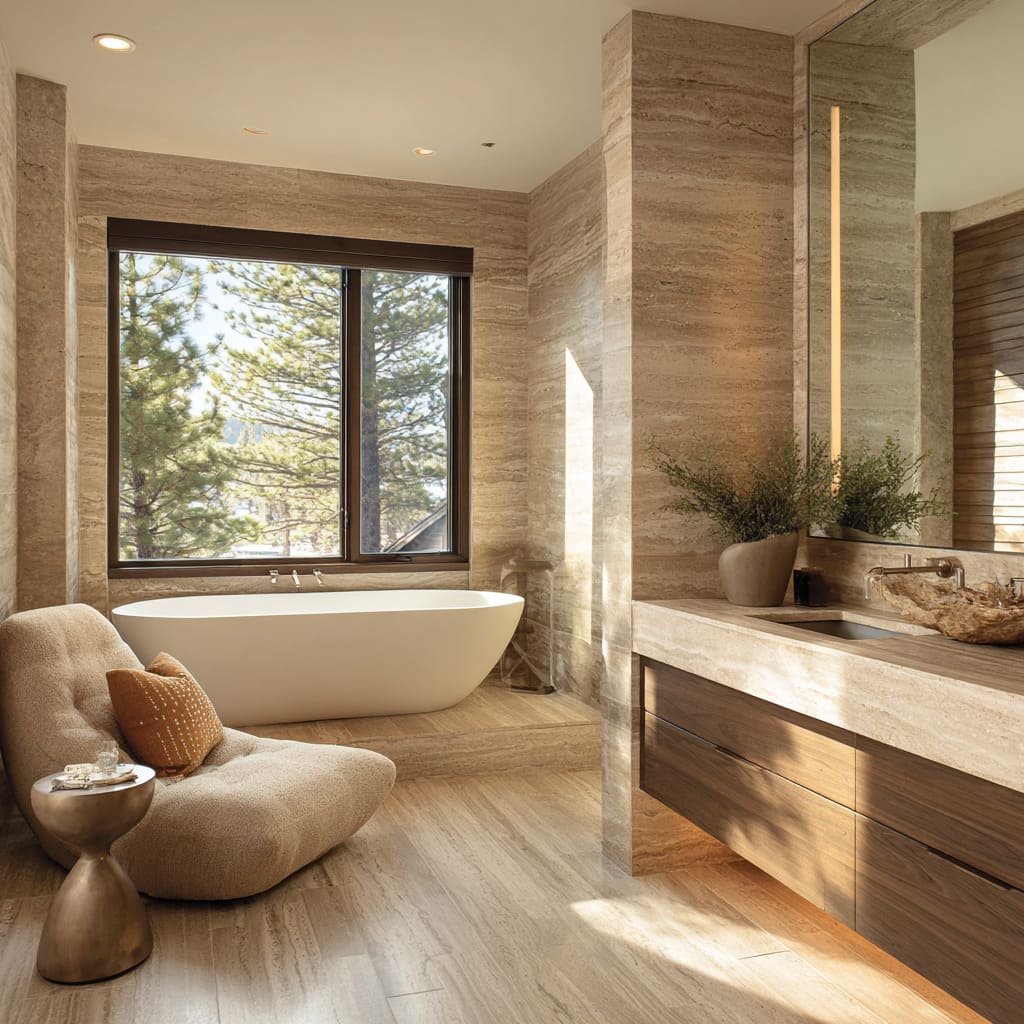
Nature-facing retreats take the same ingredients but place them opposite large windows filled with trees, sky, or soft landscapes. A freestanding tub on a shallow stone stage in front of a wide pane of glass, a lounge chair angled toward the view, and leafy plants on the vanity create a dialogue between rock, wood, and greenery.
Travertine bands echo distant cliffs or forest floor tones; wood references trunks and branches; the green outside supplies the only strong color. The stone holds the composition together.
It carries the soft sand palette through platforms, steps, walls, and benches, while light, view, and furnishings adjust the story: coastal loft, city spa, forest hideaway, or a blend of those moods. Within that wide field of bathroom with travertine ideas, the most interesting results come from treating travertine as a calm structure that can support many lifestyles, while decor, seating, and small objects gently shift the character from strict and gallery-like to relaxed and homely, all without leaving the sand-colored world.
Related Posts
Harmony Home Design brings 10+ years of residential interior design experience to the ideas shared here. We publish design concepts, layout thinking, and practical styling notes.