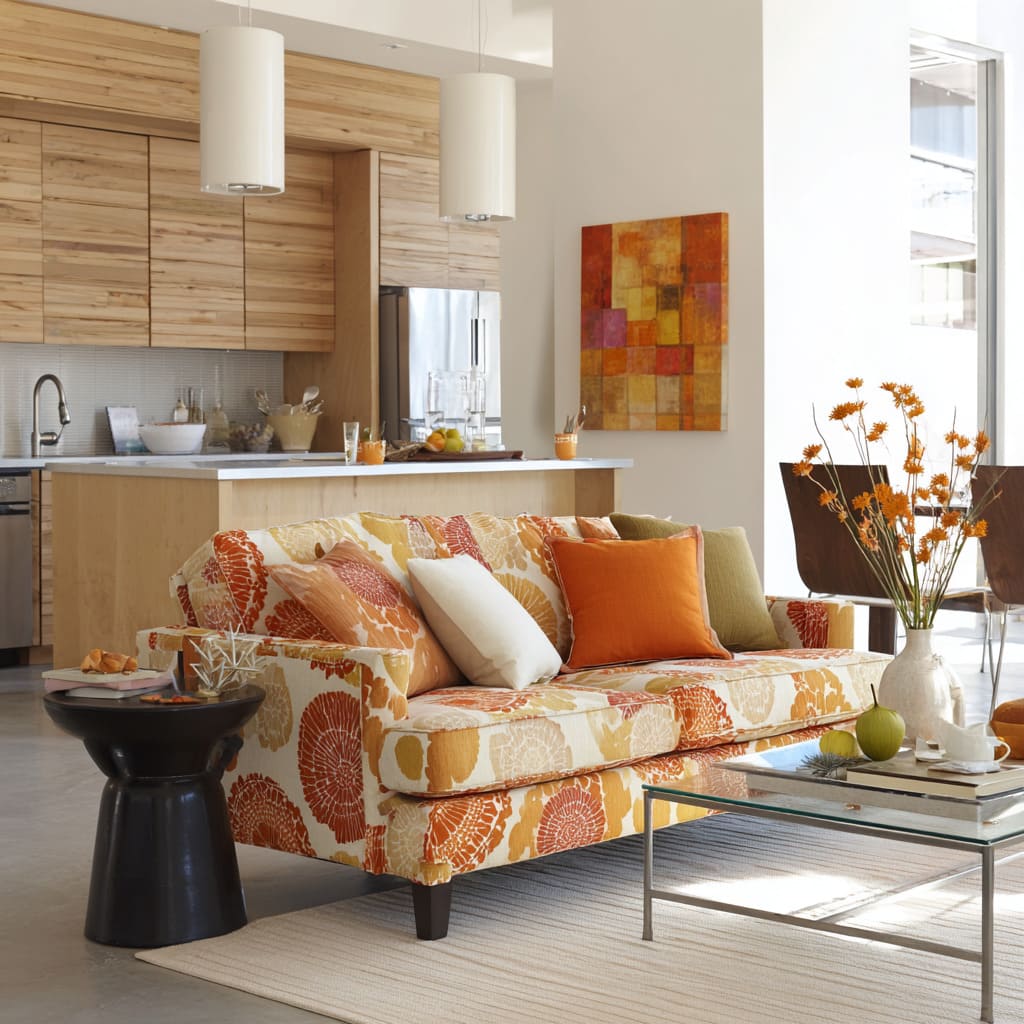
Orange looks risky because it behaves like heat: it expands, it pulls focus, it changes with light, and it can quickly make every nearby object look either too sweet or too cold. The strongest interior designs don’t treat orange as a single color choice.
They treat it as a temperature system with rules: where warmth is allowed to concentrate, where it must be interrupted, what surfaces must stay quiet, and which shapes keep the whole scene readable.
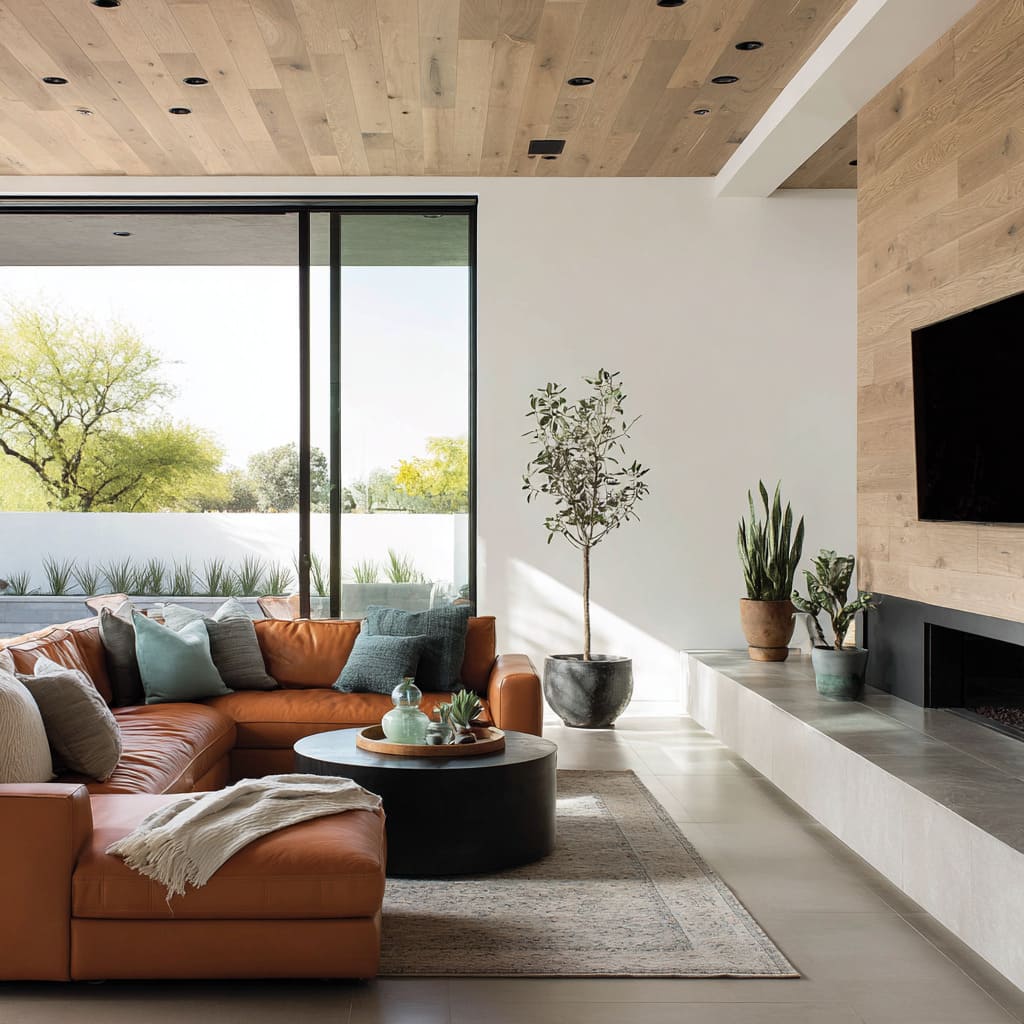
That’s why the best orange couch living room ideas tend to feel planned even when the styling is minimal. The interior design gives orange a job, then builds a calm framework so the eye doesn’t get stuck on one loud block.
Here, we are exploring how orange becomes mature, modern, and controlled without leaning on extra décor or busy pattern.
Orange looks expensive when it has authority neighbors
Orange reads childish when it sits next to surfaces that feel casual or unresolved. It reads expensive when it sits next to materials that already carry seriousness—surfaces that behave like visual authority.
The three most reliable authority neighbors
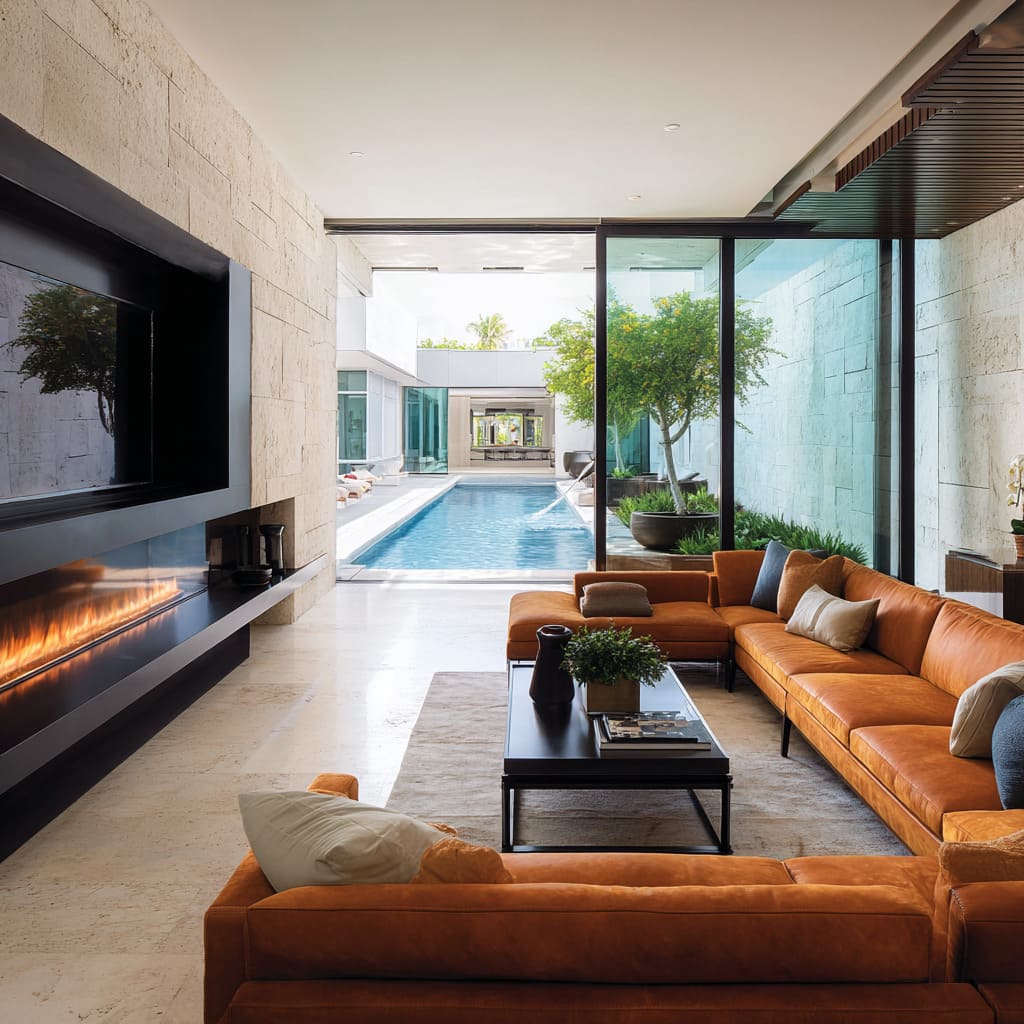
- Charcoal / black outlines: A dark fireplace frame, a black TV void, thin black window frames, or a glossy black table creates edge definition. Orange looks richer beside dark edges because the border makes the color feel intentional, like it was placed inside a strict frame instead of floating in the room.
- Pale stone / light mineral walls: Stone behaves like quiet light. It softens the room’s contrast while still feeling substantial. Orange next to pale stone reads refined because the stone acts like a calm reflector.
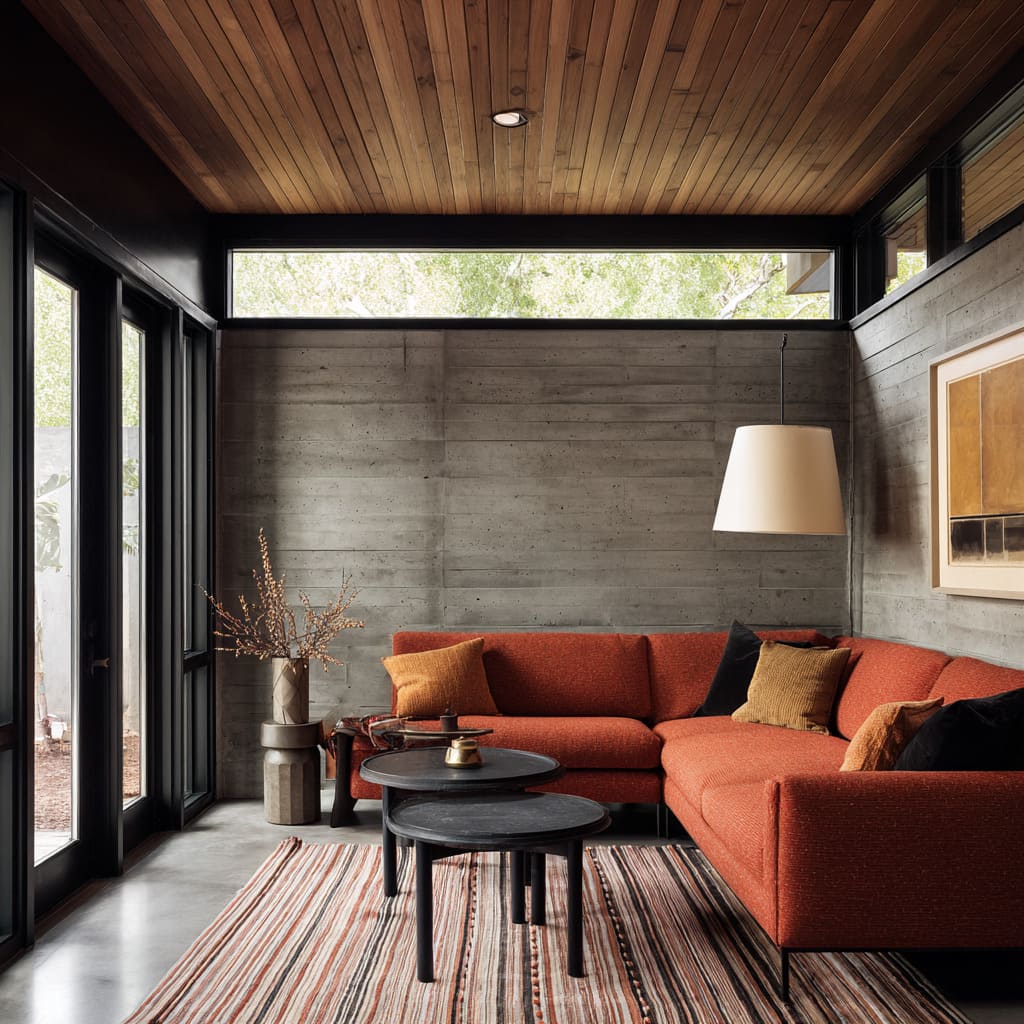
- Concrete / cool grey shells: Concrete and cool greys refuse to perform, so orange becomes the comfort layer rather than the whole personality. The result is orange that feels adult, not decorative.
This is one of the hidden mechanics behind many orange couch interior design scenes that look high-end: orange is rarely asked to prove itself alone. It’s surrounded by calm power surfaces that keep it composed.
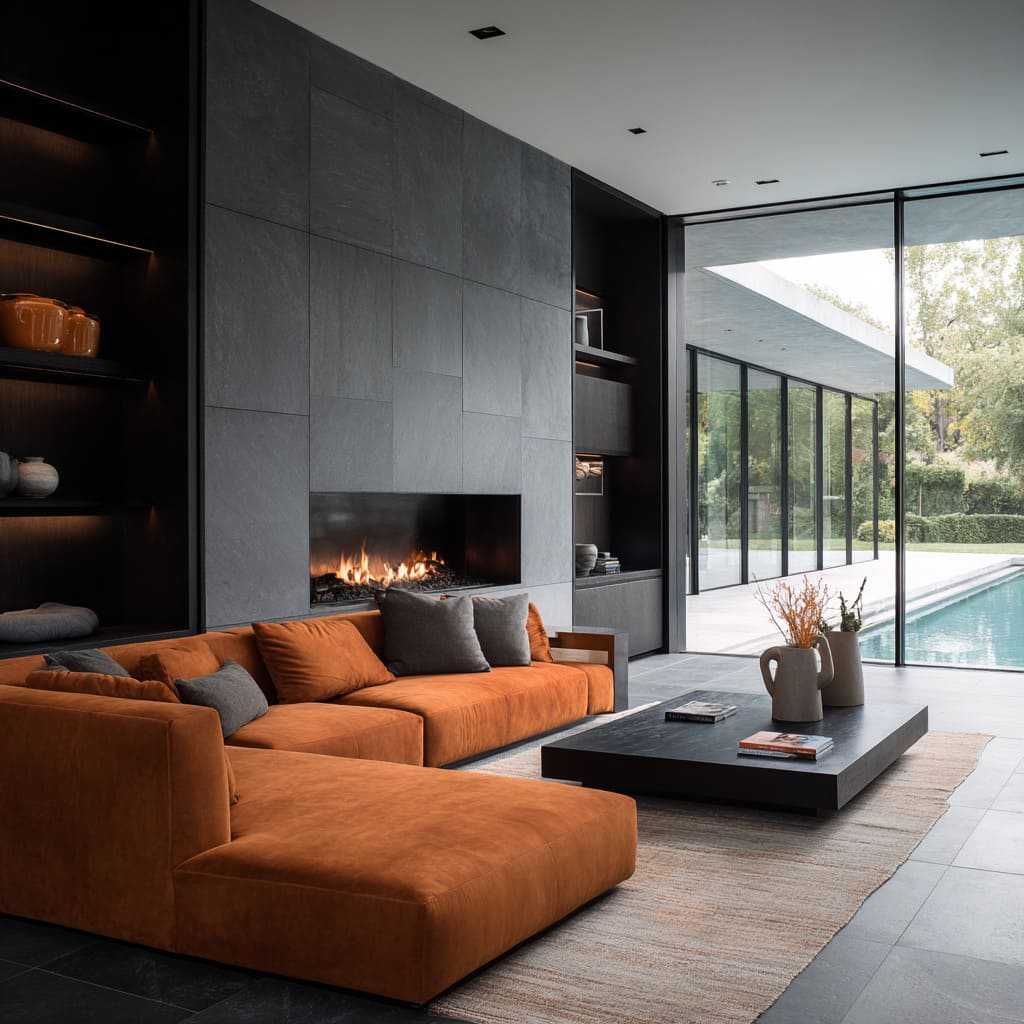
The design stays calm when orange is the warmest thing—but not the only strong thing
A interior design can tolerate one dominant warm surface if there are other strong elements that share the job of attention. Not more color—more structure.
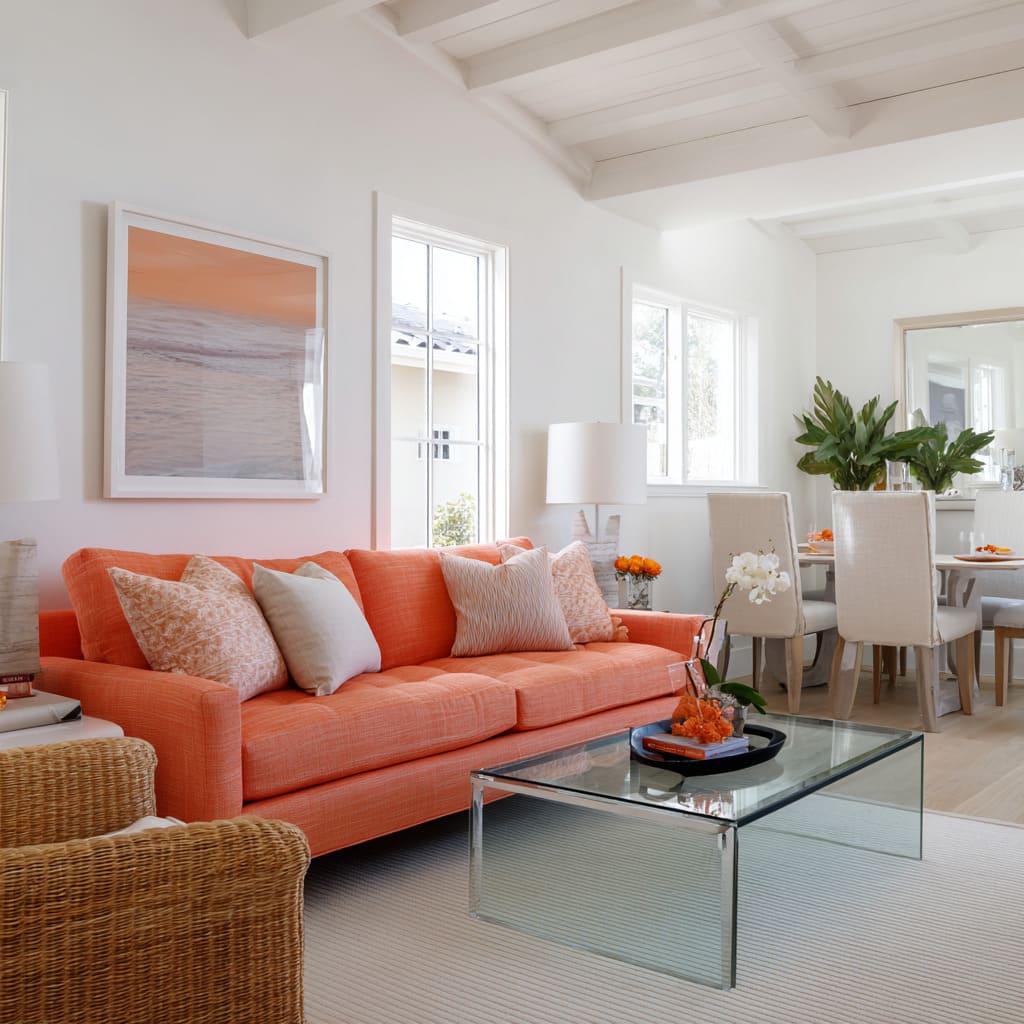
A repeated pattern shows up again and again:
- Orange is the warmest temperature shift.
- Black is the sharpest outline.
- Stone/cream is the quiet field.
- Firelight (when present) becomes the second warm signal, which makes orange feel licensed by the atmosphere rather than added as décor.
This is why interior designs with linear fireplaces often make orange feel natural. Fire is warm in motion; orange upholstery is warm in stillness.
When both exist, warmth feels like a theme of the space rather than a risky color.
Orange depends on material light behavior
A major factor in orange success is not the hue—it’s how the surface handles light.
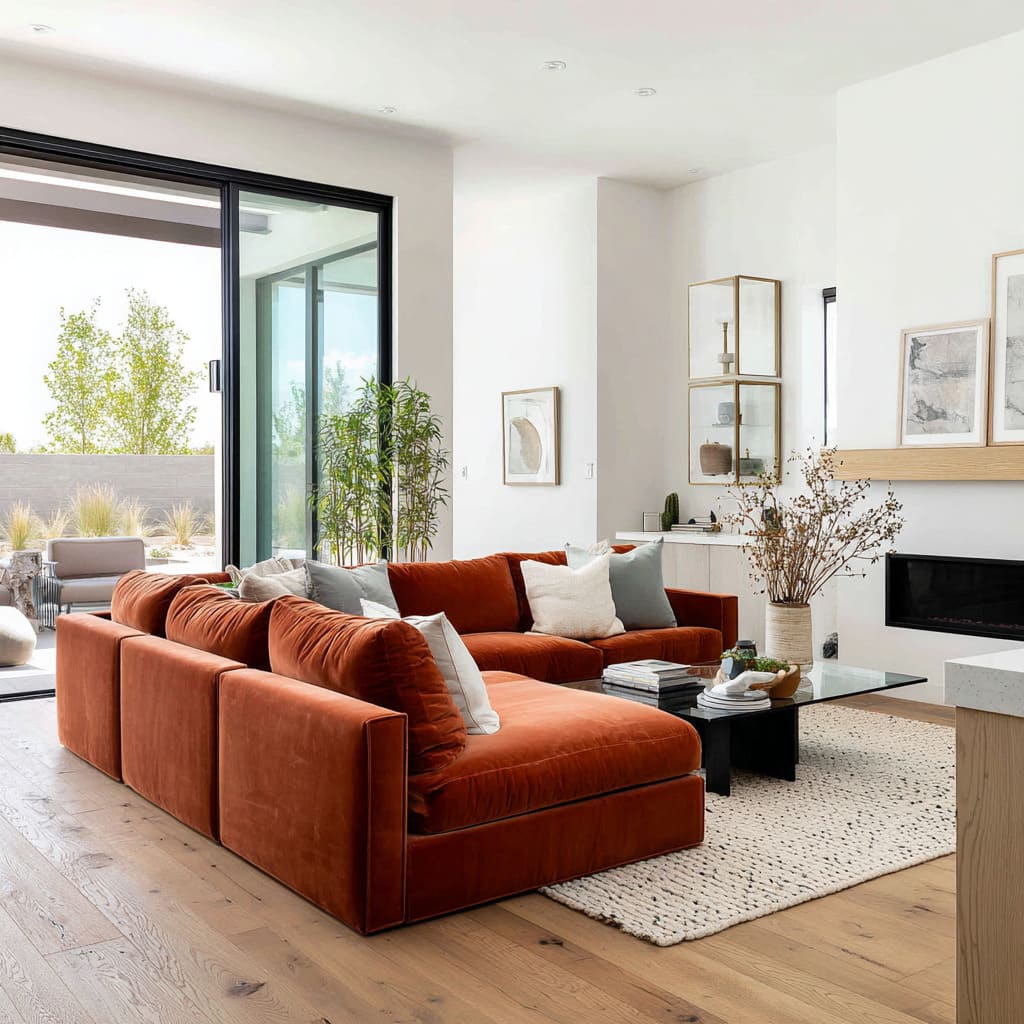
Velvet / velour orange
- Holds shadow in seams and folds.
- Reads like a gradient instead of a flat swatch.
- Makes orange feel deep, calm, and substantial in bright designs.
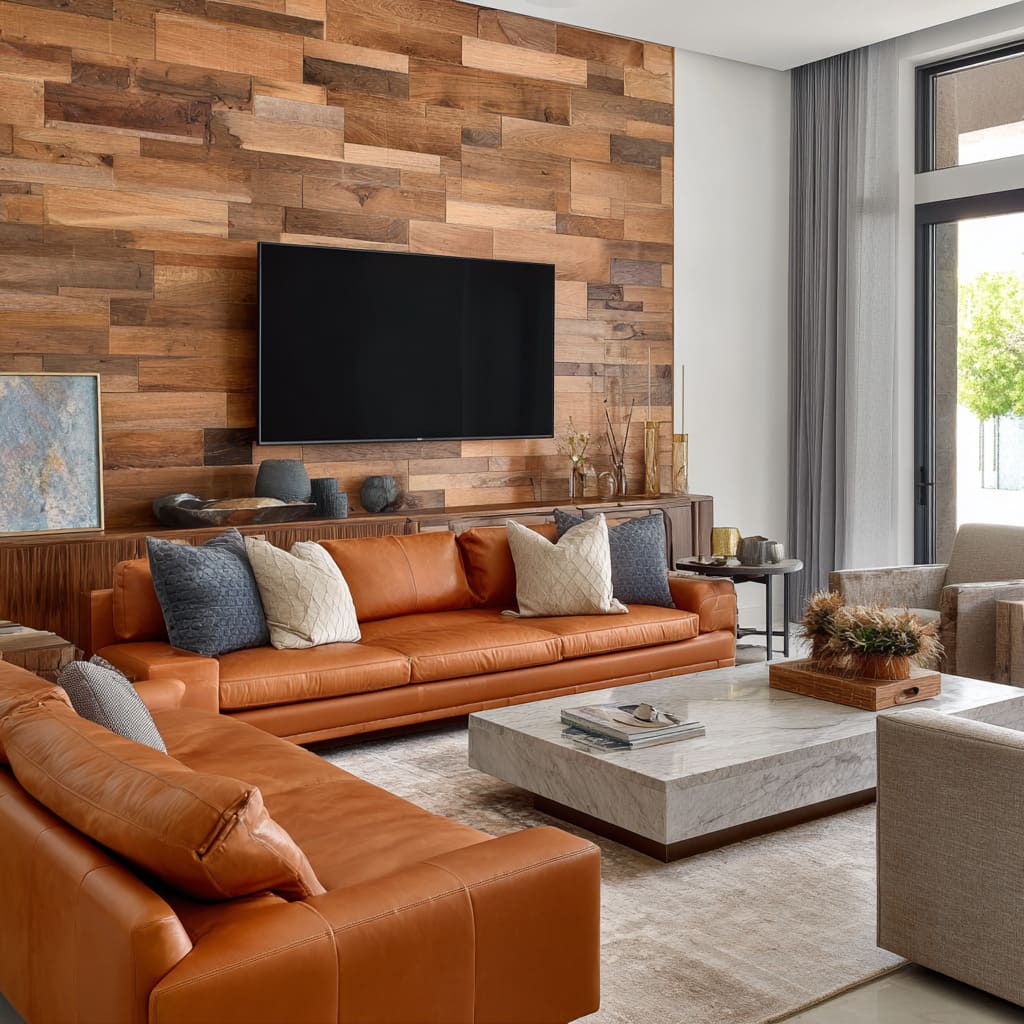
Leather orange
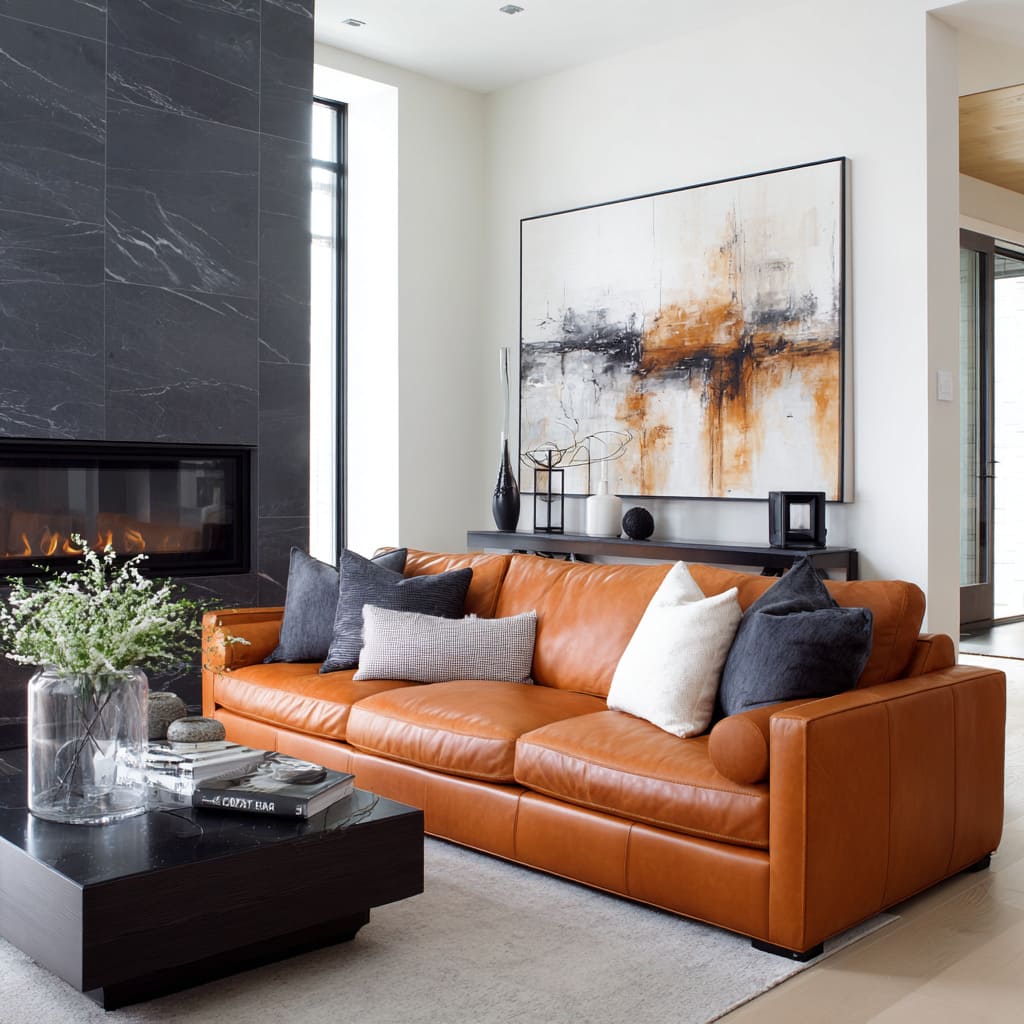
This is the core of many orange leather couch living room ideas:
- Leather reads as material first, color second.
- Highlights ride along edges and cushion crowns, so orange gains built-in dimensionality.
- Cognac/caramel leather looks composed beside wood and stone because it feels like a natural warm finish, not a playful pigment.
Woven or mixed-thread orange
- Breaks orange into micro-variation (orange + cream + muted neutrals).
- The eye reads complexity before it reads color.
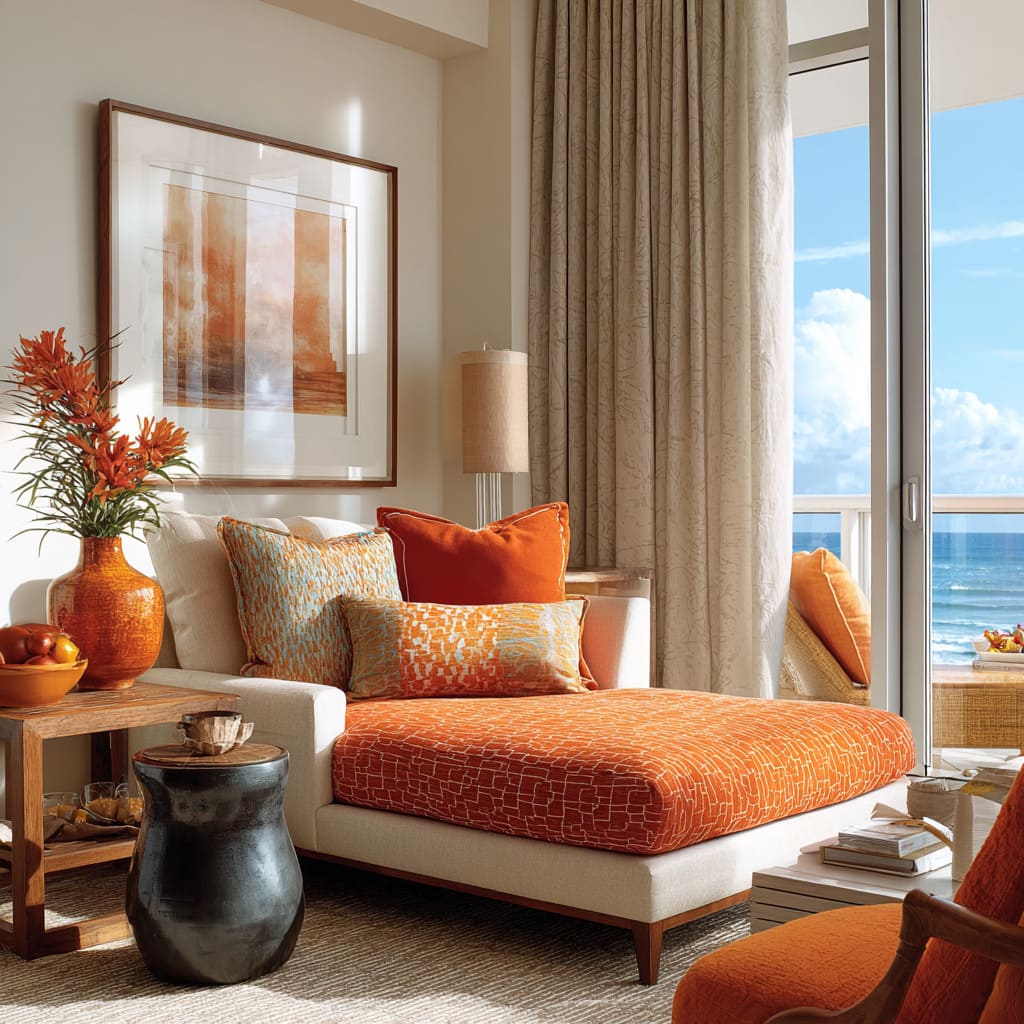
- This is why patterned or woven orange can look more modern luxury than a flat bright orange: it behaves like a crafted surface.
So two sofas can share orange and still read totally different emotionally. One looks like a bold object; the other looks like a calm textile plane.
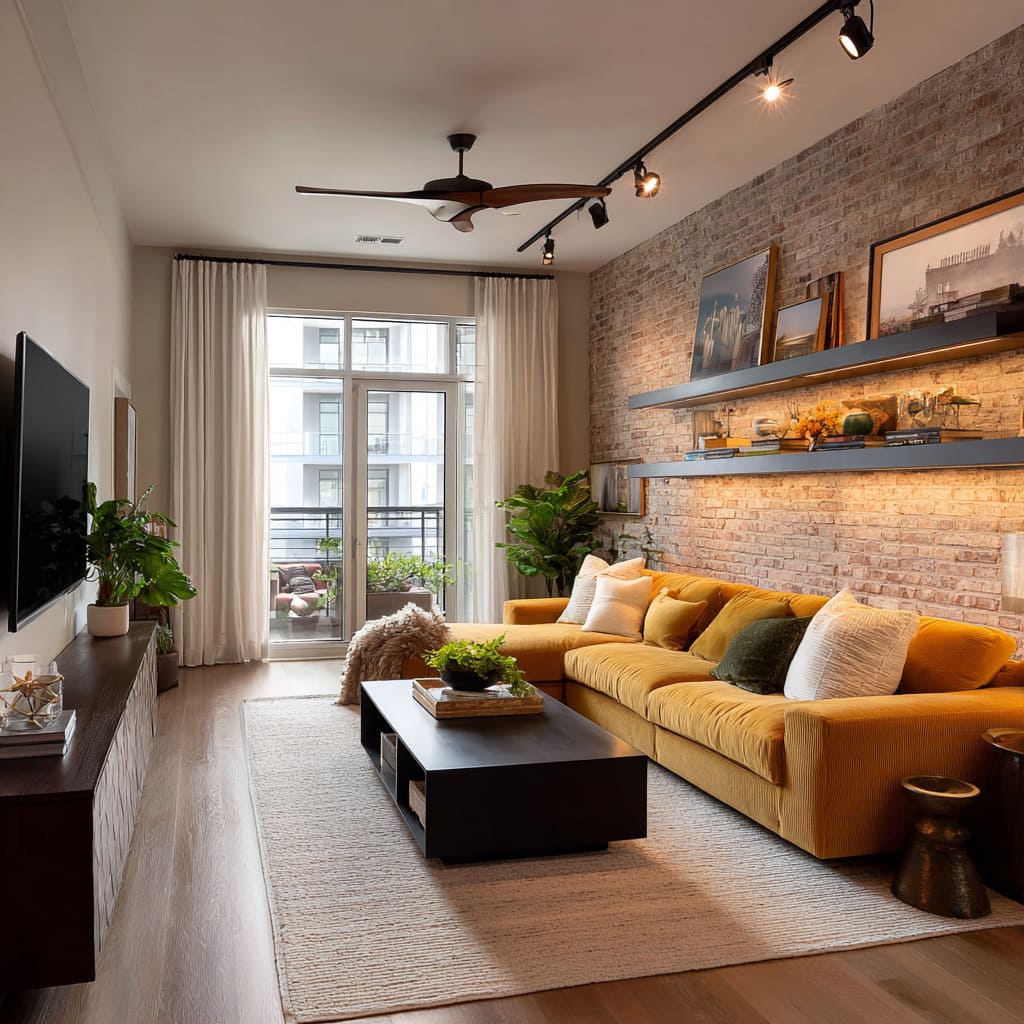
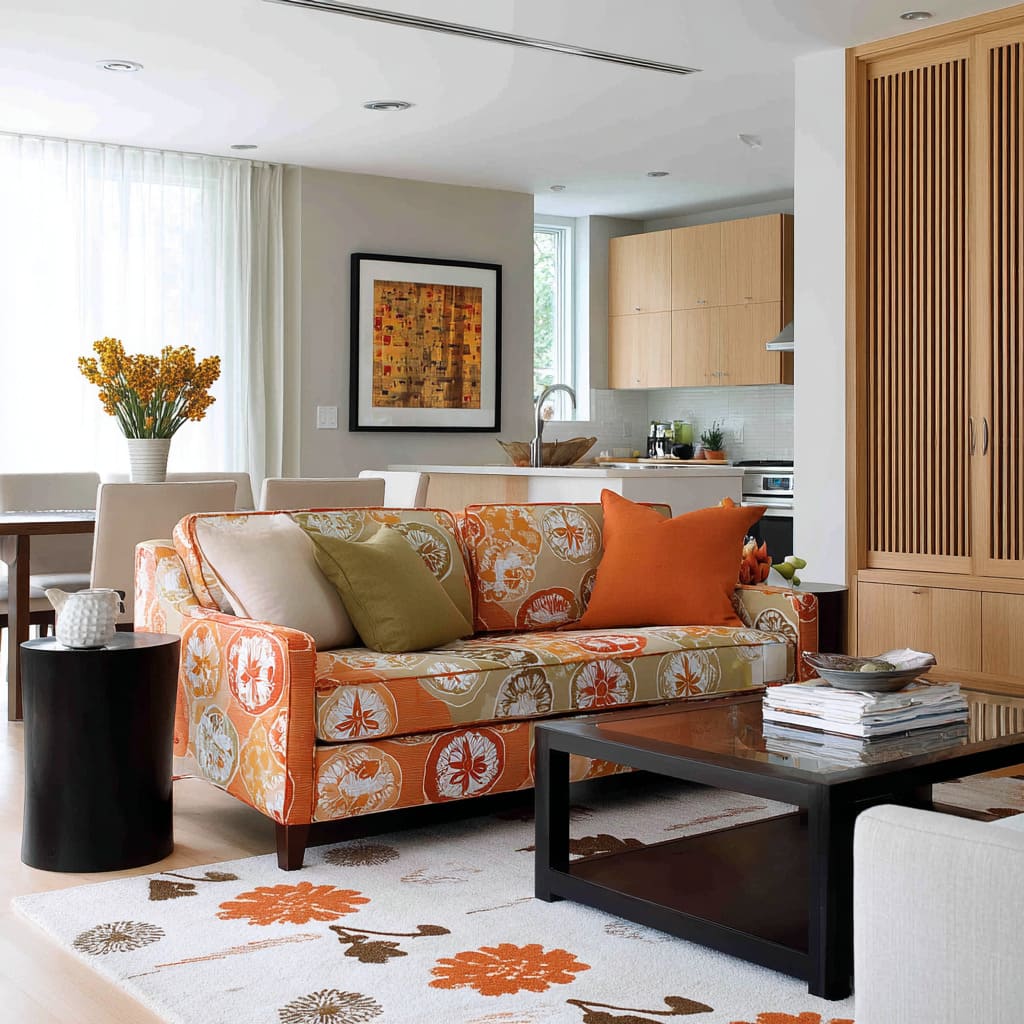
Pattern can actually make orange quieter—if the pattern is disciplined
People often fear pattern on orange seating because they assume it adds noise. In the strongest scenes, pattern does the opposite: it dilutes the flatness that makes orange feel loud.
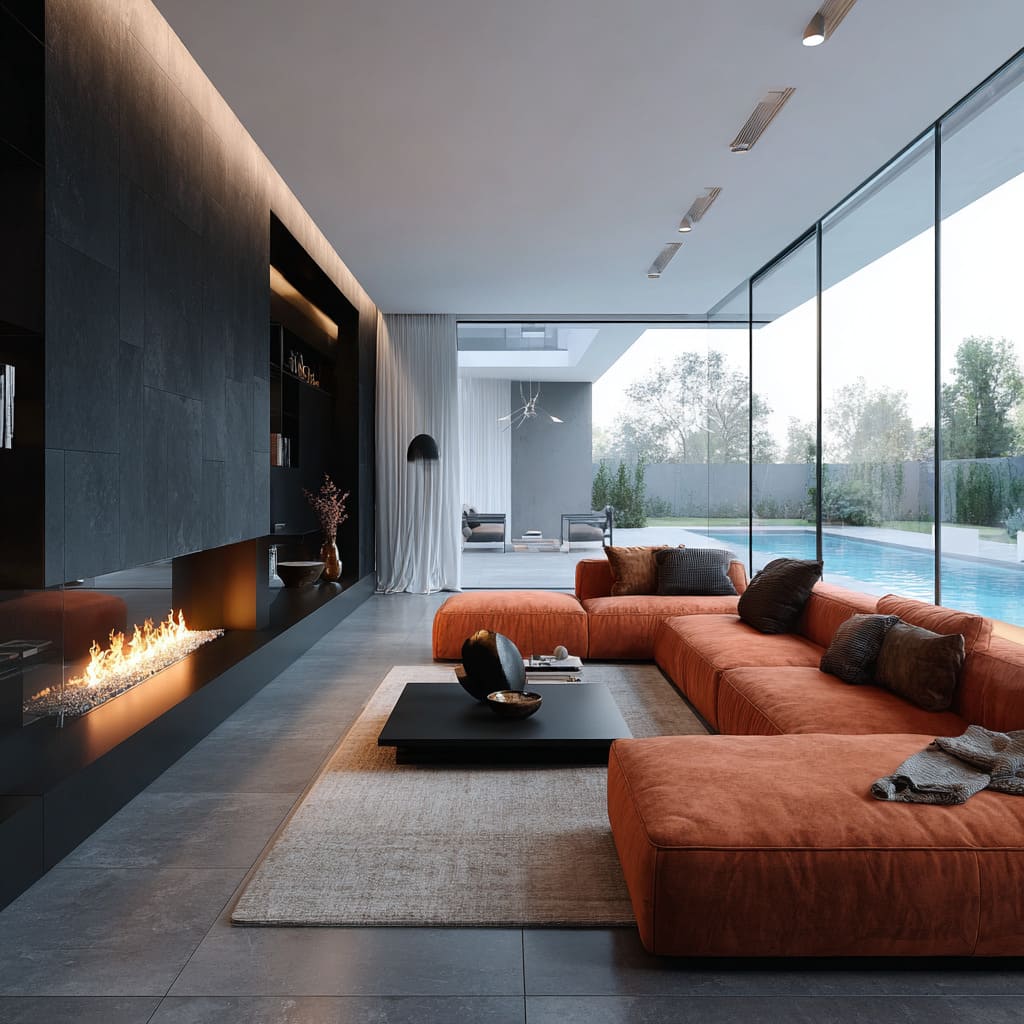
The pattern succeeds when:
- The motif has breathing room (space between shapes).
- The palette contains interruptions (cream, muted olive, soft greys) that repeatedly stop orange from becoming one uninterrupted field.
- The room around it stays quiet (light walls, calm rug, edited accessories), so the pattern becomes the single decorative engine.
This is a big reason some orange couch decorating ideas look airy and grown-up even with bold prints: the print is treated like artwork, and everything else behaves like a gallery background.
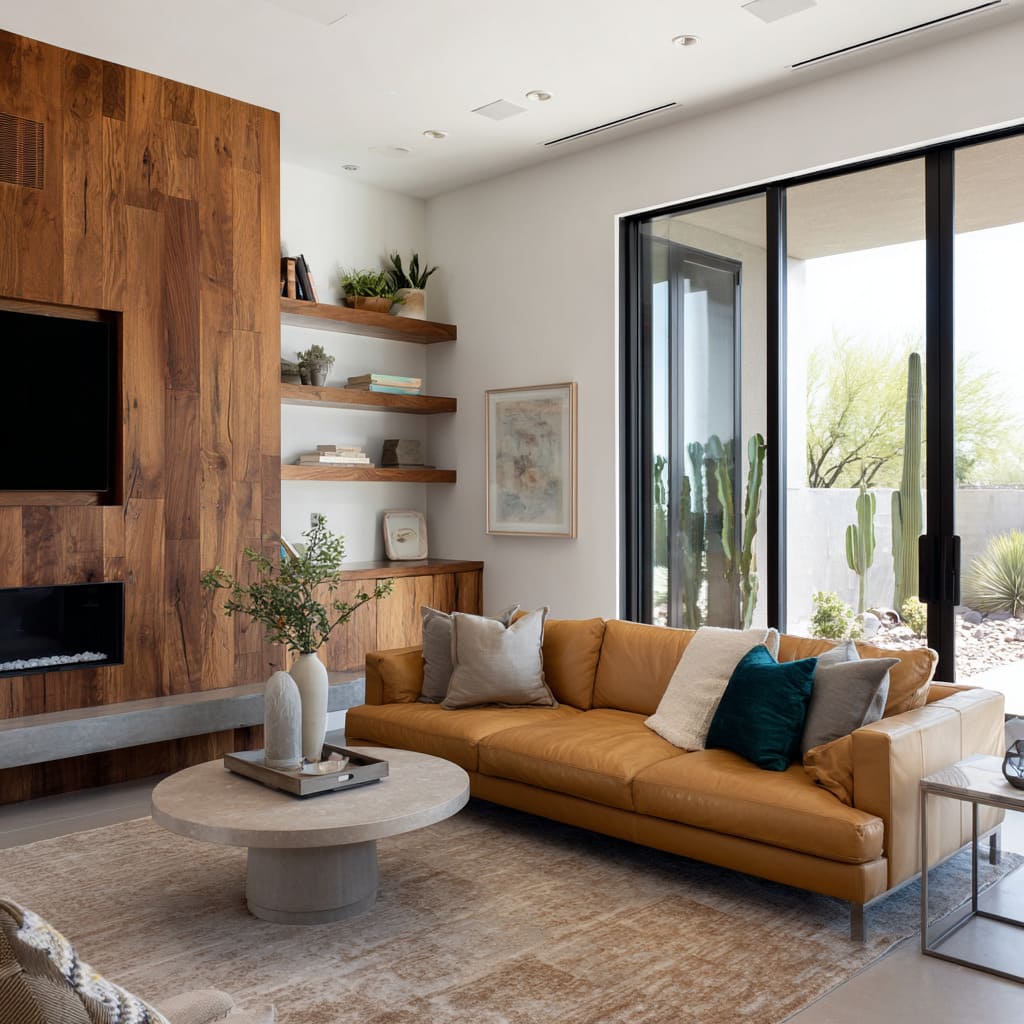
Pillow logic is edge control
Pillows aren’t just accents in successful orange sofa compositions. They are control points that break orange into readable sections.
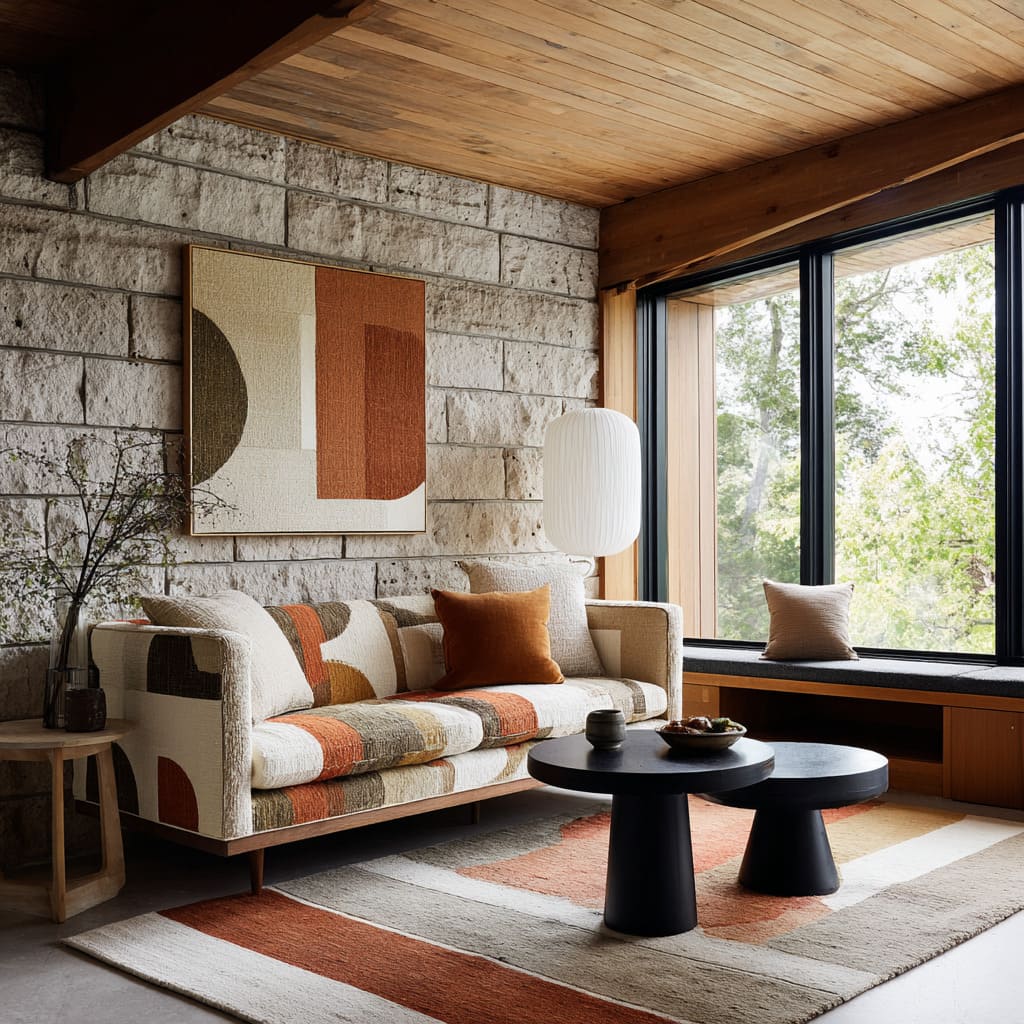
Three pillow roles show up repeatedly:
- Shadow pillows (charcoal/graphite/blue-grey): They act like cool brakes. They add depth and stop orange from reading as a single hot slab.
- Breathing pillows (cream/ivory/stone): They create bright pauses that keep orange from feeling dense.
- One warm punctuation pillow (deeper rust or solid orange): It gives the eye a clear headline for the color, which makes patterned upholstery feel intentional rather than accidental.
This is why the most convincing orange couch decor ideas often look surprisingly restrained. The pillows aren’t there to decorate; they’re there to carve the orange into a planned rhythm of warm + pause + shadow.
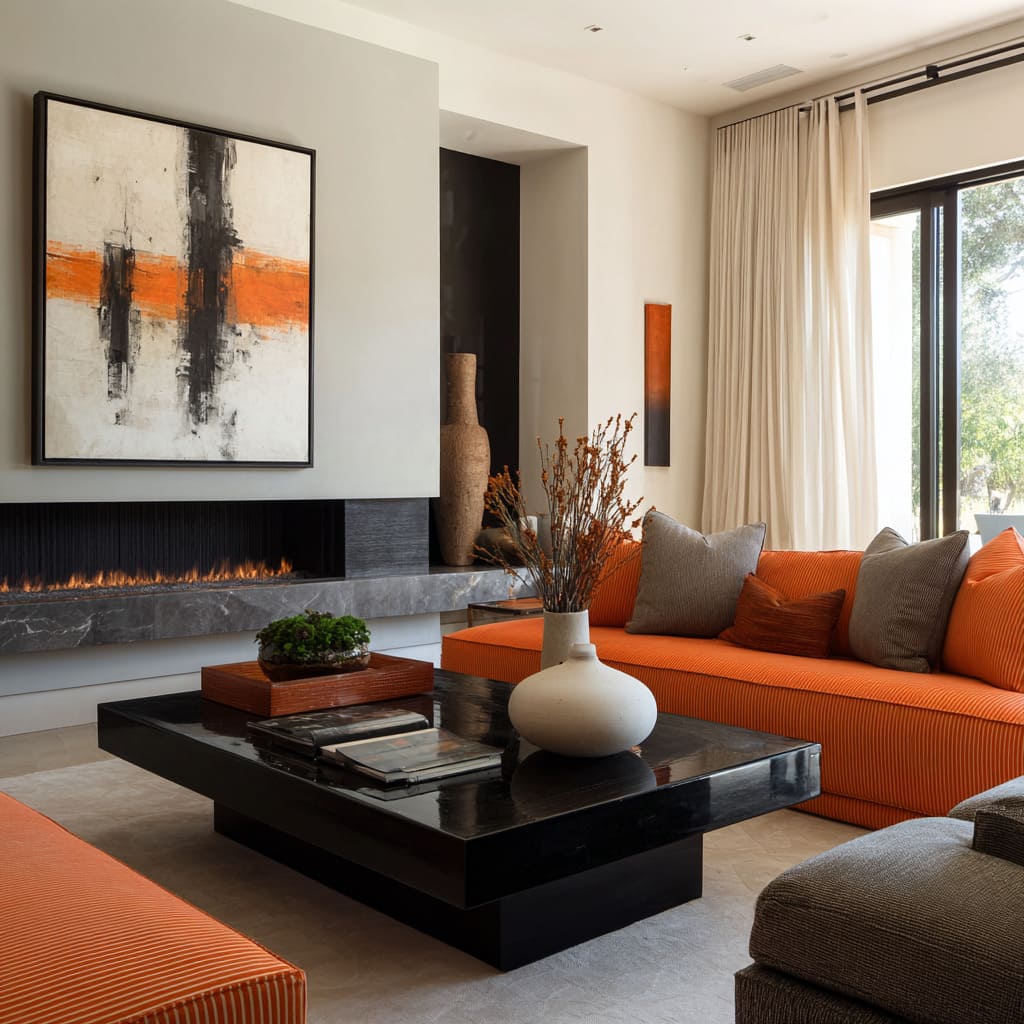
Rugs turn the volume down
A rug can make orange feel either crisp and modern or heavy and themed. The key variable is contrast, not pattern.
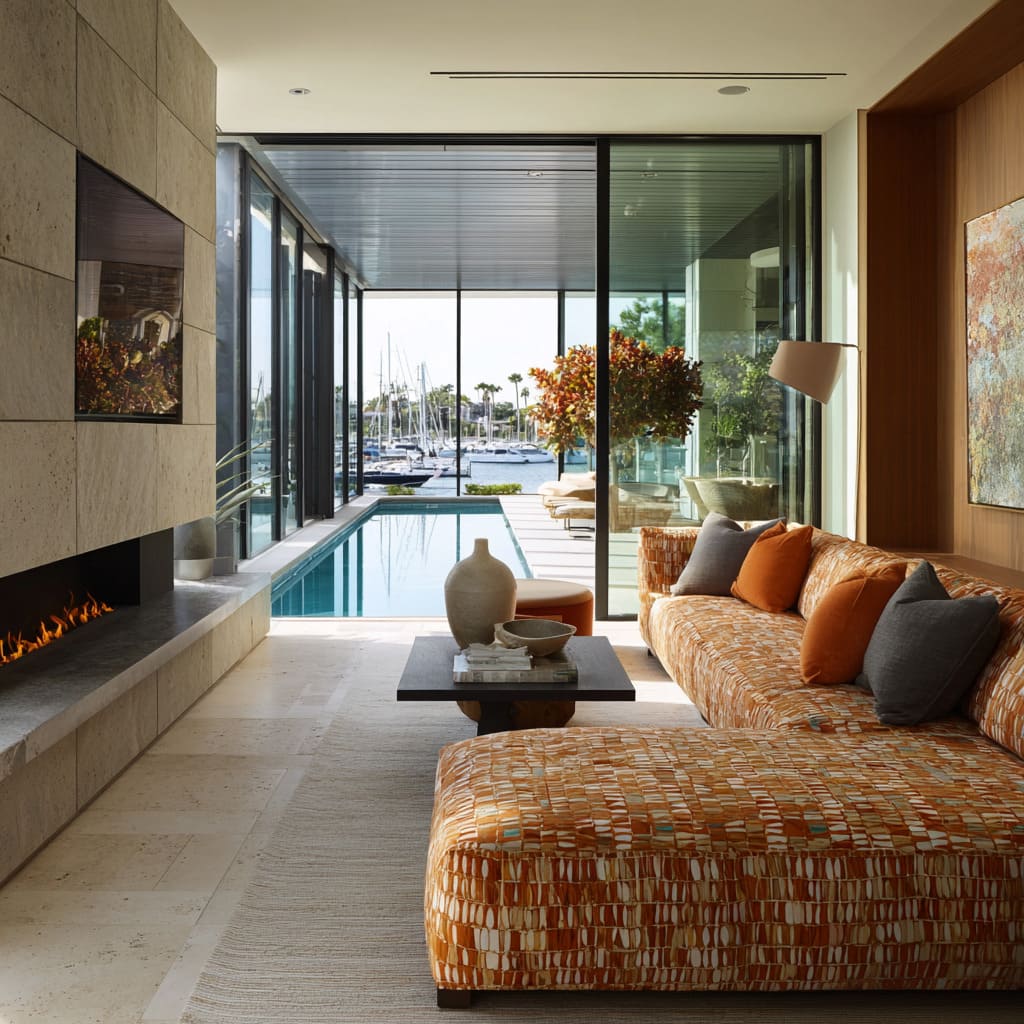
Quiet rugs that keep orange calm
- Pale, low-contrast rugs act like fog under the sofa—orange stays warm but loses harsh edges.
- Subtle texture beats strong graphics: texture gives the floor interest without fighting orange.
The most useful non-obvious rug move
A rug can echo orange, but it must do it in a different voice:
- If the sofa has small-scale pattern, the rug uses fewer, larger shapes.
- If the sofa is solid orange, the rug can carry a soft, muted orange trace—but slightly less saturated than the sofa, so the sofa remains the warm peak.
That tonal hierarchy is what prevents the matchy feeling while still making the room feel coherent. Many high-performing orange couch ideas rely on this quiet hierarchy: sofa leads, rug supports, art validates.
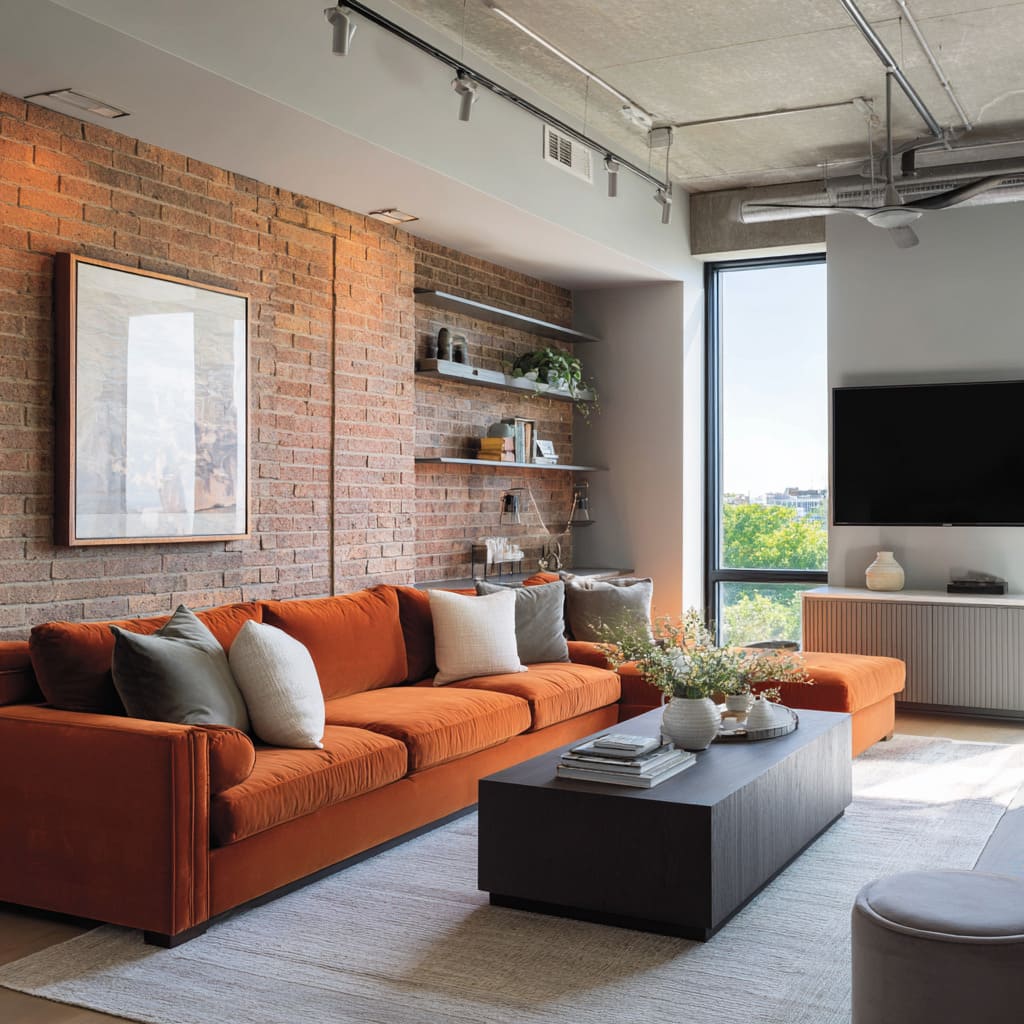
Black objects as a design tools
Black often functions like punctuation in a sentence. A single black table, a black fireplace opening, a slim black side table, or black window frames can make the entire palette feel sharper and more deliberate.
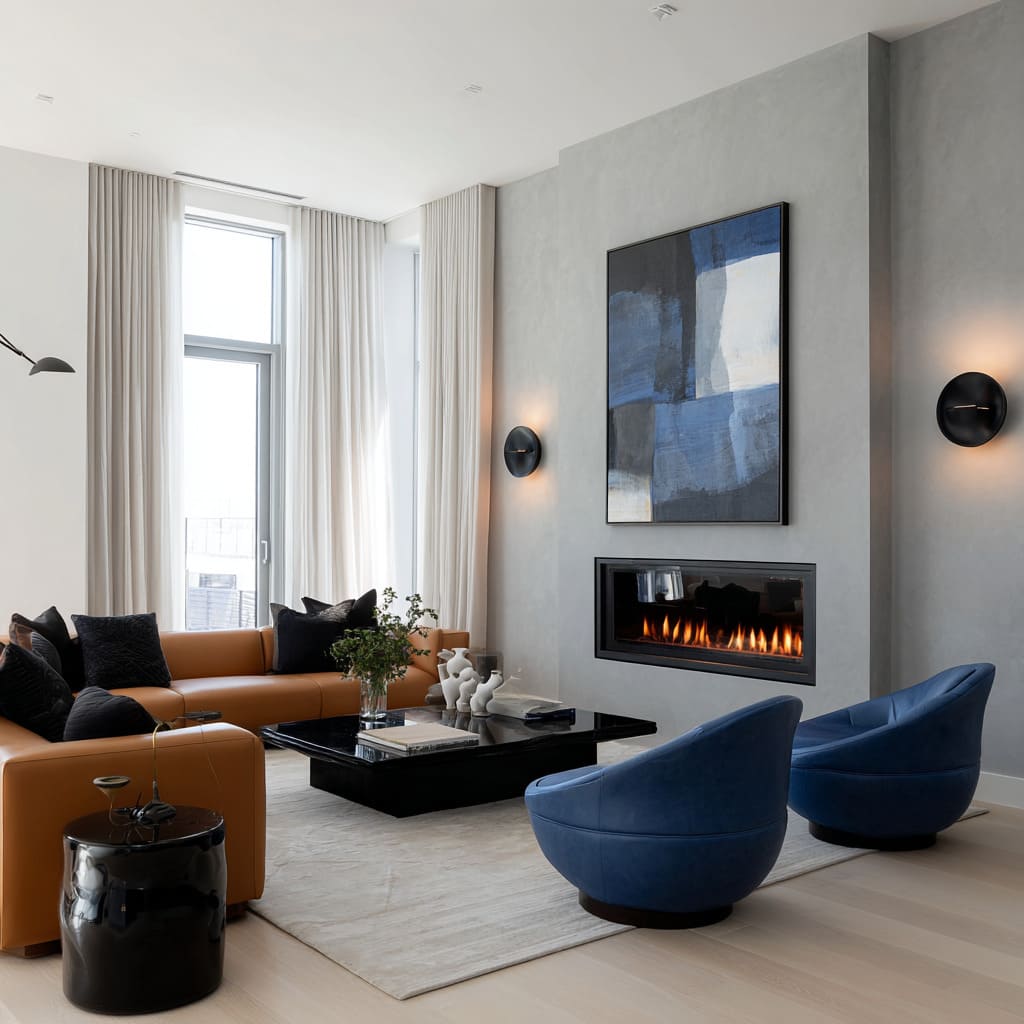
Black works especially well when:
- It appears as simple geometry (rectangles, thin frames, clean circles).
- It repeats in at least two places (for example: fireplace + coffee table, or window frames + table).
- Styling stays minimal on black surfaces, so black reads as form, not clutter.
This is why glossy black tables often appear in modern orange sofa interior desisgns: reflection adds movement without adding another color story.
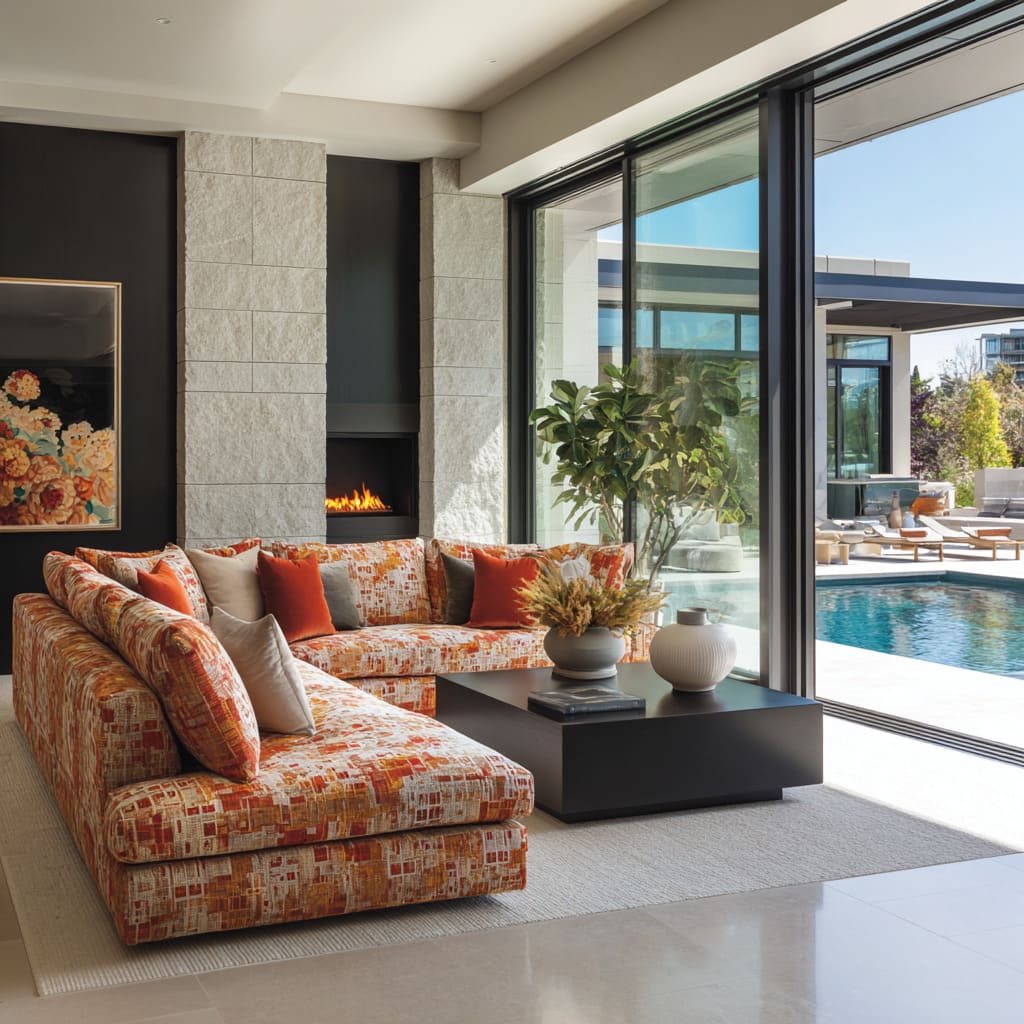
Wood is the warm bridge that makes orange feel architectural
One of the most consistent hidden moves in strong interior designs is warm wood used as a quiet relative of orange.
Wood helps orange feel believable because:
- It introduces warmth at a lower intensity, so orange is not the only warm surface.
- It creates a natural rhythm (grain, plank variation, slat lines) that keeps orange from feeling like a single artificial blob.
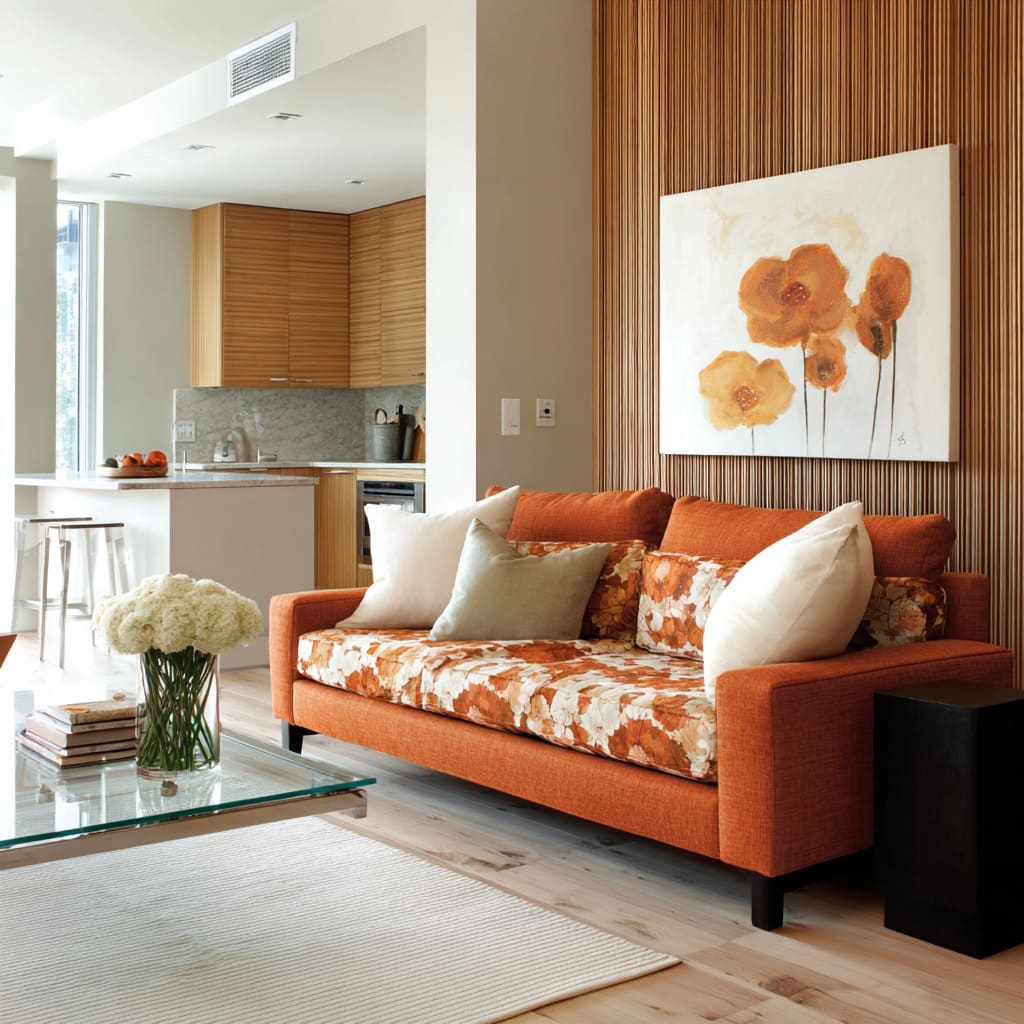
A slat wall behind an orange sofa is especially effective because the vertical beat adds order behind the warm upholstery. The sofa can carry pattern or saturated color while the wall provides steady structure.
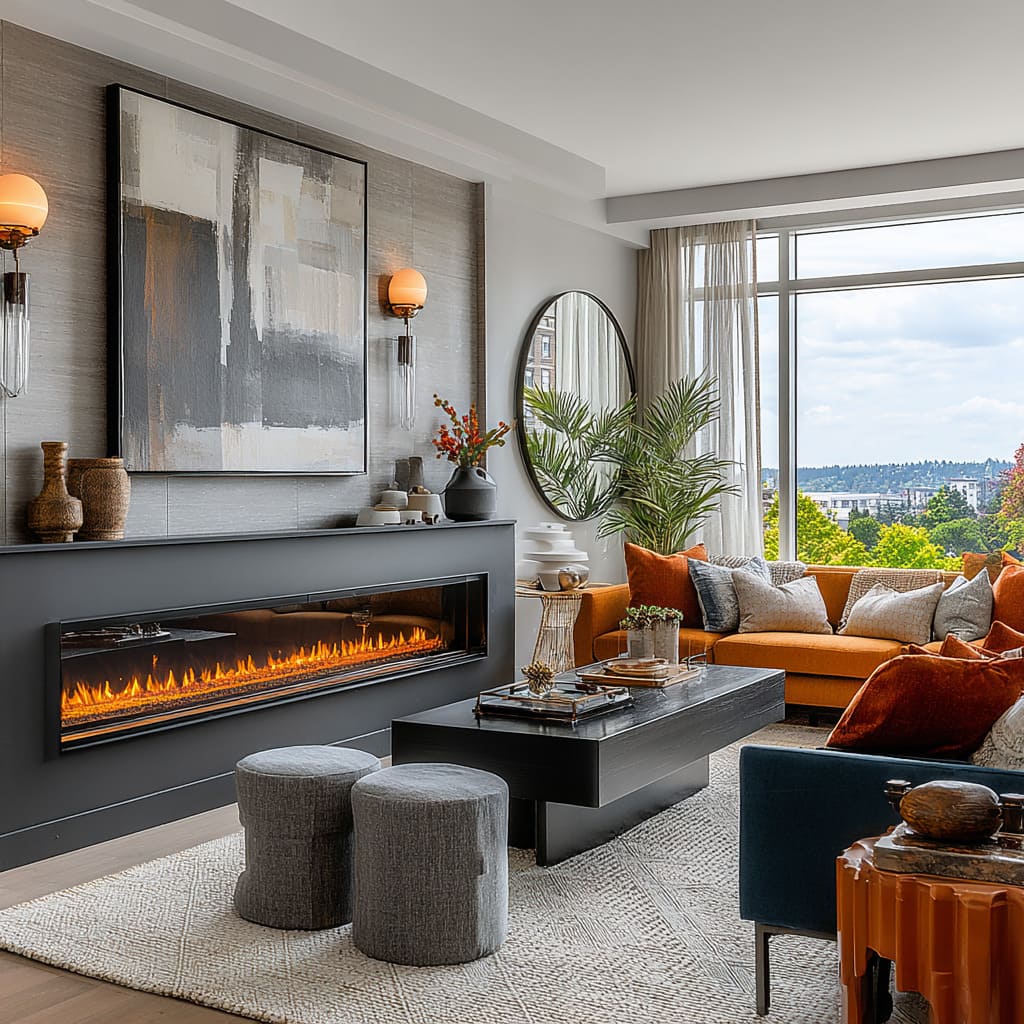
This is a major backbone of many orange couch design ideas that feel planned: wood prepares the eye for warmth, then orange arrives as the comfortable center.
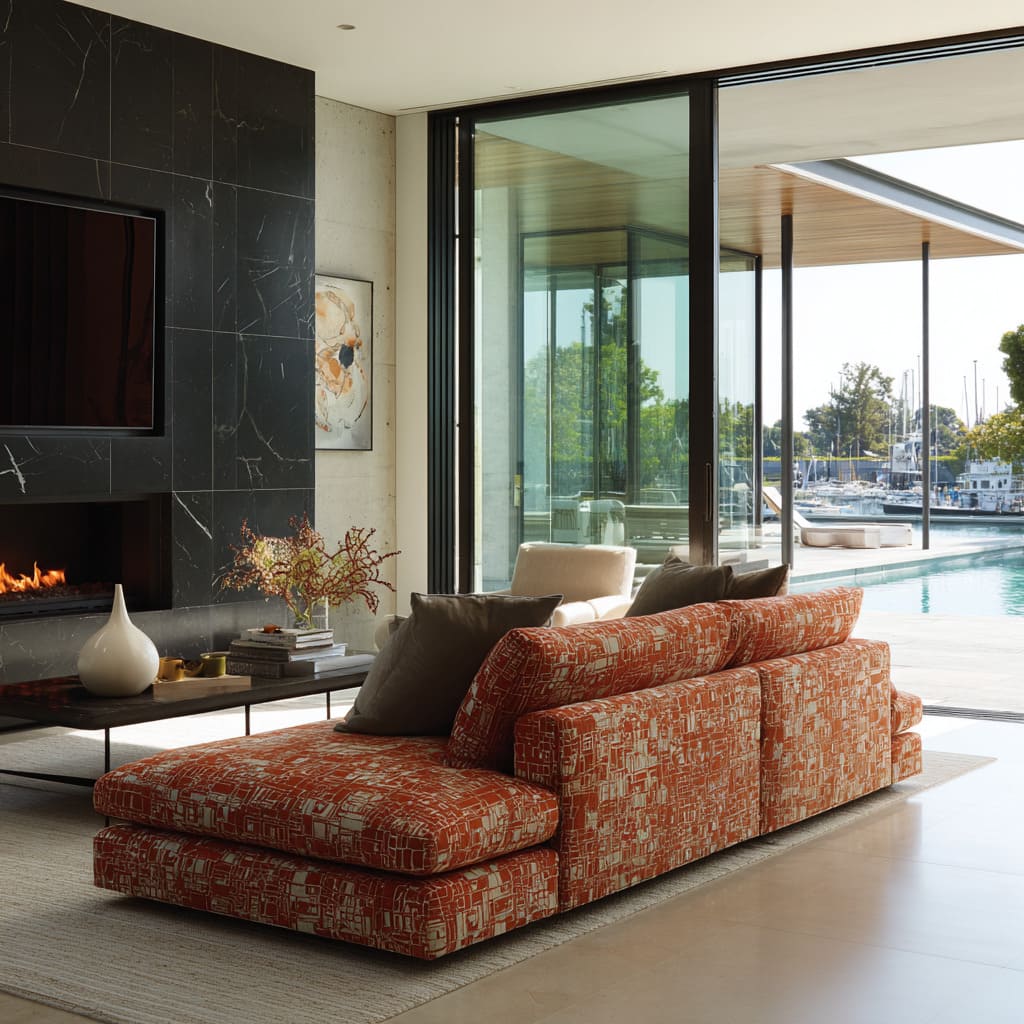
Art is not an accessory here—it’s permission at eye level
Orange often fails when it exists only at seat height. The interior design looks like it has a random warm object and no story explaining it.
Art fixes that by giving orange a second reason to exist.
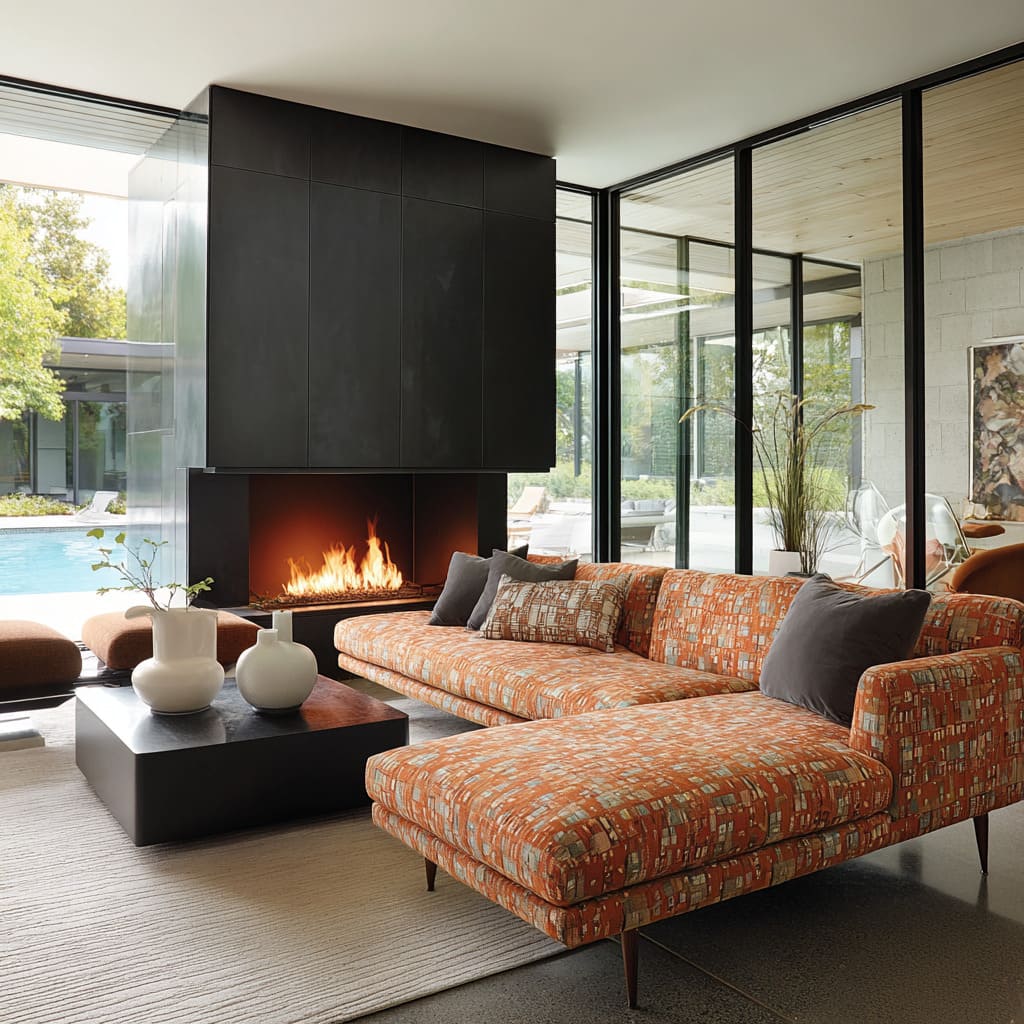
The most convincing art strategies:
- Broken echo: Orange appears in art as a smoky wash, scattered marks, or a single painterly stroke—not a literal match. This makes orange feel collected rather than themed.
- Controlled repetition: One large art piece does more than five small orange accessories. Large, calm repetition reads mature; many small repeats read costume-like.
- Different texture language: Pigment, print, or abstract shapes translate the sofa color into another medium, which makes the palette feel designed instead of coincidental.
This is why orange couch living room ideas often look instantly better when there’s one strong, calm artwork supporting the warmth.
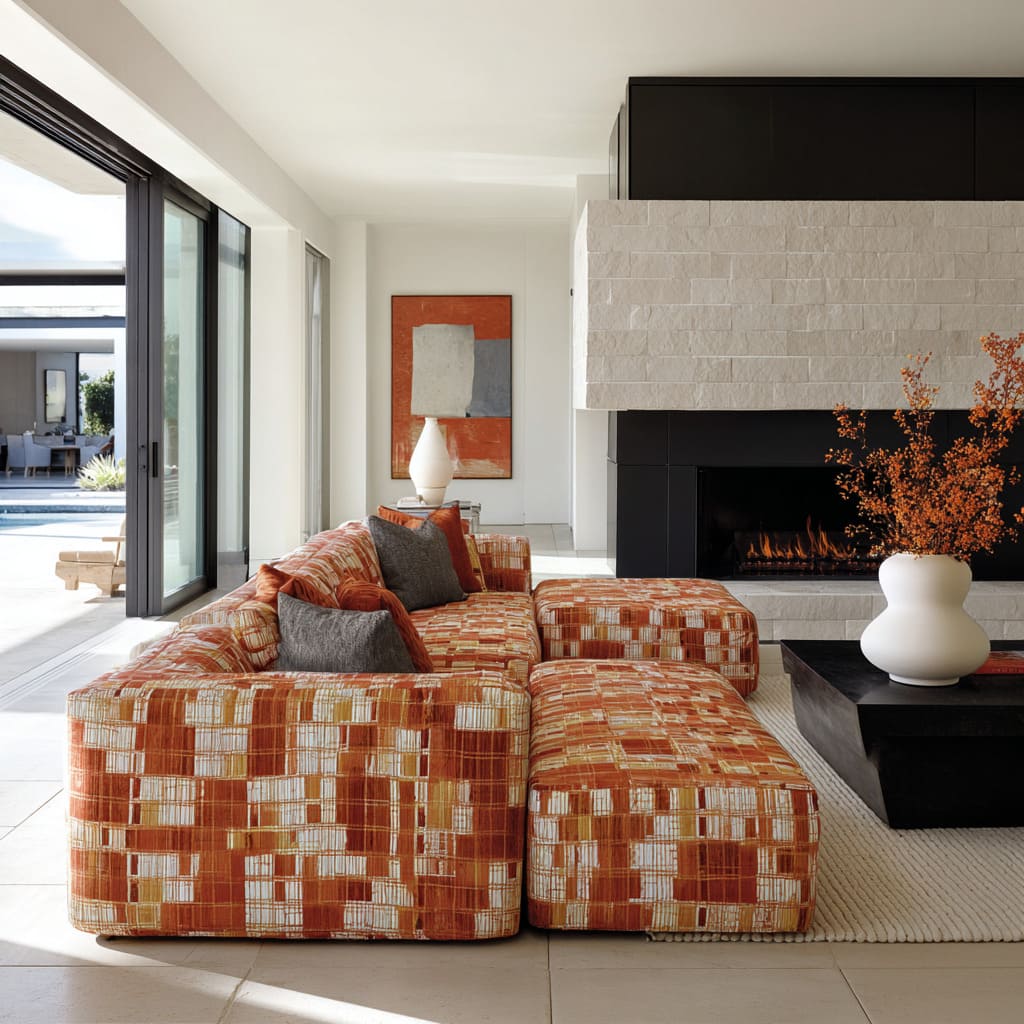
Daylight changes what orange means
Orange can go harsh under bright daylight if the room has stark whites and hard contrast. The interior design that stay calm usually add soft filters:
- Tall sheers or warm beige drapery that diffuses the window light.
- Creamy whites instead of icy whites, so orange doesn’t look acidic.
- Pale rugs and stone surfaces that reflect light gently, not sharply.
Outdoor blue (sky, pool, water) becomes the cool partner that keeps orange fresh. The interior can stay neutral, and the view supplies the coolness.
That’s a quiet reason orange stops reading autumn in bright modern homes: cool exterior light changes the emotional meaning of the orange.
When orange looks modern
Another interesting pattern: orange feels calm when its shape participates in the room’s main lines. Example ideas:
- A long sectional echoes a long linear fireplace strip.
- Low seating repeats the low horizon of a stone hearth or a wide window track.
- A circular black table softens a room full of rectangles, preventing orange from feeling like one more block in a blocky parade.
This is why many strong orange couch interior design scenes feel architectural: orange is not only color; it becomes a horizontal band that stabilizes the composition.
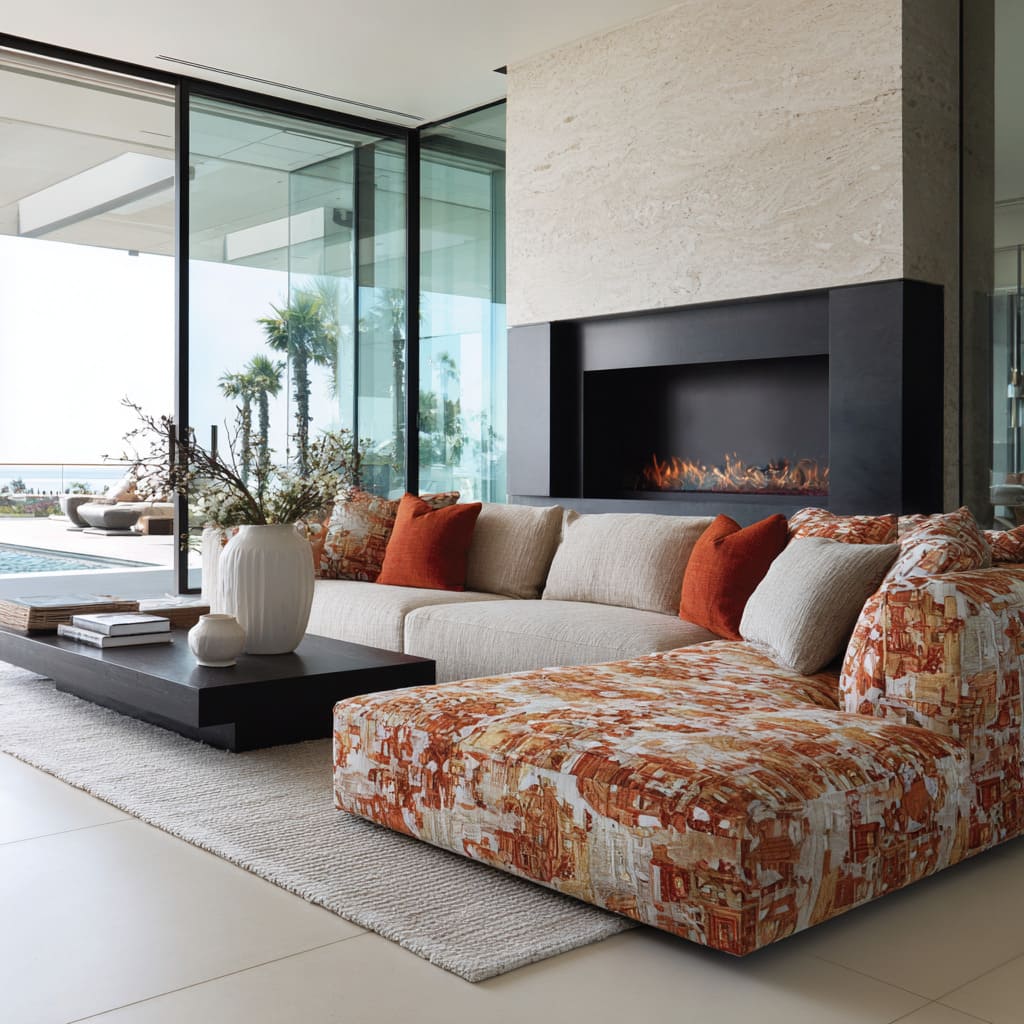
Minimal styling + Orange
Orange carries emotional weight. When extra objects pile up, the room starts to argue with itself: every vase, book, plant, and bowl competes with the sofa’s heat.
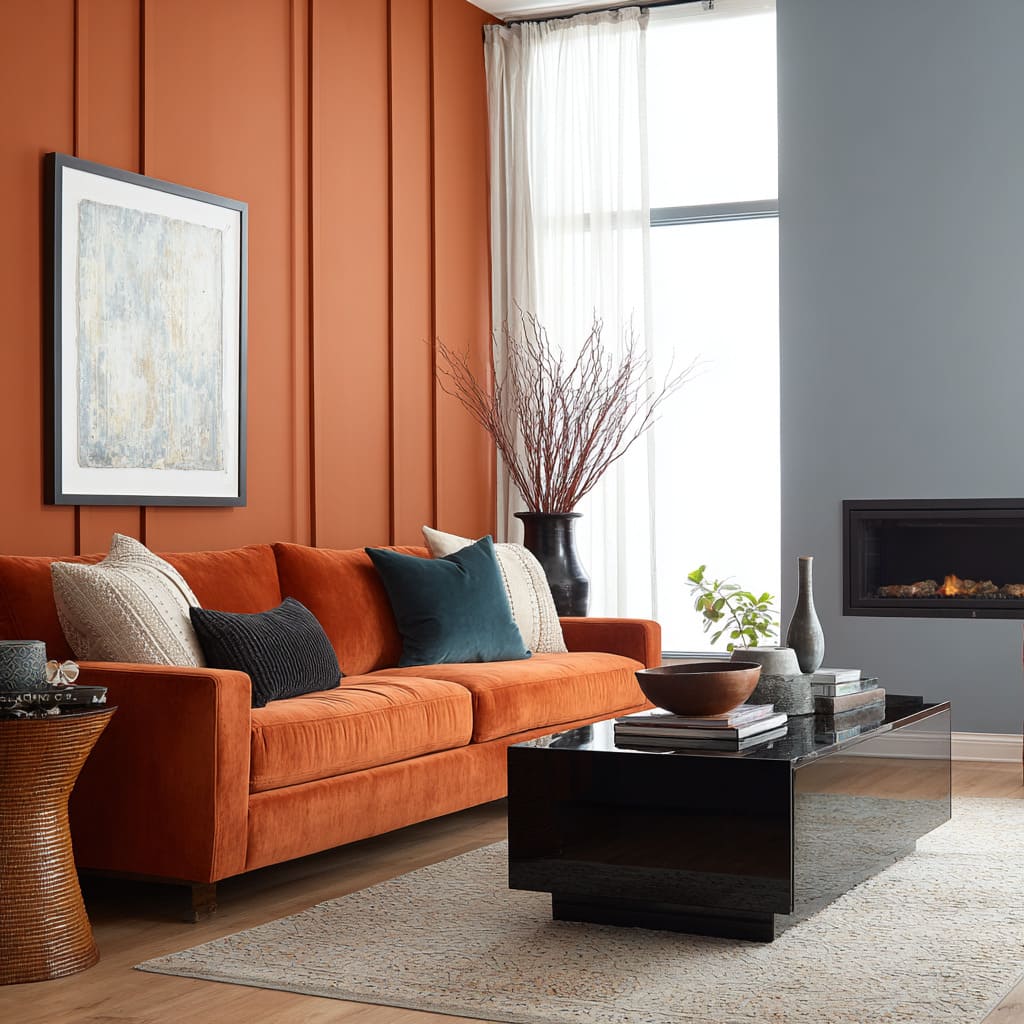
So the best orange couch decorating ideas often rely on restraint:
- A few sculptural vessels in white or neutral tones (a clean reset point).
- One organic gesture (branches or stems) to soften strict geometry.
- Clear negative space so the eye can rest.
This is not about emptiness. It’s about letting orange be the comfort identity while the rest of the room stays readable.
Open-plan layouts
In open-plan layouts, orange becomes especially useful because it can mark the living area as a distinct island without walls.
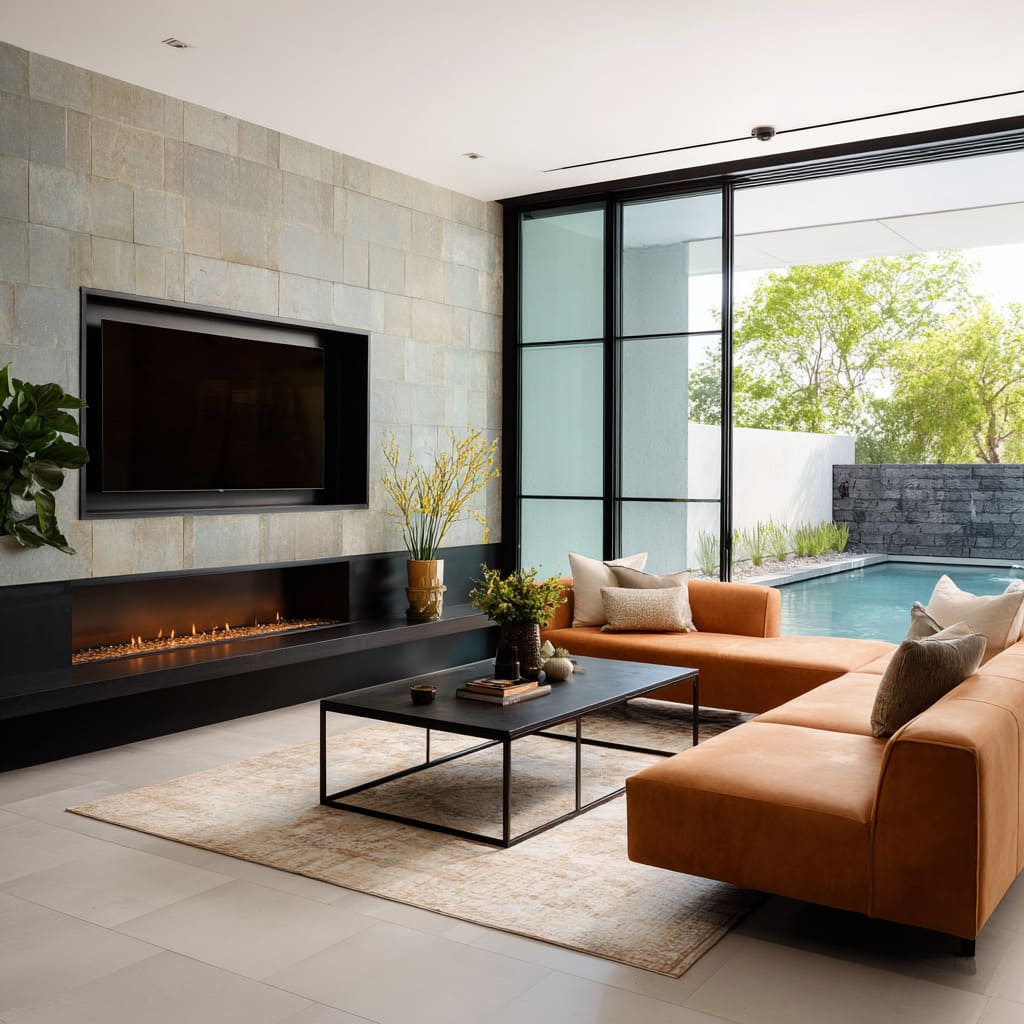
The zoning reads finished when:
- The rug defines a soft boundary under the seating group.
- The coffee table sits centered and grounded, creating a visual core.
- The kitchen and dining areas stay quieter (light cabinetry, restrained pendants), so orange doesn’t spill visually into every zone.
This is where orange couch decor ideas become spatial logic: orange helps the room say this is the lounge zone in a clear, confident way.
How orange avoids seasonal vibes
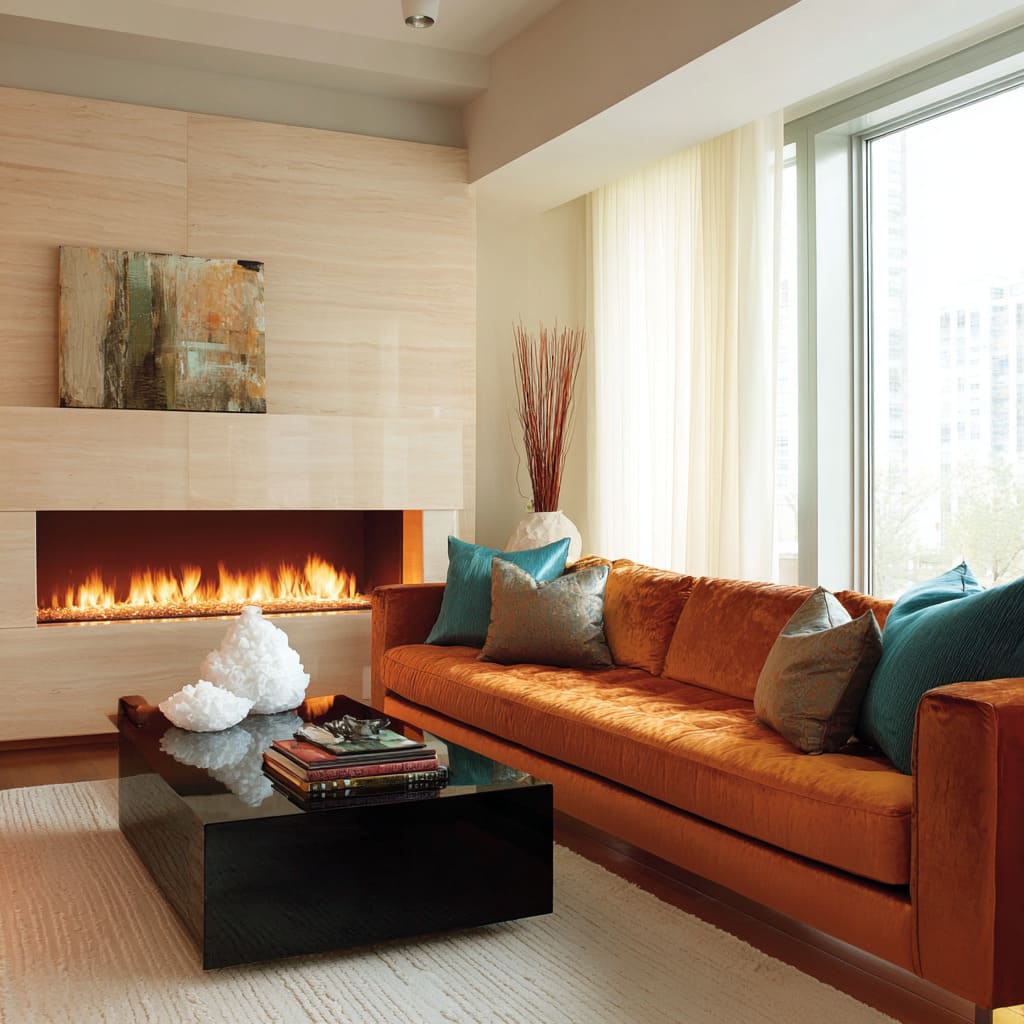
A silent worry behind orange is seasonal association. Interior designs avoid that not by removing warmth, but by changing the supporting context.
Orange reads year-round when:
- It sits next to cool partners (blue-grey pillows, outdoor water light, charcoal outlines).
- It’s paired with mineral neutrals (stone, concrete, soft greys) rather than only creamy warm tones.
- Repetition is controlled: orange appears as one major surface and one or two calm echoes, not scattered everywhere.
That’s the deep difference between orange as decor theme and orange as temperature. The best orange couch living room ideas treat orange like temperature.
Summary
Orange looks mature when the designs does five things consistently:
- Gives orange a clear role (warm center of gravity, comfort layer, zoning marker).
- Adds outlines (black frames, dark voids, charcoal anchors) so orange feels edited.
- Uses quiet fields (pale rugs, stone, soft greys) so orange has space to breathe.
- Builds depth on the sofa surface (material light behavior, shadow pillows, patterned thread mixes).
- Validates orange at eye level (one strong art echo, not many small orange objects).
That’s the underlying logic connecting orange couch design ideas, orange couch decorating ideas, and orange couch decor ideas that read calm and high-end: orange is allowed to be warm, but it is carefully interrupted, framed, and translated into a full-room story.
Related Posts
Harmony Home Design brings 10+ years of residential interior design experience to the ideas shared here. We publish design concepts, layout thinking, and practical styling notes.