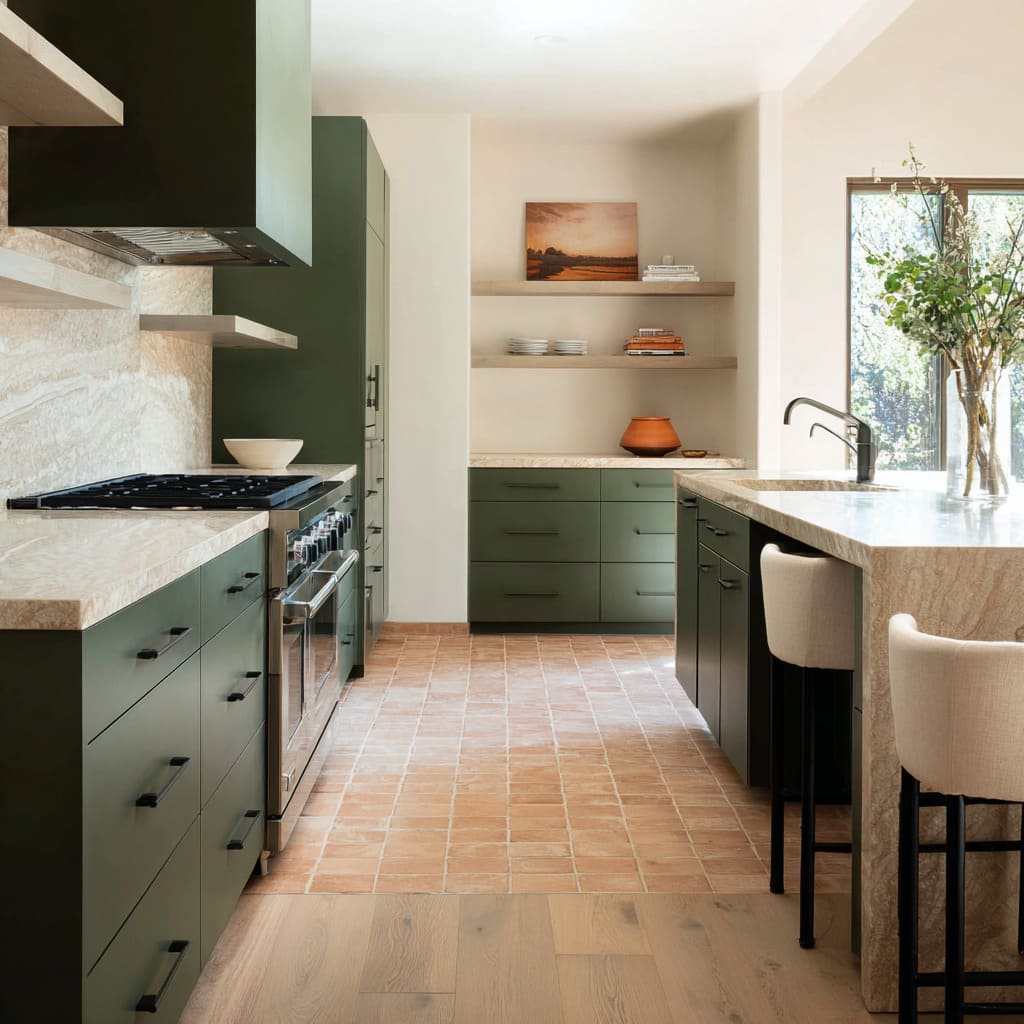
In many compositions, terracotta defines functional zoning: islands sit on clay “patches,” circulation paths shift to pale timber, or cooking zones occupy a clay rectangle bordered by wood. These patterns quietly guide movement without using strong contrasts.
What is notable is the intentional continuity; grout follows the tile tone, so the floor behaves like one warm field rather than a rigid grid. This base carries the room’s mineral character, influencing everything layered above it.
Sculptural Clay on Vertical Planes and the Idea of a Clay Envelope
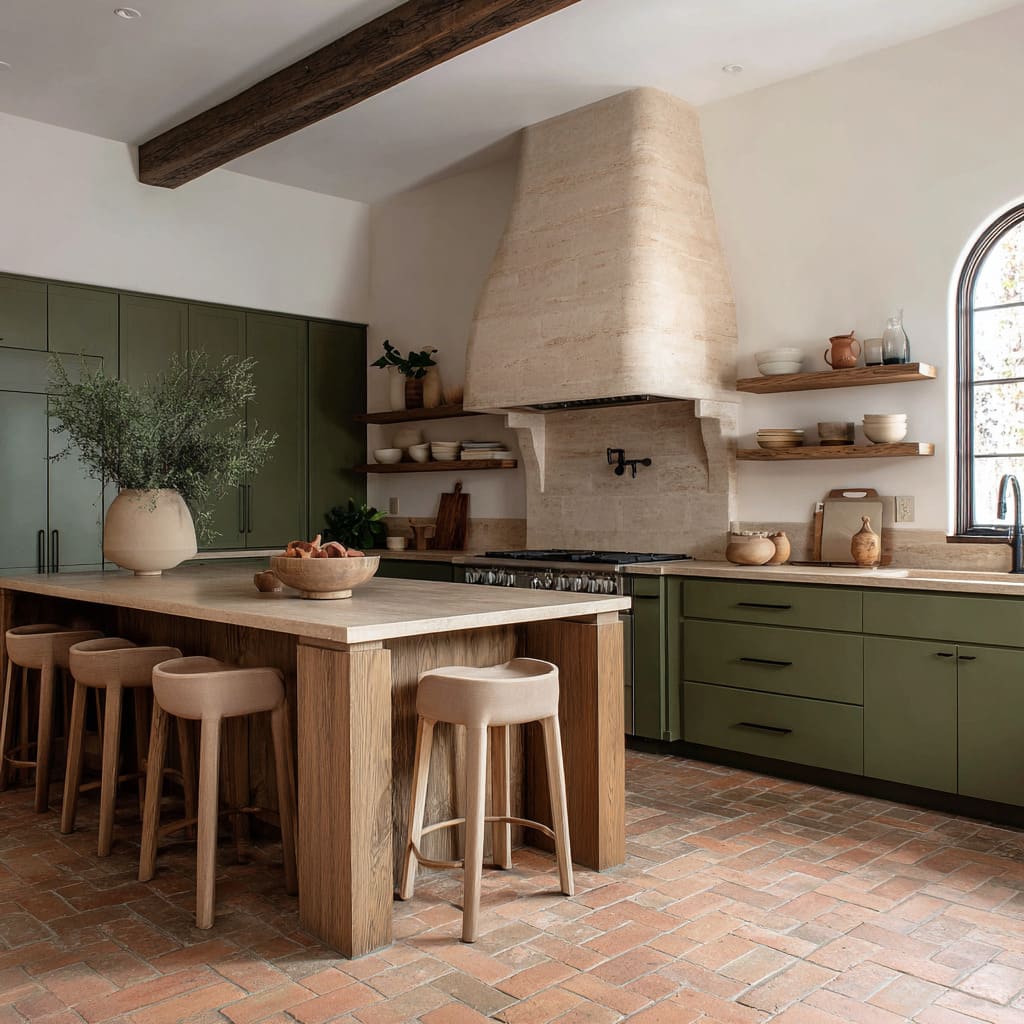
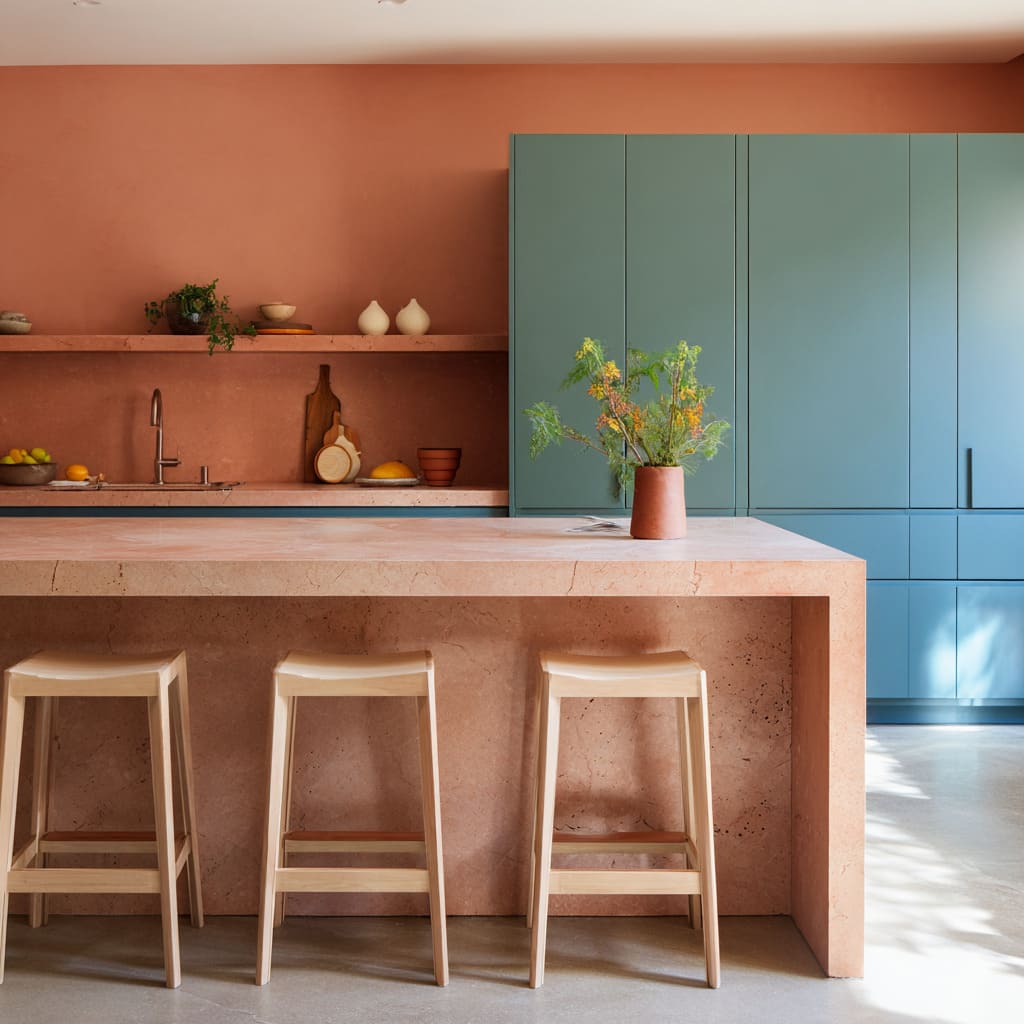
Some kitchen design compositions extend terracotta upward, letting clay become a full vertical presence rather than only a floor finish. Matte plaster in soft baked-pink hues, salmon-tinted hood volumes, or glossy vertical clay tiles form surfaces that behave like architectural skins.
Sometimes, clay wraps the hood and the recess around it, turning the cooking wall into a sculpted clay niche. Elsewhere, long vertical tiles make the backsplash shimmer when daylight grazes it, creating quiet animation against smooth cabinetry.
They sometimes encode terracotta indirectly in stone by using blush veining, clouded beige patches, or caramel threads that reference clay without repeating its exact shade. This upward movement of clay establishes a visual rhythm: warm ground, warm vertical plane, then lighter wall above.
Three strategies appear repeatedly: clay as a full wall wash, clay as a single sculptural element (hood or niche), and clay as undertone embedded in stone. Each version changes the emotional temperature of the space.
These moves collectively form one dimension of green and terracotta kitchen ideas, showing how clay shifts from grounding element to atmospheric envelope depending on scale and placement.
The Green Spectrum: From Leafy Softness to Structural Depth
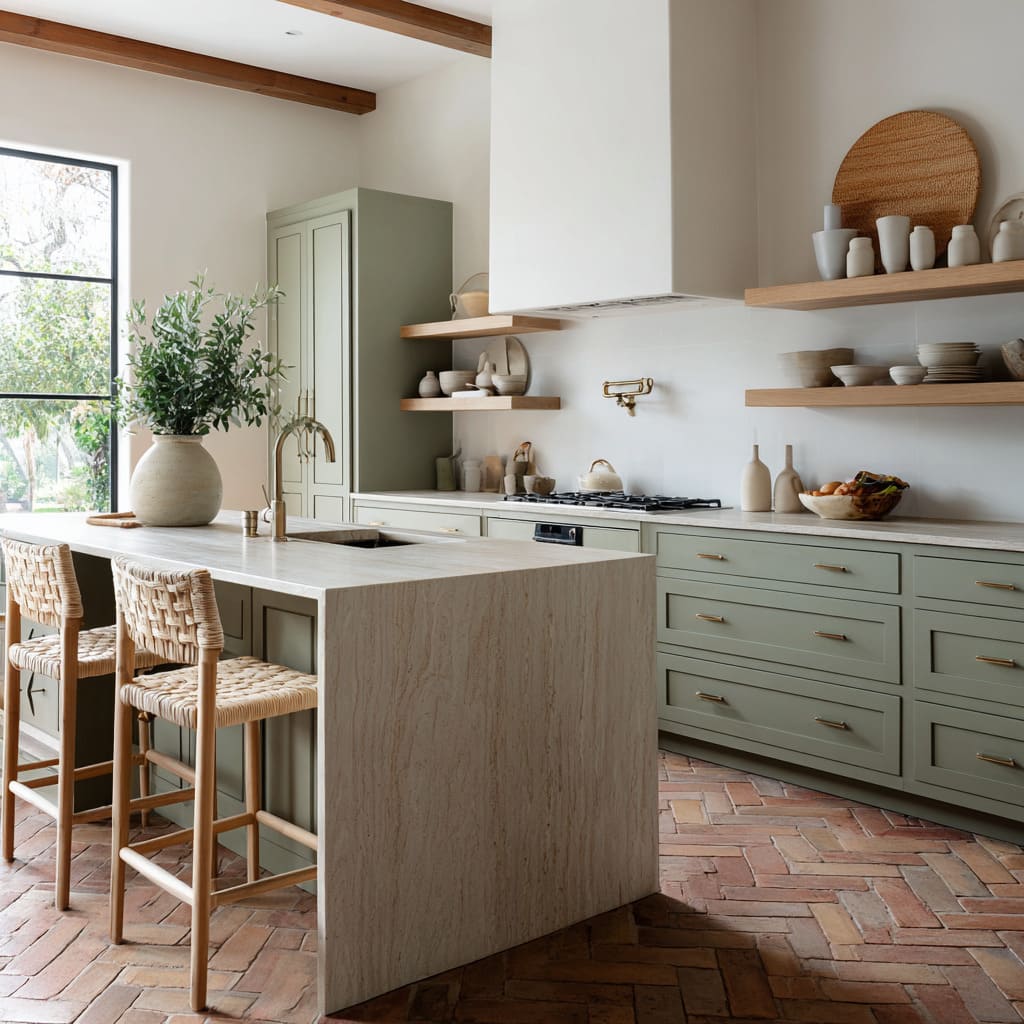
The green palette behaves like a flexible framework, moving from gentle foliage tones to strong architectural mass. Soft sage, pistachio, fern, and misty herb shades often appear in kitchens where clay floors carry more color variation; the quiet greens sit like gentle foliage above mineral ground.
This is where one sees the spirit of sage green and terracotta kitchen ideas, because these herbaceous notes echo outdoor gardens visible through windows. Deeper tones—hunter, pine, emerald, and juniper—get used when cabinetry forms tall storage walls or heavy blocks.
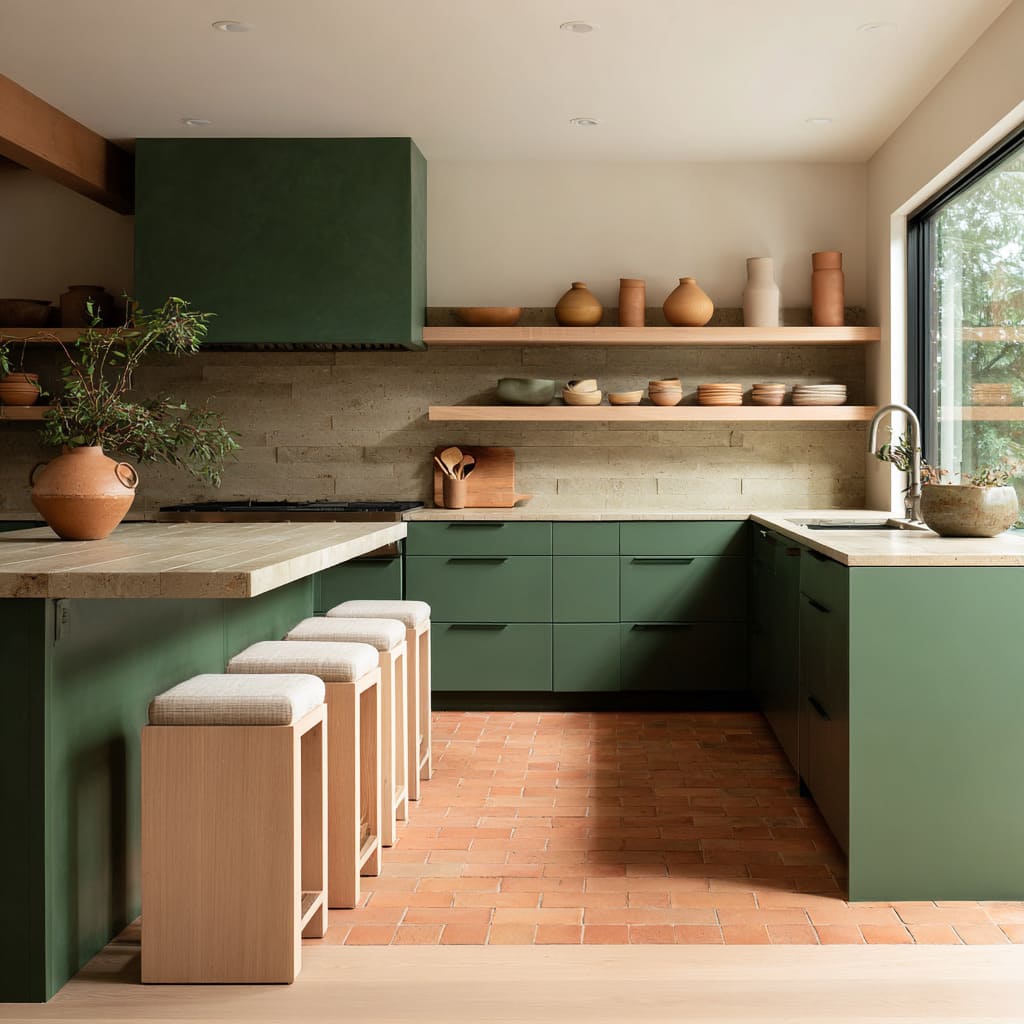
In those scenarios, green reads almost like carved volume, providing weight and quiet contrast to clay’s softness. The most sophisticated examples avoid pairing bright greens with terracotta; instead, the greens carry grey or blue undertones that keep them calm next to clay.
These hues help the cabinetry blend or stand out depending on how they are massed: long horizontal runs feel like hedges in an indoor landscape, while tall deep-green towers behave like built-in architecture. The interplay of green and clay becomes a study in depth and grounding rather than a literal nature palette.
Stone as a Transitional Layer Between Warm and Cool Surfaces
Stone emerges as the mediator between terracotta and green, building a middle register that steadies the palette. Islands often appear in creamy stone with subtle tan, honey, or faint blush veining.
These veins echo clay underfoot while keeping the surface light enough to connect with pale walls and ceilings. Stone backsplashes create vertical continuity, lifting mineral tones above counter level so the palette feels coherent instead of segmented.
In some scenes, stone has a chalky, powdery finish that softens the presence of stacked clay tiles below.
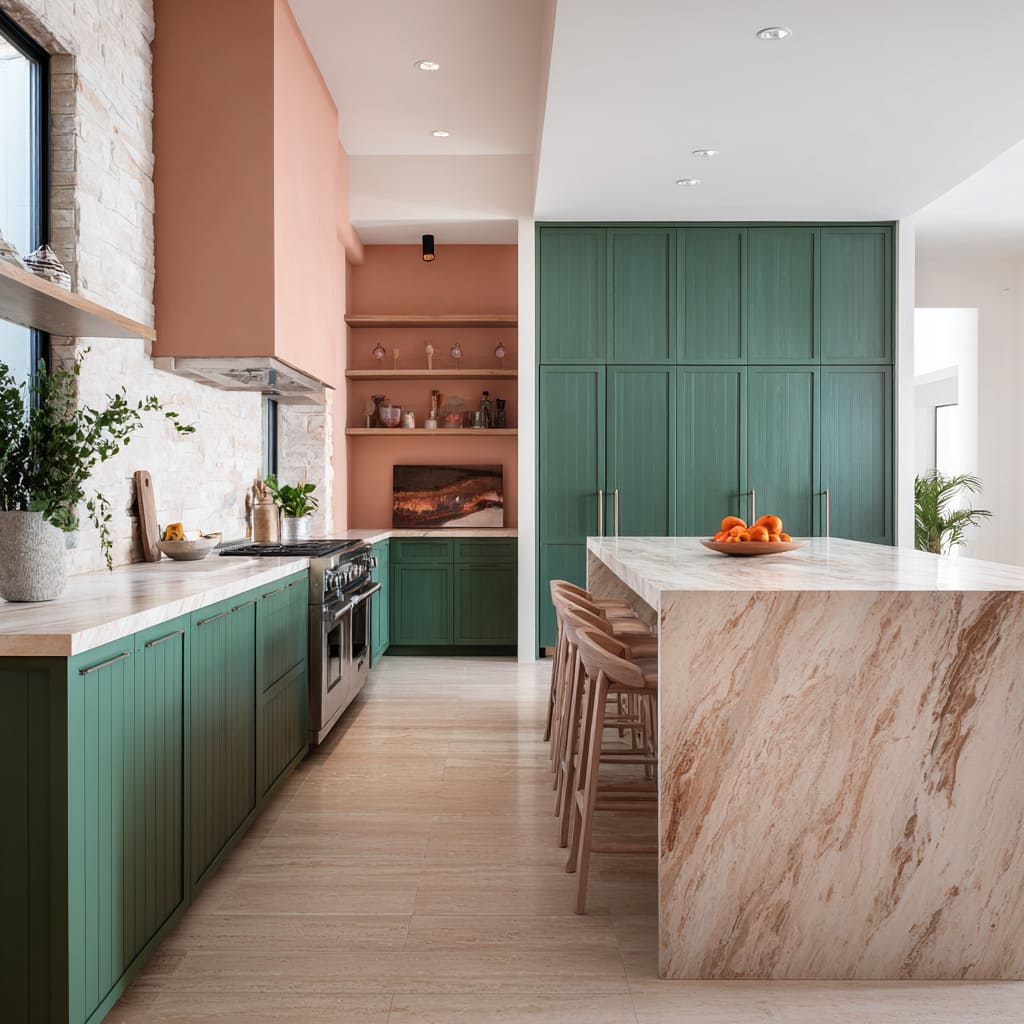
In others, pronounced veining adds movement when floors are quieter. Stone can be used to separate clay’s warmth from green’s coolness; the eye reads terracotta → stone → green as a natural sequence.
This transitional role becomes especially clear in layered compositions where the island seems carved from a warm block, with green cabinetry wrapping around it. Stone also participates in the room’s horizontal banding: floor, green cabinets, stone backsplash, shelving, and upper wall.
Because stone appears at multiple heights, it prevents abrupt color shifts and helps the design feel unified.
Wood as the Neutral Thread Binding Every Height Level
Timber becomes the element that quietly bridges clay and green. It appears in floors at the periphery of clay patches, in thick floating shelves aligned with hood undersides, in stool legs, in island frames, and in ceiling beams.
They often tune wood carefully: pale ash or oak for calm zones, warm honey tones when echoing terracotta veining, and slightly reddish woods when linking clay floors with clay pottery on shelves. Wood rarely pulls attention; it stabilizes the palette by repeating at different heights.
In some kitchens, shelves wrap corners at the same elevation, forming a continuous timber band that aligns multiple surfaces. This horizontal “thread” ties together backsplash, cabinets, and negative space above.
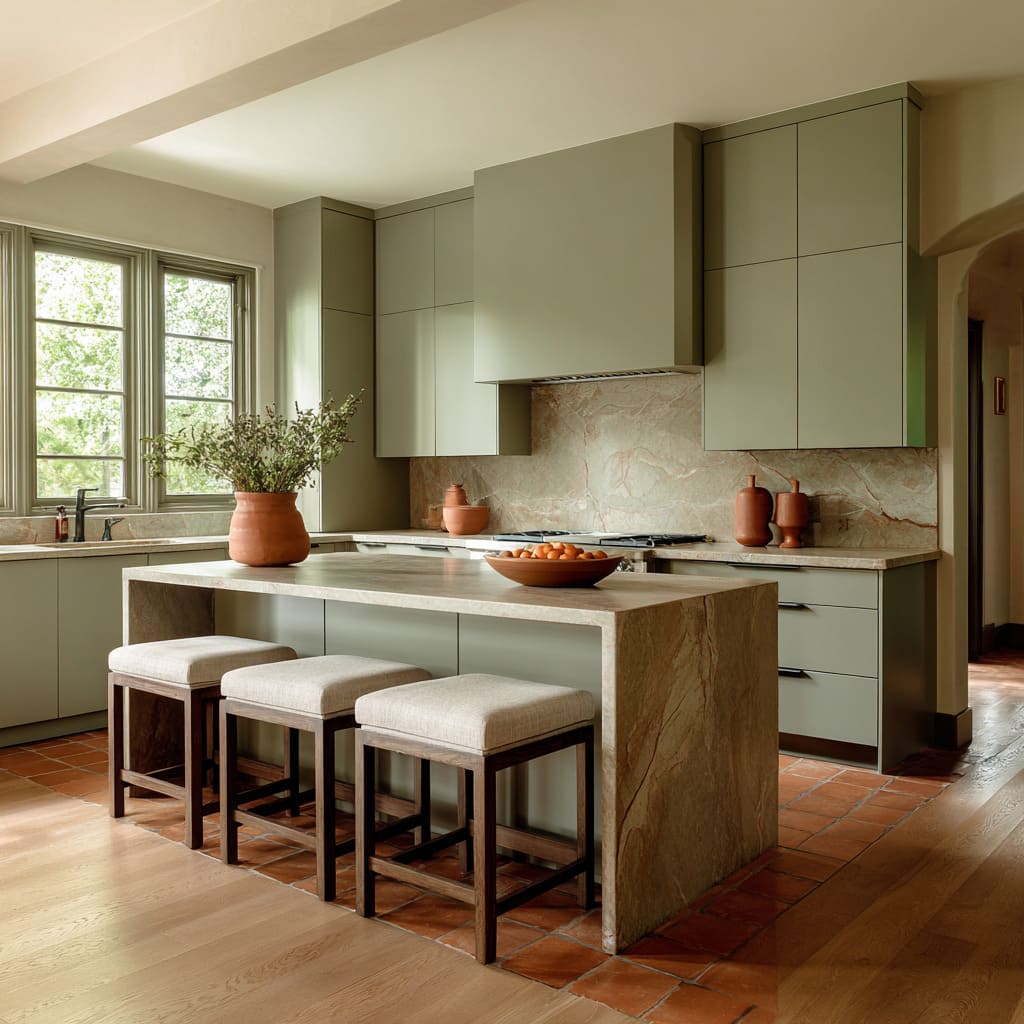
Wood appears in a few key roles:
- As a soft border outlining clay floors in zoning strategies.
- As a massing connection between stone counters and green cabinetry.
- As a warm counterpart to cooler green panels and pale stone.
- As a visual anchor that repeats from stools to beams to shelving.
This consistency gives the entire palette a natural continuity, allowing terracotta and green to interact without competing.
Open Shelving as a Visual Horizon and Storyline
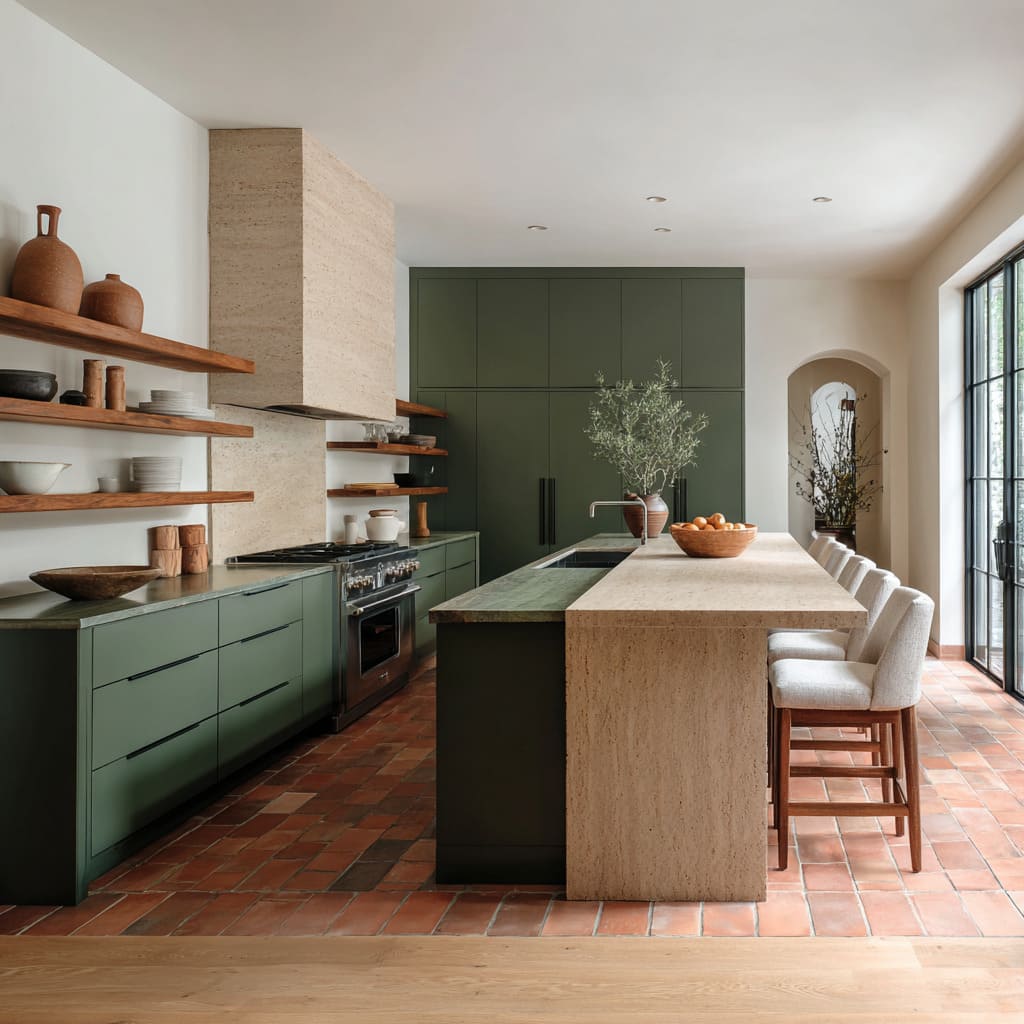
Open shelves anchor many of such designs, acting as a horizon line that organizes the scene. Thick oak shelves often run parallel to beams or align with the bottom of the hood.
They hold carefully spaced objects—groups of bowls, tall jugs, stacks of shallow plates—arranged so each grouping forms a small still life. The spacing is intentional: objects are never crowded, and each silhouette matters.
Clay appears again here in pottery: unglazed vessels, matte terracotta bowls, sandy-toned plates, and muted blush ceramics echo the floor.
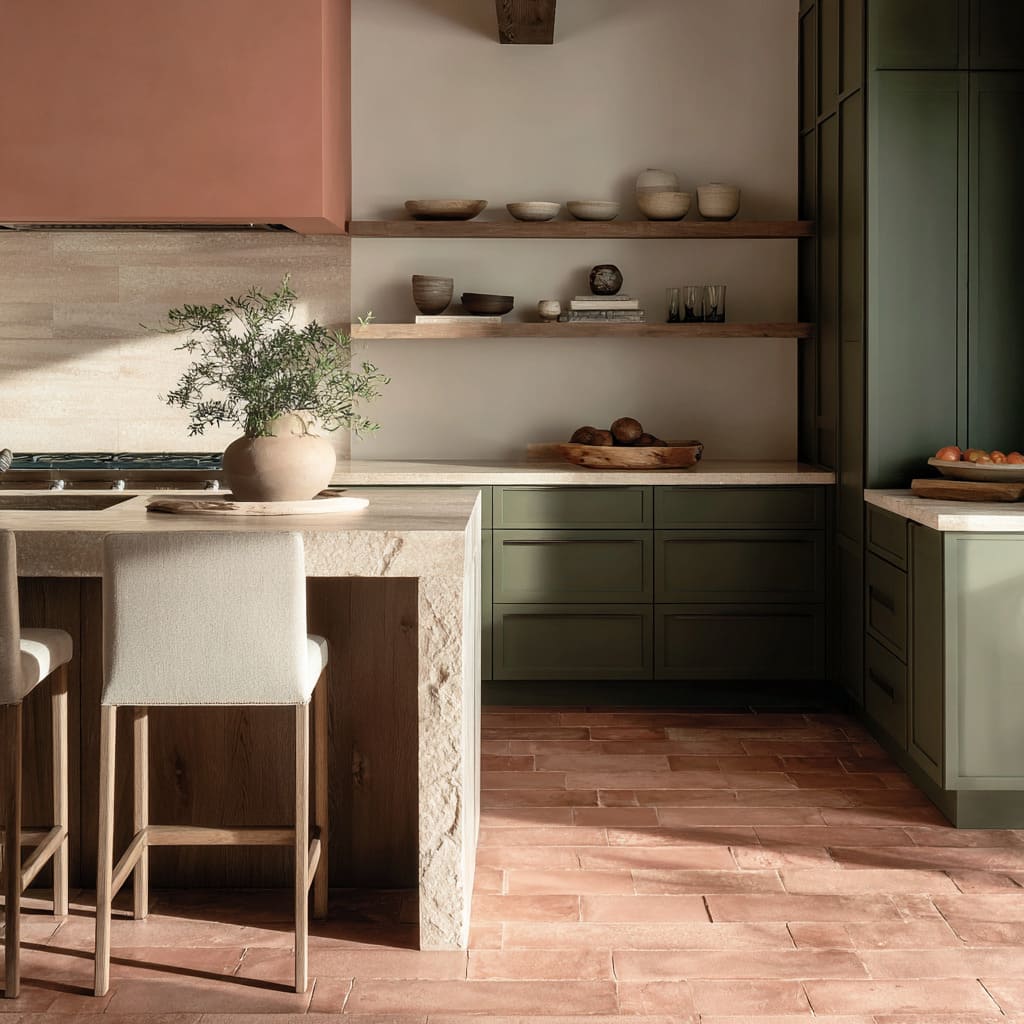
Green returns as foliage: branches displayed in tall clay vases, mint-colored glassware, or small plants that echo cabinet hues. Some shelves show a “gradient” effect: lighter ceramics near windows, deeper clay pieces near solid cabinetry, creating subtle shading.
This band of curated objects stops the eye from wandering aimlessly and gives the composition rhythm. Shelving becomes the point where terracotta, stone, timber, and green meet in miniature, as if the room’s story is retold at eye level through small objects.
Texture, Light, and Surface Behavior
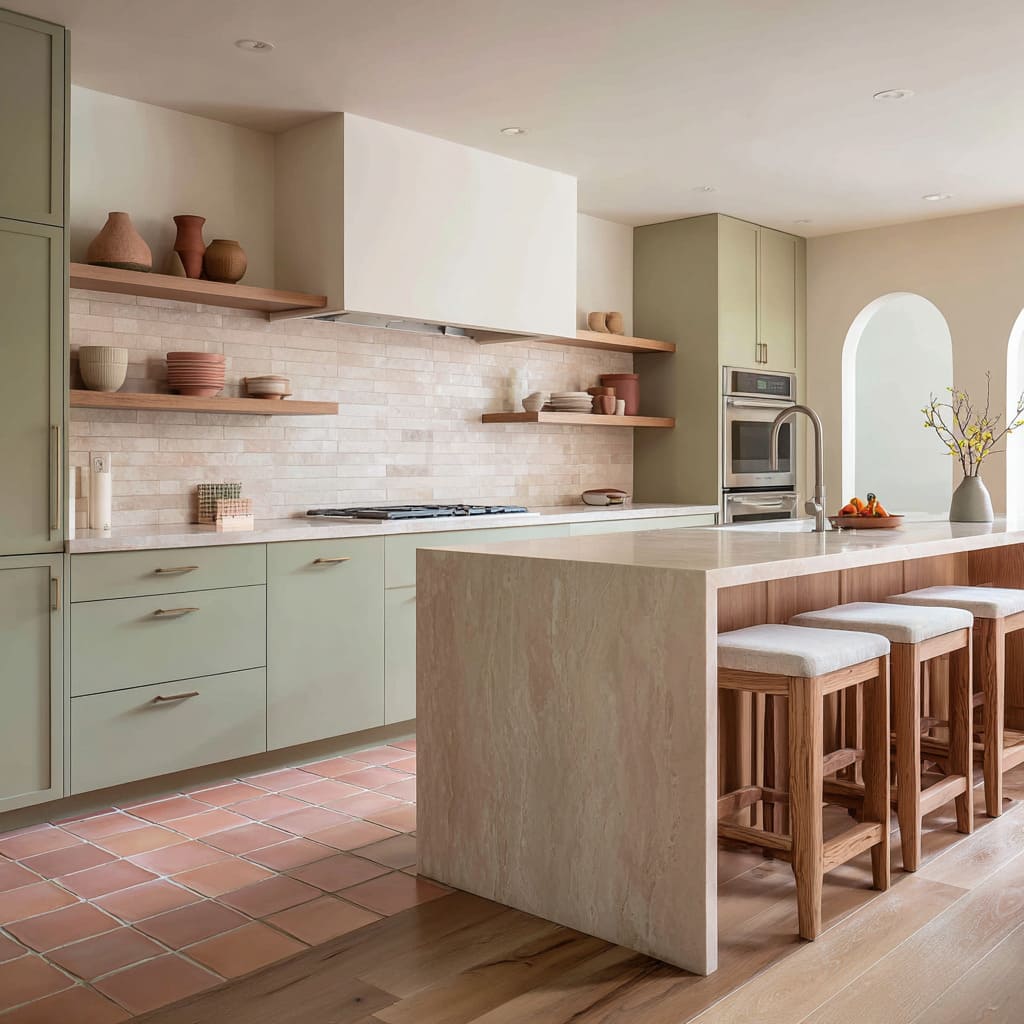
Texture plays a crucial role in shaping how clay and green feel under daylight. Mattes dominate: matte plaster, chalky stone, powder-finished terracotta, and soft paint absorb light gently rather than reflecting it.
Gloss appears only where intentional—on small ceramic pieces or a limited section of vertical clay tiles—so the design stays calm. Ribbed and fluted textures capture light in thin shadows: ribbed terracotta tiles resemble ceramic corduroy; fluted timber hoods create a vertical rhythm; panel grooves in green doors cast gentle shadows that keep large surfaces from looking flat.
Rough island edges can echo the irregularity of handmade terracotta edges, creating a thread of “rough-to-smooth” transitions. These textures add movement without requiring pattern.
Daylight grazing across plaster or clay tiles creates lively streaks, while stone surfaces glow softly under downlights. Light becomes the final medium that ties the palette together, revealing the room’s layered surfaces at different times of day.
Clay and Foliage Color Echoes Through Objects
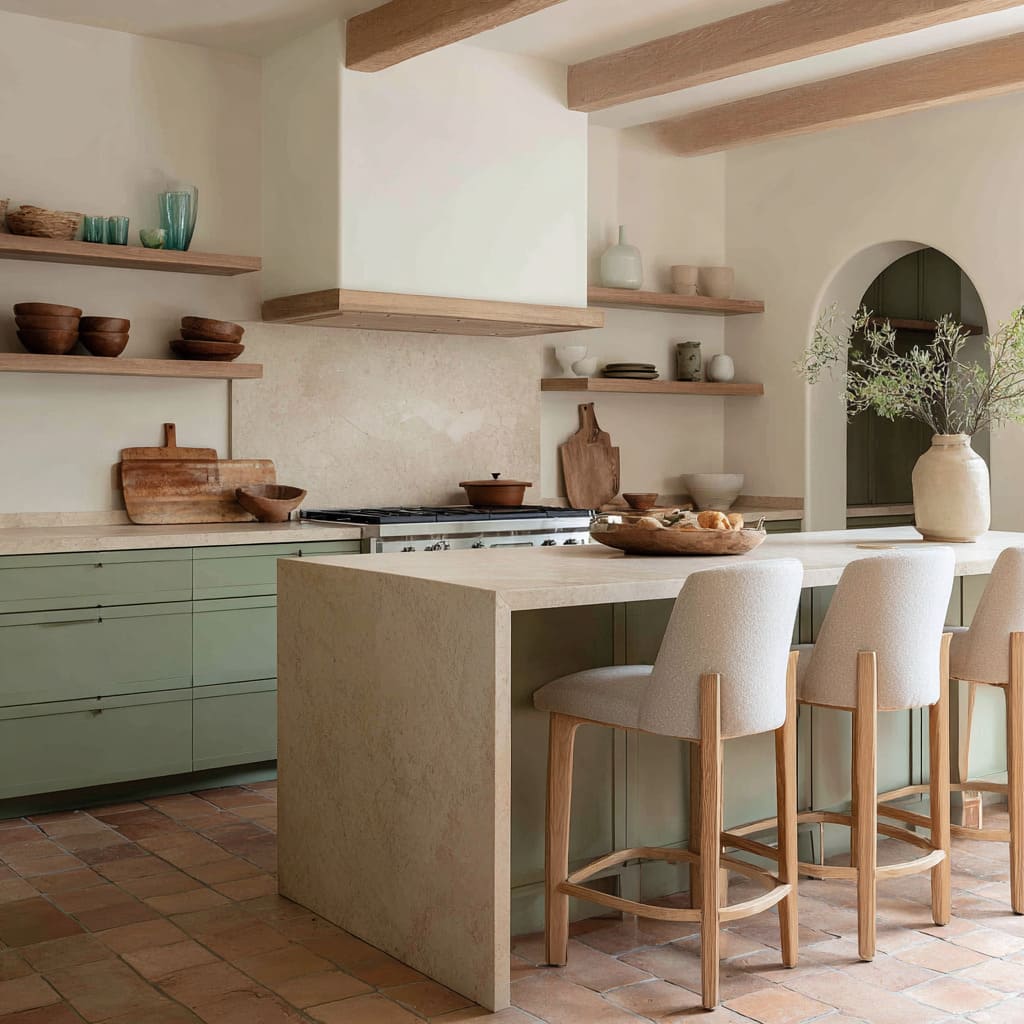
One of strategies is the echoing of core colors—terracotta and green—through selective objects rather than through additional architecture or paint. Clay reappears through pottery, sculptural jugs, stacked terracotta plates, soft-pink ceramics, and low bowls with earthy texture.
These pieces act as elevated versions of the floor color. Green reappears through foliage: tall branches, herbs, citrus leaves, and glimpses of outdoor gardens framed by windows.
Fruit bowls also bridge the palette: oranges, peaches, or sweet potatoes bring saturated clay tones into bright pockets of color; green fruit links the cabinets with plants. Because these accents remain functional and subtle, they avoid overwhelming the palette.
They repeat key hues in small doses, reinforcing the warm-soil-and-soft-foliage theme without heavy-handed decoration. This dual echo—clay in objects, green in foliage—creates layered harmony and helps the palette feel genuinely grounded rather than staged.
Pathways, Carpets, and Zoned Functionality
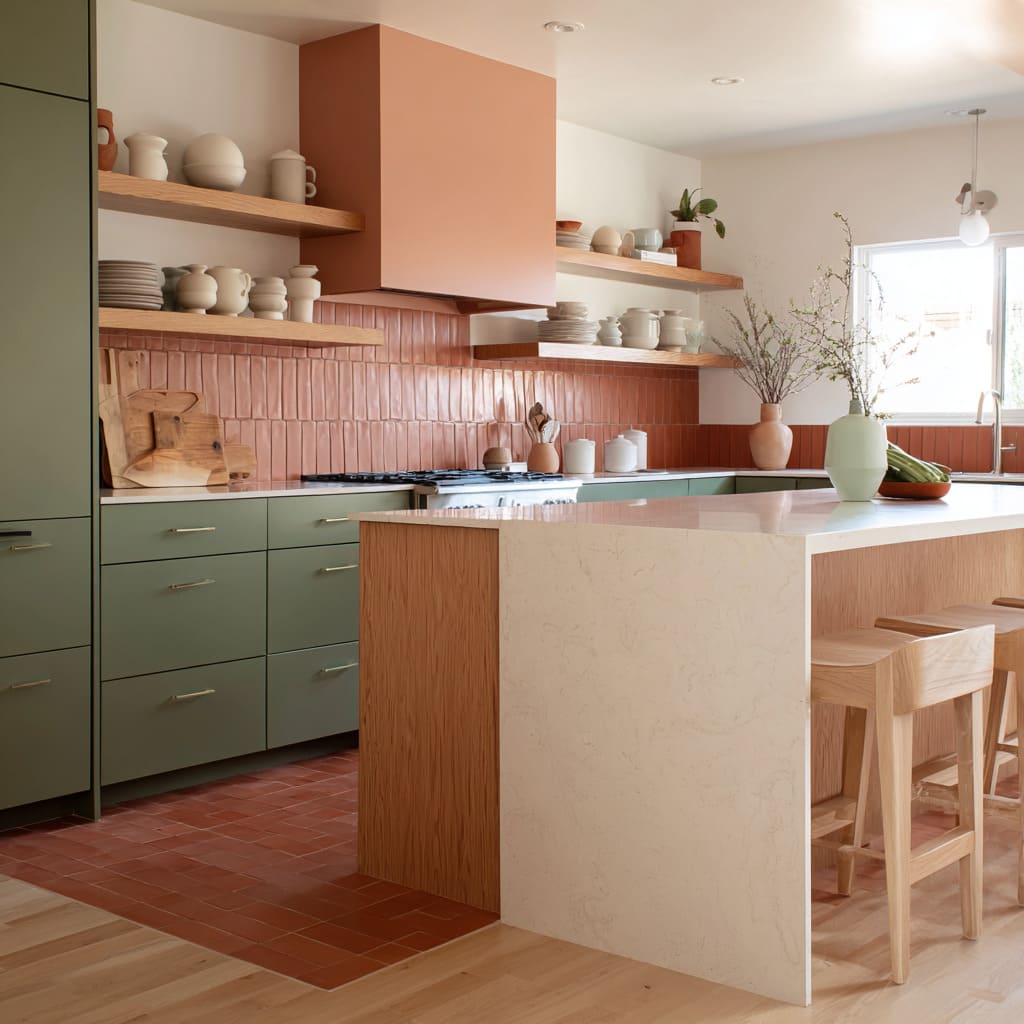
One subtle but recurring theme is how terracotta acts as a spatial map. Many layouts use clay tiles to mark the active zone around the cooktop or the working side of the island.
The result resembles a built-in stage for food preparation.
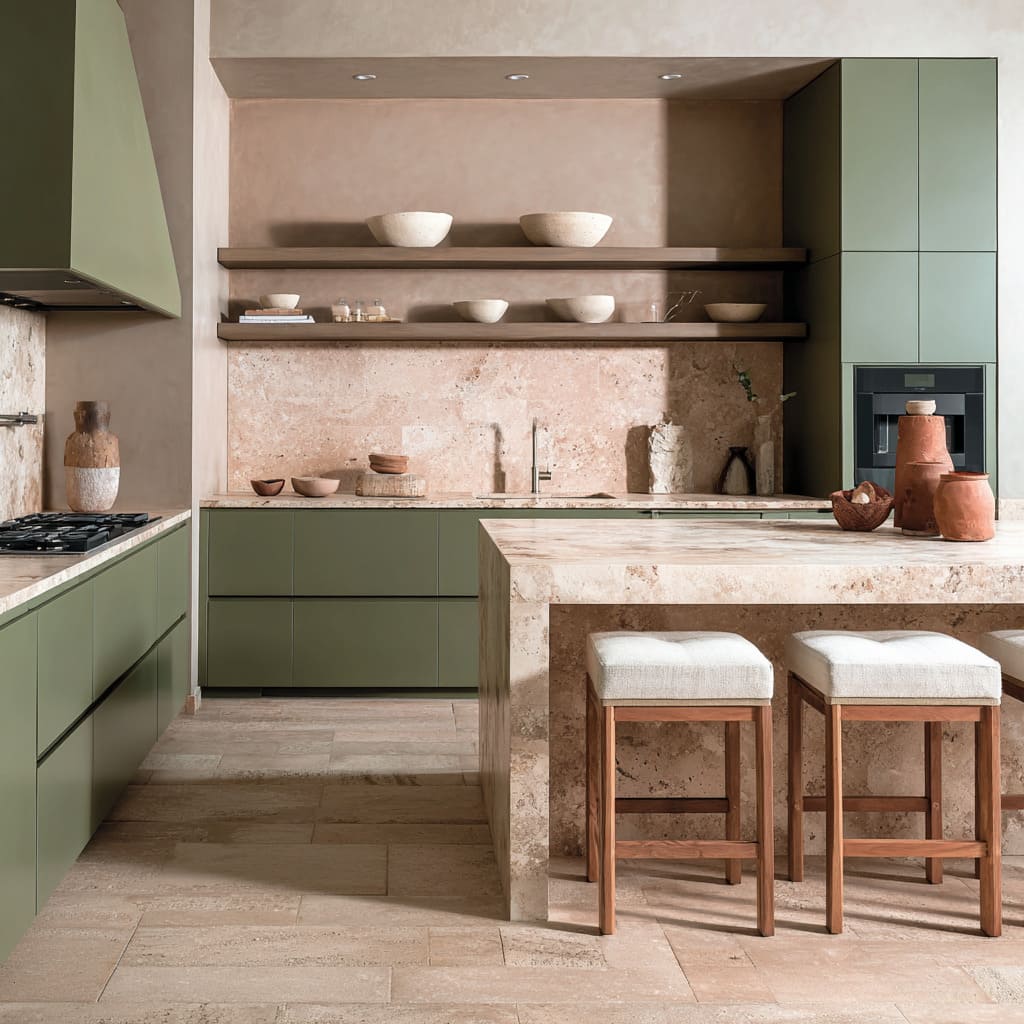
Three zoning approaches stand out:
• Full clay field.
It can be in compositions where the entire design becomes a warm courtyard-like space.
• Clay “carpet” insert.
Placed beneath islands, forming a visual anchor for the main workspace.
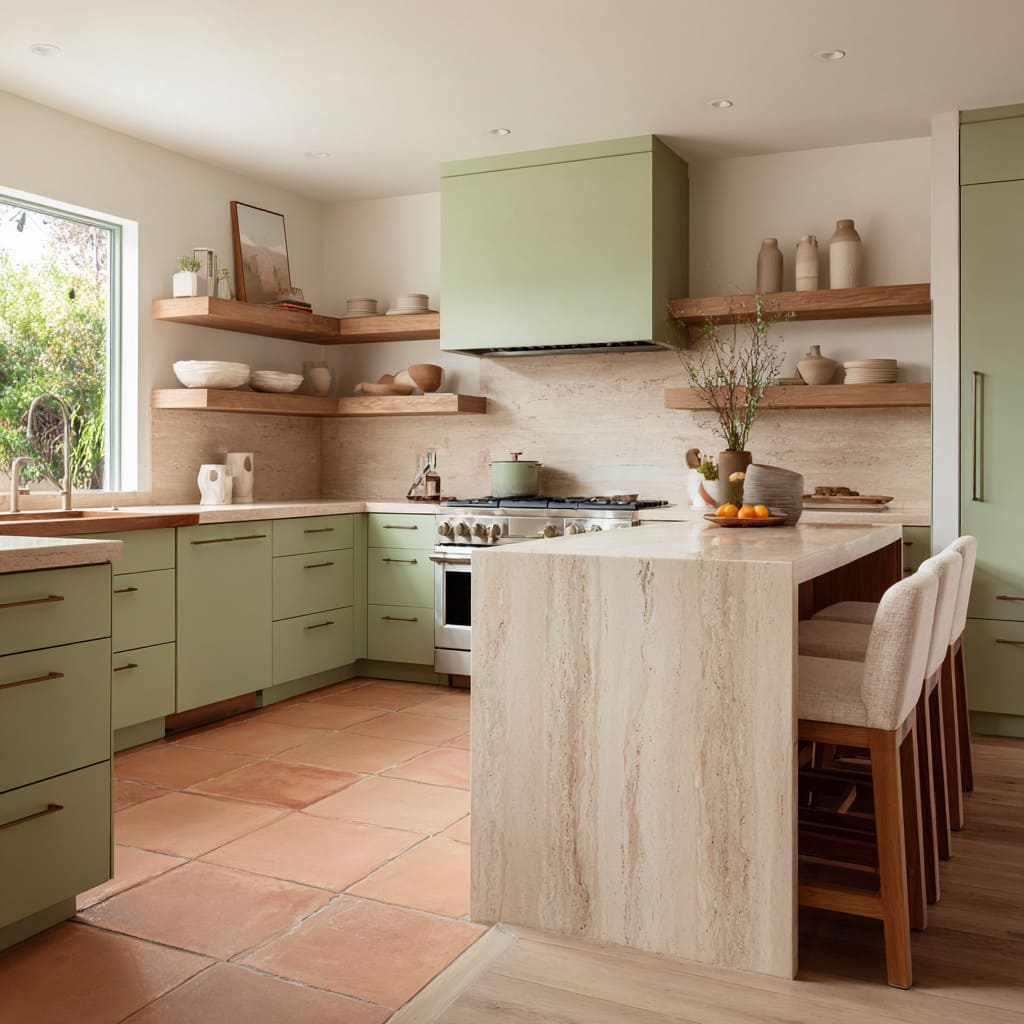
• Clay path or corridor.
A long terracotta run from entry to the back wall narrows the perspective and guides the eye forward.
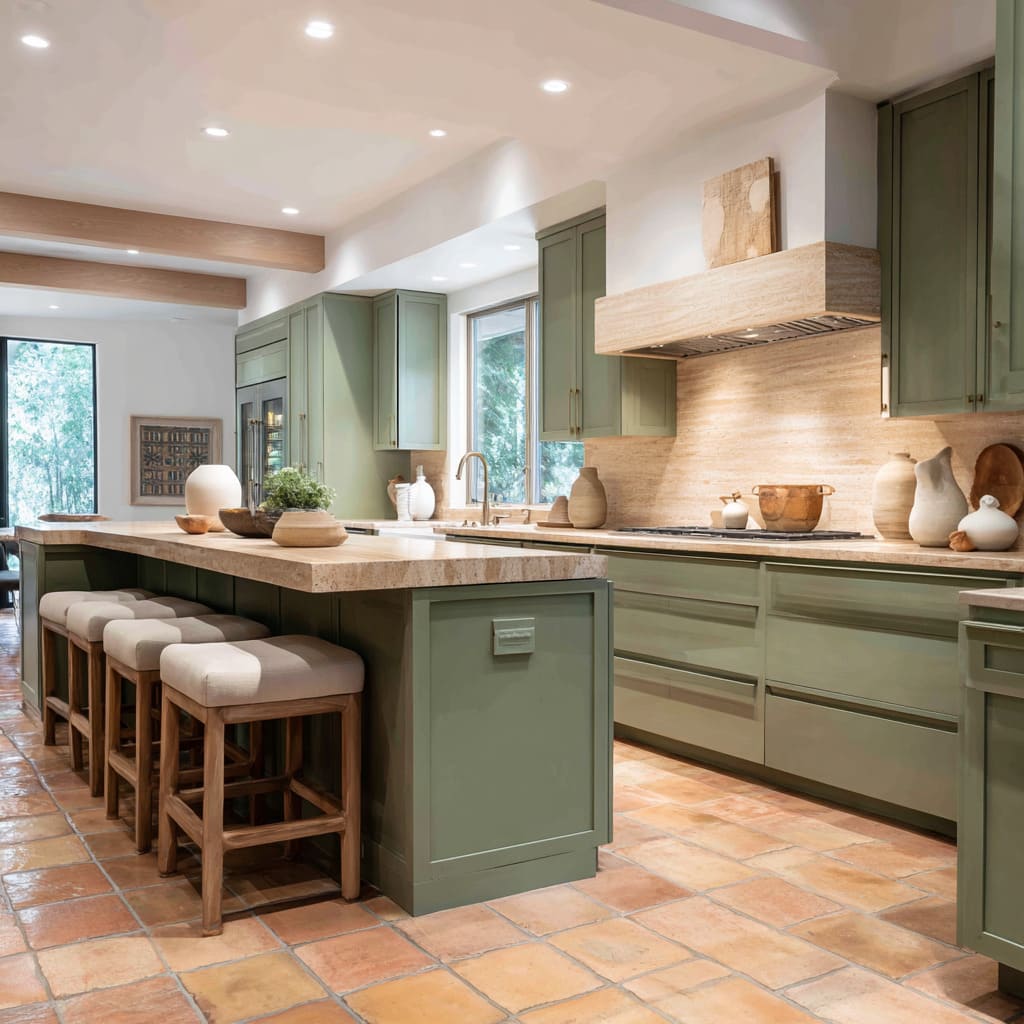
This mapping technique quietly directs movement and indicates where activity naturally takes place. It also gives the green cabinetry a stable partner; the cabinets appear to “grow from” the clay ground, especially in deeper tinted greens.
In such cases, the palette reads as a calm evolution of terracotta and green kitchen ideas, where the floor and cabinets share an organic relationship. The division between clay zones and timber perimeter zones amplifies this effect: wood feels social and relaxed, clay feels grounded and task-focused.
Large-Scale Green Masses as Architectural Elements
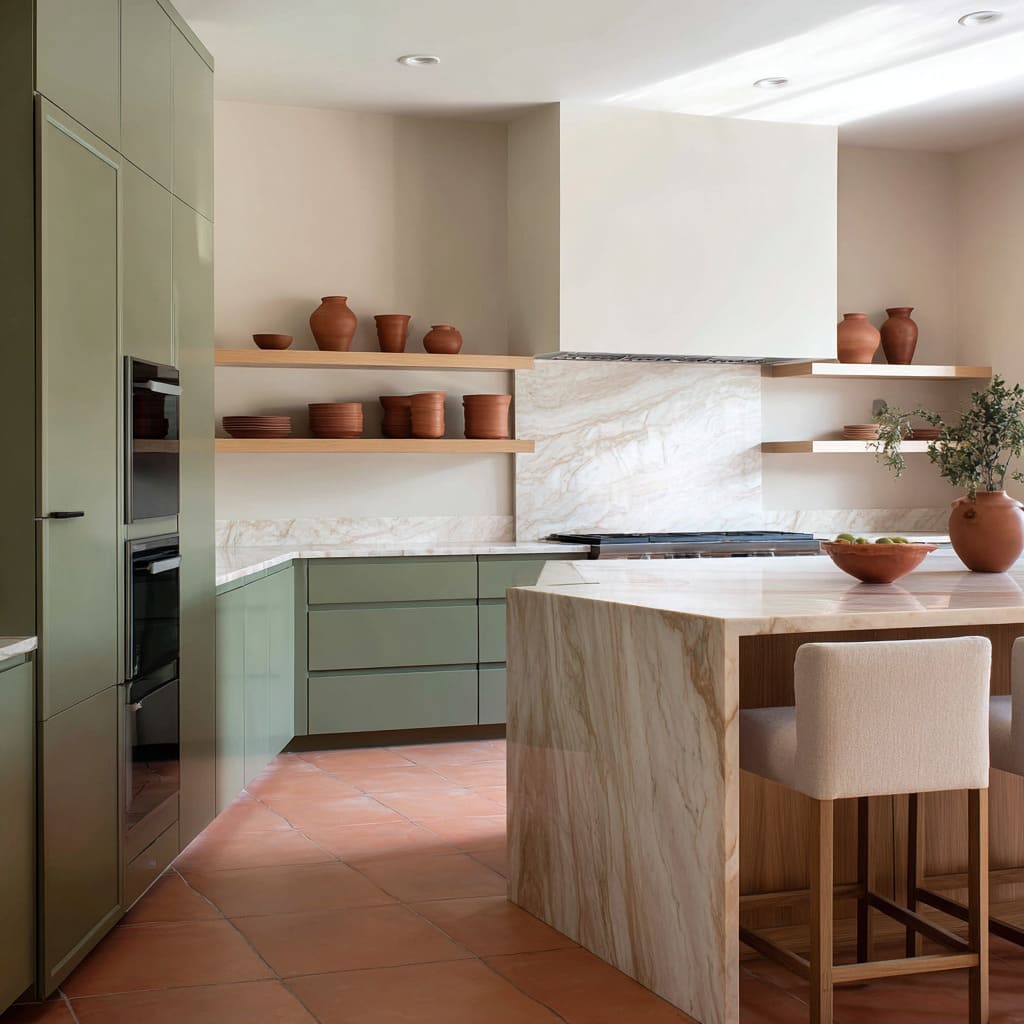
Green cabinetry often forms bold masses that sit above the clay floor like constructed volumes rather than decorative furniture. Tall storage walls in pine or hunter green read like panels rather than cupboards, especially when their hardware is minimized or aligned in strict vertical or horizontal sequences.
Integrated fridges appear as uninterrupted color planes.
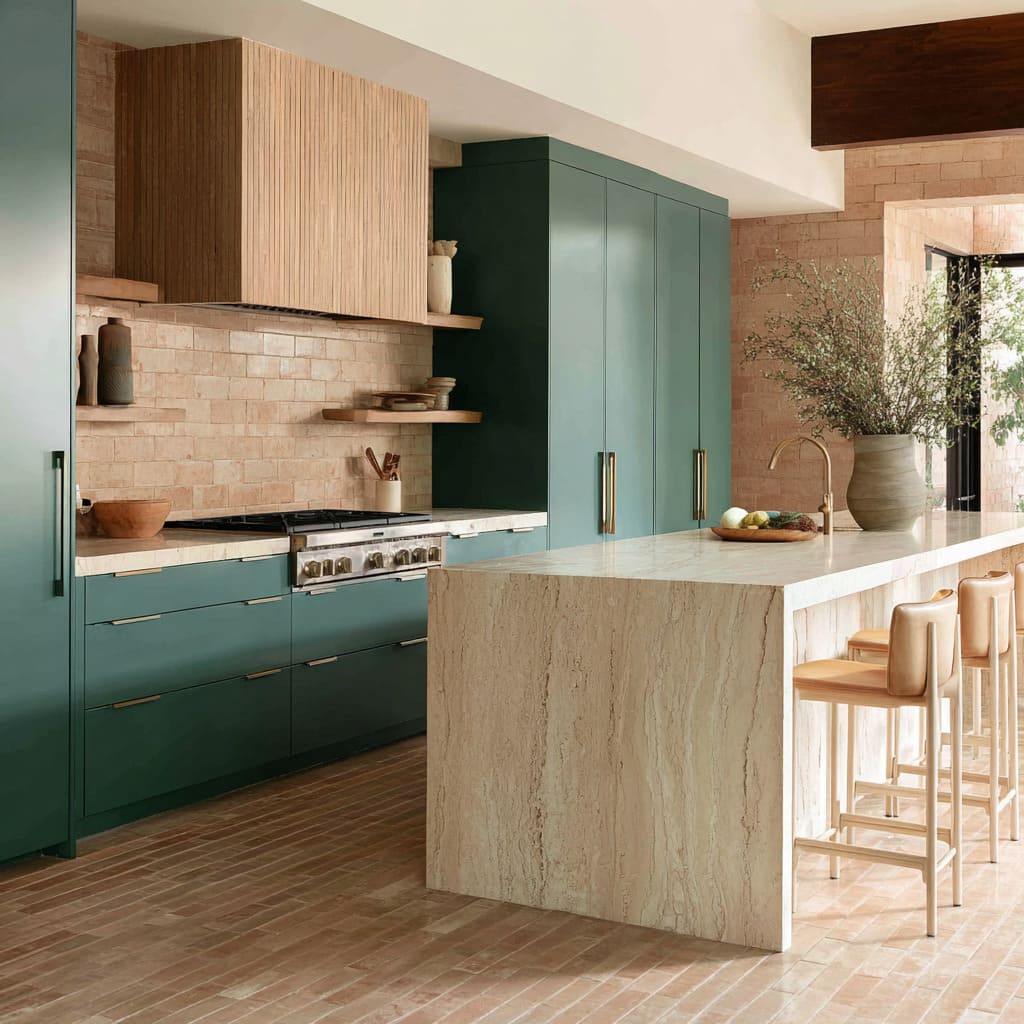
These green masses serve several purposes:
- They counterbalance the warm ground with cool structure.
- They draw the eye upward, expanding perceived height.
- They act as visual “walls” that complement stone islands or clay inserts.
In designs where terracotta appears in narrow formats, the tall green cabinetry makes the clay feel even more tactile by contrast. In designs where clay covers larger areas, the green cabinetry becomes more subdued, almost blending into foliage seen outdoors.
This volatility—green either as anchor or as backdrop—makes it a versatile partner to terracotta. The palette can tilt earthy, refined, urban, calm, or sculptural depending on how green is massed, shaped, and lit.
The Shared Identity of Clay and Foliage Tones
When all these elements combine—clay underfoot, stone as mediator, green cabinetry as structure, wood as thread, and curated objects as echoes—the design takes on a layered, atmospheric identity. Terracotta becomes the mineral component, grounding the space with warmth, softness, and natural irregularity.
Green becomes the foliage component, offering shade-like calm or deep structural presence depending on tone.
Stone binds them, wood connects them, and light animates them. This combination forms the broader world of green and terracotta kitchen ideas, where the palette behaves as both indoor architecture and outdoor reference.
It allows clay to act as soil, green to act as leaves, and neutral surfaces to act as air and daylight within the design. The resulting kitchen designs feel quietly composed, rich in material nuance, and deeply rooted in a natural palette that carries a sense of familiarity and refinement at the same time.
Related Posts
Harmony Home Design brings 10+ years of residential interior design experience to the ideas shared here. We publish design concepts, layout thinking, and practical styling notes.