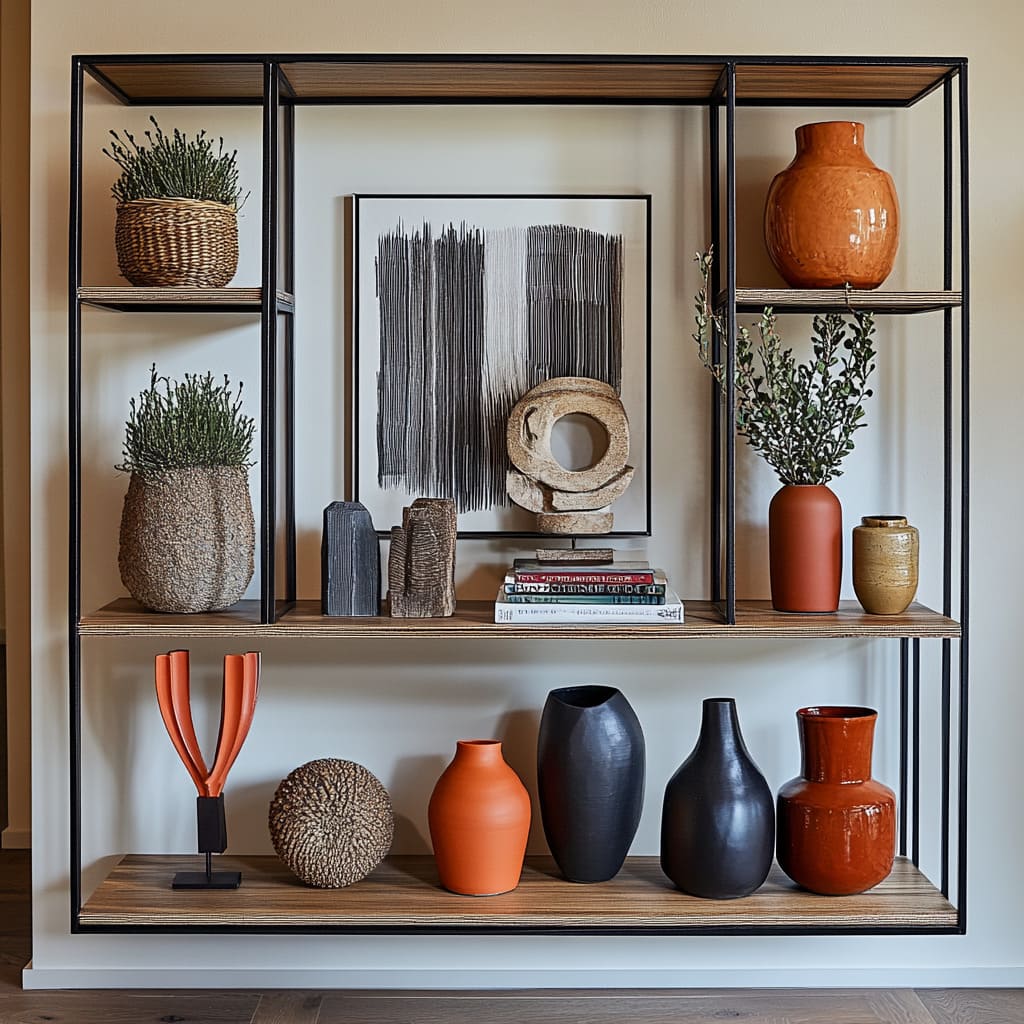
Decorative wall shelves can feel like small emotional portraits rather than ordinary storage. The key lies in how everyday objects, natural textures, and quiet asymmetries build a mood that carries through the entire sitting area.
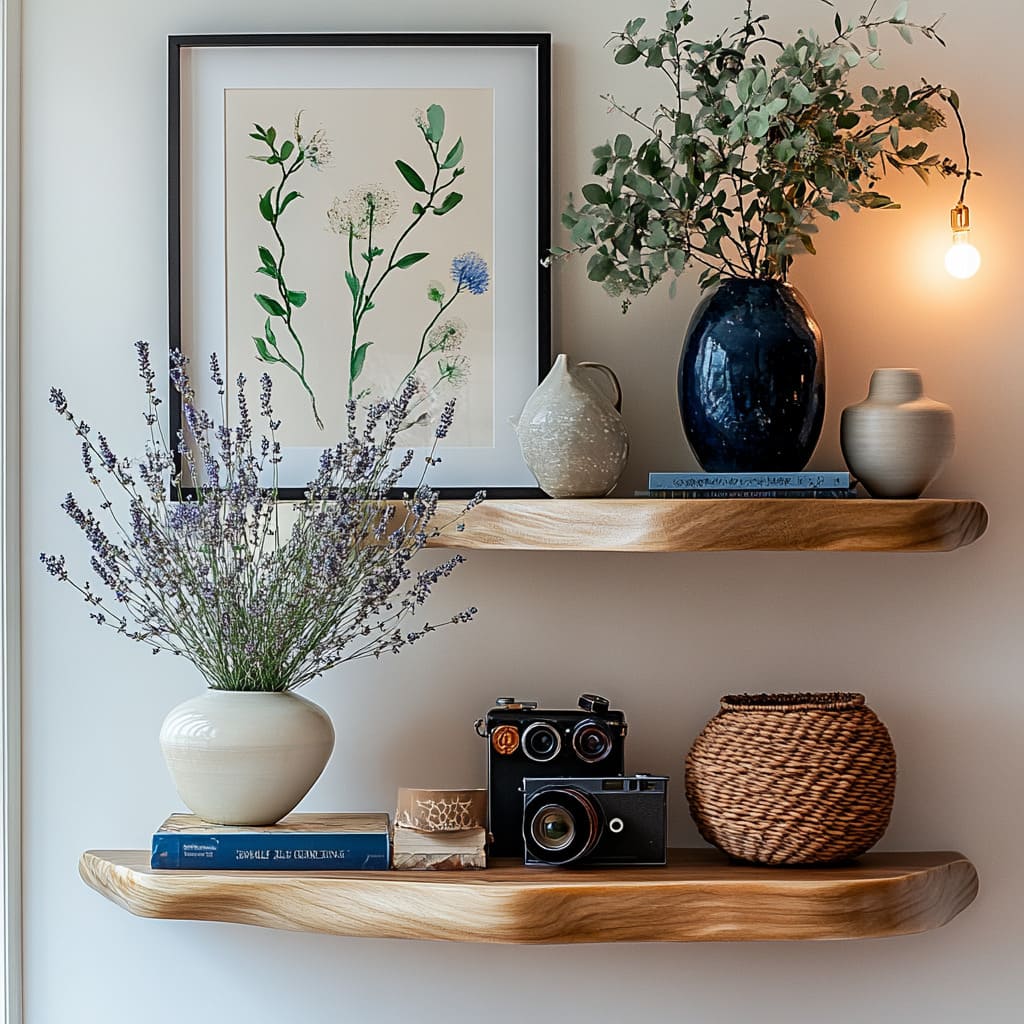
Instead of thinking of a shelf as a flat board on a wall, this perspective treats it as a soft stage where relationships between framed art, ceramics, plants, and personal pieces form a gentle rhythm. One of the most nuanced aspects is how a single leaning artwork can shift the entire emotional tone: a botanical drawing, for example, behaves like a quiet anchor that links the flat image world with the real stems and foliage placed nearby.
When dried lavender or eucalyptus stretches upward, its loose shape softens the cleaner geometry around it, echoing the lines in the artwork without repeating them exactly. The effect is a layered field of visual poetry, where nostalgia is embedded in textures—worn book spines, woven baskets, brushed ceramics—and not in obvious themed decorations.
These arrangements often express a thoughtful mix of muted blues, parchment tones, matte whites, and natural wood grains, which makes the composition feel intimate and familiar without depending on any bright color block. This gentle staging is a strong foundation for wall shelf ideas that feel personal without looking cluttered.
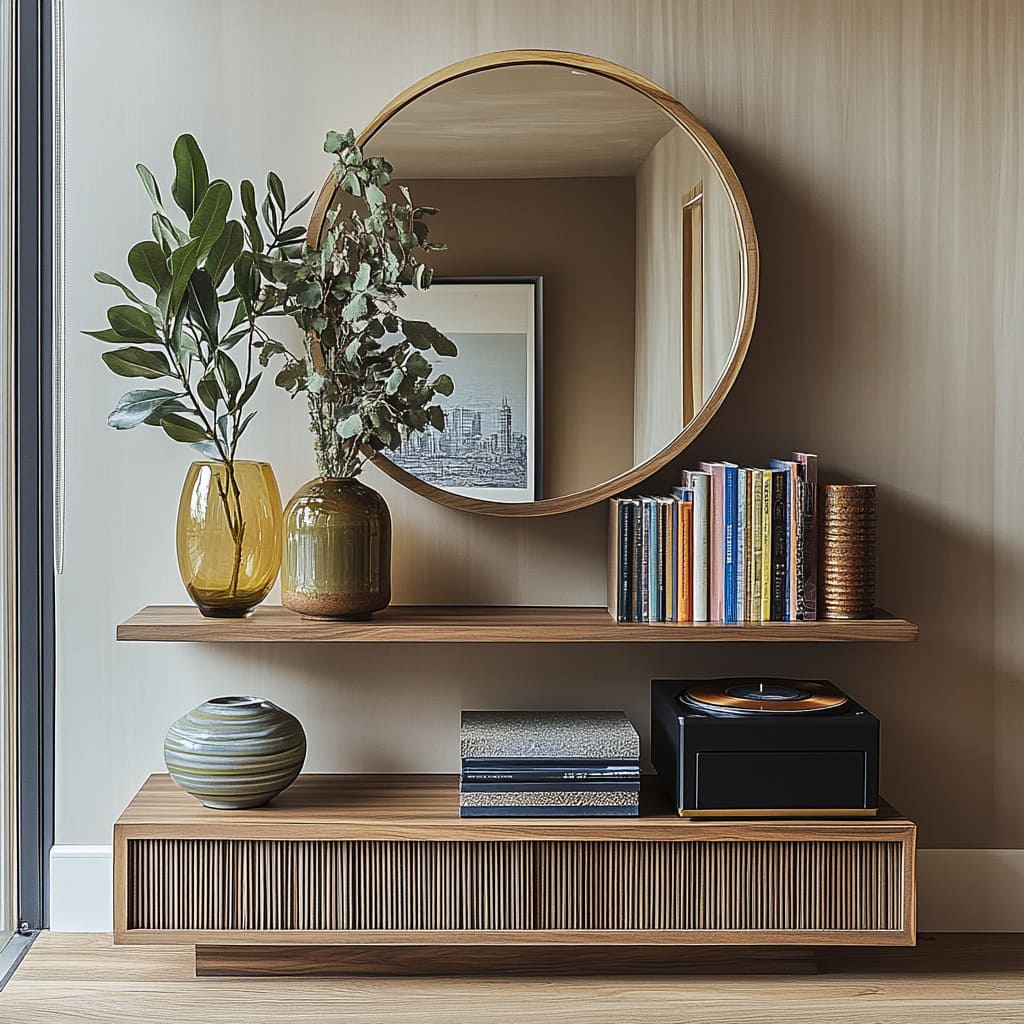
Calm and Intellectual Charm: Books, Music, Art
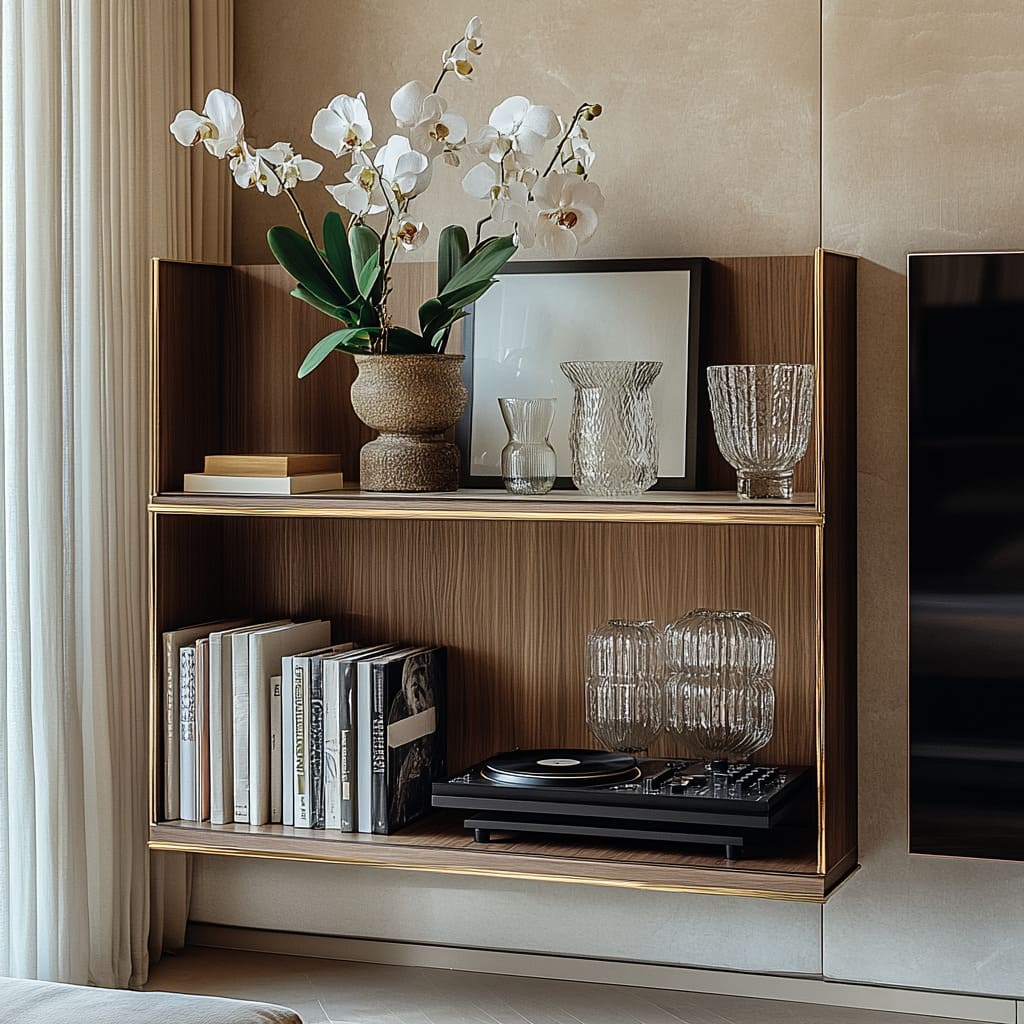
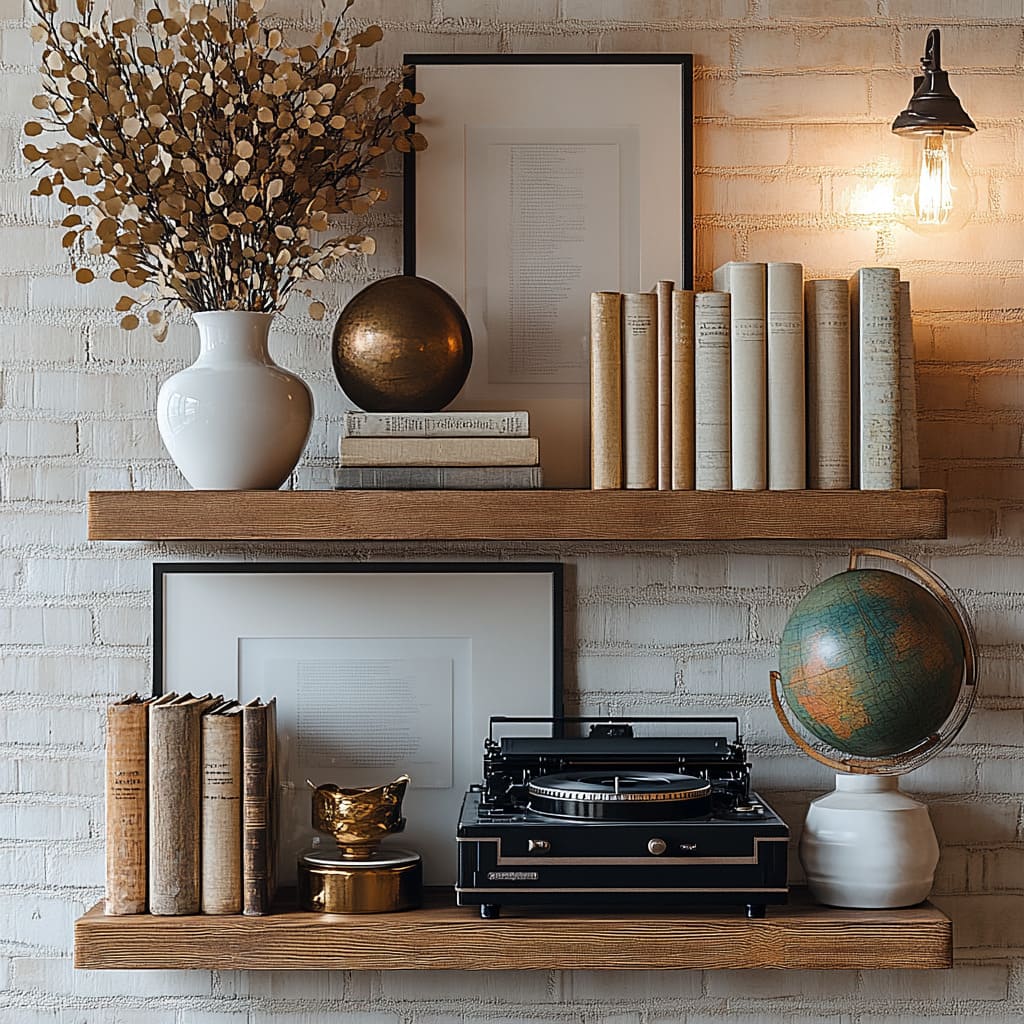
When shelves begin to carry books, record players, text-based artwork, and small globes, they shift into a completely different visual character—one that reads as calm, thoughtful, and quietly cultured. Instead of loud typography or themed “study” decor, these arrangements rely on the natural elegance of aged spines, creamy paper hues, and simple frames leaning behind the objects.
Even the framing of text matters: faint writing behind glass, partial paragraphs, or poems tucked behind vases create the impression of private reflection rather than display. A record player can introduce an important visual element.
Its round platter creates the only strong circular form among a landscape of rectangles, adding soft graphic rhythm without needing bright color. The musical presence hints at movement even when the space is silent.
Layering also plays a major role. As objects overlap—books in the back, brass pieces in front, a globe to one side—each creates a subtle hierarchy that feels balanced and purposeful.
This type of styling connects closely to shelves in living room ideas that emphasize culture over ornament, using a restricted palette of parchment hues, aged leather tones, brushed brass, and soft shadows to build an environment that feels intellectual yet relaxed.
How the intellectual mood forms
- Horizontal books create low-weight anchors.
- Vertical books act as visual pillars.
- Metallic vessels add soft highlights.
- Framed text deepens the wall without overwhelming color.
Together, these elements create a refined sense of presence, as if the shelves are gently holding a lifetime of quiet fascinations.
Geometry: Grids, Circles, and Rhythmic Lines
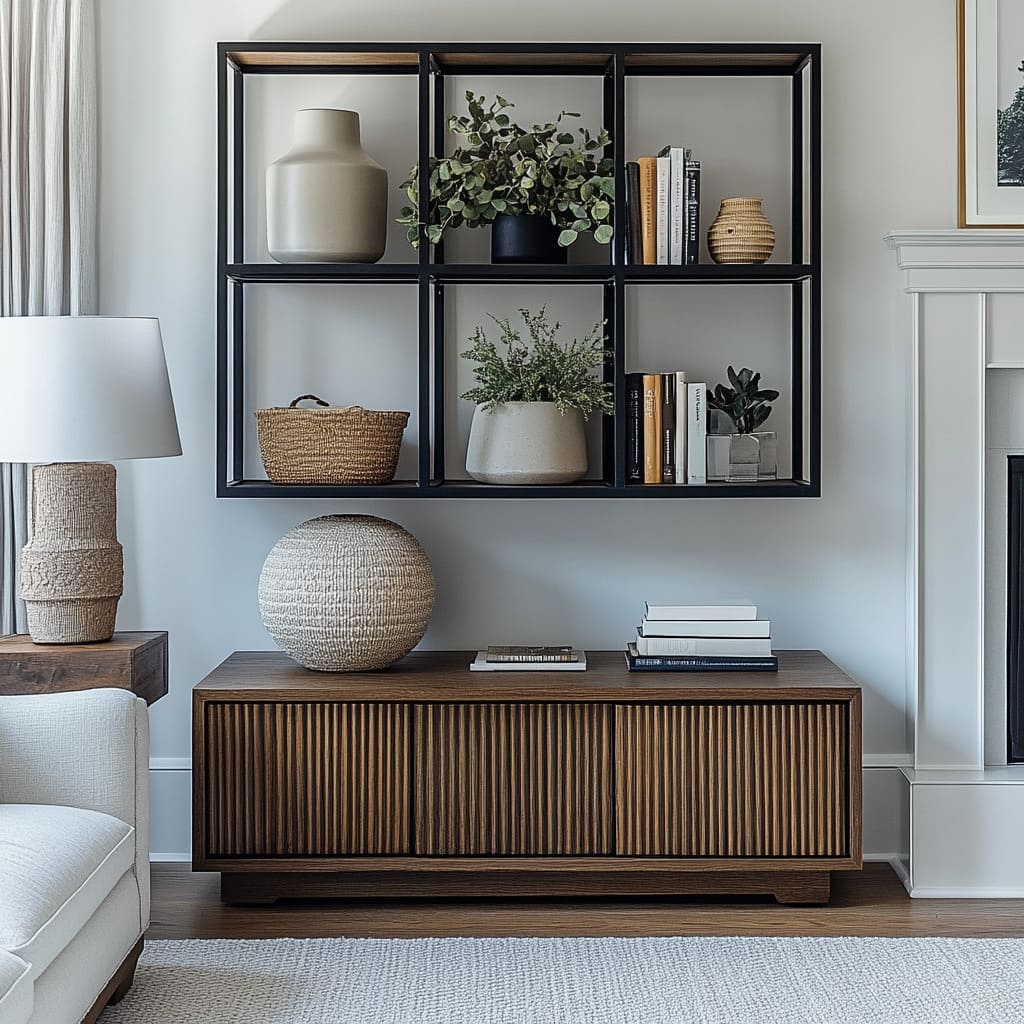
Some shelf design structures introduce their own architectural presence long before any objects are added. Black metal grids, slatted wood cabinets, and circular shelving frames have a strong visual identity that shapes the arrangement inside them.
In grid compositions, the equal-sized cubbies work like tiny rooms—each one carrying its own vignette, but all tied into a shared rhythm. The most interesting detail is that these grids never allow two neighboring cubbies to behave exactly the same; a large sculptural vase might sit alone in one compartment, while a plant spills over the edge of another, and a small stack of books fills a third.
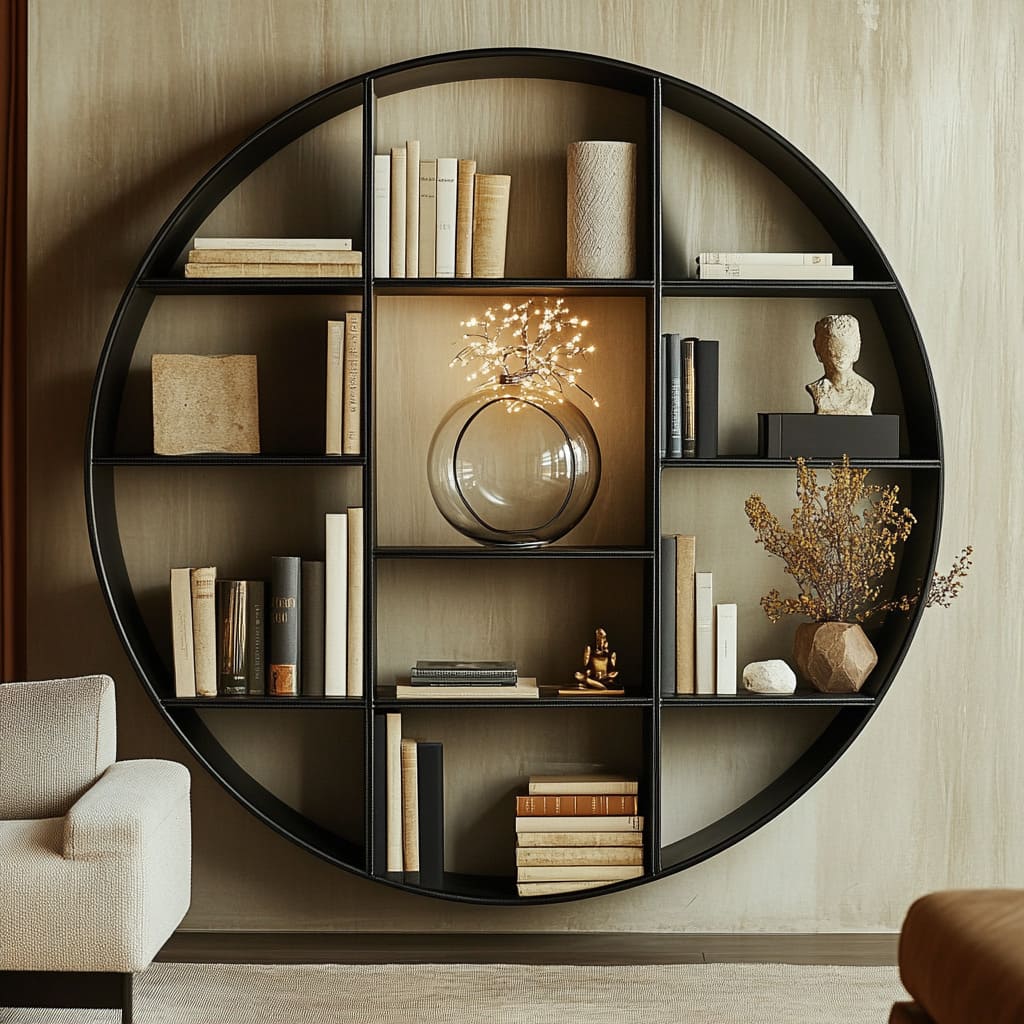
This alternation prevents visual stiffness and creates a pulse across the wall. In circular shelf systems, the outer curve becomes a soft boundary holding more angular compartments inside.
This contrast between round enclosure and straight dividers produces a calm sense of containment that feels both modern and timeless. At the center, a glowing glass vessel or softly lit botanical element often becomes the emotional heart of the structure, turning the shelving into a quiet focal point.
These formations naturally support decorating ideas with shelves where the aim is more about atmosphere than accents, using the shelf’s geometry as the primary design language and allowing the objects to whisper their presence rather than compete.
Elements that keep structured shelves from feeling rigid
- Plants with loose silhouettes that break straight lines
- Wicker or rattan textures that soften dark frames
- Negative space used as a deliberate design element
- Repeated tones rather than repeated shapes
Through this balance, structured shelving becomes both a functional surface and a graphic feature.
How Color, Transparency, and Texture Build Coherence
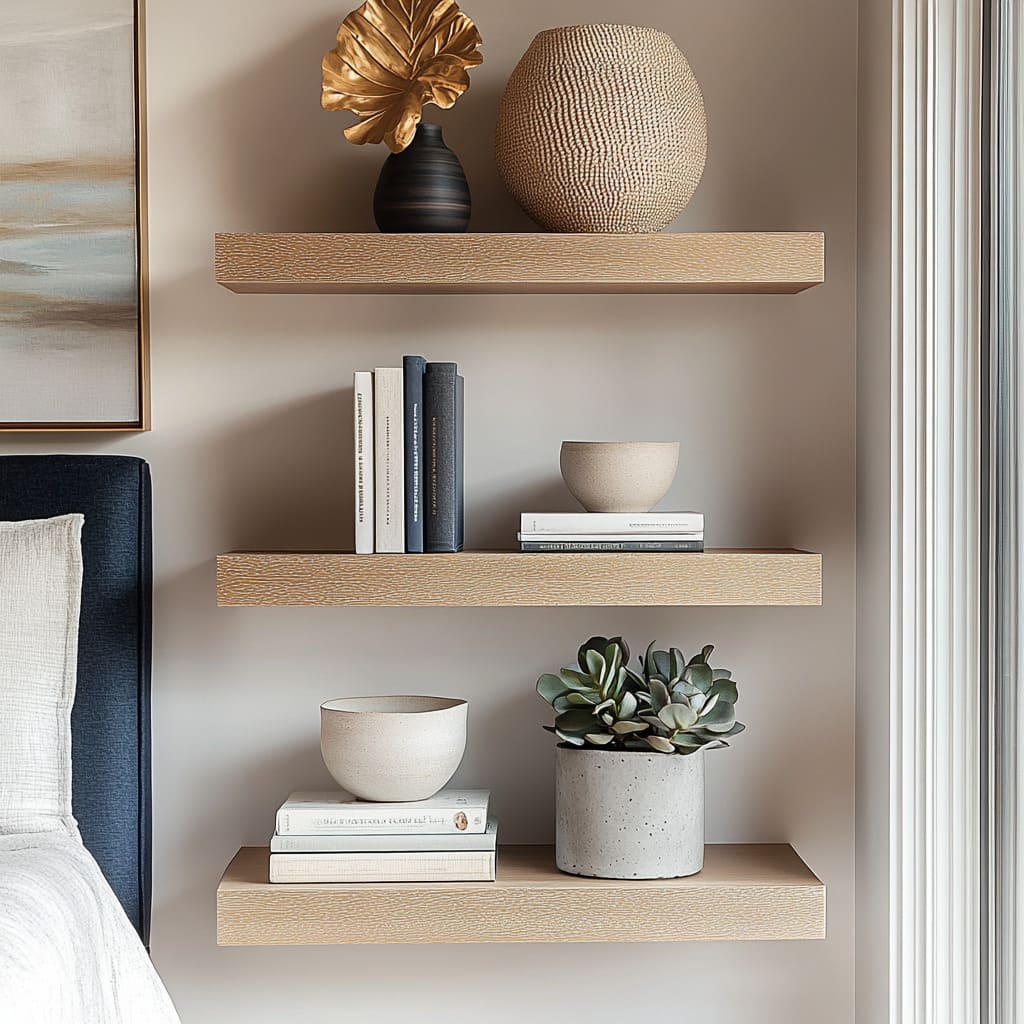
One of the clearest lessons across all the compositions is that large color areas are almost never used. Instead, color appears as tiny, repeated notes scattered across different shelves—one navy vase, a few bluish book spines, a small ceramic detail, a touch of muted green in foliage.
These small echoes act like threads stitching the arrangement together. The same is true for warmer tones: golden branches, a brass orb, soft parchment books, and pale ceramics form an understated glow that doesn’t dominate the space.
Transparency is another tool used in subtle ways. Cut-glass vessels, clear jars, and smooth globes provide small flashes of light reflection that make the surface feel alive without becoming flashy.
The most advanced detail is how solidity and transparency alternate: a heavy stone pot for orchids sits next to faceted glass; a matte ceramic vase sits near a reflective brass bowl. This interplay creates perceived depth even when the shelves are physically shallow.
Such combinations shape shelf ideas for walls that feel rich yet restrained, relying on surface qualities and quiet light behavior rather than heavy decoration.
Texture layers observed across compositions
- Rough backgrounds: whitewashed brick, soft plaster, visible grain
- Medium textures: matte ceramics, woven baskets, brushed metal
- Smooth surfaces: glass, polished metal accents, glossy glazes
- Soft organic textures: dried florals, natural branches, leafy plants
These texture layers make the arrangements feel dimensional, tactile, and visually engaging even within a neutral palette.
Power of Intentional Asymmetry
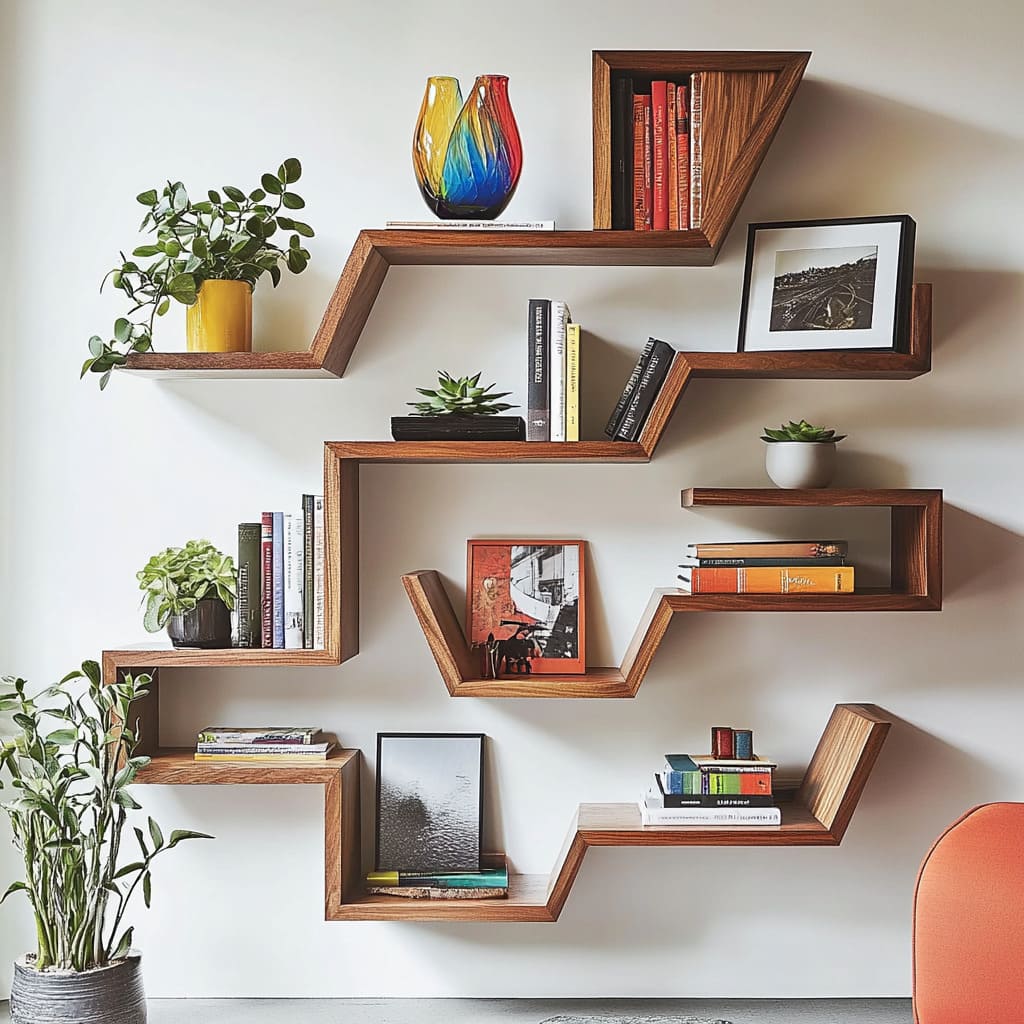
The zigzag shelving design demonstrates how movement can exist in a completely static object. Unlike straight boards or grid systems, the zigzag structure behaves almost like a drawn line with intentional pauses and sudden shifts.
Each angle becomes a natural stage for an object: a bold glass vase where the line bends, a plant where the shelf length extends, or a framed photo angled within a corner. The genius of this arrangement lies in its color discipline.
Strong reds, yellows, and blues appear only where the geometry changes direction, guiding the eye along the zigzag path. Lower sections become calmer, with neutral books and minimal artwork, creating a soft descent of energy.
This approach works not as a pattern but as a rhythm—lively near the top, steady near the bottom—similar to a visual score. It connects easily to shelving ideas for a sitting room where personality comes from controlled playfulness rather than strict uniformity.
Organic pieces like succulents and round pots cushion the sharper lines, preventing the structure from feeling aggressive. This allows the shelf to feel expressive without overwhelming the room design.
How movement is built
- Color repeated at the angles creates a pathway for the eye
- Plants soften the zigzag into a friendlier shape
- Empty spaces at the bottom balance the density at the top
- A mix of upright and horizontal books adds small directional cues
Together, these choices produce a wall installation that behaves almost like artwork.
Role of “Breathing Space” in Modern Shelf Styling
Empty space can be treated with the same respect as objects. Instead of filling every inch, designers leave strategic gaps that allow each item to hold its own quiet presence.
A single ceramic vessel placed in a large cubby feels important because there is nothing else to compete with it. An open area near the corner of a floating shelf prevents the arrangement from collapsing visually toward the ends.
Leaning frames create gentle shadows and give smaller objects a boundary to speak against. Even light is used with intention: an exposed bulb spilling warm light across the shelf introduces a soft glow that lands on metal accents, plant leaves, and wood edges in small, meaningful ways.
This entire approach shapes decorative wall shelves for living room design that are calm, airy, and visually generous. The result is not minimalism in the strict sense, but thoughtful spaciousness—letting each object breathe so its texture, color, and silhouette can be fully appreciated.
Personality Through Placement
A final perspective connects all into a broader understanding of styling. Storytelling on shelves does not come from themed décor or obvious signs; it emerges naturally from the relationships between objects.
For example, a camera near old books suggests memory and observation. A globe near a text artwork hints at curiosity about the world.
A glowing vessel inside a circle feels like a quiet symbol of warmth. Plants positioned near geometric structures show how softness interacts with order.
Transparency placed before artwork introduces depth without clutter. These connections form gentle narratives without spelling anything out.
As a result, shelf decorating ideas for walls become a subtle form of portraiture—less about display and more about atmosphere. Every object plays a part in the emotional composition, and the shelves act as the stage where these relationships become visible.
Related Posts

Harmony Home Design brings 10+ years of residential interior design experience to the ideas shared here. We publish design concepts, layout thinking, and practical styling notes.