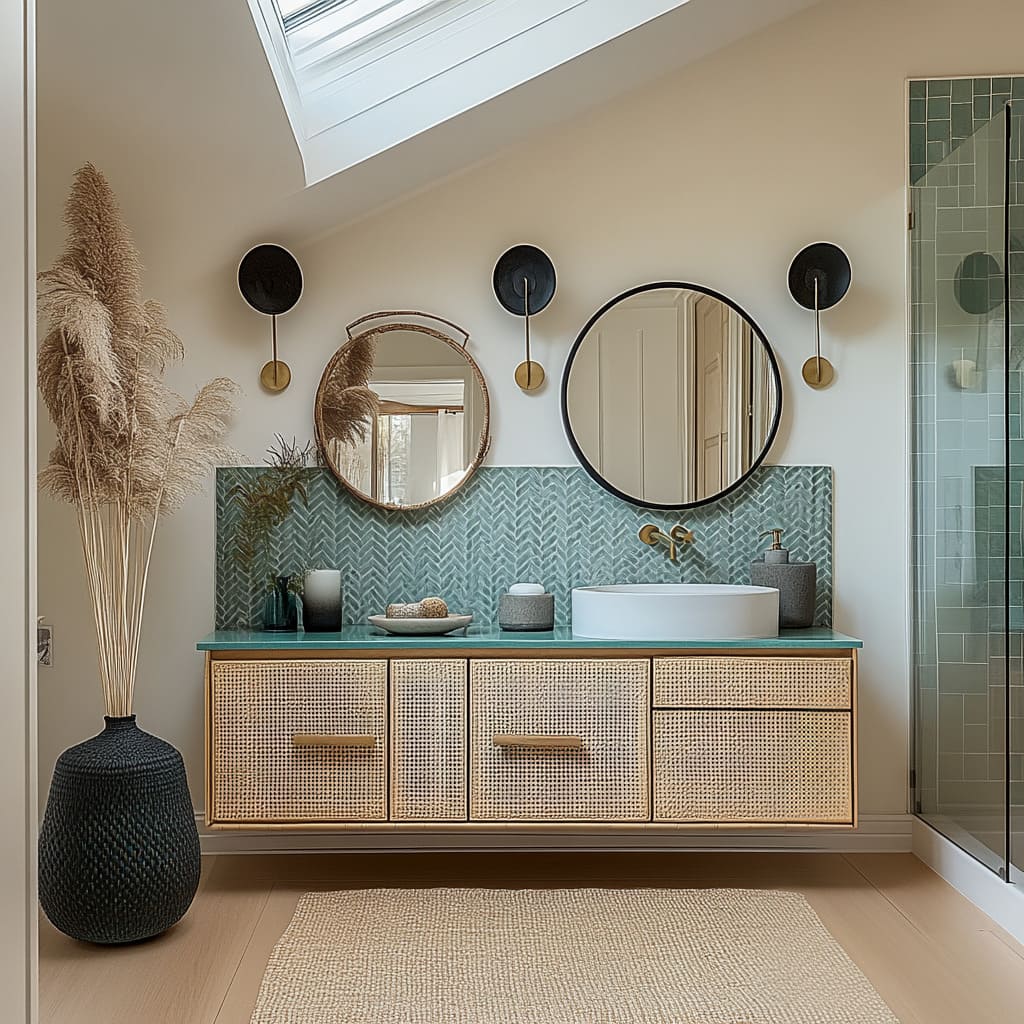
Mid-century bathroom designs often rely on color as a primary visual structure rather than surface decoration. Many design compositions from this style use large, confident color planes that behave almost like architectural anchors.
Emerald, deep green, soft sage, and teal appear as steady slabs wrapping backsplash walls, extending across vanity counters, or forming tall tile panels that pull the eye upward. These color fields shape the perception of width, height, and mood in ways far beyond an accent tone.
A strong vertical color panel behind mirrors can stretch a room visually, while a long teal counter can read like a horizontal beam that stabilizes the whole façade. The key outcome is a bathroom environment shaped by color geometry rather than printed pattern.
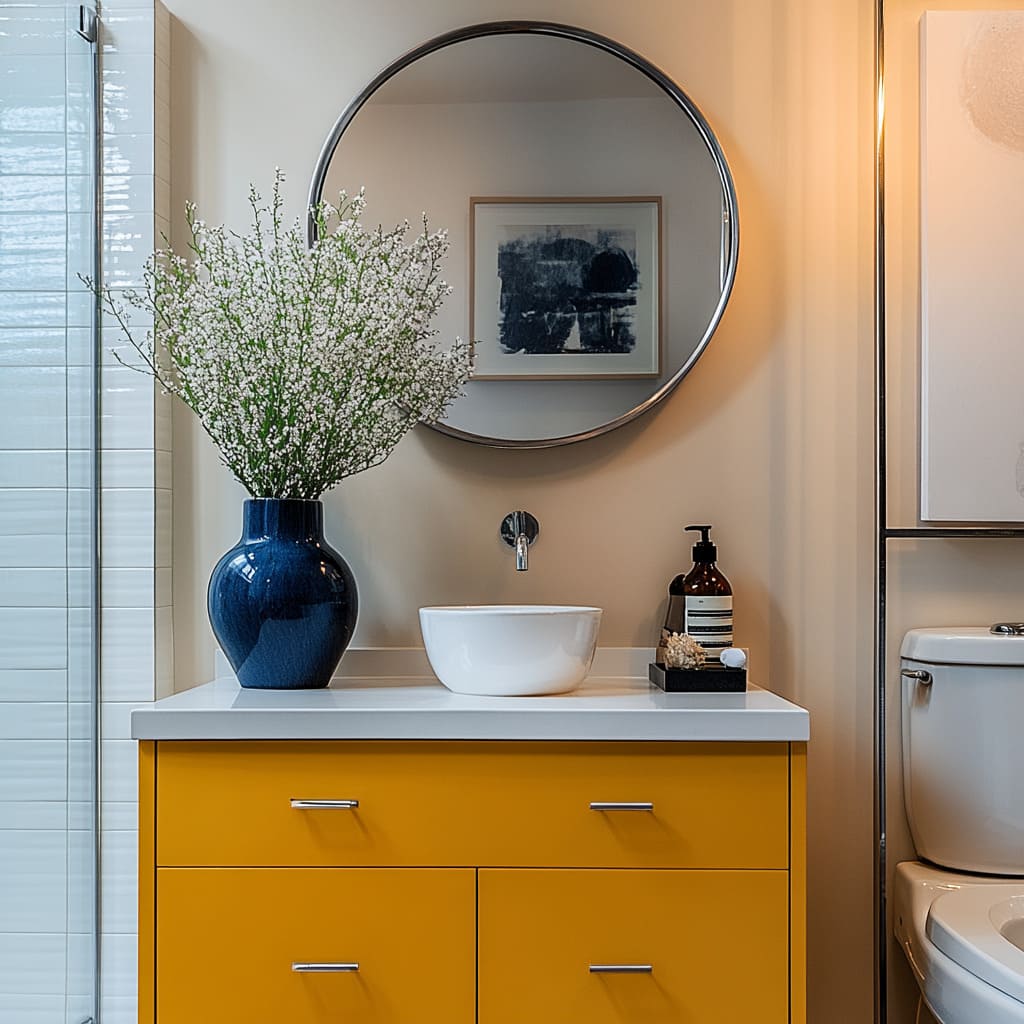
Even “joyful” tones, such as clean mid-century yellow or navy softened with matte finishes, follow the same visual logic. In this way, mid-century bathroom ideas use color not as ornament but as a structural element guiding the emotional character of the room.

Typical Color Frameworks in Mid-Century Bathrooms
Vertical color panels
Tall zones of green or teal behind mirrors and sconces stretch the wall visually and place all fixtures into one organized “field,” reducing visual noise.
Horizontal counters as color beams
When a colored top runs from one end of the vanity to the other without interruption, it reads as a single, calm line, even if the objects above it vary in size and tone.
Color wrapping from counter into backsplash
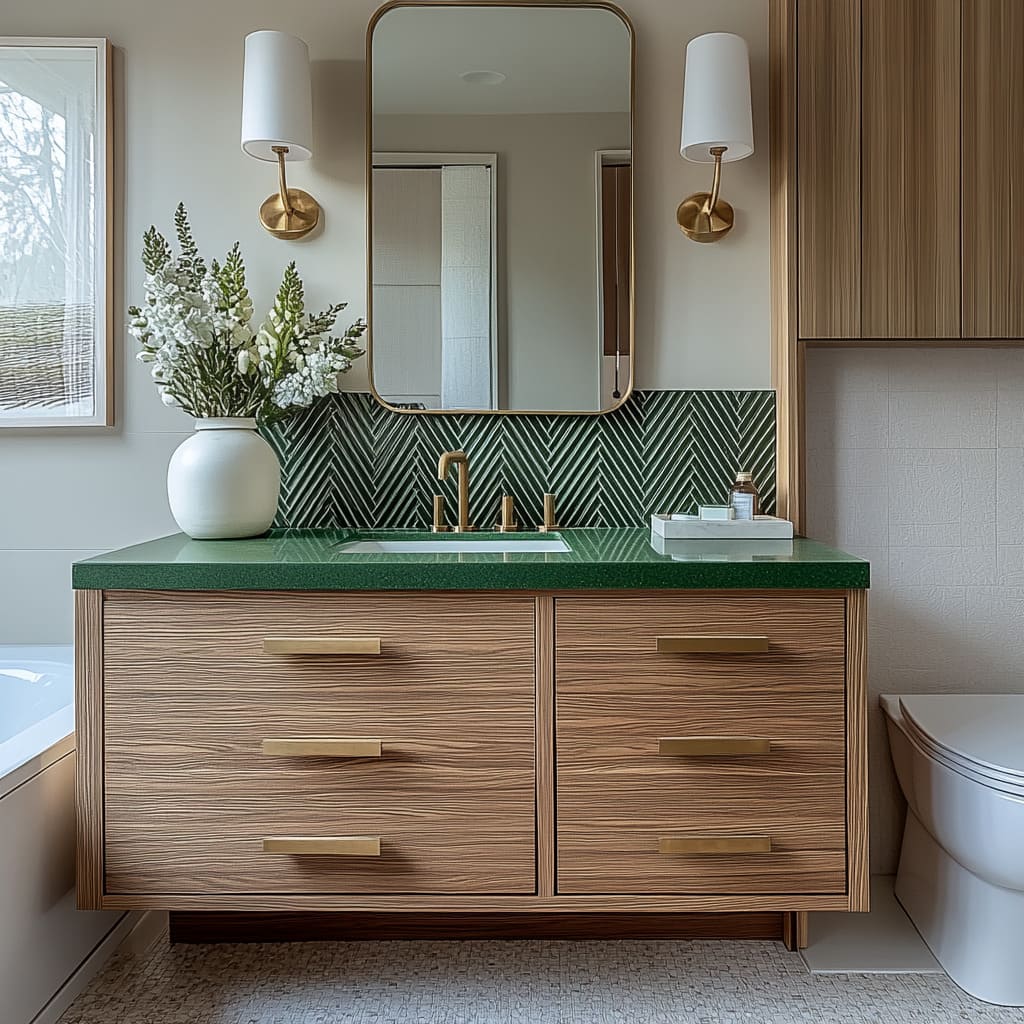
A green or teal surface that continues from counter up into herringbone tiles forms a single color block that gently bends from horizontal into vertical, giving the wall a soft, sculptural feeling.
Dark bands against pale surroundings
Black, navy, or deep green on one plane stand out against light floors and walls and help define zones such as vanity, tub, or shower without the need for heavy framing.
Emotional Tuning Through Color Saturation
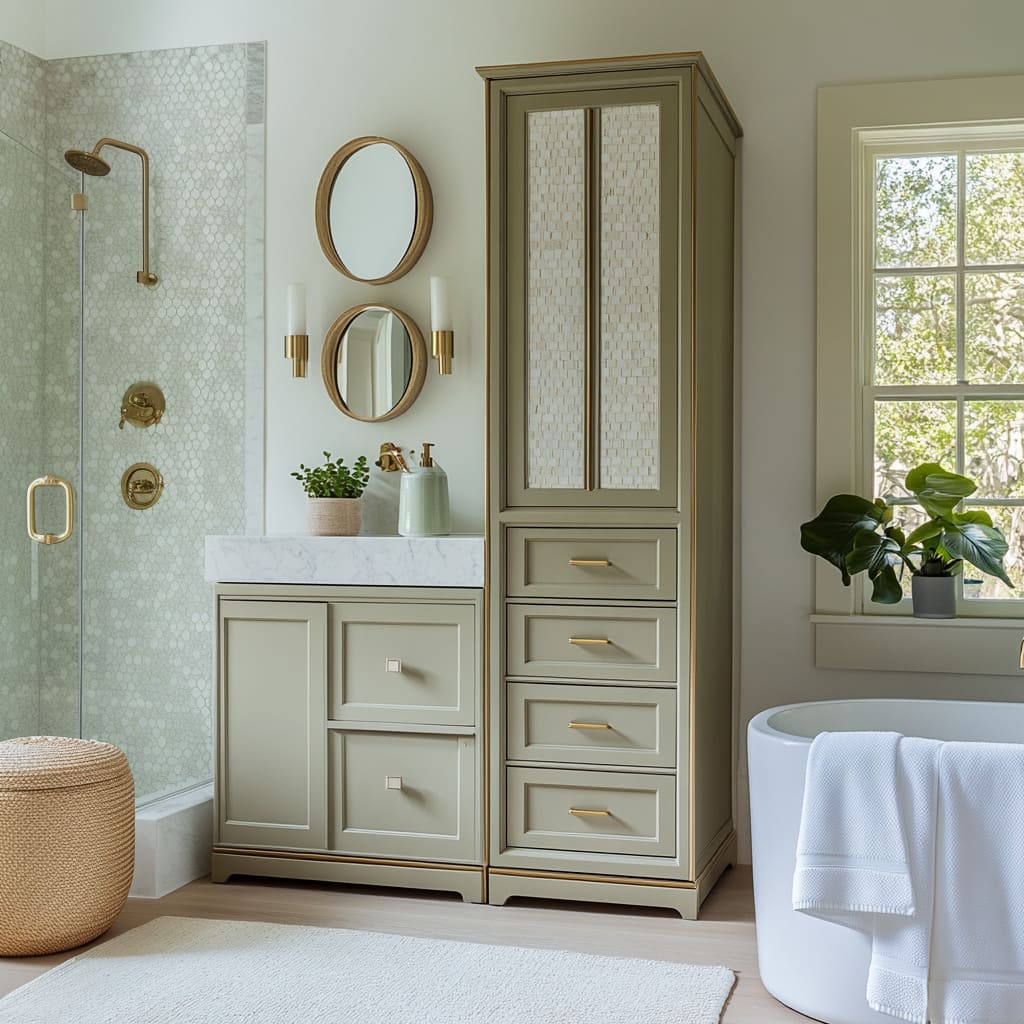
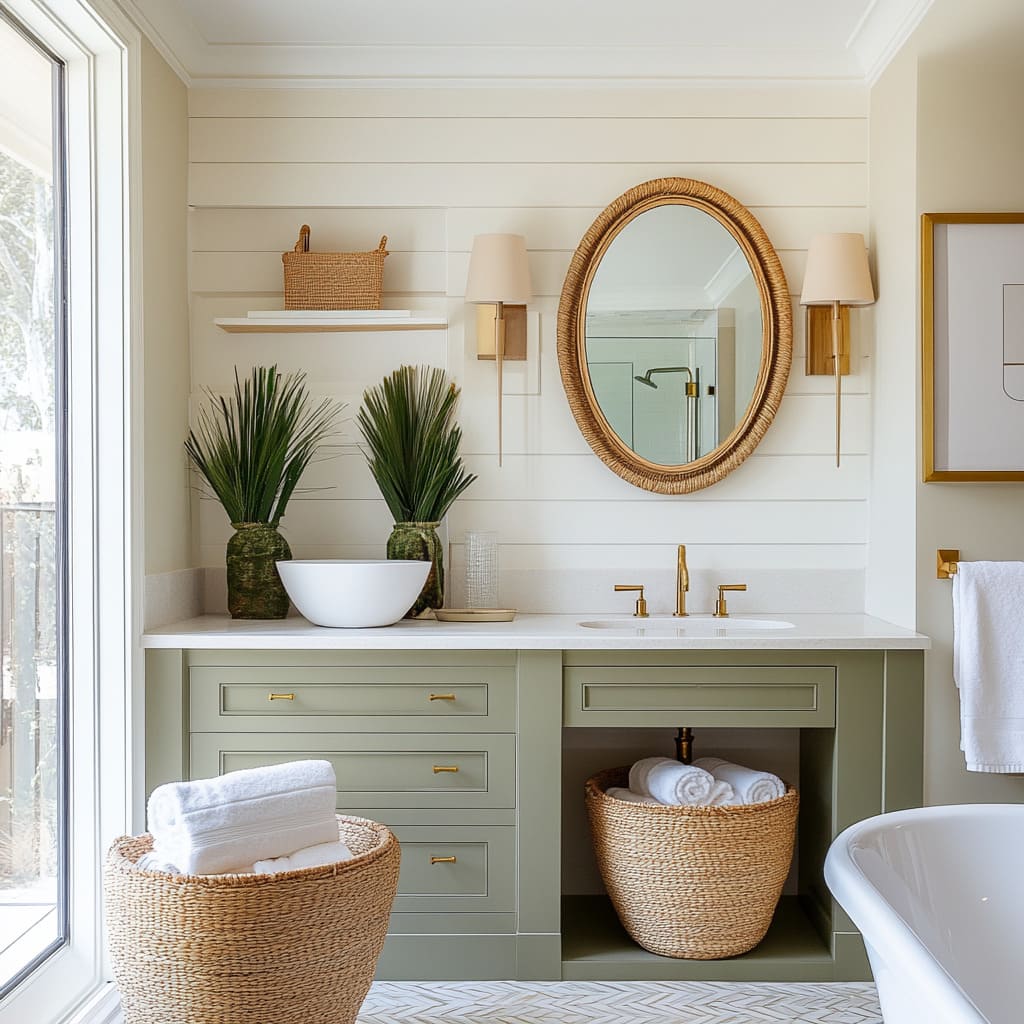
Color can also acts as a mood dial. Sage and soft sea-glass tones keep the room in a calm register, especially when paired with light wood and pale terrazzo.
A brighter yellow or a clearer teal pushes the mood toward playful but still controlled if all other surfaces stay quiet. Darker greens and navy create a more intimate bathroom feeling, where brass highlights almost glow against the depth of the wall.
The same layout can feel light and breezy or quiet and cocooned simply by changing the depth of the colored band, showing how much psychological weight a single, well-placed color field can carry.
Geometry Interplay: Lines, Curves, and Spatial Rhythm
One of the strongest visual languages seen across mid-century modern bathrooms is the dialogue between strict linear structures and softened curve forms. Vertical ribbing, horizontal striping, and angled patterns like herringbone or chevron create a directional field that quietly organizes the wall and vanity fronts.
These surfaces produce fine shadow lines that keep even plain wood or painted fronts visually active. In contrast, mirrors are often round or soft rectangles, vessel sinks adopt dish-like forms, sconces appear as white globes or cylinders, and vanity corners round slightly to ease the transition between materials.
This pairing of straight and curved shapes forms a core of mid-century modern bathroom ideas that treat geometry as a gentle back-and-forth between sharp order and soft relief. It allows a bathroom to feel structured without becoming rigid, and expressive without becoming overly animated.
Linear Systems as a Background Grid
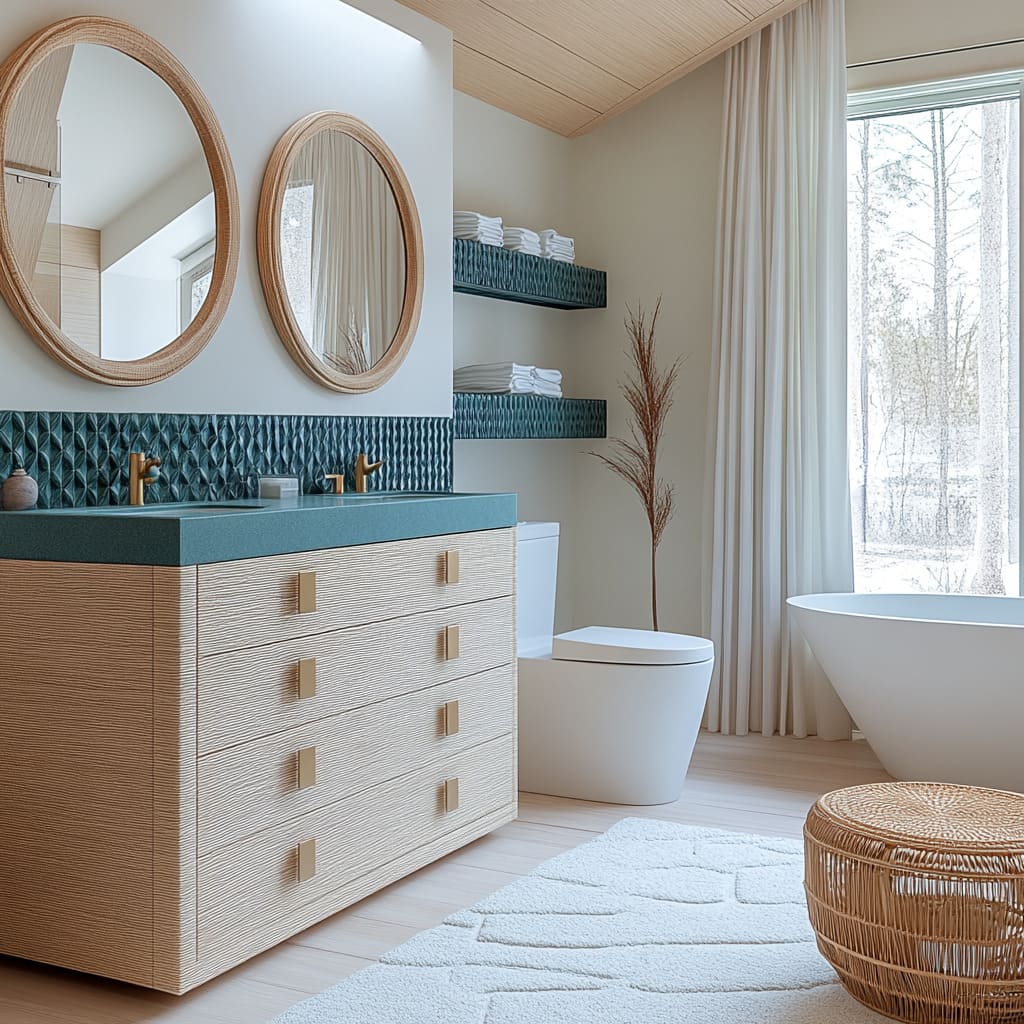
Under the surface, many mid-century bathrooms build an invisible grid from repeated lines. Vertical ribbing on a vanity, planked ceilings, or tall tile joints all pull the eye along one direction and make the room feel taller.
Horizontal moves—low rectangular tiles, long counters, continuous towel bars—stretch the room in the other direction and can make compact spaces feel wider. Diagonal layouts such as herringbone or chevron introduce a third vector without changing the palette; they send a faint sense of motion through the wall without creating a busy pattern.
Together these line systems behave like a quiet background drawing that supports everything else.
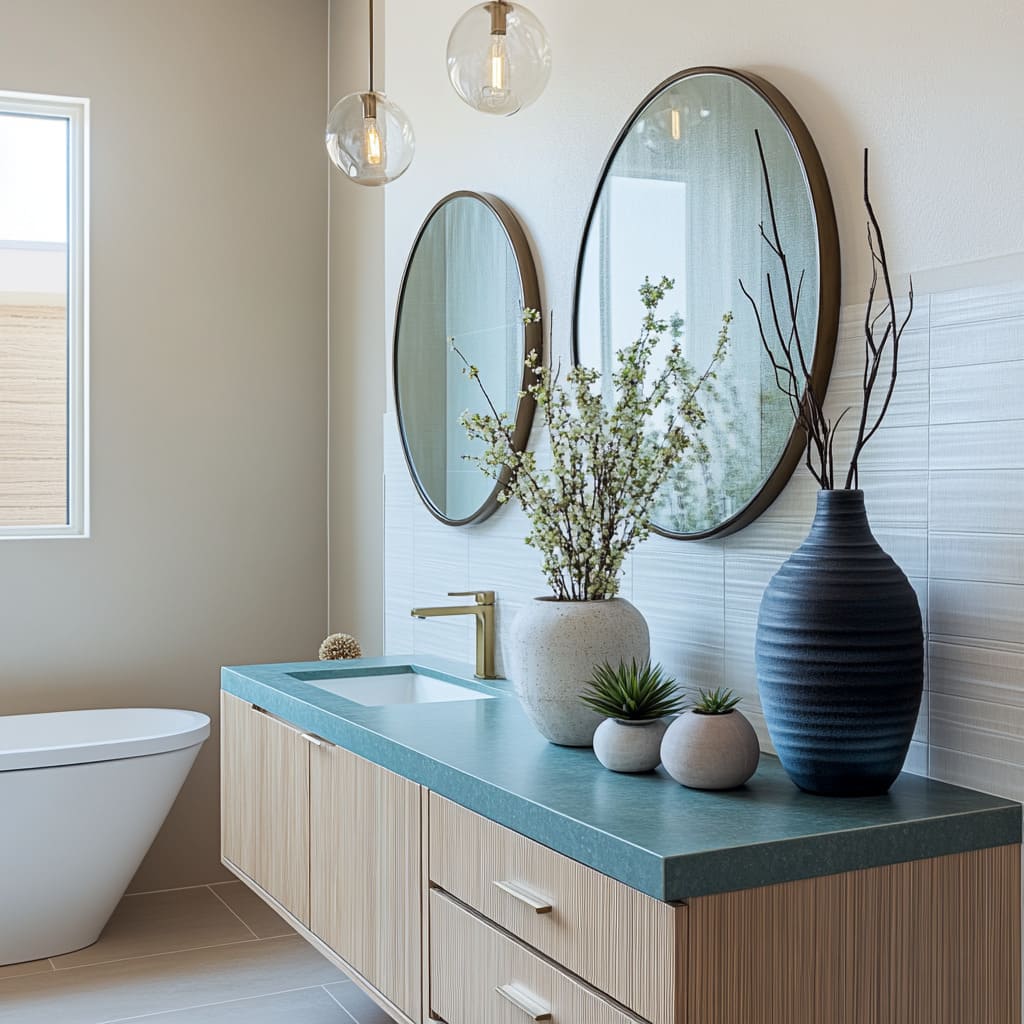
Common line-based strategies in mid-century bathroom designs:
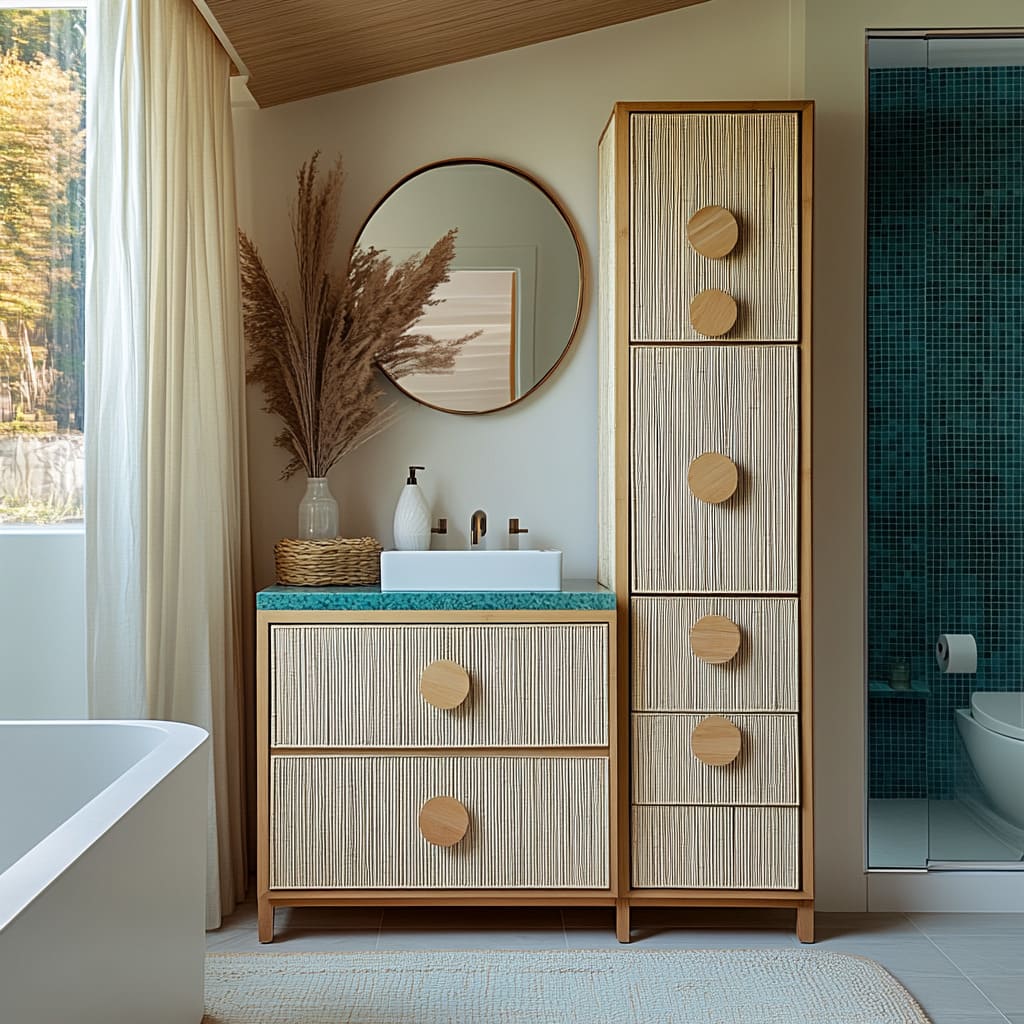
- Slim vertical ribs on cabinet fronts that echo the idea of tambour or reed panels
- Horizontal tile bands at low height that visually tie vanity and wall into one strip
- Herringbone arrangements used only in one zone (often behind the mirror) to keep the effect focused
- Ceiling boards or beams running in the same direction as floor joints or vanity grain for a unified flow
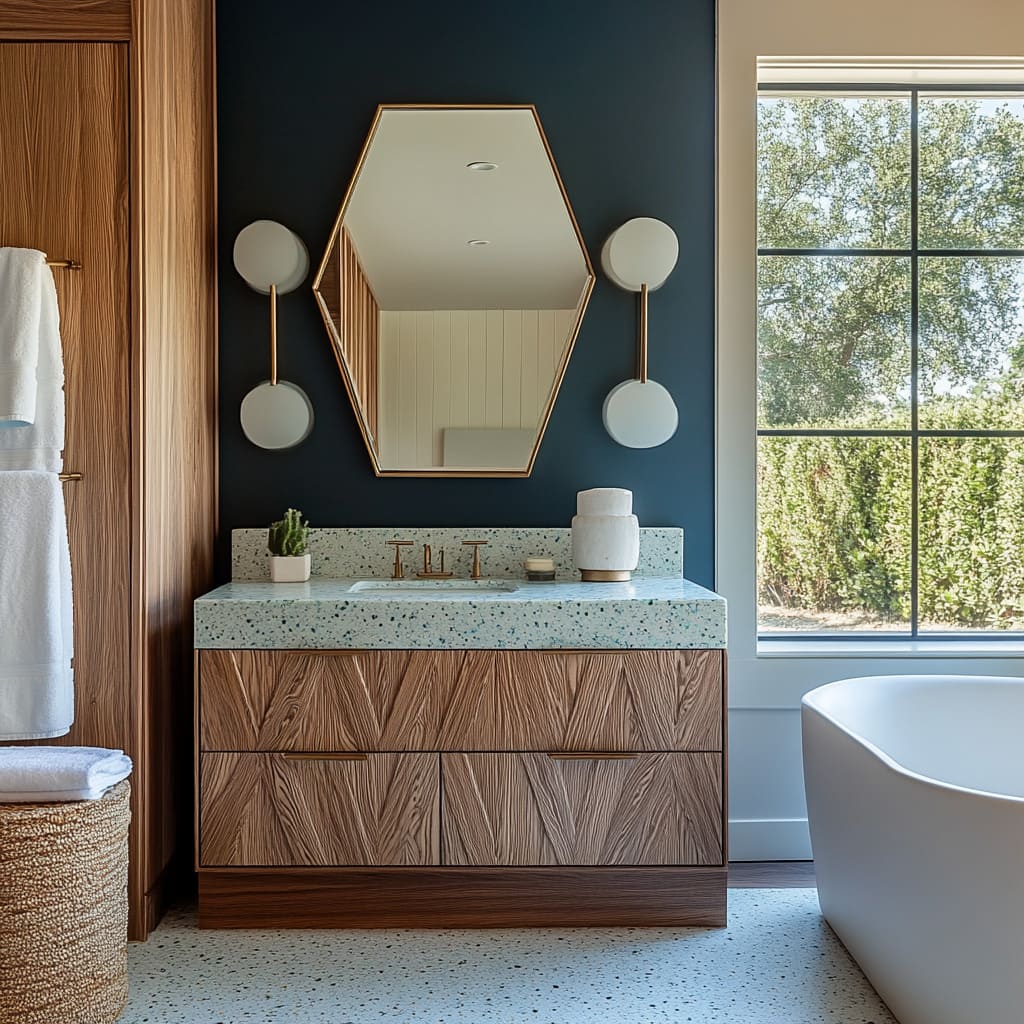
Curved Elements as Visual Breathing Space
Curved objects step in whenever the geometric grid risks feeling too strict. Round mirrors soften a strongly linear backsplash instantly, especially when placed over vertical tile or ribbed wood.
Vessel sinks shaped like shallow bowls give the counter a gentle, sculptural focus that breaks the straight lines around them. Globe sconces mount on thin rods or small discs and act like little punctuation marks of light.
Even the edges of a vanity sometimes round into open shelves, turning what could be a hard corner into a more welcoming, tactile one. This softening effect is subtle but powerful: curved elements do not fight the lines; they sit on top of them and keep the whole composition relaxed, even when the layout is highly ordered.
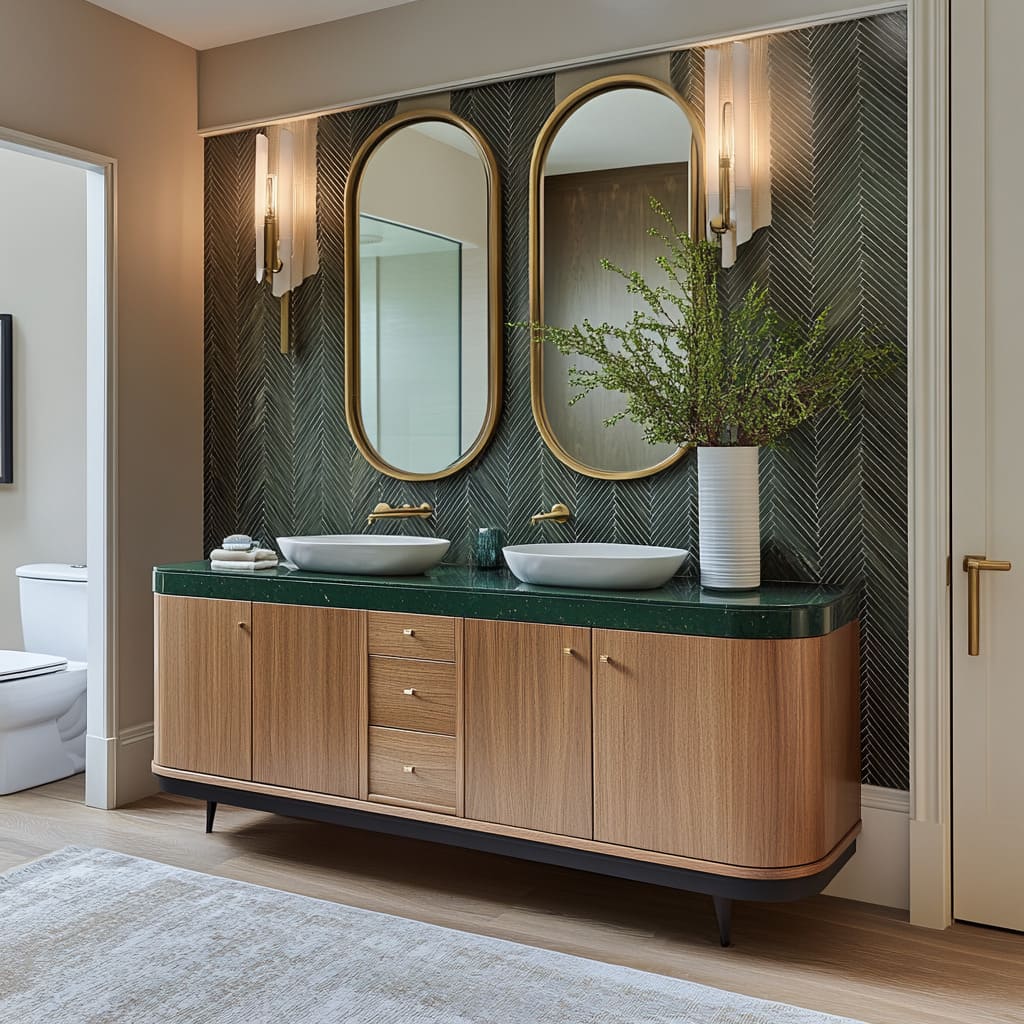
Texture Over Graphics: Relief Surfaces as Quiet Detail
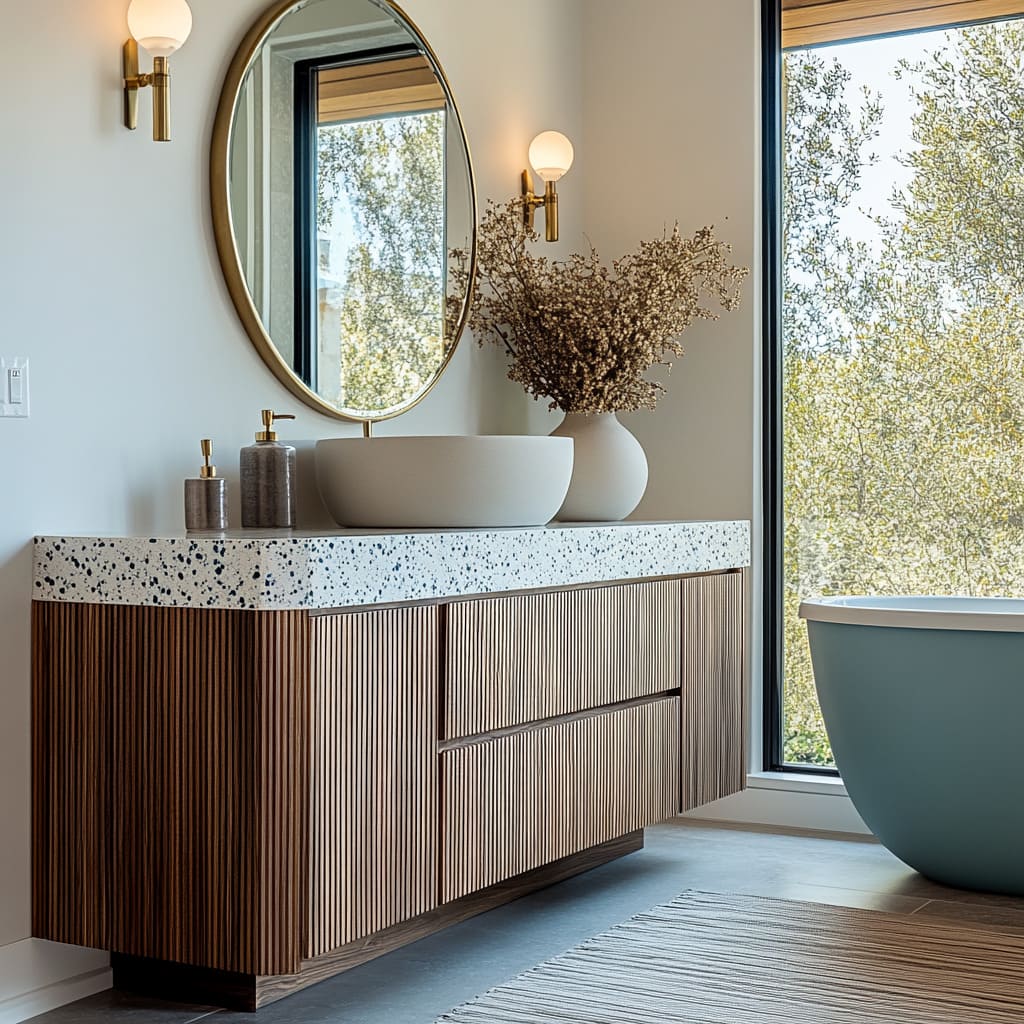
Rather than leaning on printed patterns, mid-century bathrooms elevate relief surfaces and tactile finishes to bring depth. A carved vanity front inspired by folded paper techniques, cane panels with woven grids, terrazzo surfaces with tiny speckles, and ribbed vertical wood reminiscent of tambour fronts all show how texture drives character.
These relief treatments create a subtle light play throughout the day—morning light brushing the grooves softly, evening glow making herringbone walls shimmer, or globe sconces grazing fluted wood to reveal micro-shadows. This approach is an essential part of mid-century modern bathroom design, in which texture becomes the main “print” and the quiet foundation that keeps the bathroom visually rich even when the palette stays controlled.
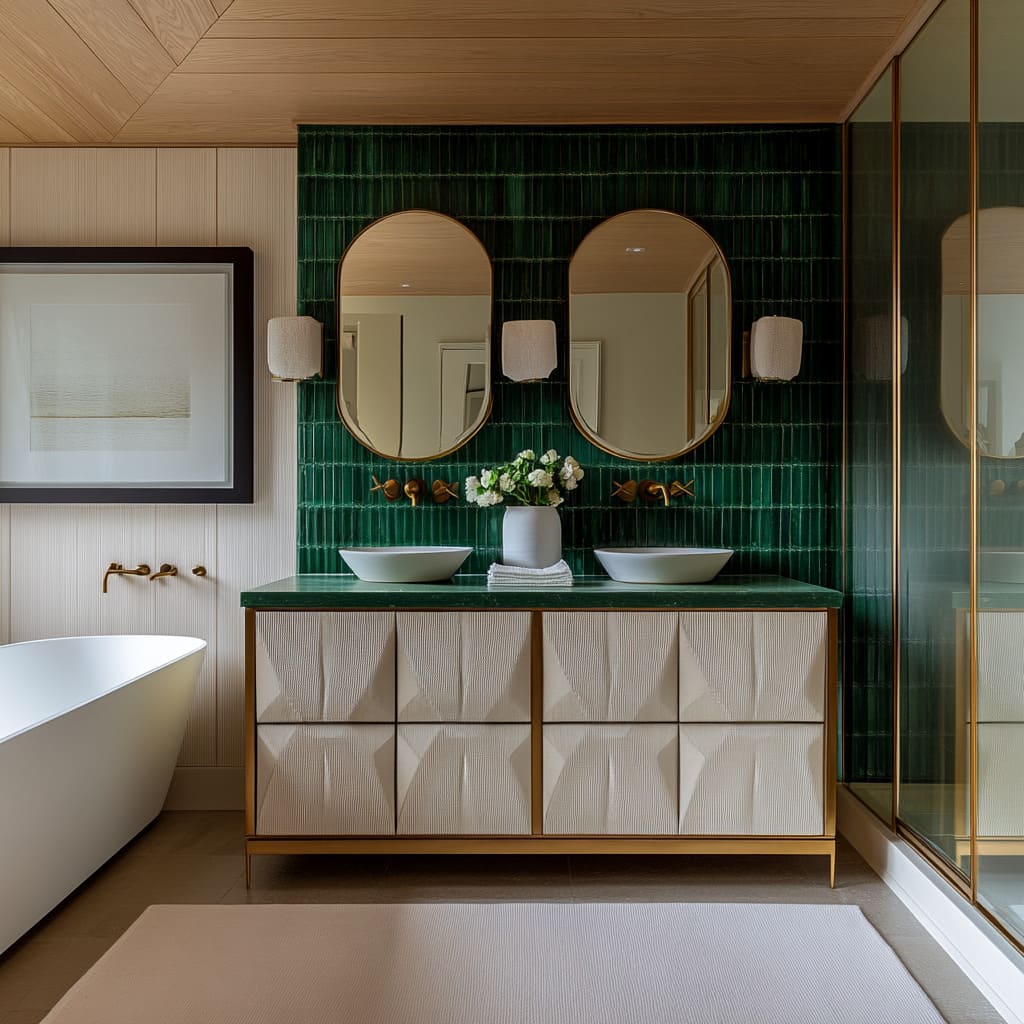
The Vanity as Furniture: A Core Identity
In many mid-century compositions, the vanity behaves more like a sideboard or cabinet from a living space than a conventional bathroom fixture. Floating oak boxes, tapered legs, recessed plinths, open curved shelves at the edges, and symmetrical wood drawer grids are often used to create a sense of craftsmanship and furniture presence.
Oversized circular knobs, long brass bars, or square pulls placed at perfect intervals form tiny glowing accents across the wood surface. This echoes the way classic mid-century furniture designers approached cabinetry—with clarity, proportion, and restraint.
In this framework, mid-century modern small bathroom spaces can feel far larger because the vanity reads as a sculptural object that floats, rather than as a heavy block attached to the floor.

Furniture Logic in Bathroom Layouts
The idea of the vanity as furniture changes how the whole room is composed. Instead of a built-in box filling a wall, the vanity behaves more like a sideboard placed inside a room.
Floating construction or visible legs leave floor space visible under the cabinet, which makes the bathroom feel visually lighter and more open. The cabinet fronts are often organized into readable units—three pairs of drawers, a central door flanked by equal sections, or a strict grid—which gives the piece a clear rhythm similar to a living-room console.
This furniture-like reading also encourages the use of decor and art above the vanity, since it already feels like a natural display surface.
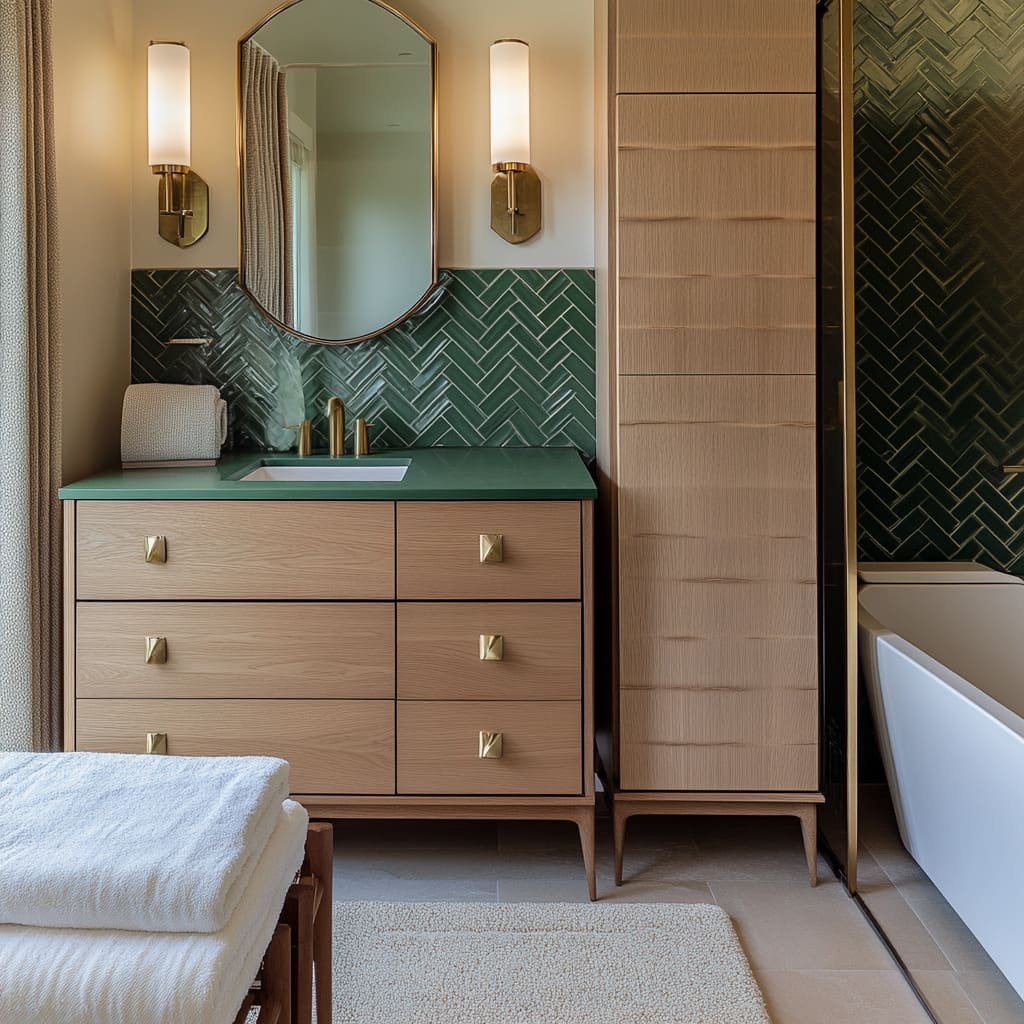
Furniture-Inspired Vanity Moves
- Floating boxes with recessed plinths. A slight shadow gap under the cabinet suggests a piece set in front of the wall instead of built into it.
- Tapered legs and visible frames. Legs and framing give the eye clues about how the cabinet stands and support the idea of a freestanding object.
- End conditions with character. Rounded corners, open shelves, or gently radiused ends bring the language of Scandinavian cabinets into the bathroom.
- Hardware as small, repeated accents. Oversized knobs and long pulls in brass or wood punctuate the cabinet like a row of brooches, giving the front a measured sparkle.
Hardware as a Unifying Miniature Story
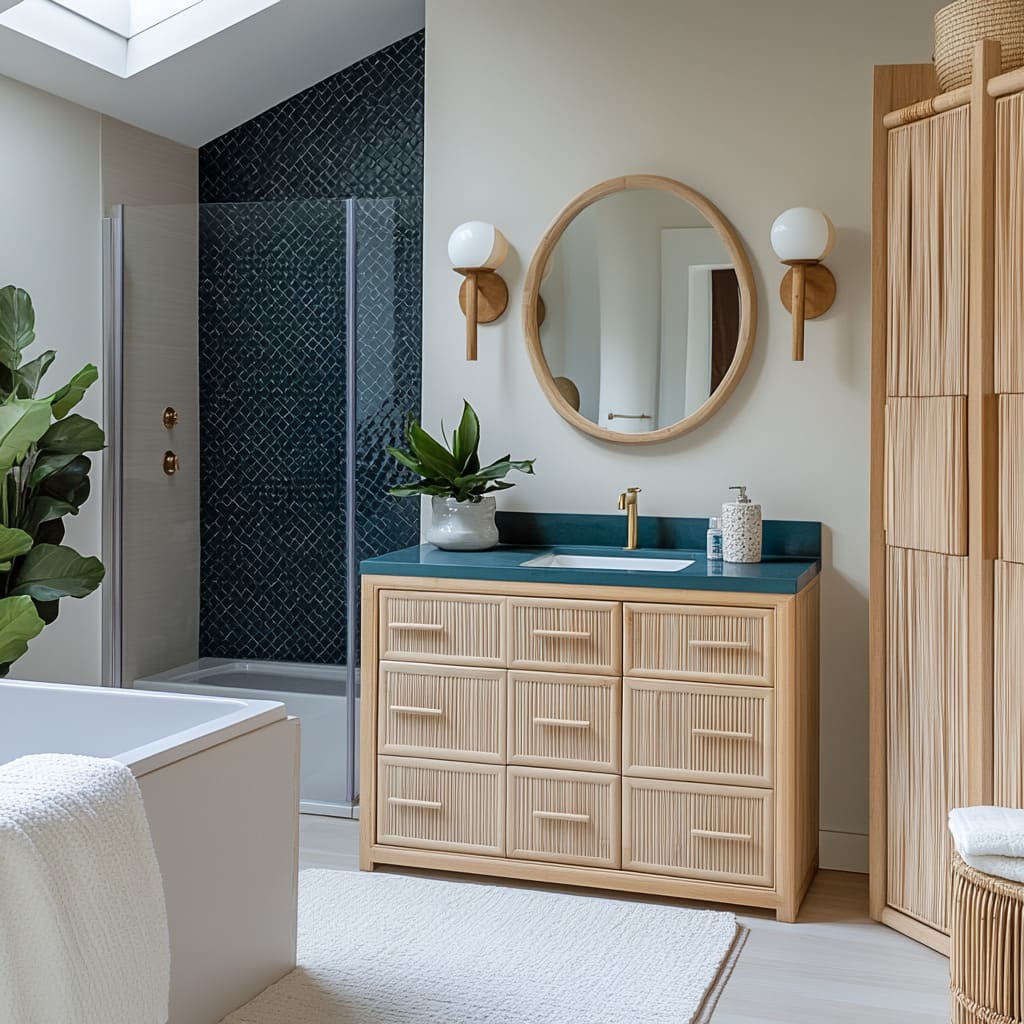
Handles and pulls carry a surprising amount of stylistic information. Square brass plates on pale wood, circular wooden knobs on ribbed doors, or lean horizontal bars on striped fronts all express slightly different sides of mid-century aesthetics.
Despite their small size, these pieces often provide the most concentrated metal presence on the vanity. When they align in a simple grid, they echo the proportions of drawers and panels and quietly reinforce the order of the whole object.
Because the same metal tone appears in faucets, mirror frames, and sconces, each handle becomes one note in a larger melody of warm highlights carried through the design.
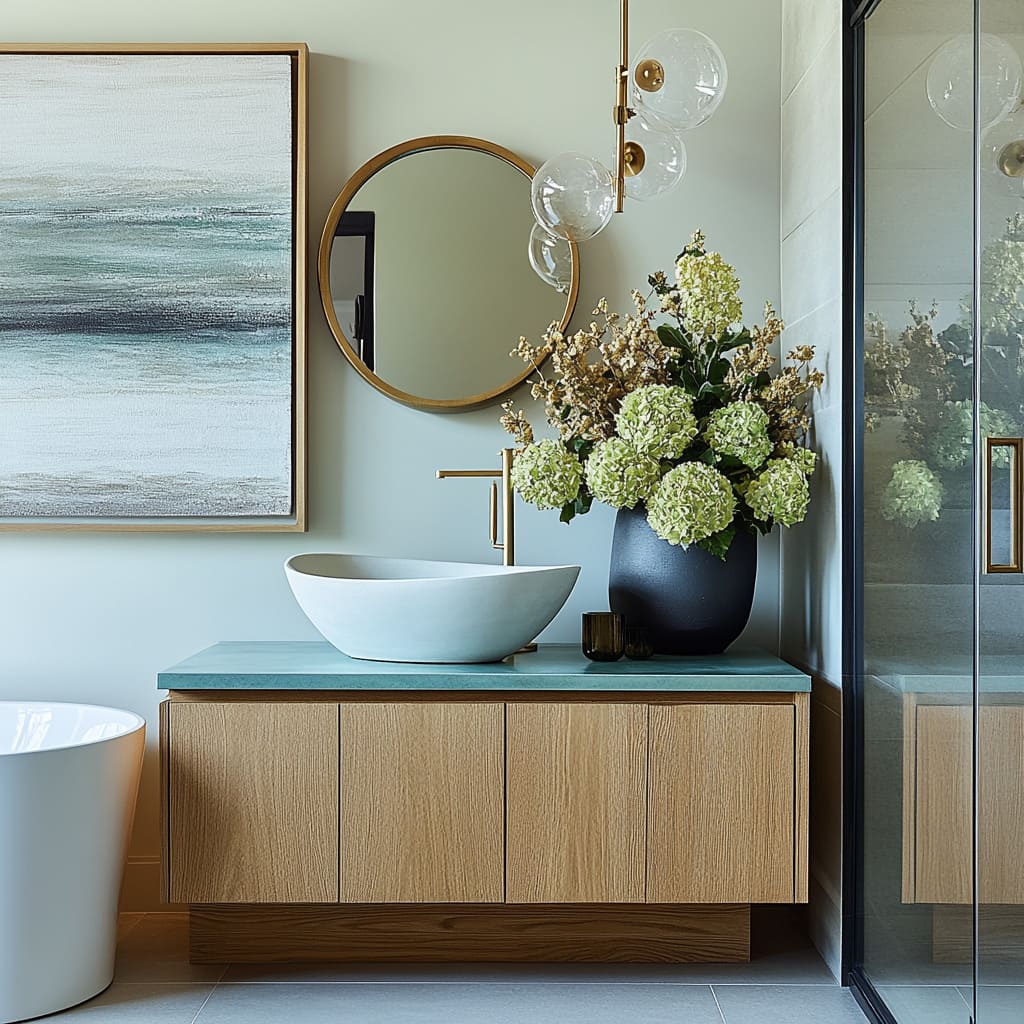
Mirrors and Art as Visual Anchors
Mirrors in mid-century bathrooms are rarely treated as simple functional surfaces. They behave as sculptural objects or intentional compositions.
Round mirrors placed in pairs, stacked ovals, hexagonal mirrors trimmed in brass, or clusters of circular mirrors arranged like wall art shift the perception of the bathroom from utilitarian zone to curated interior. When placed near large abstract artworks, the mirror’s reflection creates a layered display that expands spatial depth without increasing physical elements.
Art often leads the color story—teal counters echo brushstrokes, muted green mirrors connect to painted landscapes, or graphic prints stabilize the tone of the entire layout. This approach is a key aspect of mid-century bathroom decorating ideas, where art and mirrors play an essential role in shaping the room’s personality.
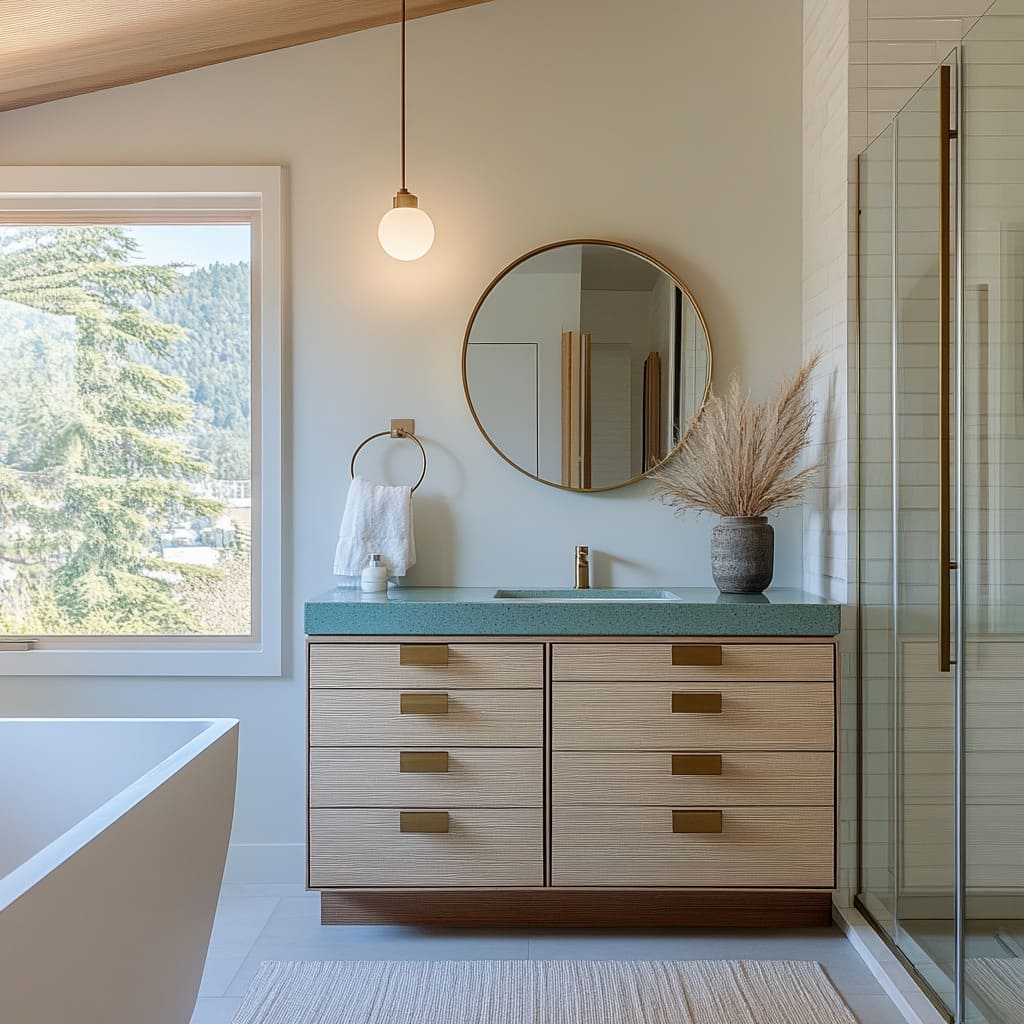
Lighting That Sculpts Surfaces
Lighting in mid-century inspired bathroom designs is used less as illumination and more as a shaping tool for the room’s materials. Globe sconces, slim brass rods, transparent pendants, bubble-like clusters, and frosted cylinders all distribute light in directional ways that emphasize texture.
A globe placed near ribbed wood reveals its rhythm; a vertical pendant overlapping a mirror creates layers of reflections; a pair of symmetrical sconces along a herringbone wall highlights the diagonal flow. Many designs avoid harsh overhead lighting, instead using wall-mounted sources to cast a soft glow across counters and tiles.
In this method, light sculpts relief surfaces and saturates green and teal tones more deeply, forming a rich, atmospheric expression typical of mid-century bathroom design.
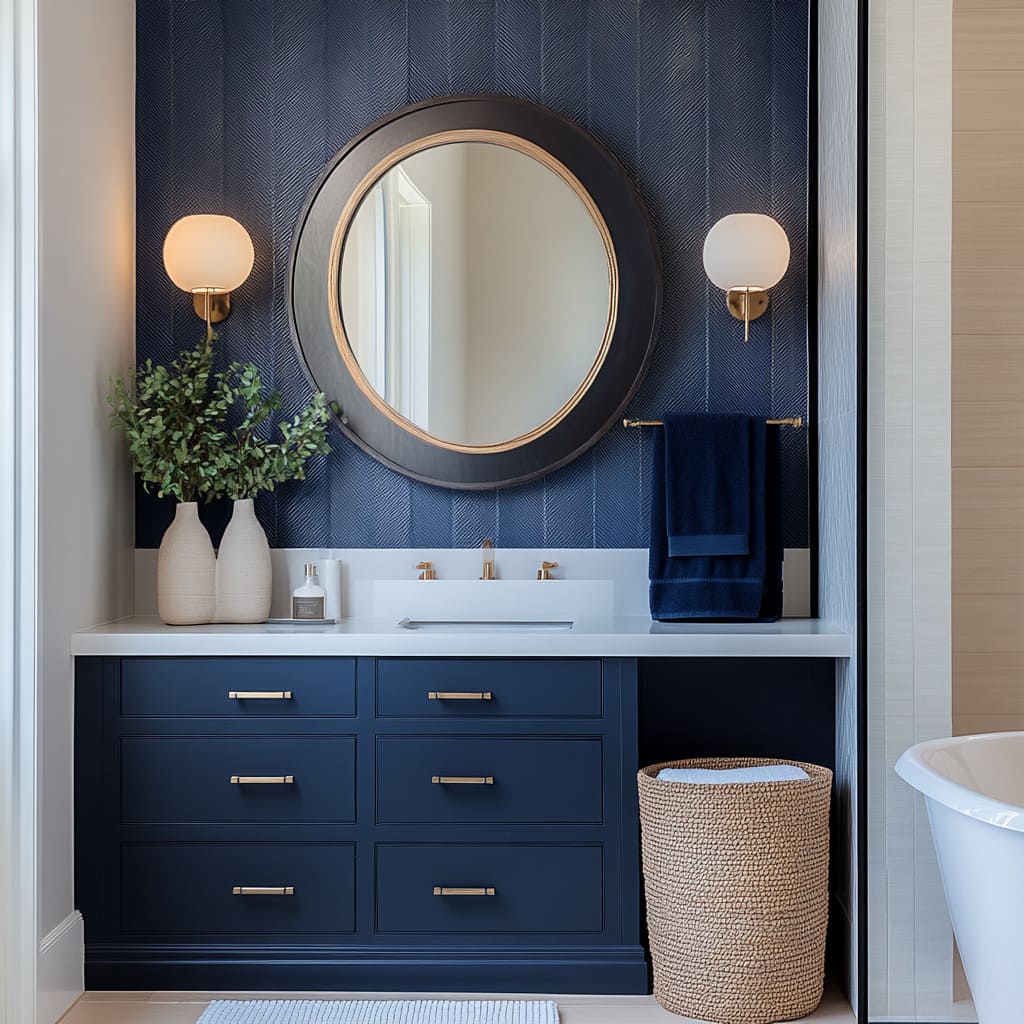
Light as a Partner for Texture
A strong part of the lighting story in such bathroom designs is the relationship between light direction and material relief. Fluted wood, carved tile, chevron grain, cane fronts, and terrazzo all respond differently to grazing light or frontal light.
Wall-mounted sconces placed slightly to the side of a textured surface allow shadows to fall sideways into grooves, making the pattern more pronounced. When the same surface is lit more frontally, the relief softens and reads almost like a subtle tonal shift.
This means the mood of the bathroom can change through the day as daylight and artificial light take turns defining which textures are more apparent.
Lighting roles:
- Face-level wall sconces to light the area around the mirror gently without harsh overhead beams
- Pendants or bubble clusters used as sculptural points that double as ambient sources
- Indirect light bouncing from pale counters, white tubs, and glossy tiles to soften contrast
- Skylights or high windows washing large planes of tile or brick to show their natural irregularities
Reflections, Overlaps, and Layered Glows
Mirrors and glass parts help light travel further and create layered effects. A clear globe pendant hanging in front of a mirror multiplies the image of the bulb and its brass stem, turning a single fixture into several overlapping forms.
Long glass rods or cylindrical sconces placed against dark herringbone tile line up with the grout pattern and exaggerate the feeling of vertical height. Even simple decisions like allowing a globe sconce to overlap the edge of a mirror slightly can produce a richer, more complex reflection, where glass, metal, and the tinted surface behind all merge.
Through this layering, the bathroom gains depth without adding extra objects, relying purely on how light traces the surfaces already in place.

Natural Materials and Organic Shapes as Soft Counterpoints
Nature appears in mid-century bathroom designs not as a thematic decoration but as a complementary shaping force. Indoor greenery—pampas, cacti, large branches, dense leaves—adds height or softness wherever needed.
Cane fronts, woven rugs, baskets beneath counters, and woven mirror frames introduce organic texture that breaks the smooth planes of wood and stone. Terrazzo surfaces with multi-toned speckles serve as miniature landscapes, grounding bold counters or tile walls.
Windows often frame greenery outside, turning the bathroom’s color palette into an extension of the outdoors. Through this approach, mid-century modern bathroom design embraces natural shapes and fibers as essential balancing elements for strong geometry.
Harmonizing Layers: Composition, Color, and Object Placement
Across many ideas, mid-century bathroom designs maintain a specific compositional rhythm. One surface—usually a counter, tile wall, or color plane—acts as the leading element.
Supporting surfaces echo its lines or textures at lower intensity. Accessories appear in small groupings with stepped heights.
Tall floral arrangements balance low vessel sinks; large objects appear only once per wall; negative space is placed deliberately around sculptural pieces. This layered strategy integrates herringbone walls, round mirrors, brass details, teal slabs, and fluted wood under a single visual order.
It also explains how even small spaces can feel open and structured, forming the essential character of mid-century modern small bathroom compositions.

Mood Variations Within a Unified Style
Although the mid-century vocabulary stays stable—wood, brass, teal, gentle curves—the emotional tone varies widely through selective shifts. Saturated yellow paired with blue accents creates an upbeat atmosphere.
Deep navy and brass give a quiet, cocoon-like mood. Sage cabinetry paired with woven textures forms a calming, grounded environment.
Chevron wood and terrazzo deliver an energetic but orderly tone. These variations demonstrate how mid-century modern bathroom ideas can adapt to different emotional directions while keeping the same core visual logic.
The style remains recognizable by its marriage of structure, warmth, relief surfaces, and sculptural elements.
Retro Echoes Without Literal Repetition
Mid-century bathroom designs in contemporary settings rarely attempt a literal replication of the past. Instead, they extract essential patterns—floating cabinetry, sculptural lighting, relief-driven surfaces, deep wood warmth, controlled color planes—and reinterpret them through modern palettes and cleaner proportions.
Brass is softer, teal is dustier, yellow is clearer, mosaics are finer, terrazzo is more refined. The result is a look shaped by nostalgia but executed with restraint.
This nuance is central to mid-century bathroom design, where the visual memory of the era is preserved but refreshed for modern clarity.
A Unified Visual Identity
Mid-century bathroom ideas —emerald sculptural vanities, ribbed wood with teal counters, terrazzo compositions, navy herringbone walls, cane-fronted cabinetry, soft sage built-ins, and warm brick surfaces— follow one shared idea: the concept is designed as a quiet, expressive interior rather than a technical wash space. Furniture-like vanities, art-led walls, sculptural lighting, and material tactility unify these designs across different moods, colors, and settings.
These choices form a visual identity rooted in geometry, warmth, and considered texture, creating a spectrum of interpretations connected through timeless design logic. In this sense, mid-century bathroom decorating ideas hold enduring relevance because they blend sculptural clarity with soft atmosphere, allowing the bathroom to feel composed, expressive, and serene at the same time.
Related Posts
Harmony Home Design brings 10+ years of residential interior design experience to the ideas shared here. We publish design concepts, layout thinking, and practical styling notes.