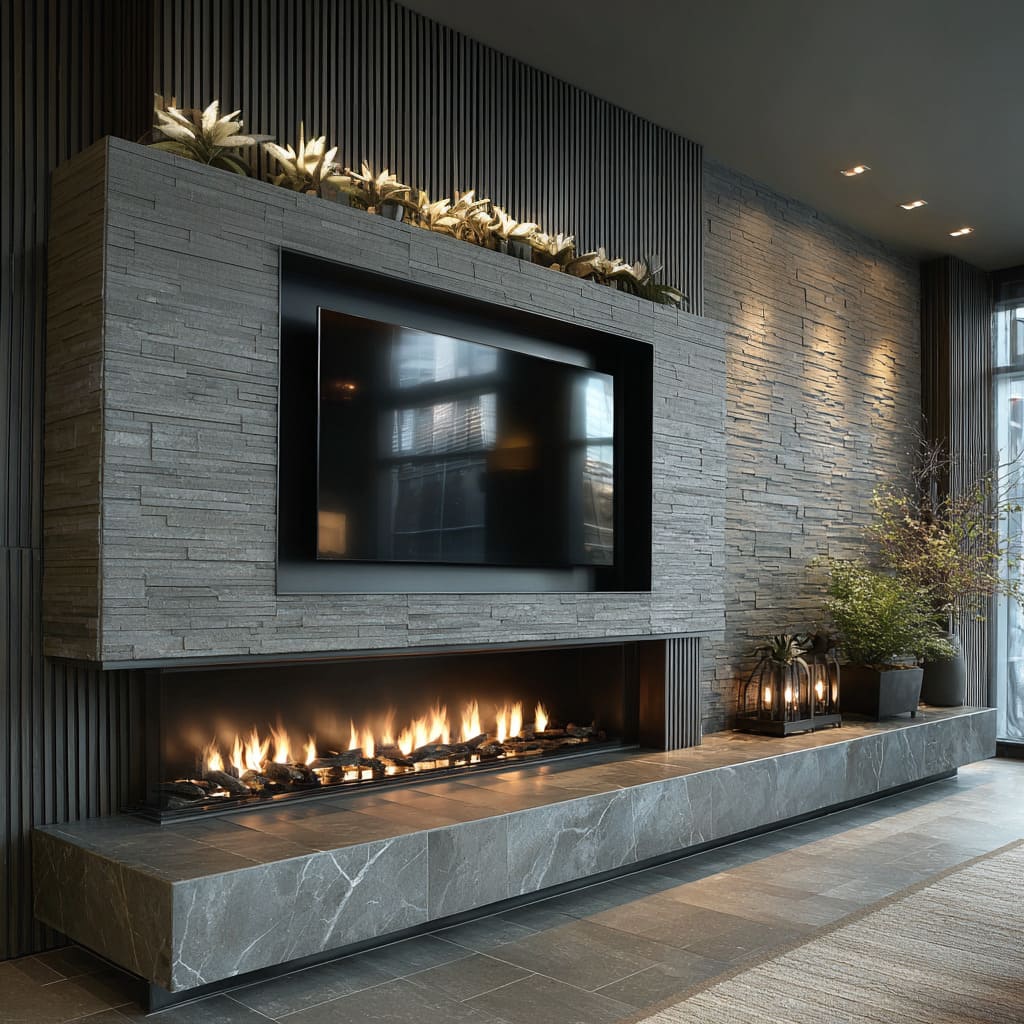
A lot of modern stone fireplace ideas succeed for reasons that are easy to feel and hard to name. The difference rarely comes from better stone or bolder stone.
It comes from whether the fireplace wall behaves like a visual design system: edges that stay readable, texture that stays quiet, weight that’s distributed, and warmth that shows up in the right places so the interior design feels finished without looking styled to death. When stone fails visually, it’s often because it’s treated like an isolated feature—a patch of texture added after everything else.
When it works, it behaves like a calibrated background that lets the other elements (TV, seating, shelving, windows, art, lighting glow) read as one organized composition. That’s the core thread running through stone fireplace ideas that look clean and current: stone is not extra; it’s the wall’s main logic.
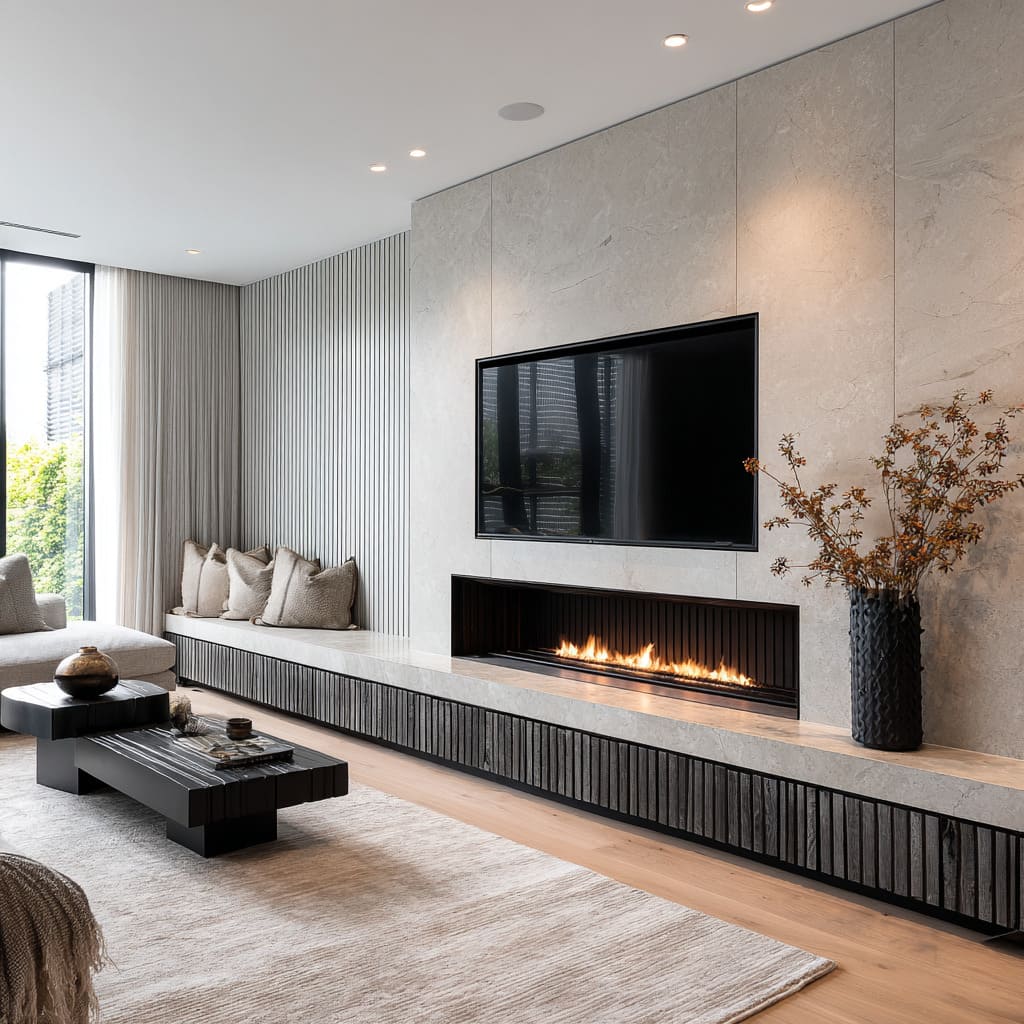
Making the fireplace look like it belongs to the room
In the strongest fireplace with stone ideas, stone doesn’t act like a separate style choice. It acts like a connector between the room’s biggest surfaces: floor tone, wall tone, furniture tone, and the room’s dark outlines (window frames, shelving voids, firebox voids, TV rectangle).
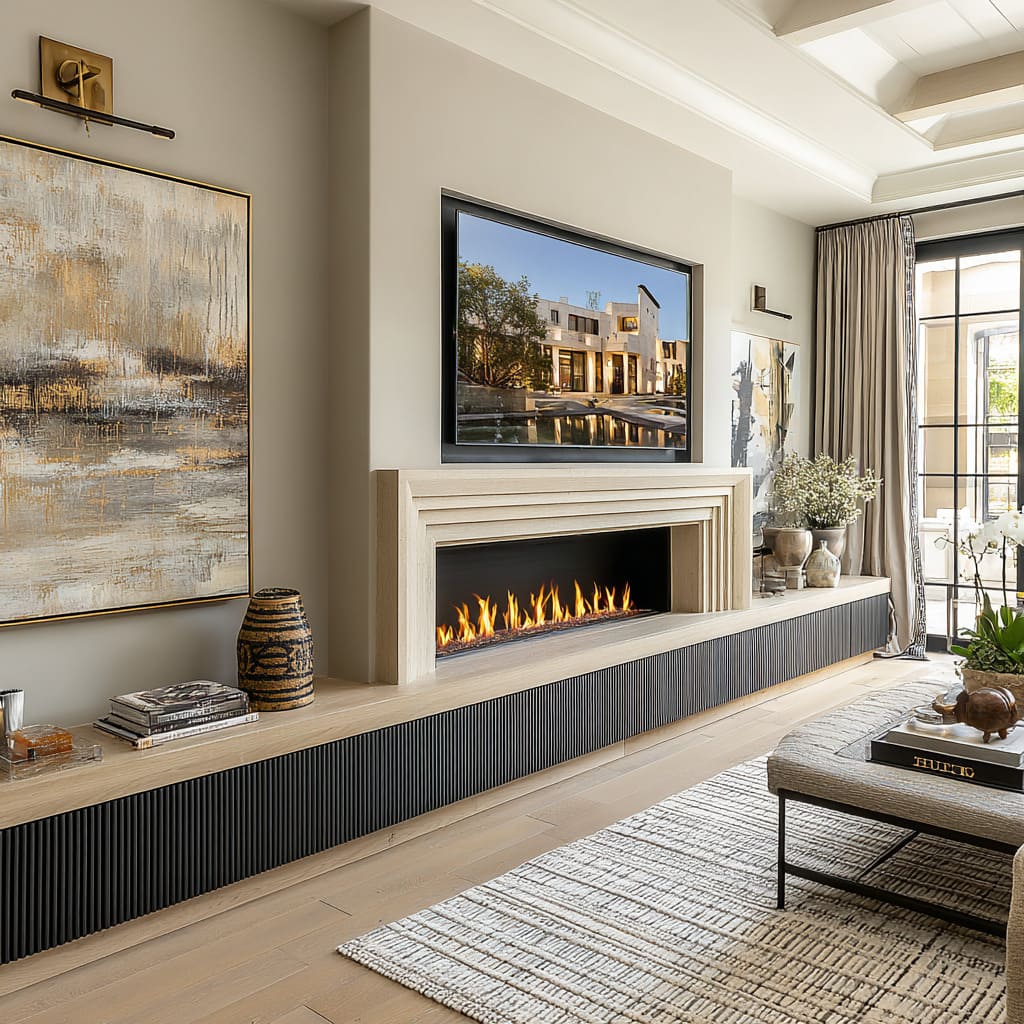
The outline language that makes stone feel native
A modern design usually has a quiet grammar of outlines: black window grids, dark shelving openings, thin metal table frames, shadow gaps, and the TV’s rectangle. Stone belongs when it supports that grammar instead of fighting it.
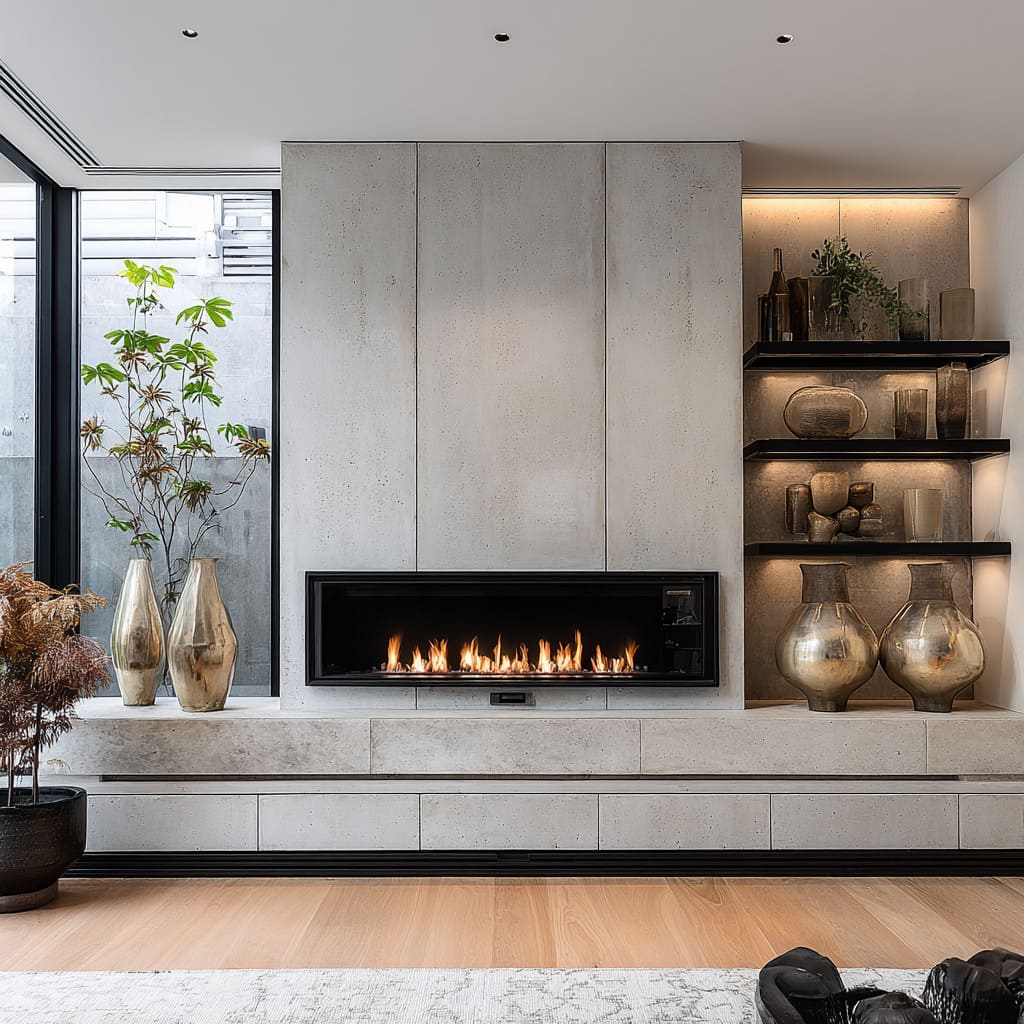
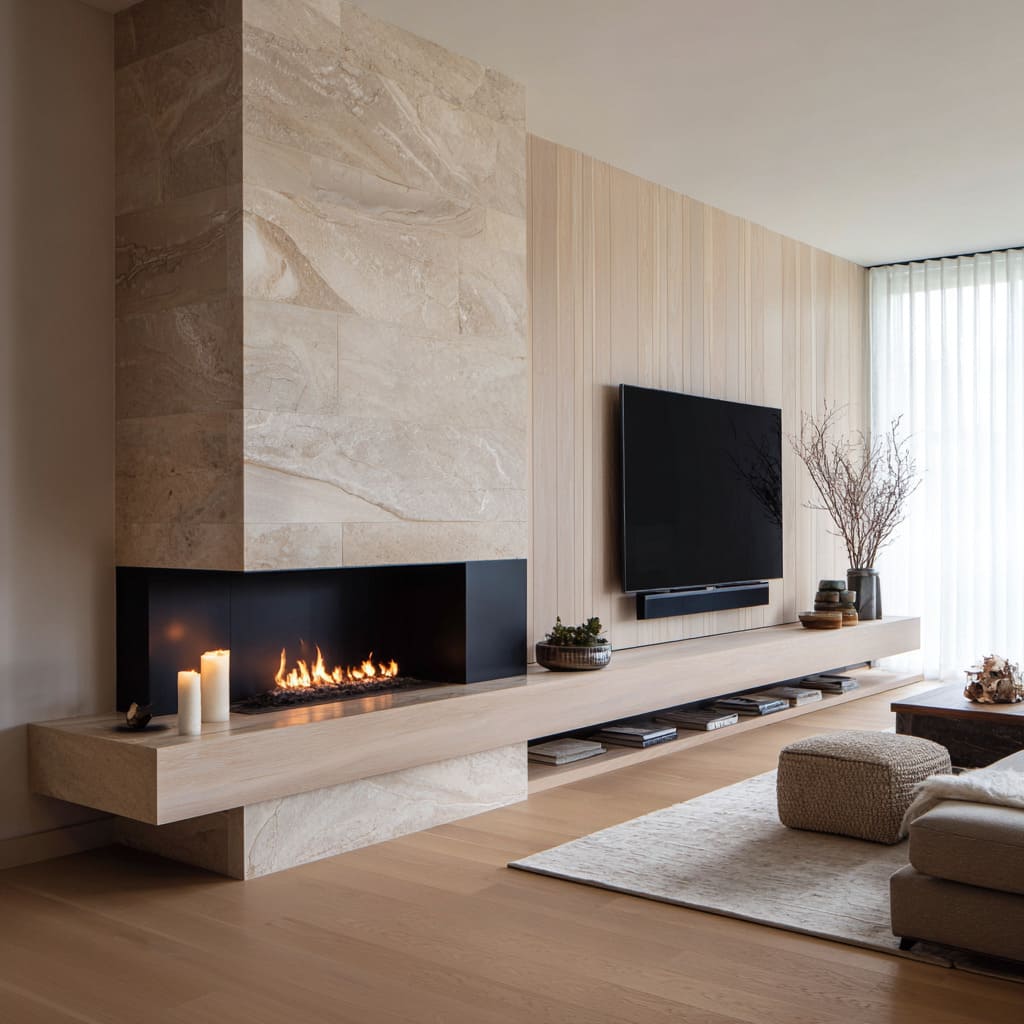
- Black cutouts make stone look intentional. A long, thin firebox opening (a dark line drawn through pale stone) works like eyeliner: it sharpens the stone’s perimeter and prevents the stone from reading as a blurry beige patch. The stone becomes a crisp plane because the void defines it.
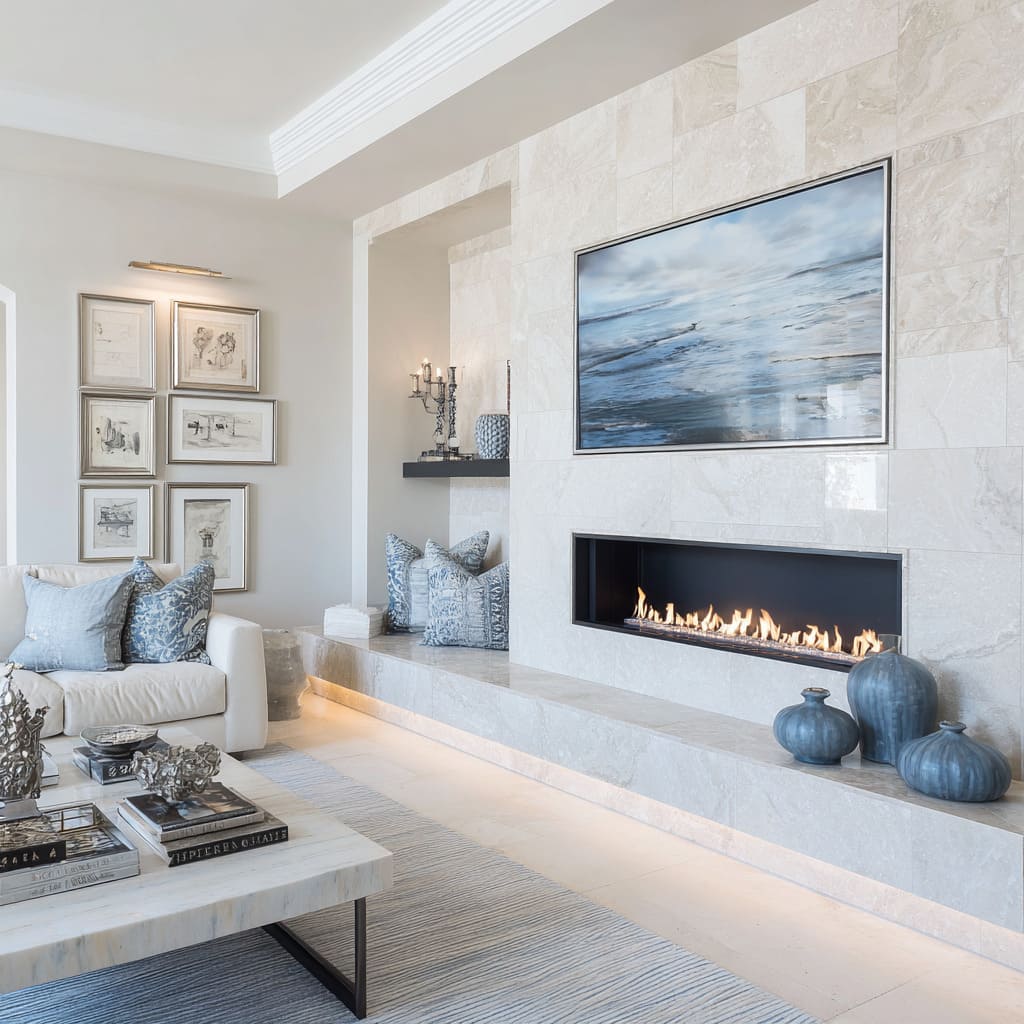
- Stone becomes calmer when it’s treated as one plane first, texture second. Pale stone walls that read creamy-white or greige with faint banding succeed because the eye reads one calm field, then notices variation later. That delay is what makes the surface feel planned rather than busy.
- A horizon line quietly organizes the whole wall. When a mantel or ledge is treated as a simple, flat line—almost like a rule that everything obeys—the fireplace stops feeling pasted on. The wall suddenly has a measurable structure: below-line (fire), on-line (styling), above-line (art/TV). That single rule can make stone wall fireplace ideas feel coherent even with very little decor.
Stone belonging is often about tone agreements, not matching
In stone tile fireplace ideas that look expensive, the stone tone isn’t copied everywhere; it’s agreed with.
- Warm pale stone behaves best when the floor has a warm base note (oak-like warmth, sandy neutrals, warm greige textiles). Even if the room’s design has charcoal walls or black shelving, the warm base note prevents the stone from looking chalky.
- Cooler pale stone (cement-like, speckled greys) reads more welcoming when there is a warm counterweight at eye level—often a softly lit niche or warm metallic objects—so the design doesn’t slide into icy minimalism.
This is why living room stone fireplace ideas can feel right even when the palette is tight: the design doesn’t try to match stone; it builds a controlled set of agreements around it—warmth level, contrast level, edge clarity.
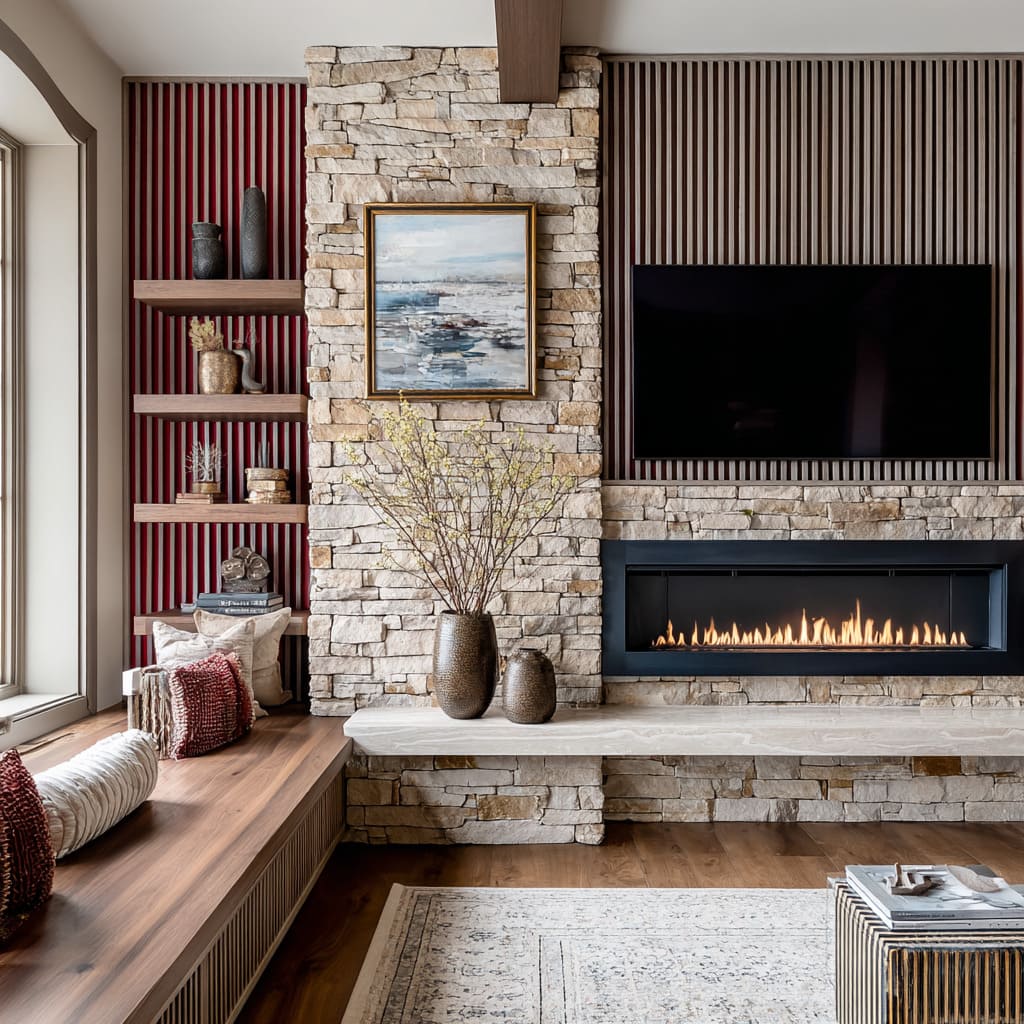
Getting texture without visual noise
A lot of stone fireplace living room ideas are requested because people want depth, but they’re worried stone will dominate everything. The modern solution is rarely less stone.
It’s lower contrast texture and predictable rhythm.
Low-contrast texture: the quiet stone effect
The most calm modern stone fireplace ideas often use stone that has variation, but that variation sits in a narrow value range.
- Large-scale cloudy movement (soft greige-beige shifts) reads like atmosphere rather than pattern. It gives depth without shouting.
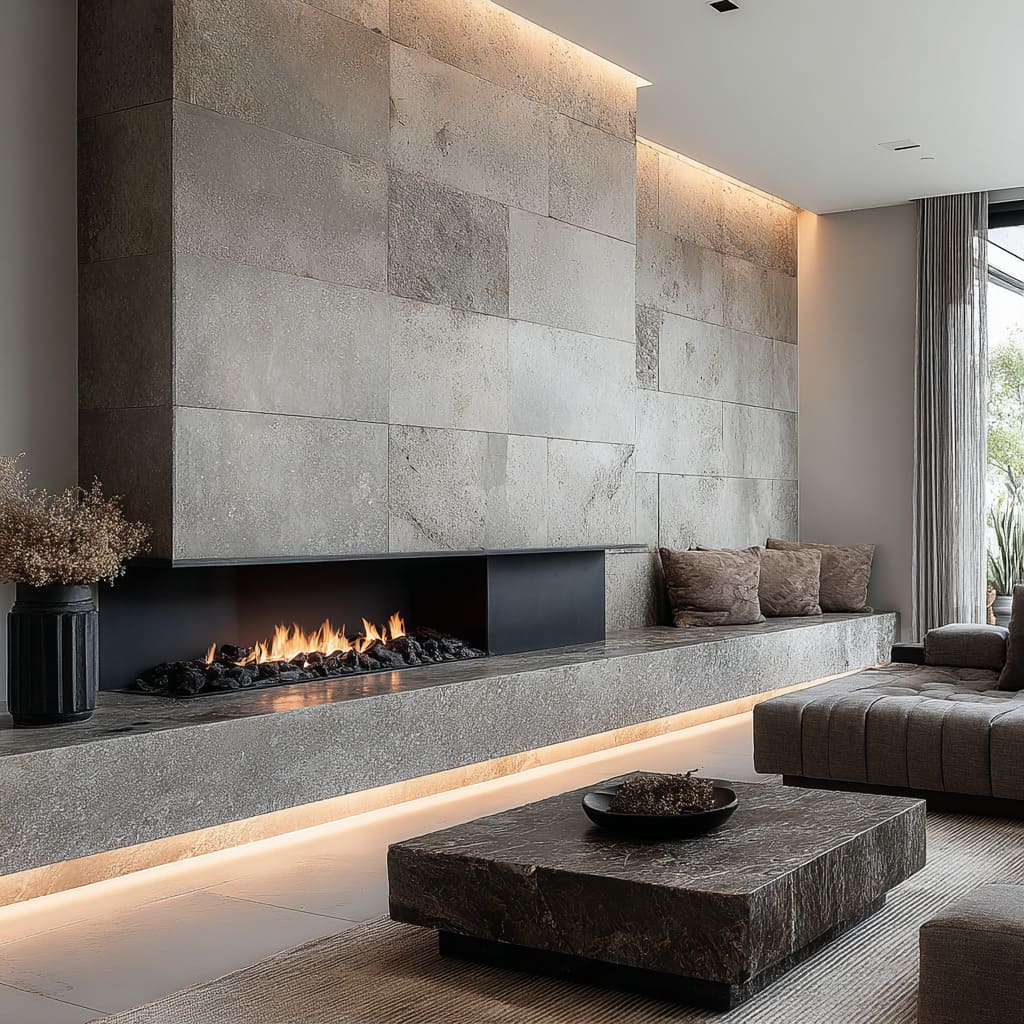
- Fine veining on a charcoal stone plane can work as movement, but only when the lines are thin, sparse, and not high-contrast. The wall looks dimensional rather than decorated.
This is the key difference between texture and noise: noise has high contrast steps that demand attention; quiet texture has small contrast steps that reward attention only after the main composition is understood.
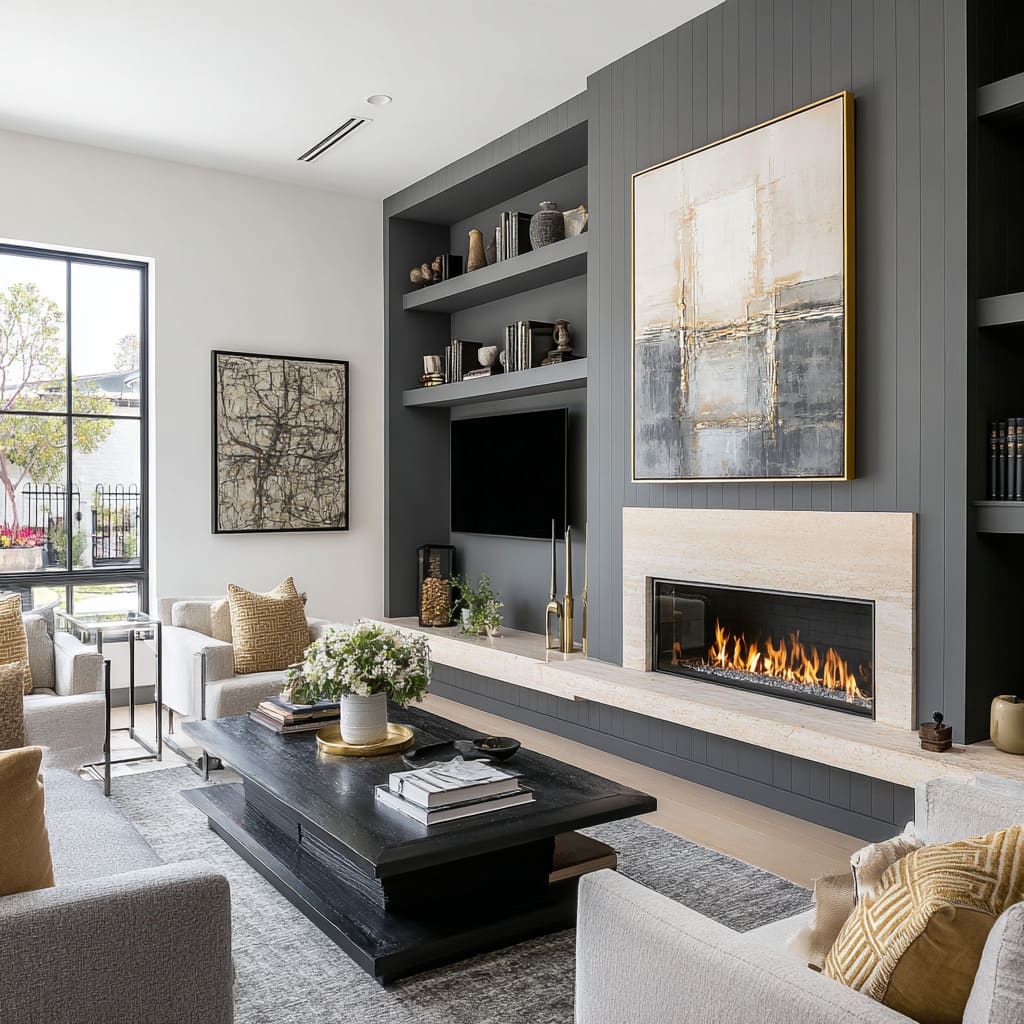
Rhythm control: repeating one type of line, then letting stone be the soft note
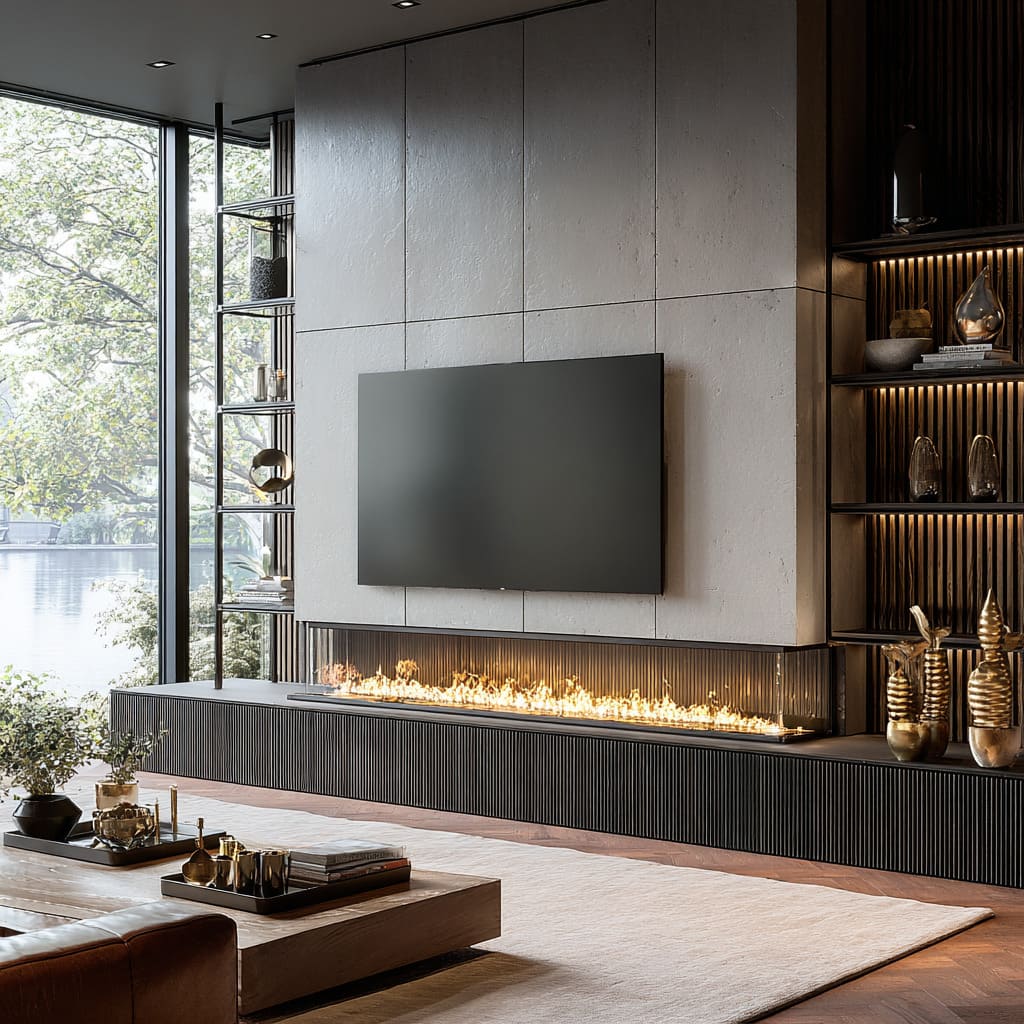
Many successful stone accent wall with fireplace compositions include a second texture that is more disciplined than stone—often vertical slats or ribbing.
- Vertical slats introduce a matte rhythm that breaks up severity in dark schemes. They make a large dark wall feel designed, not slab-like.
- Ribbed cabinetry fronts repeat a fine-line rhythm at the base, turning a dark mass into a surface with gentle highlights and shadow grooves.
This pairing is subtle: stone supplies organic variation; slats or ribbing supply measured order. The design reads modern because the order texture keeps the stone from drifting into rustic associations.
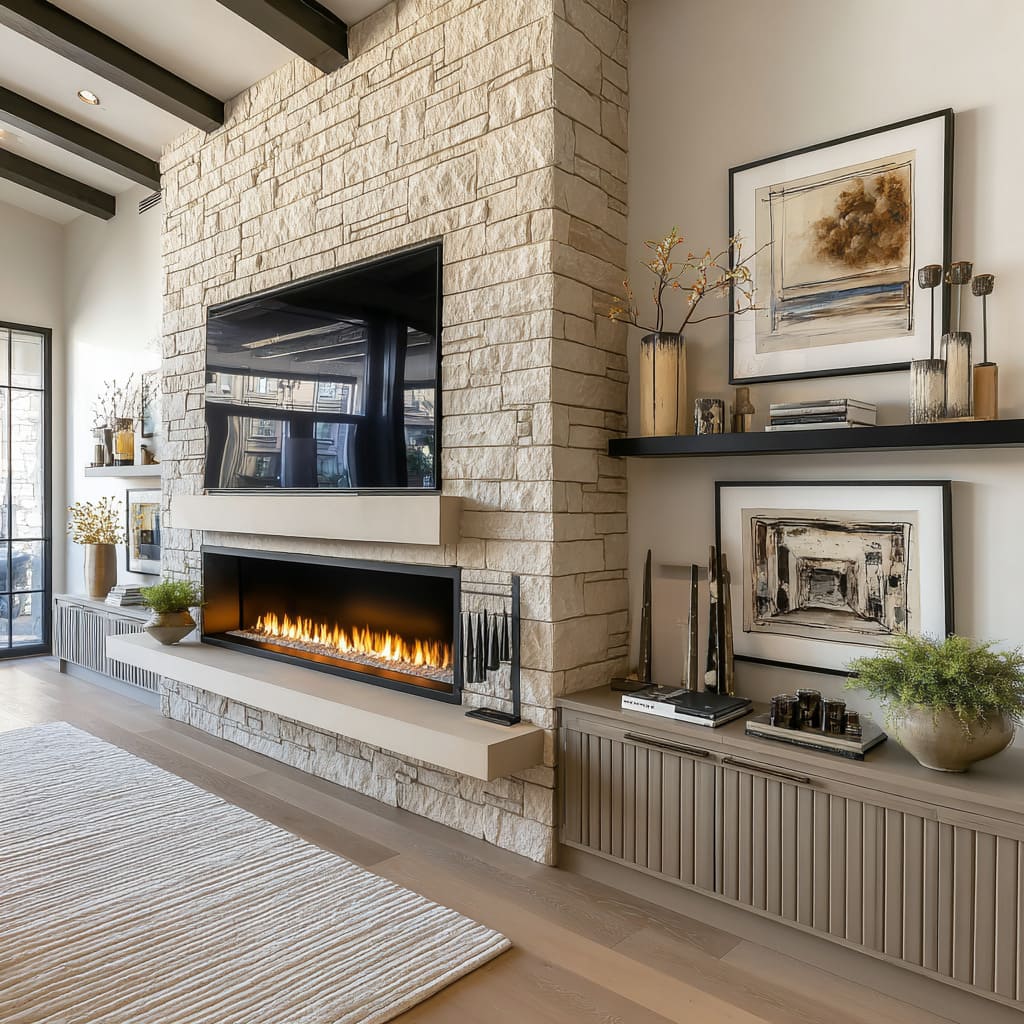
Negative space is part of the texture strategy
An interesting point in modern stone fireplace ideas: the wall can look finished with fewer objects when the surface itself is rich and the objects are spaced with intention. Dark shelving niches styled with lots of breathing room do more than decorate.
They turn emptiness into a design tool: the wall gains depth through shadow pockets, not through clutter. This is a major reason stone wall fireplace ideas can look complete with minimal styling—because the wall already has texture and depth built into its big planes.
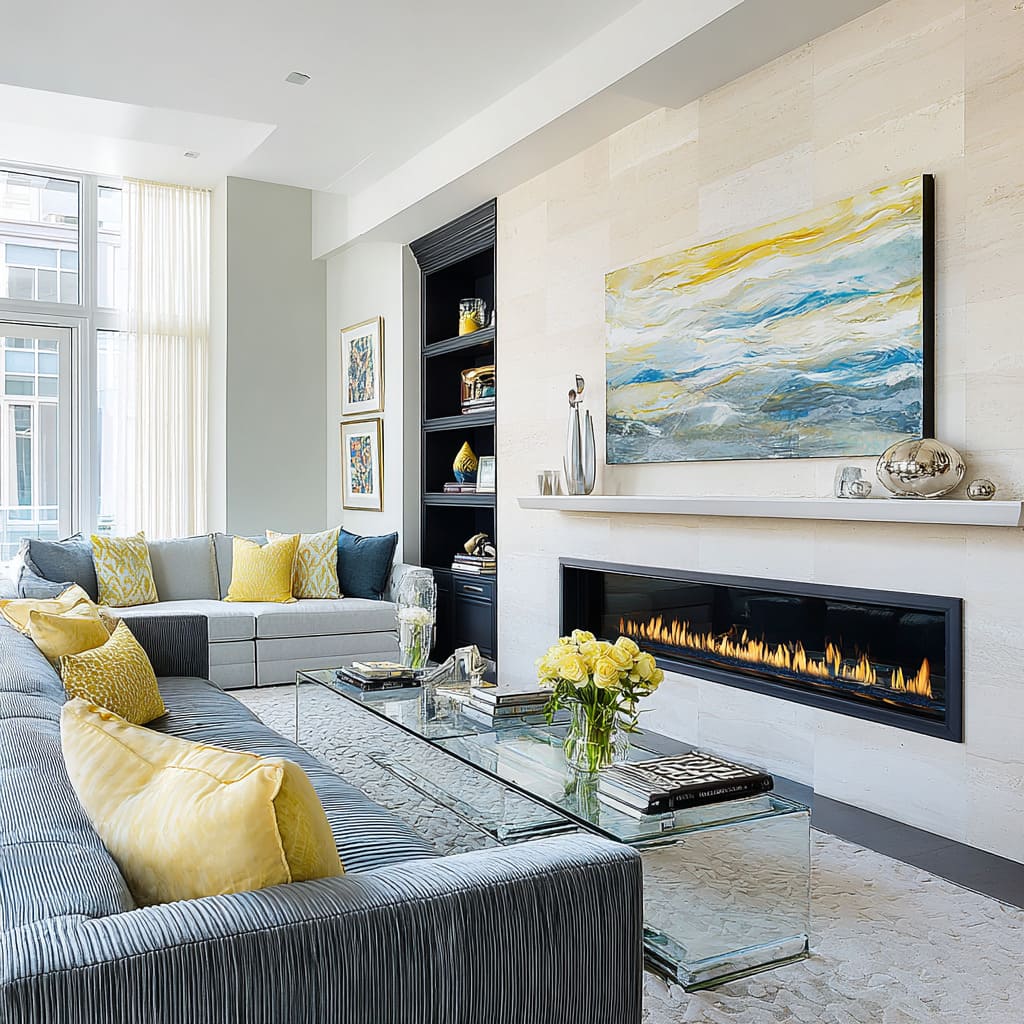
Controlling weight: grounded but not crushed
A stone fireplace wall is often the heaviest visual object in the room’s design, even when it’s pale. Modern designs control weight by manipulating three things: mass placement, void placement, and relief placement.
Mass placement: where the wall lands
In many living room ideas with stone fireplace, the wall feels right when the lower zone looks stable and continuous. That stability often comes from a long base line:
- A bench-like ledge that runs under the fireplace and continues outward makes the feature feel anchored. The fireplace stops floating as a separate box and becomes part of a grounded platform.
- When that base extends into a seating perch with pillows, the weight becomes livable instead of monumental. The wall’s mass turns into comfort, not intimidation.
Void placement: black rectangles that lighten heavy surfaces
It sounds counterintuitive, but adding black voids can make stone feel lighter.
- A long linear firebox is a controlled void: it cuts a clean gap that reads as a precise incision, not a bulky insert.
- A TV framed as a void (especially when aligned with the firebox language) feels less like a random glossy object and more like an intentional cutout.
When both TV and fire are treated as voids inside one larger stone plane, the wall becomes one organized feature instead of two competing weights.
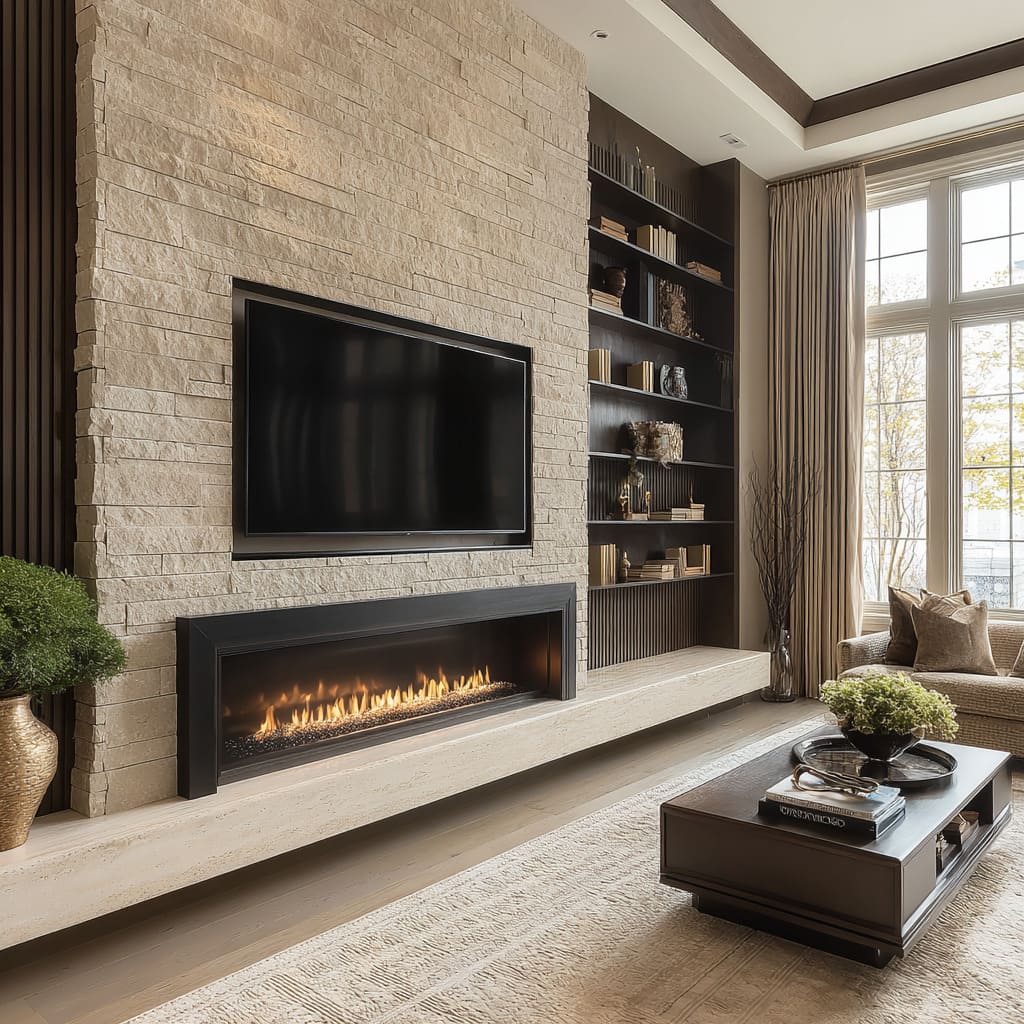
Relief placement: texture that reduces heaviness
Heavy walls feel heavier when they are smooth and uninterrupted. Relief (slats, ribs, stacked micro-lines) can reduce that heaviness by breaking the surface into many small light-catching events.
- A ribbed dark base reads lighter than a flat dark base because it has built-in highlight/shadow rhythm.
- Slatted panels next to stone prevent a large stone field from reading as a blunt block; the wall gains a softer visual edge without losing clarity.
This is why some modern stone fireplace ideas look strong but not oppressive: weight is distributed into rhythm, not concentrated into one flat slab.
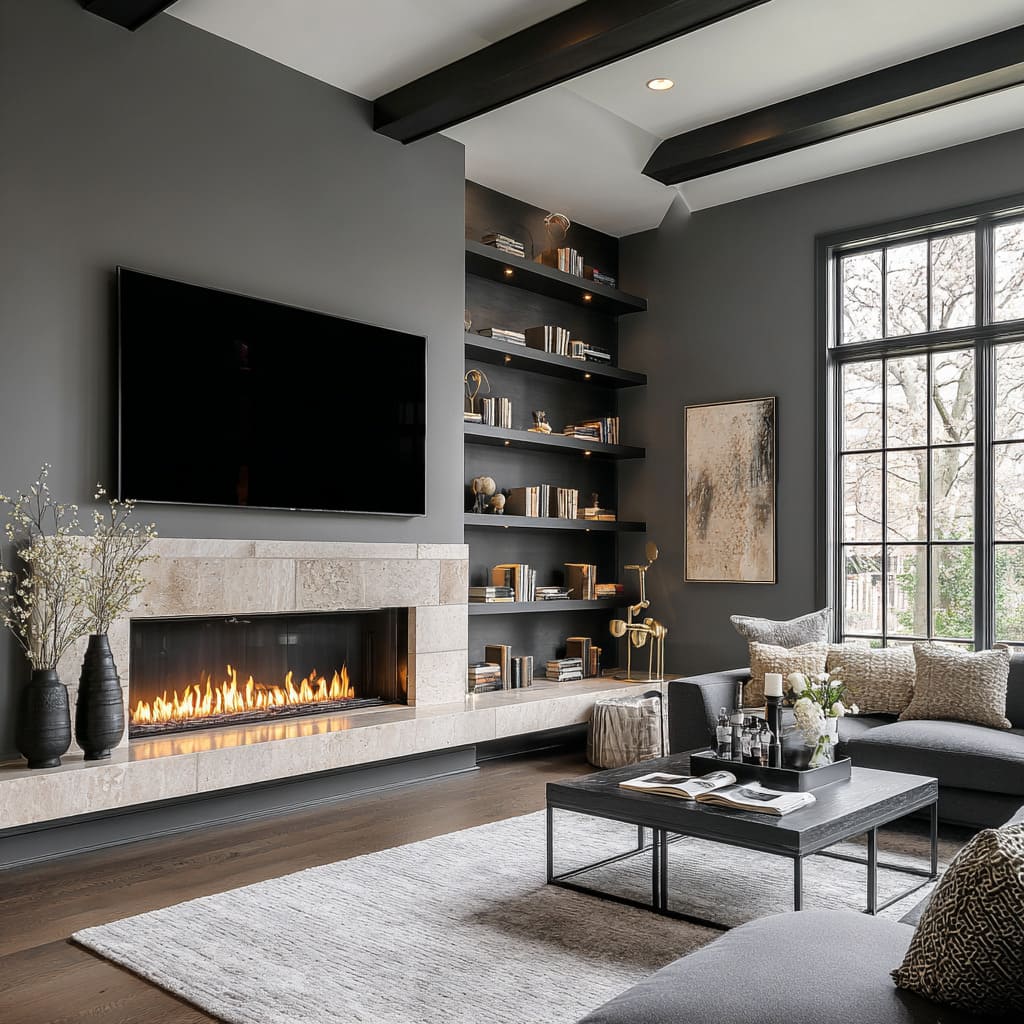
Fixing the blank wall problem without adding clutter
Stone is often used to solve a wall that feels empty or unfinished. The modern trick is making the wall’s architecture do the finishing work so decor can stay sparse.
Stone as a finished surface
A pale stone-look wall with subtle banding can replace the need for lots of art and accessories because it already reads like a completed plane. The wall looks planned because it carries its own visual interest.
Panel seams and grids: structure without decor
In the most minimal modern stone fireplace ideas, stone is divided into large panels with clear seams. Those seams create a quiet grid that makes the wall feel designed even if the mantel is nearly empty and the styling is restrained.
This is a mature solution for blank walls: the wall’s job is not to hold many objects; it’s to hold proportion.
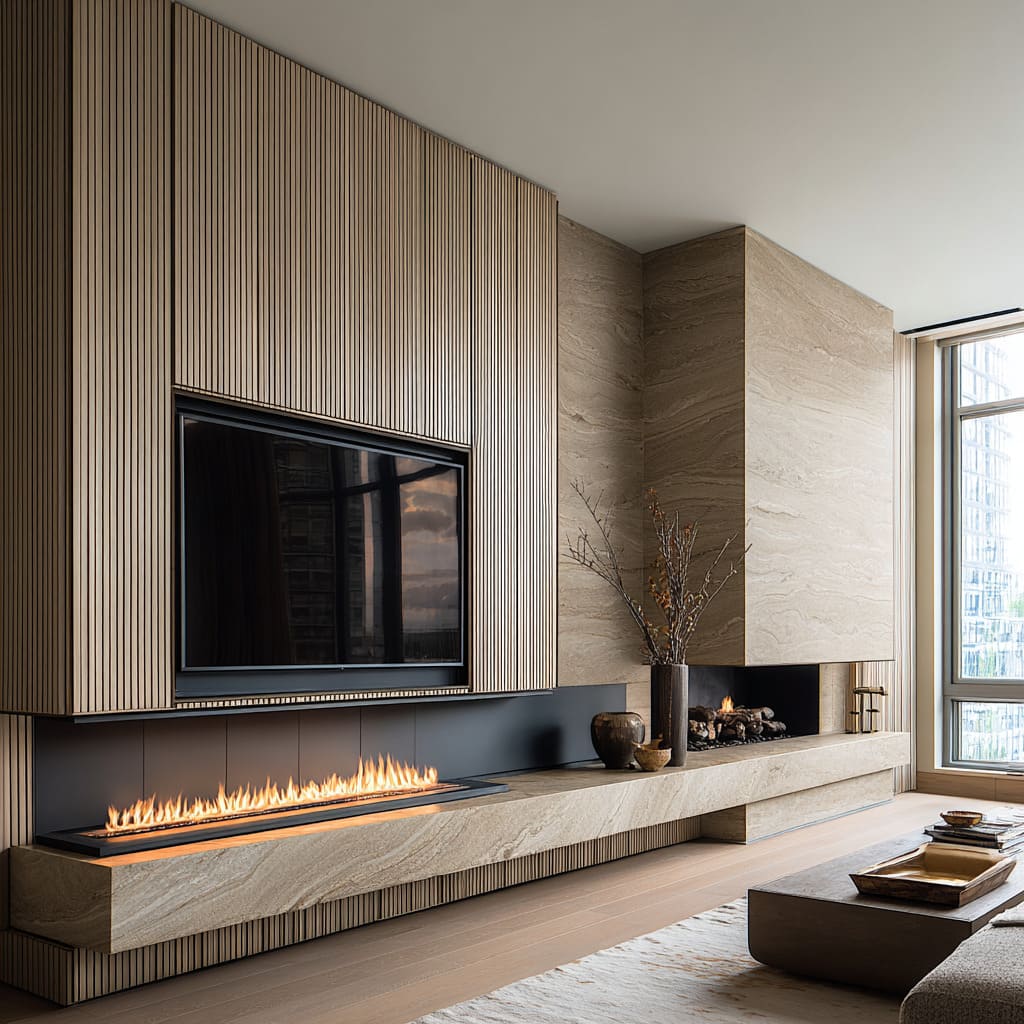
The long line: a single gesture that finishes the wall
A continuous horizontal media line (a long ledge or base that ties fireplace and TV zones into one system) can make the wall feel complete by itself. It creates a compositional rule that everything else follows:
- The fire becomes a warm underline.
- The TV becomes a graphic rectangle that sits in the same logic.
- Styling becomes secondary, because the wall already has clear structure.
This is why stone fireplace ideas can look finished in photos without looking crowded: the wall is done through lines and planes, not through accessories.
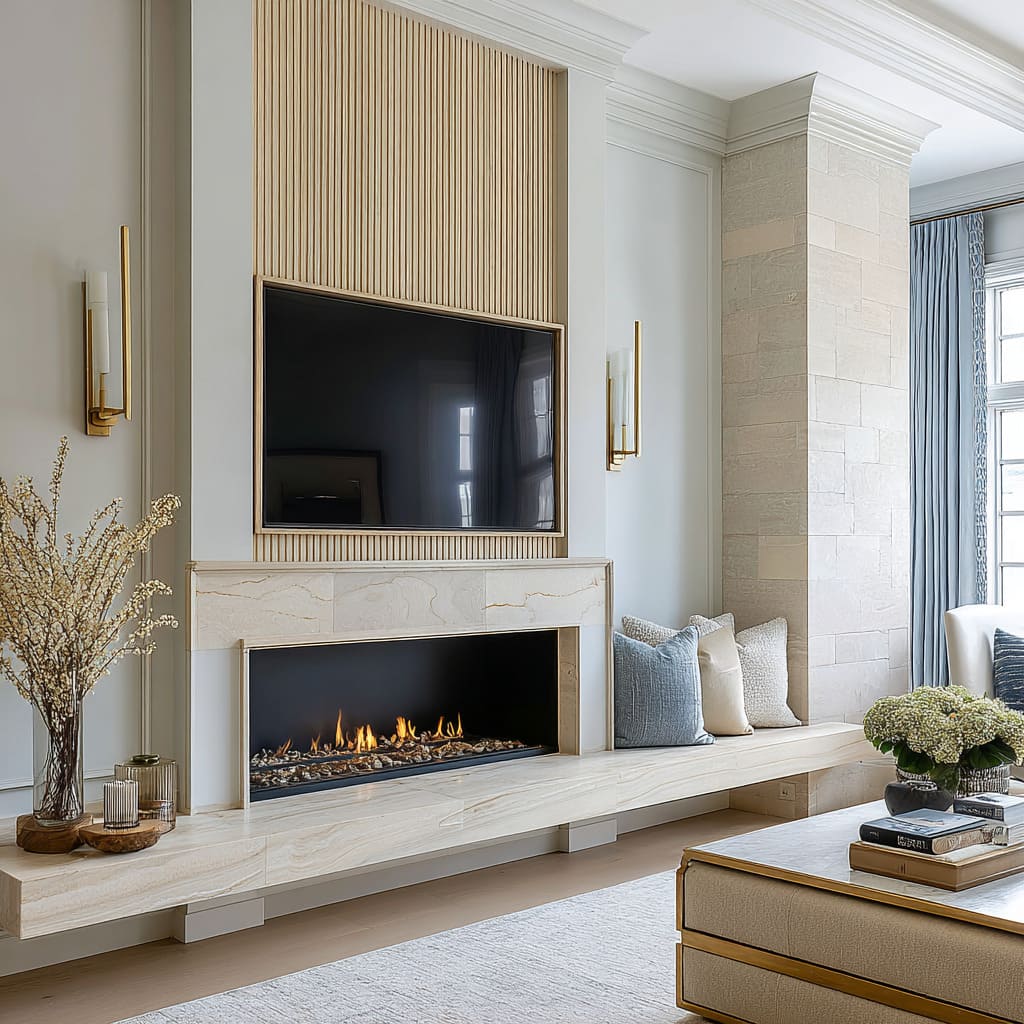
Keeping stone clean and current (avoiding a rustic cabin feel)
The rustic outcome usually happens when stone reads as busy, chunky, and irregular, or when it’s paired with soft traditional cues that turn the design themed. Clean and current stone reads modern when the design emphasizes edited pattern, crisp boundaries, and restrained warmth.
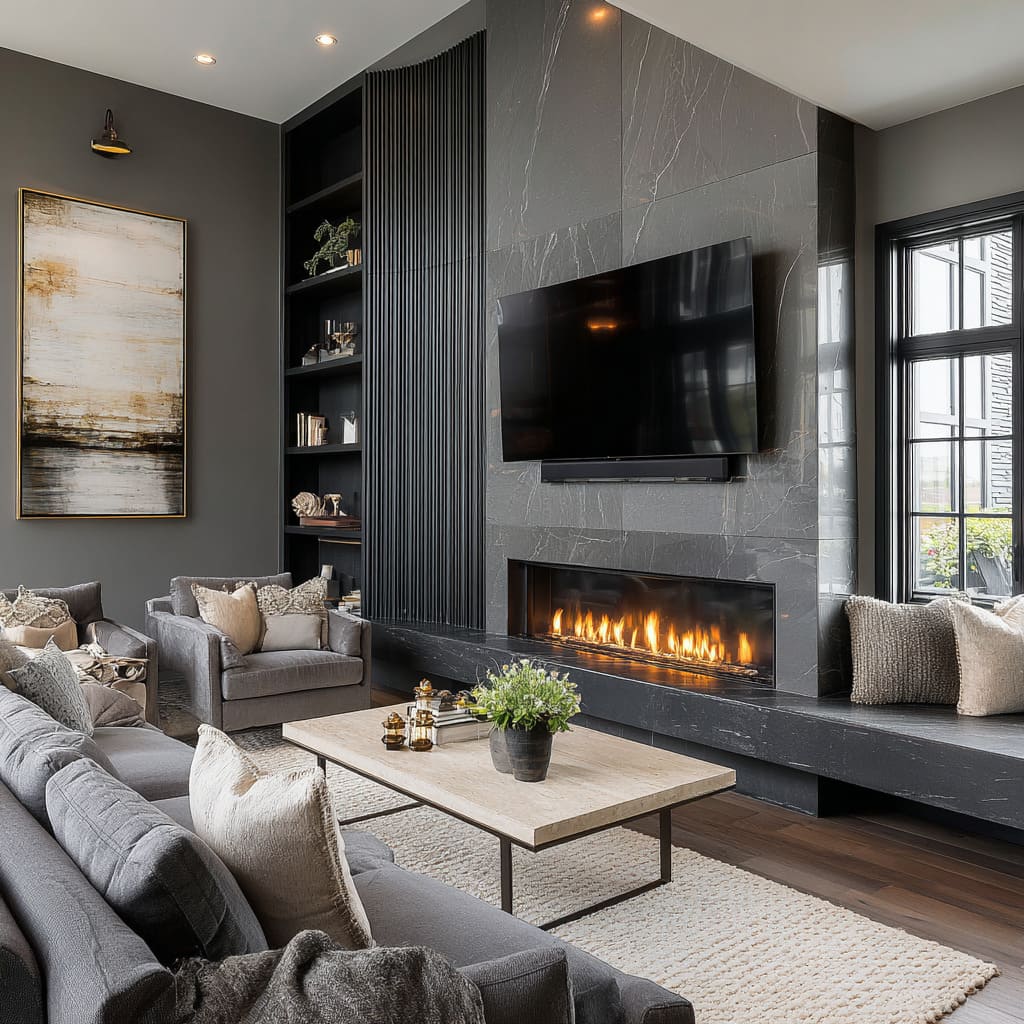
What makes stone read modern
- Calm pattern scale. Large slab-like movement or low-contrast stacked micro-lines (all in one tight color family) keep the surface contemporary.
- Crisp black boundaries. A black firebox opening and, often, black window frames or black niche voids give the wall sharpness. Sharpness is what stops stone from drifting into cozy-lodge styling.
- Minimal object height. Low-profile styling along long ledges avoids the mantel clutter look that pushes a fireplace toward traditional.
The stone + disciplined texture pairing
Stone becomes noticeably more modern when paired with a second surface that has strict order: vertical wood slats, dark ribbing, or matte grooved panels. The stone reads as a refined material plane because it sits next to a surface that feels engineered and precise.
This is a big reason stone wall fireplace ideas often look best when there is at least one other architectural texture nearby. The wall feels curated rather than themed.
The high-end signal: why stone looks expensive fast
Stone signals permanence, but the expensive look comes from restraint, hierarchy, and light behavior, not from more stone.
Restraint: fewer materials, clearer roles
High-end modern stone fireplace ideas usually assign each material a single job:
- Stone = calm depth / permanence
- Black voids = outline / precision
- Wood = warmth filter
- Metal = controlled sparkle
- Textile = softness and scale relief
When materials have clear roles, the interior design feels intentional. When too many surfaces compete for attention, stone can look like a random add-on.
Hierarchy: stone supports the focal point instead of becoming the only focal point
A refined stone wall often acts as a supporting plane that makes the fireline, the TV rectangle, and art read crisp. The stone doesn’t need to be dramatic if it makes everything else look sharper, softer, or richer.
Light behavior: the hidden luxury tool
The fastest expensive effect is often how stone handles light:
- Sheer curtains and diffused daylight make pale stone look creamy and intentional rather than blotchy.
- Warm backlighting in niches makes cool stone feel welcoming without changing the palette.
- Under-bench glow lines can make thick stone bases feel lighter, turning mass into a floating gesture (visually), which reads refined.
These moves also connect to yellow: in many stone fireplace living room ideas, yellow appears as warm glow (firelight, niche light, candle-like highlights), which reads richer than bright yellow decor.
Solving the TV + fireplace visual fight
Even when it’s not said out loud, many living room stone fireplace ideas are really about reducing awkwardness: two focal points competing on one wall. The most effective solutions treat the wall as a single composition with shared rules.
One plane, two voids
The cleanest approach is placing TV and fireplace on the same dominant surface so they read as related cuts:
- On pale stone: the TV becomes a calm dark rectangle, and the fire becomes a warm dark rectangle, both stabilized by the stone’s quiet movement.
- On charcoal stone: both TV and fire read as voids carved into the same mass; the wall becomes one statement, not two statements.
Shared outline language
A major fix: when the TV and fire share similar boundary treatment (thin black frame language, consistent alignment, or a connecting horizontal line), the wall reads organized even if the TV sits above the fire.
The counterweight: shelving and vertical rhythm
Tall shelving niches or vertical slat panels act as counterweights that stop a long linear fire from stretching the wall visually. They also break up the wall’s scale, which prevents the TV and fireplace from becoming the only readable items.
This is why modern stone fireplace ideas often include one vertical element near the composition: it prevents the wall from feeling like a long horizontal stripe with a big black screen.
The big takeaway: stone works when it behaves like a visual stabilizer
In the strongest stone fireplace living room ideas, stone is the stabilizer that makes everything else feel more intentional:
- It gives the TV a calm background so the screen looks integrated.
- It gives the fire a crisp boundary so the flame reads like a refined warm underline.
- It solves blank-wall unease by supplying structure (seams, grids, long lines) so decor can stay edited.
- It adds depth without noise when contrast steps are small and rhythm is controlled.
- It makes yellow feel sophisticated because yellow becomes light and reflection, not a loud accent object.
That is why living room stone fireplace ideas and living room ideas with stone fireplace often feel high-end even when the decor is minimal: the wall itself carries the composition through tone discipline, outline clarity, and quiet texture rhythm.
And that’s the real reason fireplace with stone ideas feel like they belong in modern rooms: stone isn’t treated as an add-on. It’s treated as the room’s organizing surface—calm enough to hold everything, rich enough to finish the space, and precise enough to keep the mood clean and current.
Related Posts
Harmony Home Design brings 10+ years of residential interior design experience to the ideas shared here. We publish design concepts, layout thinking, and practical styling notes.