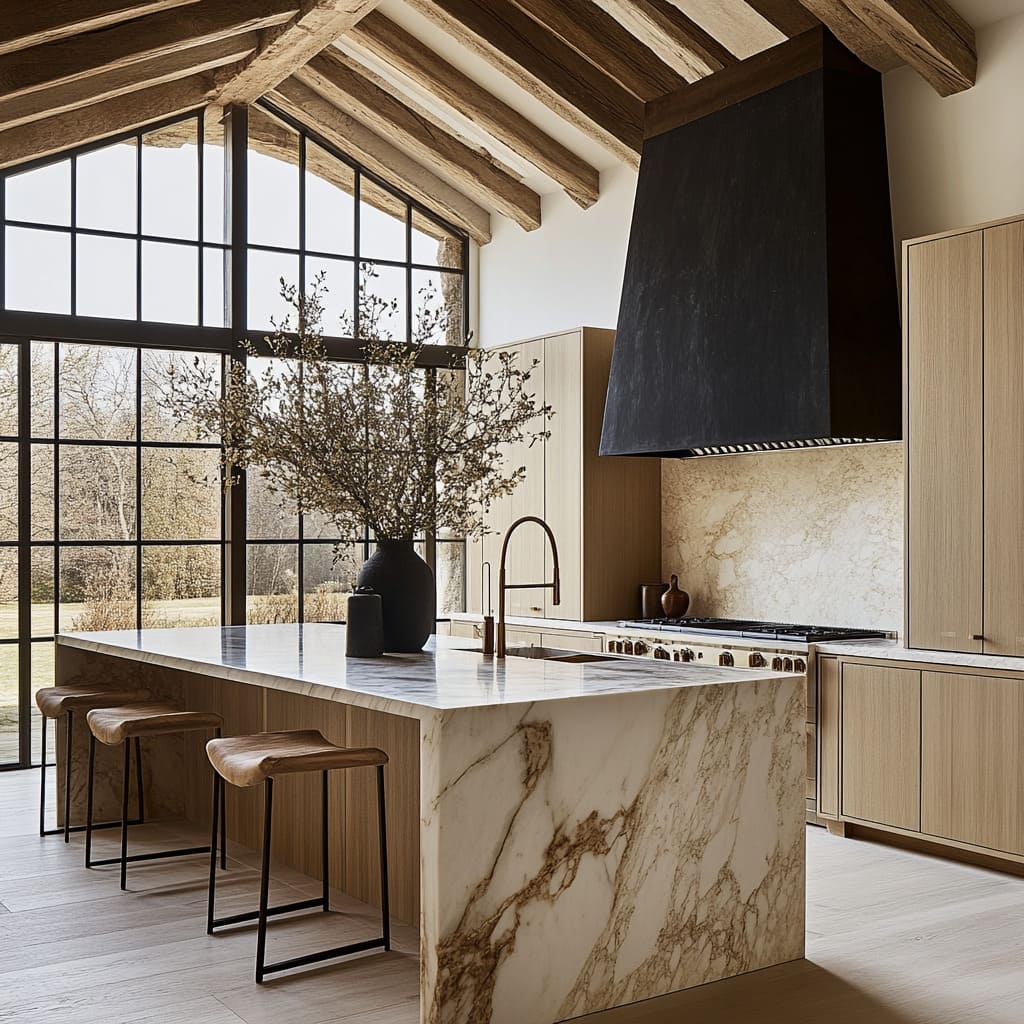
Modern farmhouse kitchen styles are sometimes considered as a single style, but the farmhouse designs that feel current rarely follow one fixed look. What repeats is a set of main points: the design is built around a few oversized anchors, the finishes stay in tightly related families, and texture gets placed in limited zones so the space looks intentional even when the counters stay usable.
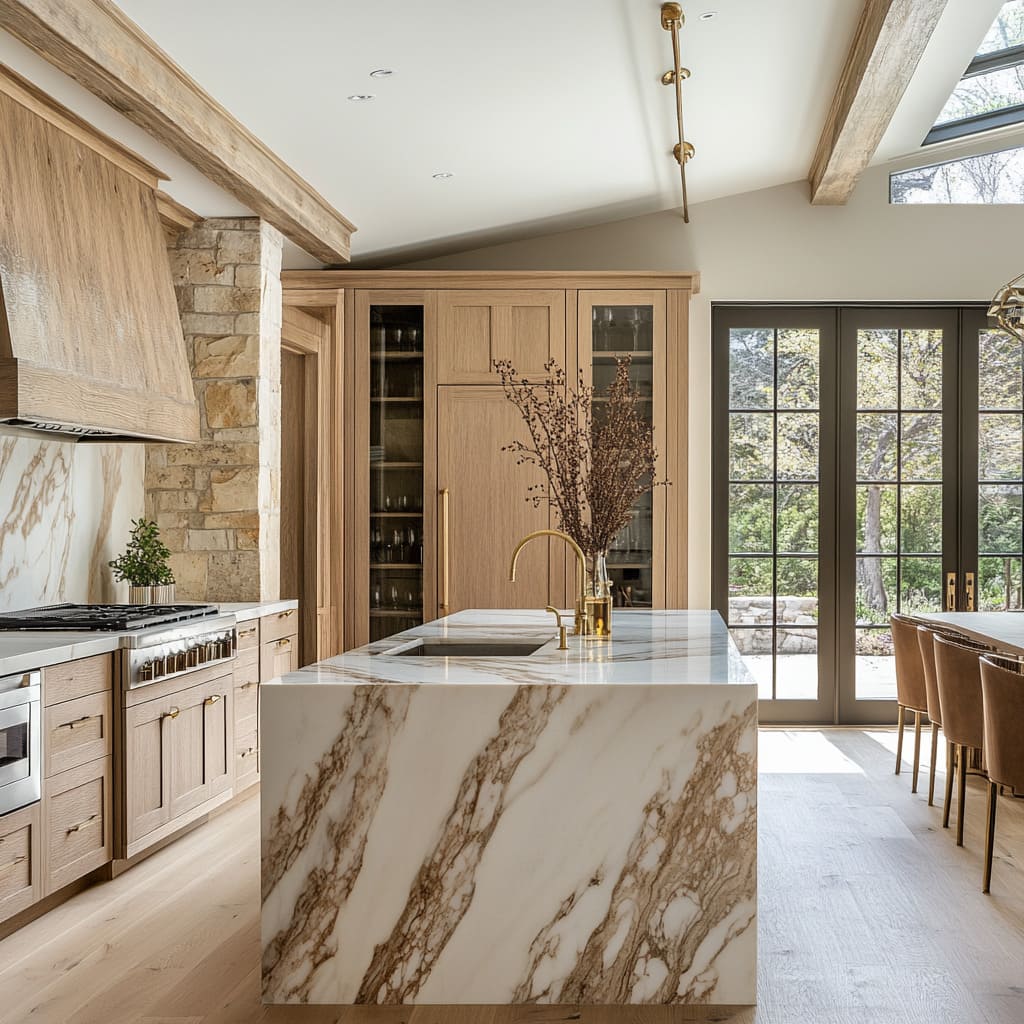
The farmhouse style part usually lives in the architectural shell—beams, trusses, plank ceilings, stone masses, and black-grid windows—while the modern part lives at eye level: simplified cabinetry lines, slab surfaces instead of small tile mosaics, and lighting forms that feel sculptural rather than decorative. The result can look bright and gentle or dark and weighty, yet the same underlying structure keeps showing up.
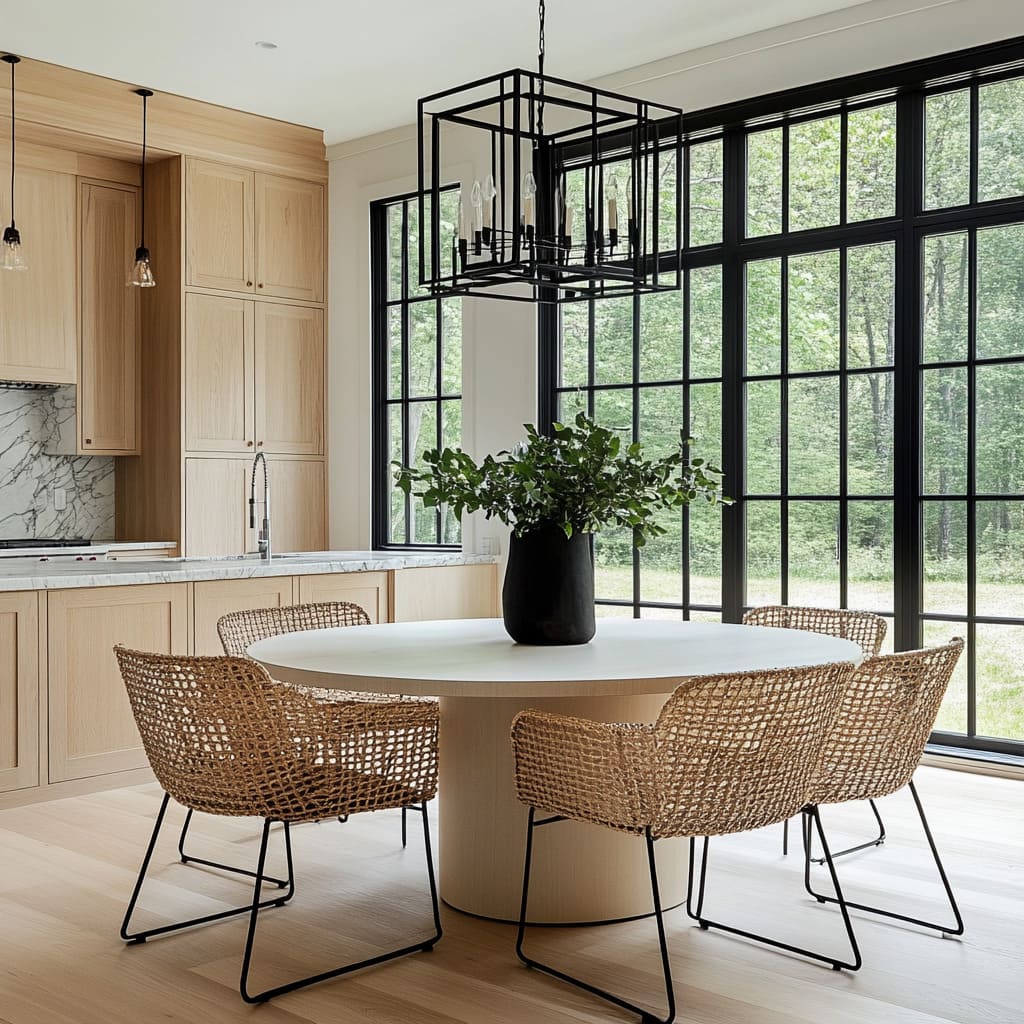
The main rules behind modern farmhouse kitchens
A modern farmhouse kitchen tends to land well when it’s organized around two big architectural anchors: A tall vertical identity on the cooking wall (hood, chimney mass, or stone hearth wall) and a strong horizontal identity in the center (island as a block or table-like object).
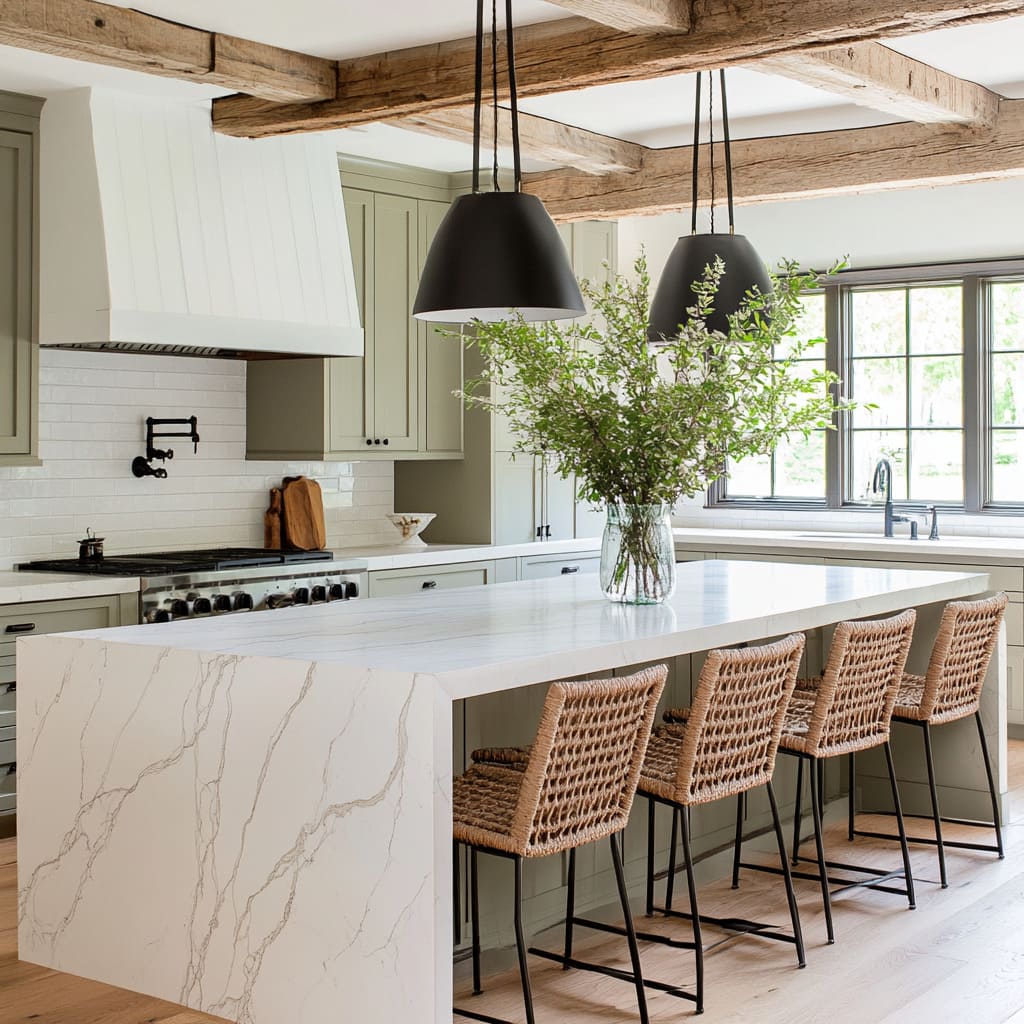
That pairing creates instant hierarchy. In the vaulted kitchen layouts, the hood or chimney is the vertical counterweight to wide window walls and long counter runs.
In the brighter versions, the same hierarchy holds, but the vertical anchor becomes plaster or pale stone so the room feels airy while still having a clear center. The finish logic stays controlled.
Even in the boldest rooms, the ingredients typically sit in a short list:
- warm wood (cabinetry, beams, ceiling slats, stool seats)
- stone (slab backsplash, waterfall island faces, thick tops)
- black linework (window grids, pendants, faucets, hood silhouettes)
- a small dose of warm metal (brass, bronze, copper) used in repeats, then stopped
That control is what keeps large-scale elements from fighting each other. A space can hold a dramatic hood plus a waterfall island plus a wall of black-grid glass if the material families stay disciplined.
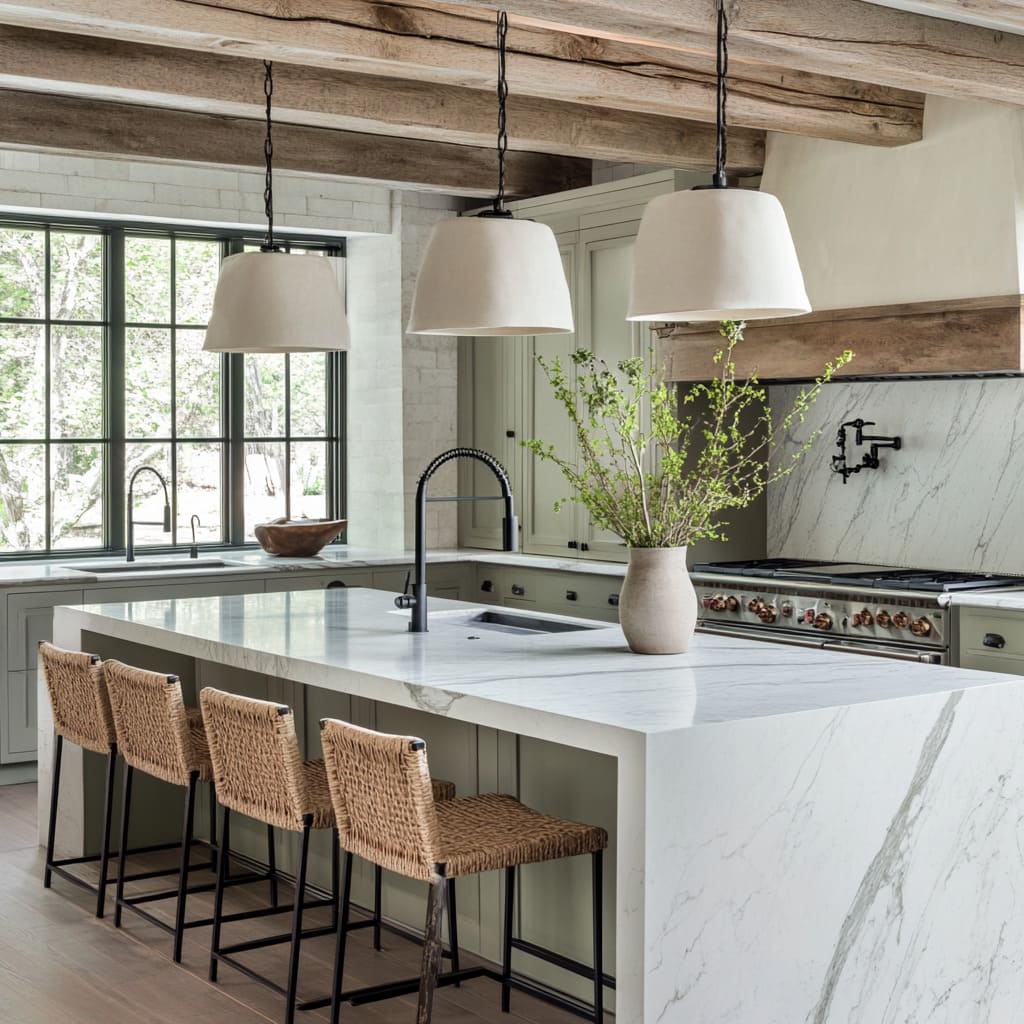
Texture is treated like a zoning tool, not a room-wide theme. Instead of spreading texture everywhere, the strongest examples place texture in a few concentrated locations:
- overhead: beams, trusses, coffer grids, slatted ceilings
- at seat height: woven stools, leather, cane backs
- on one major vertical surface: stone wall, slab backsplash, or dark panel envelope
With those zones established, the rest of the room can stay calm: flat cabinet planes, long uninterrupted counters, and minimal objects on the surfaces. That’s why many of these kitchens look finished with only one tall branch arrangement and a bowl or two .
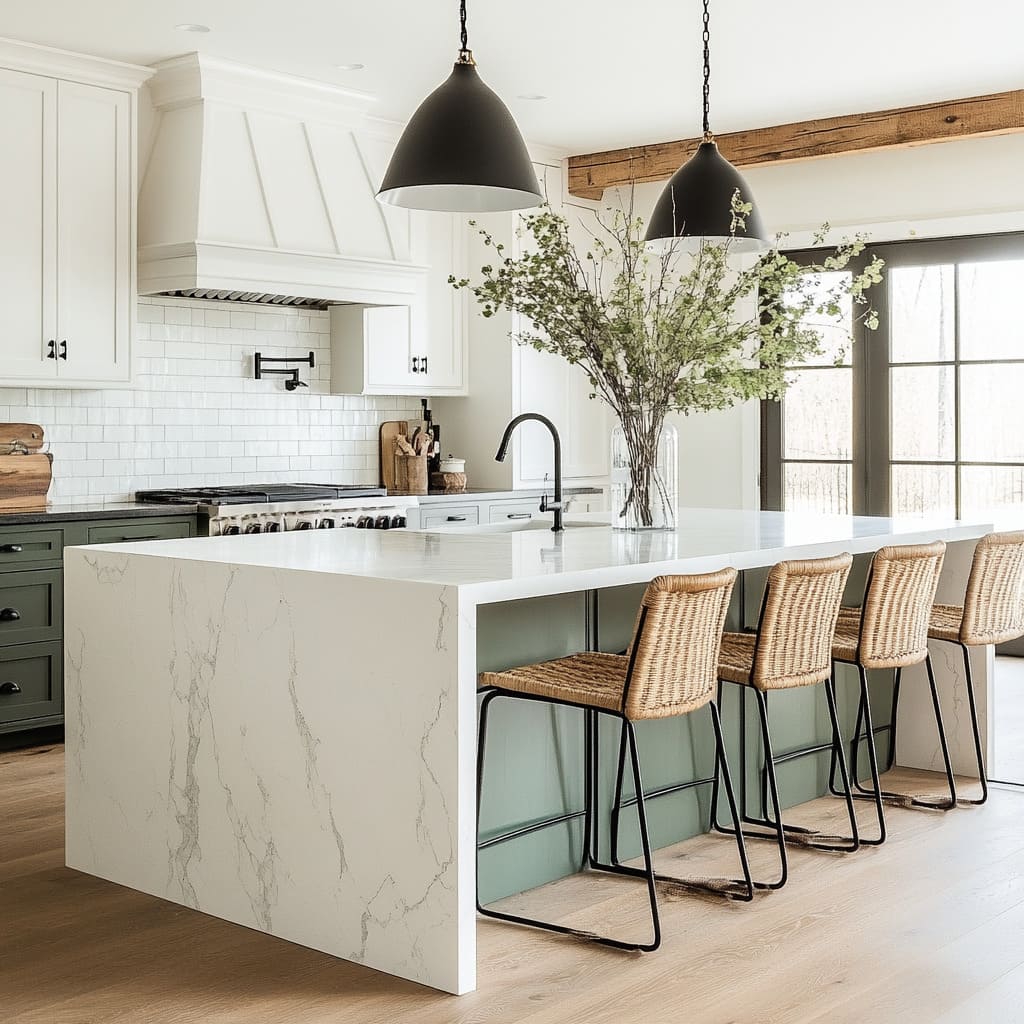
Six core design ideas and why they work
Axis planning and symmetry: the room feels built, not styled
It is about a centered alignment that runs island → faucet → hood → range, with matching visual weight left/right so the room reads as one composed scene. A strong axis reduces visual noise.
When the central stack is clear, the eye doesn’t need lots of small objects to understand the room. Symmetry also makes big architectural features feel calmer: three oversized pendants, a full-height stone wall, and a long island can look orderly instead of busy when they land on one alignment.
This is especially visible in the high-contrast hearth-wall kitchens where the chimney mass becomes the center stage and everything else frames it. It also shows up in the very clean light-oak rooms where the palette is pale and the structure does the heavy lifting.
Even darker kitchens benefit because symmetry turns a moody palette into a tailored backdrop instead of a heavy block.
The axis can collapse if one element drifts off-center: a pendant row shifted from the island, a faucet placed so it visually cuts the island in an awkward spot, or side cabinets that don’t balance the chimney mass.
Another frequent issue is mixing too many competing center markers—multiple vases, tall stacks, or scattered decor—so the central alignment gets lost.
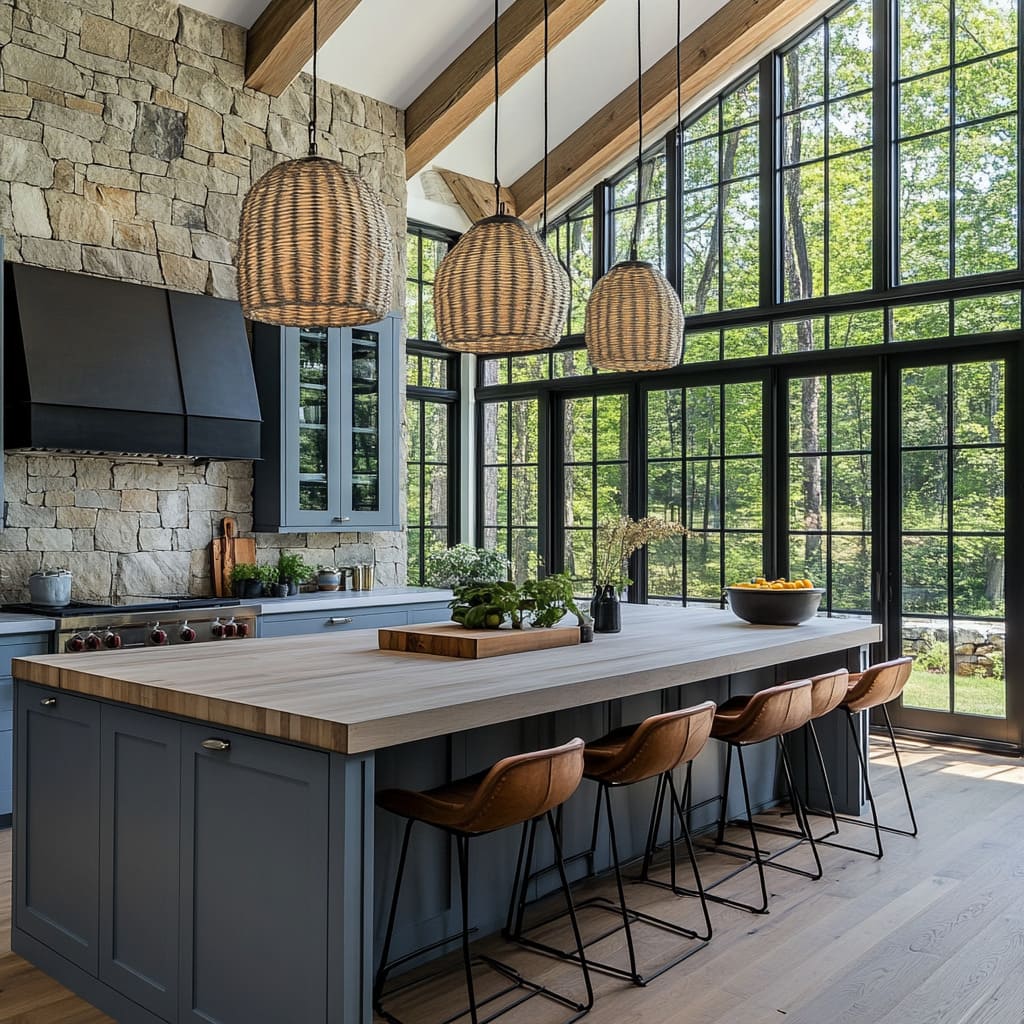
Window-grid kitchens and backsplash choices
Black-grid glazing becomes the dominant wall rhythm, and the backsplash is chosen to support that rhythm rather than compete with it. A window wall already creates a pattern: repeated rectangles from muntins, strong verticals, and a crisp perimeter outline.
If the backsplash adds another loud pattern, the kitchen starts to feel like stacked grids. The most successful rooms treat the backsplash as a continuous field—slab stone, low-contrast tile, or a quiet band—so the window grid keeps its role as the main graphic layer.
In the vaulted kitchens, the window wall behaves like architecture, so the countertop styling can be minimal without the room feeling empty. In the lighter sage kitchens with black mullions, the mullions act as the crisp outline that keeps soft paint from turning sweet, while slab backsplash choices keep the range wall calm.
In the darker kitchens, black windows prevent the palette from flattening because daylight and geometry stay active.
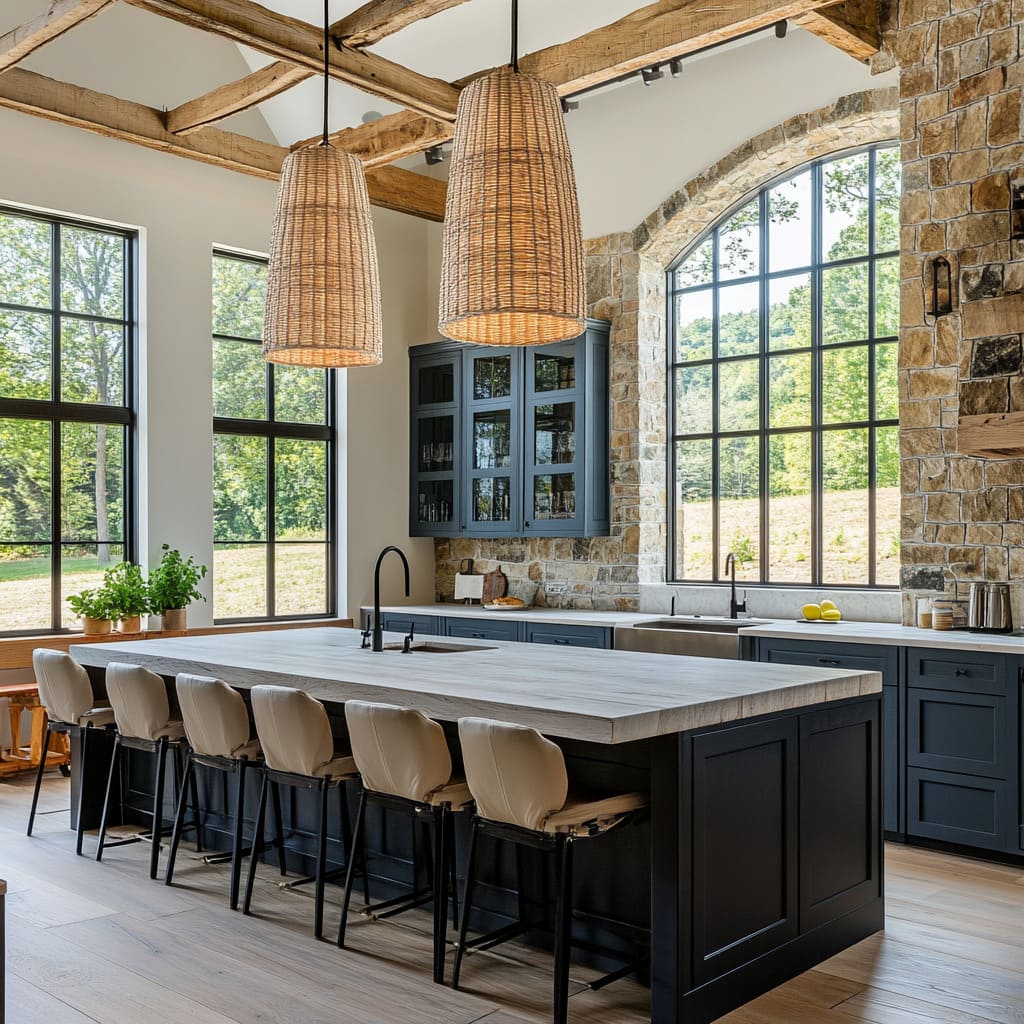
But there are two main extremes that cause trouble: a backsplash with high-contrast grout grid that competes with window muntins, or a busy patterned tile that adds a second rhythm behind the range. Another issue is choosing reflective tile in a room where glass and steel already dominate; too many shiny surfaces can make the wall feel visually restless.
Slab backsplashes and waterfall islands
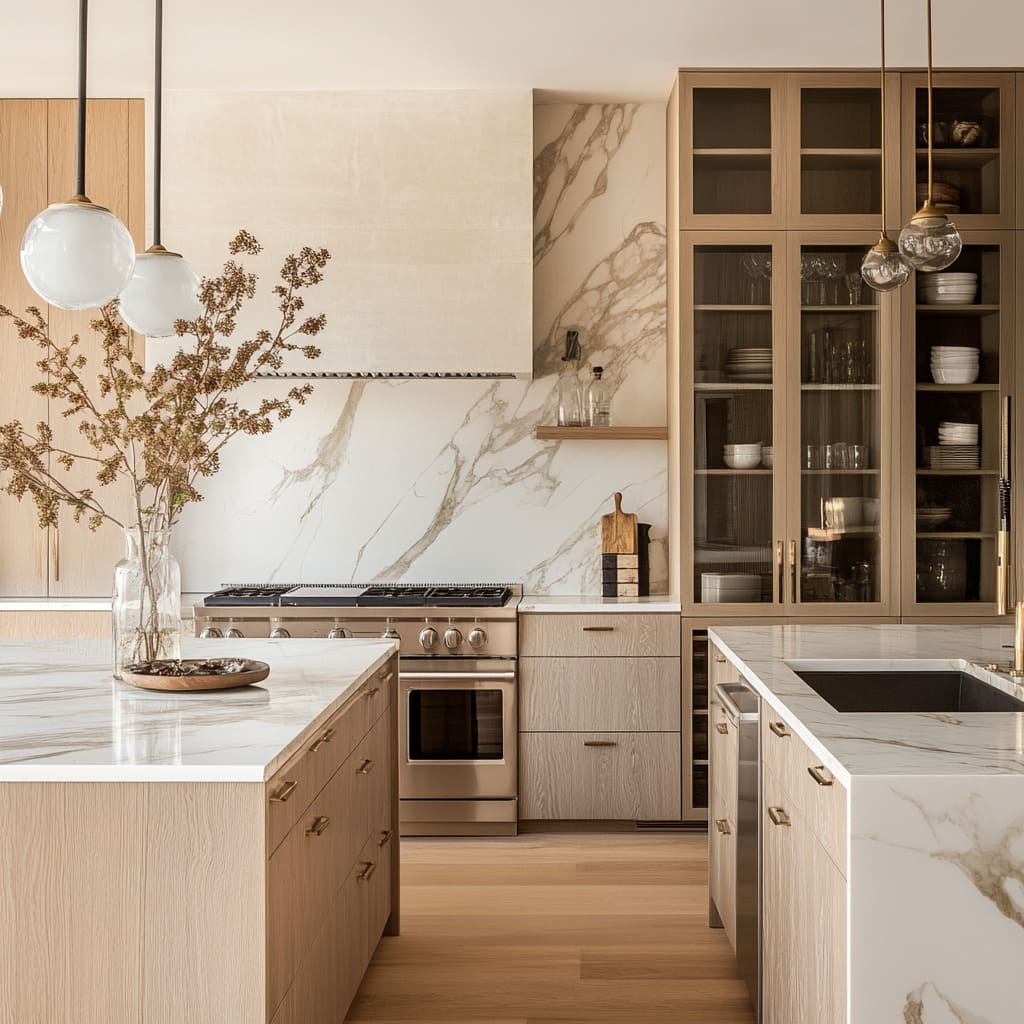
Using one or two major slab surfaces to carry the visual interest: a full-height slab behind the range, a waterfall island face (or legs), and sometimes both in the same stone family. Slabs read like continuous planes, so they simplify the room even while adding drama.
A slab backsplash also gives the hood silhouette a clean backdrop, which is why the hood can be matte black, plaster, brass, or stone and still look intentional. Waterfall panels turn the island into an object with a front elevation, so the center of the room feels finished without extra accessories.
This logic is clear in the kitchens where the island becomes a carved block through continuous veining on the vertical face. It is also common in the brighter designs where slab veining stays soft and spaced out, allowing beams, woven seating, and shaker profiles to remain readable without the stone dominating.
The two-island concept can use slabs as a way to keep a professional layout from looking utilitarian; the slab wall becomes the visual anchor while the workflow stays clean.
When slabs are used everywhere with no quiet zones, the room can feel like competing stone moments—especially if the veining is bold on both island and backsplash. The better balance usually comes from one dominant patterned plane and one calmer horizontal plane, or one dramatic stone repeated while the rest stays restrained.
Another frequent issue is choosing a slab with tight, busy veining that creates visual static at close distance.
Dark envelope with a light work plane: weight on the walls, clarity on the surfaces
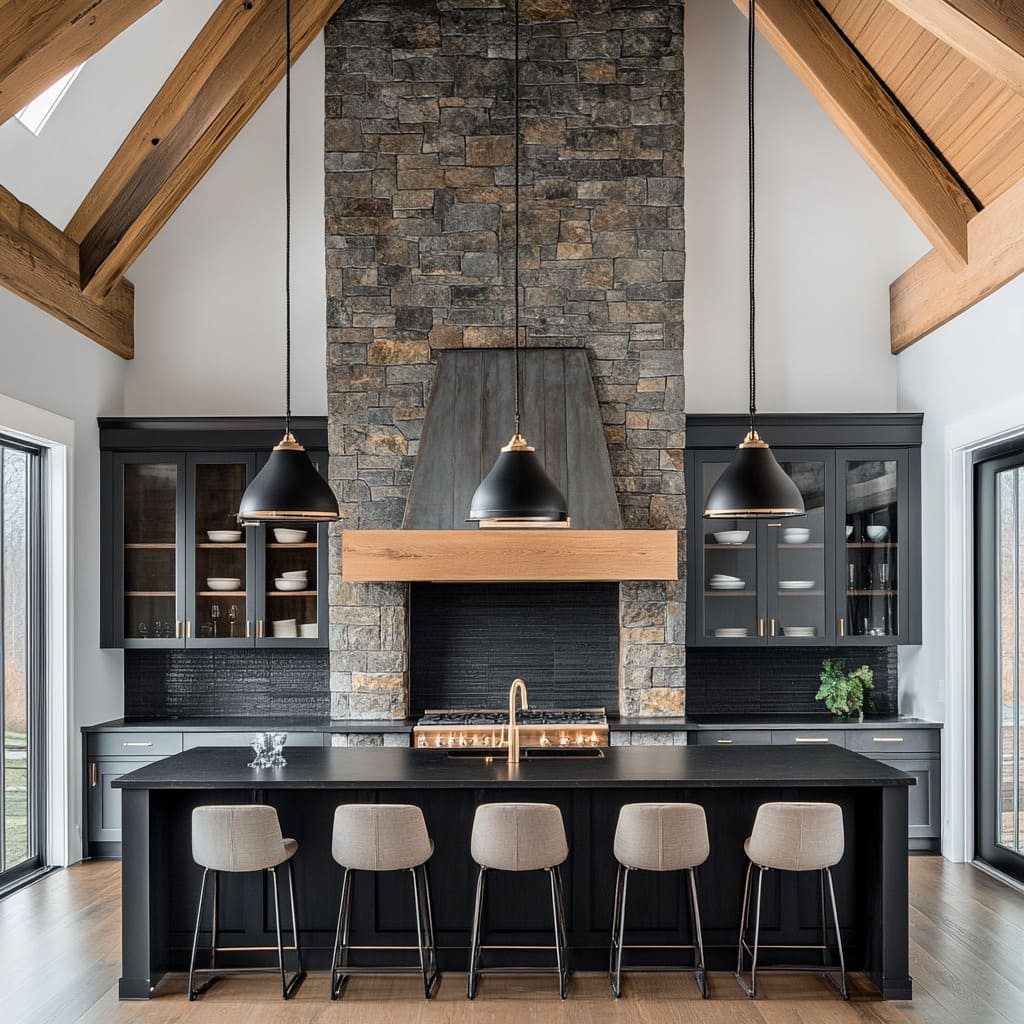
Deep cabinetry and dark vertical planes can create a wrapped, gallery-like background, while countertops and major work surfaces stay lighter and stone-like to keep function clear. Dark verticals compress visual clutter.
Cabinet lines, panels, and even recessed shelves blend into one calm mass, so the eye focuses on the few bright surfaces that matter: the island top, the cooking niche panel, a slab backsplash, or a pale stone center stack. Warm metal becomes the highlight, used in small repeats so the room doesn’t feel cold.
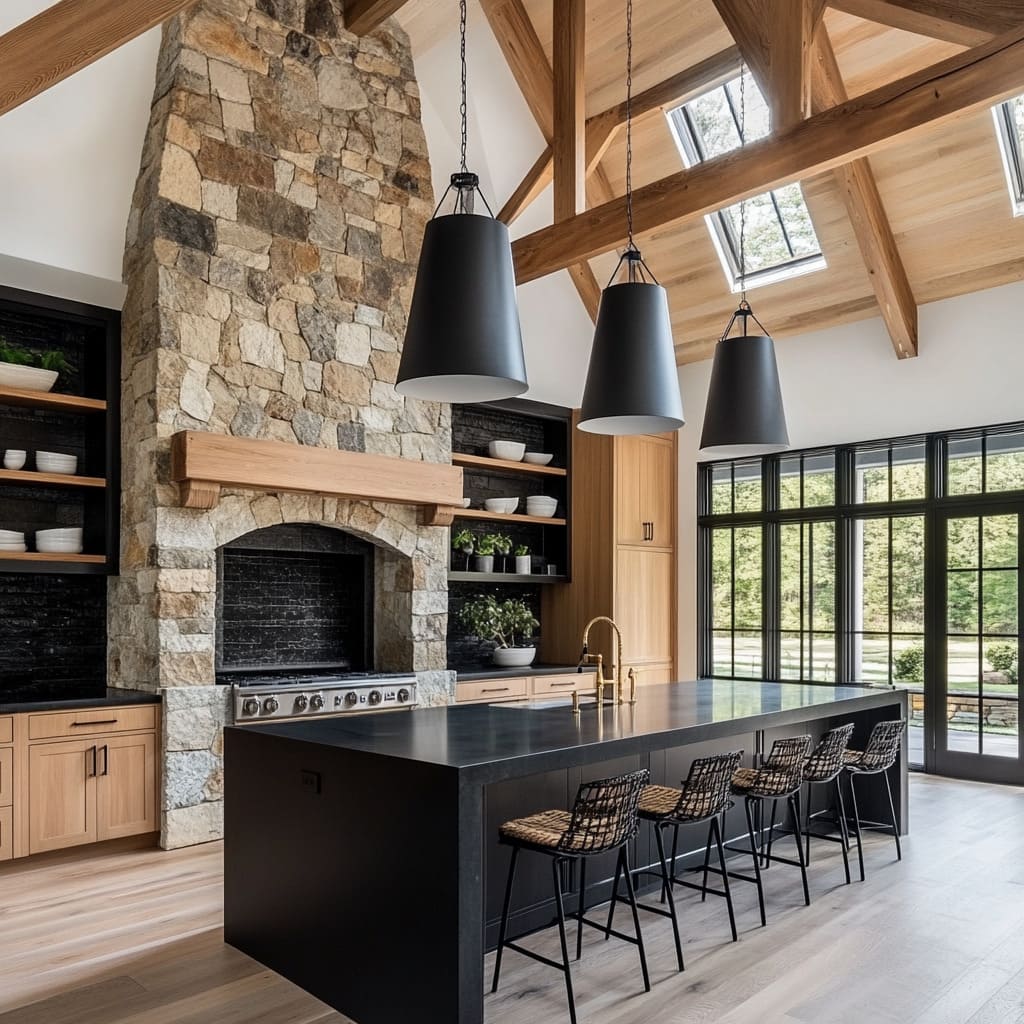
For example, kitchens can use such structure with strong symmetry, turning black cabinetry into framing wings for the stone mass. Or, if it is fireplace-style niche designs, it can use the dark recess as a shadow box that visually contains the working mess zone.
Recessed shelves can give depth without turning into open-shelf clutter. The dark envelope can feel heavy if daylight is limited or if the counters are also dark, leaving no bright plane for visual relief.
Another issue is mixing warm metals inconsistently—one brass pendant with a chrome faucet, or multiple metallic finishes—so the small highlights stop reading as intentional punctuation.
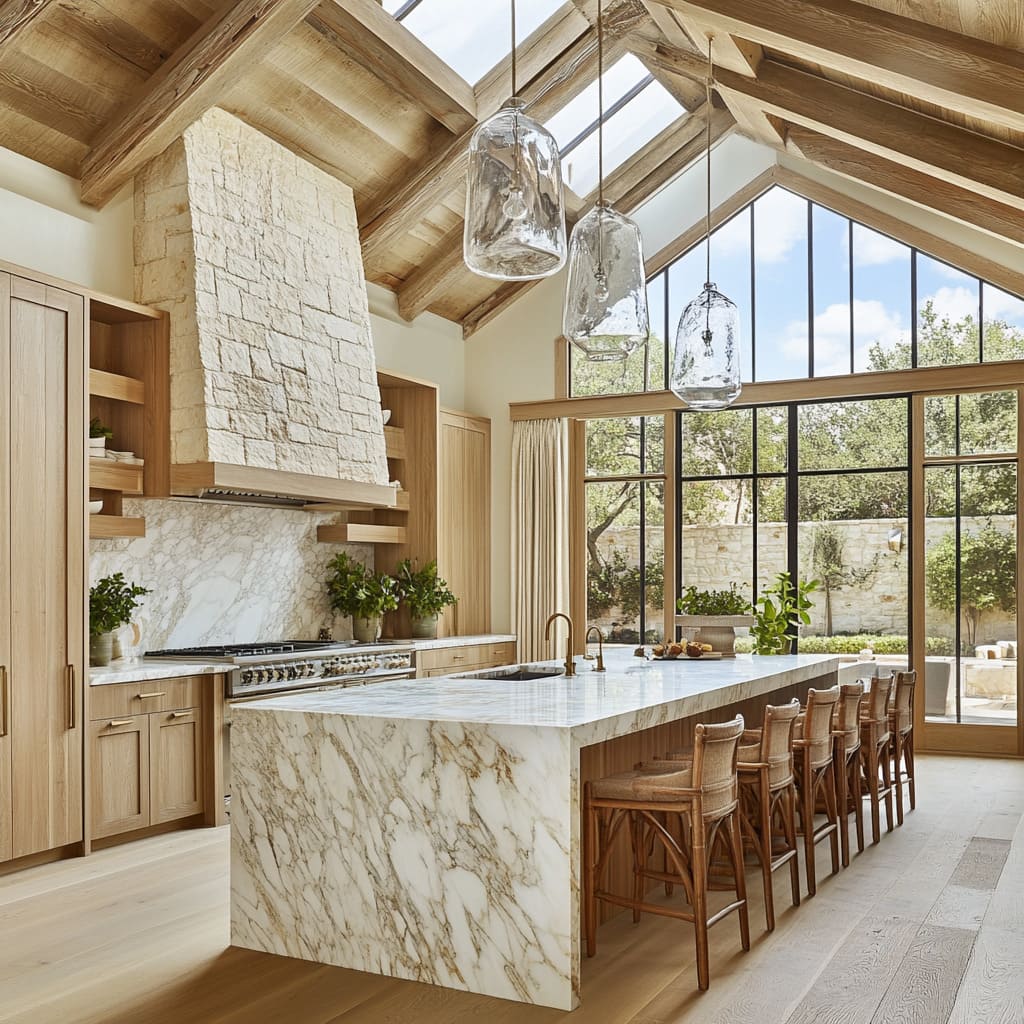
Ceiling rhythm and lighting scale
In modern farmhouse-style kitchens, the ceiling can be treated as a patterned field—beams, trusses, coffers, slats—and the pendant scale is sized to match that architecture. Modern farmhouse kitchens often have taller volume.
If the lighting is small, it disappears and the room can feel unfinished overhead. Oversized pendants create a middle layer between ceiling and island, giving the eye a clear vertical stack: structure above, lighting in the middle, island mass below.
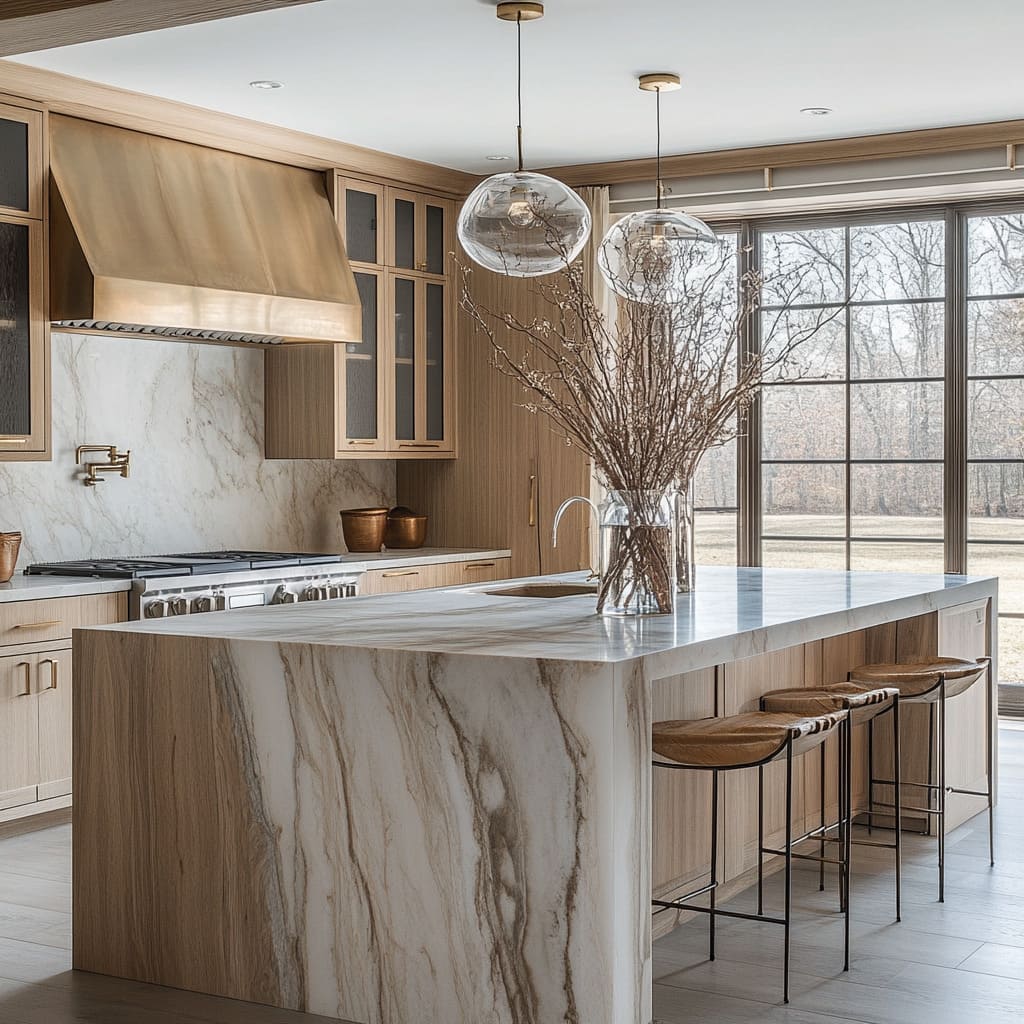
The coffered-ceiling kitchens can use grid rhythm to make the whole room feel organized before any decor appears. Lighting forms shift depending on the desired mood: lantern cages can create graphic outlines, drum pendants can soften hard rectangles with rounded volume, and woven pendants can add warm texture that balances stone walls and steel windows.
Pendant scale often fails in two directions: fixtures too small for a long island, or too many fixtures that create visual chatter. Another problem is mixing lighting silhouettes that don’t relate to the room’s geometry—soft curves paired with sharp faceted hoods and strict window grids without any bridging element.
Built-in display instead of counter clutter: depth without mess
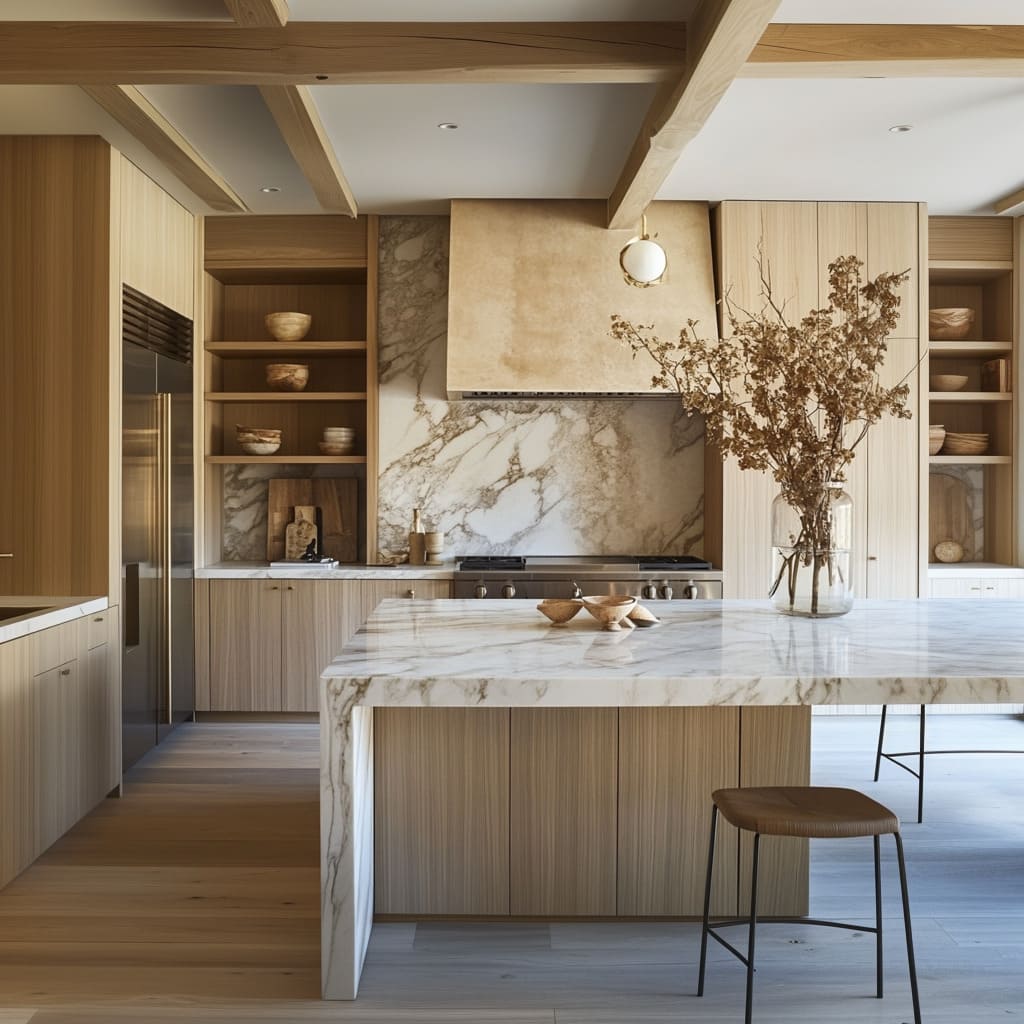
Using glass-front cabinets, recessed niches, and integrated shelving pockets so everyday items add depth without spreading objects all over countertops. A kitchen can look active and lived-in without losing clean lines if the storage display is contained inside millwork.
Glass fronts create shadow depth and a gentle reflective layer; recessed niches read like architectural voids; shelves inside a niche look intentional because the edges frame the objects. Open shelves often become visual noise when they extend outward into the room and collect mismatched objects.
Another frequent issue is filling glass-front cabinets with too many colors and shapes; the best effect comes from disciplined sets—white dishware, clear glass, neutral bowls—so the glass reads as depth, not clutter.
How the island changes the whole room
The island is one of the design elements because it decides the room’s center of gravity. The same cabinetry style can feel radically different depending on whether the island reads like a carved stone block, a dark monolith, or a worktable with legs.
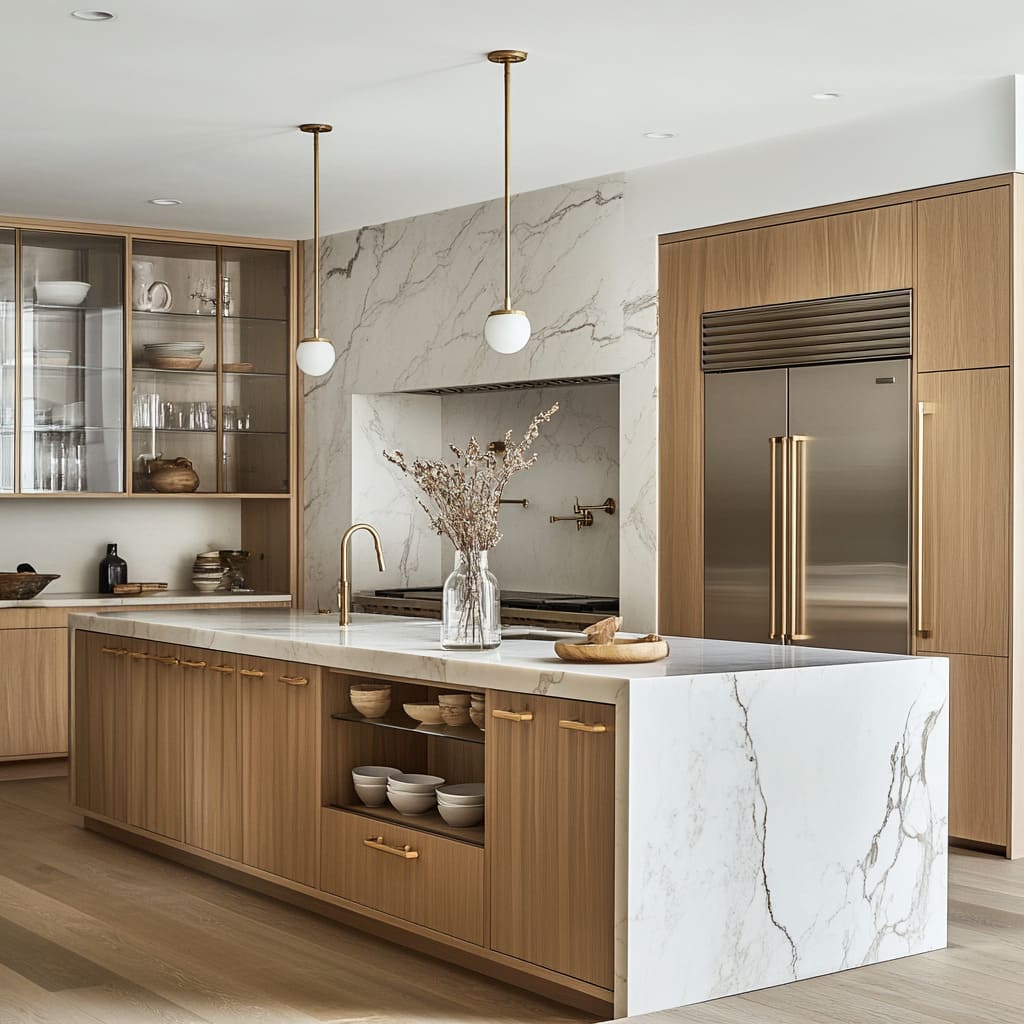
Waterfall block islands
These islands behave like sculpture because the stone drops down the sides and turns the island into a single mass. They fit kitchens where the view wall is a major feature—tall windows, big glazing, or a strong range wall—because the island can hold its own without extra furniture-like detailing.
Seating count tends to be moderate to high, but the visual success often depends on keeping the stools visually light: backless forms, thin frames, woven texture instead of bulky upholstery. Ceiling height can be generous; the waterfall island gives the room a strong center that matches the vertical volume.
Long dark monolith islands
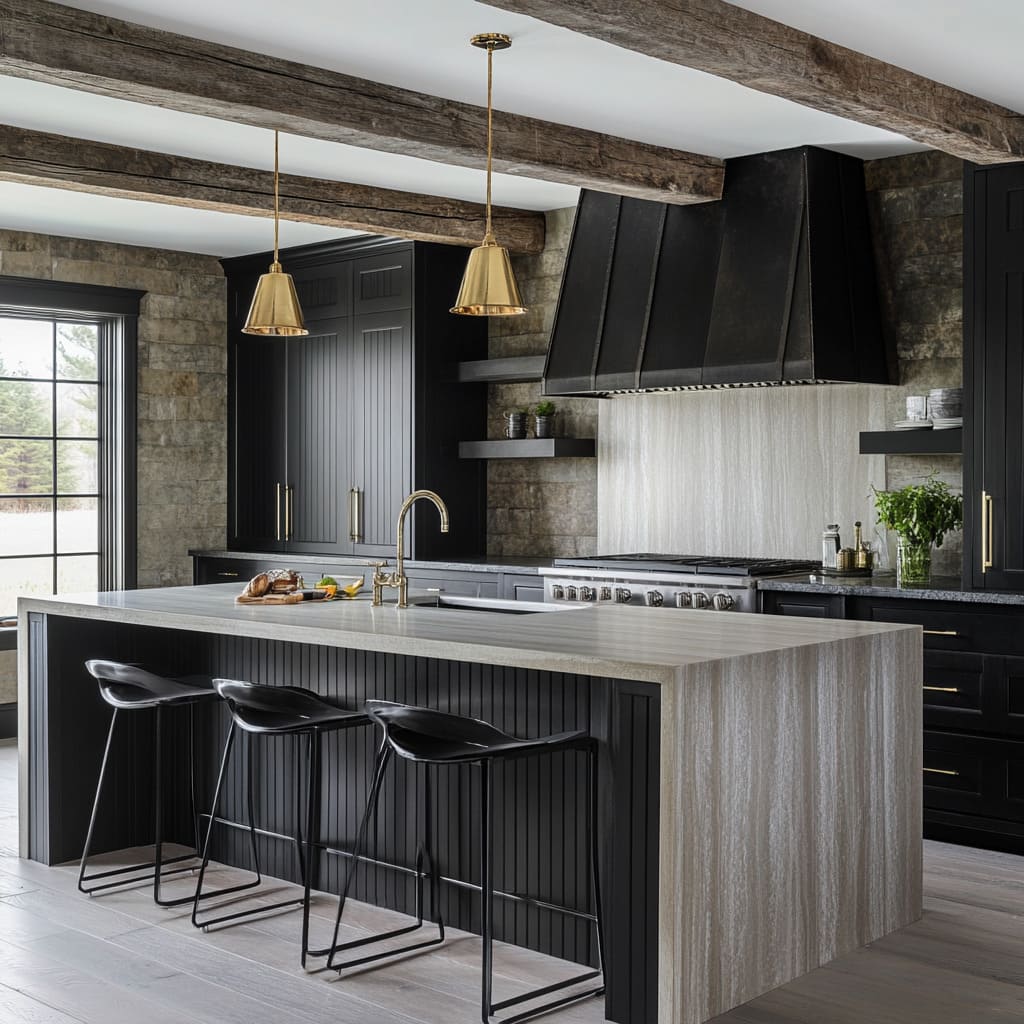
These islands read as horizontal counterweight to a tall stone chimney or a dark wall envelope. They work well when the cooking wall is already highly textured or monumental because the island stays simple and graphic, letting the vertical feature keep its authority.
Seating count is often higher, but repetition becomes important: one stool type repeated in a clean row so the long line looks orderly. Tall ceilings and strong daylight help keep the dark mass crisp rather than heavy.
Table-leg islands
This type shifts the mood toward furniture. The negative space under the overhang and the visible legs make the center feel lighter at floor level, which suits kitchens that want a friendly dining-table energy in the main zone.
Seating count is typically higher because the island behaves like a table substitute; the woven stools wrapping the side reinforce that intention. The ceiling grid in the same room adds order, so the table island doesn’t look casual in a messy way.
Stone-leg islands
The island feels like a heavy stone table: stone legs at the ends, thick stone top, and a darker cabinet base that visually recedes. This format pairs naturally with a dominant stone cooking wall because the room becomes a conversation between stone mass and dark framing.
It tends to suit spaces where the view wall is powerful (tall black-grid windows, for example) and where the ceiling height can support oversized pendants without crowding the scene.
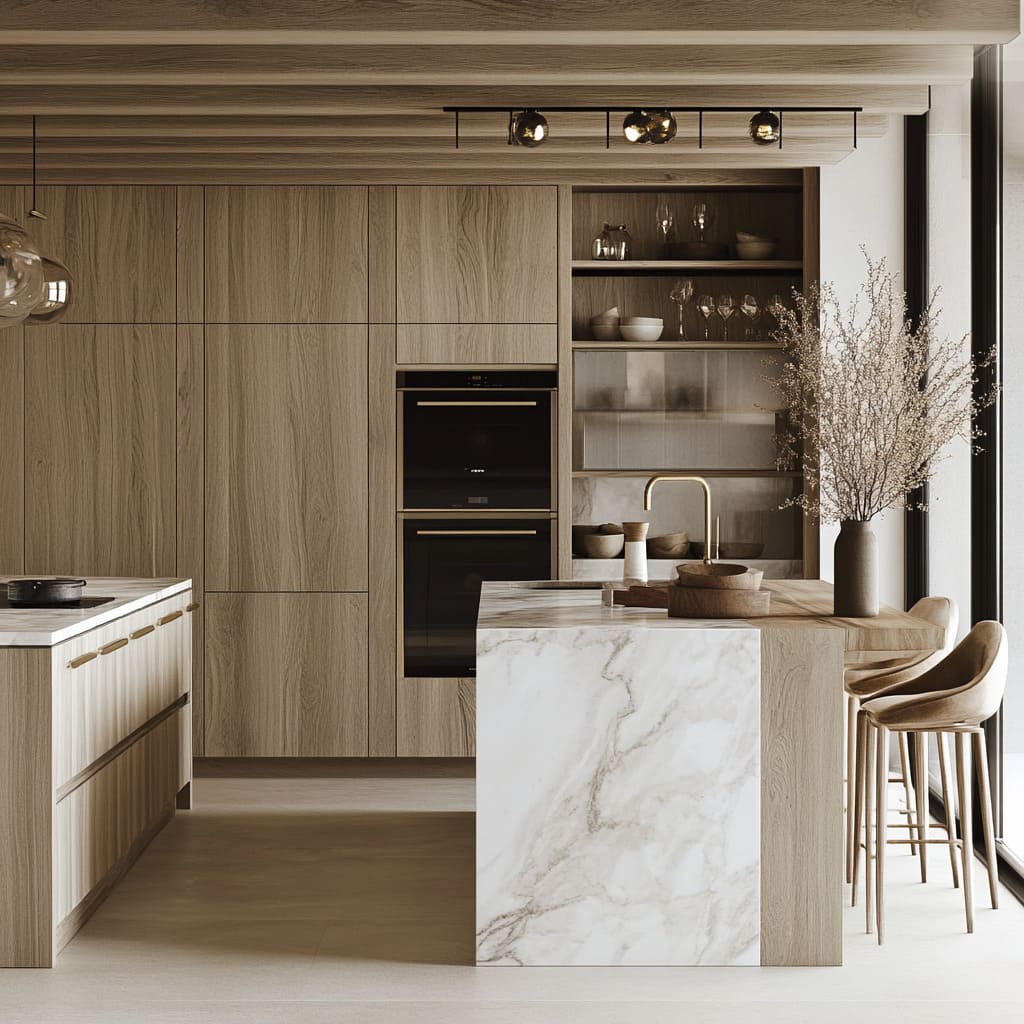
Compact plinth with a bar extension
This is the counter-argument to the oversized island trend. The island stays compact, but it still feels weighty through one strong marble face treated like a vertical plinth, then a wood bar extension creates a casual perch without a long stool row.
It fits kitchens where the storage wall is the main feature and where keeping circulation open matters more than maximizing seats.
Hood and cooking wall
The cooking wall is the kitchen’s vertical portrait. The hood silhouette and its backing surface decide whether the interior design looks graphic, soft, rustic, or tailored.
Matte-black hood as a graphic anchor
A matte-black hood functions like a bold shape cut out against lighter stone or plaster. It balances wide glazing because it provides a strong vertical mass that doesn’t need ornament.
The backsplash behind it usually stays calm—slab stone with soft movement or a pale textured field—so the hood keeps the starring role. When the wall behind is already textured stone, the hood tends to become sharply faceted so it looks modern against rugged masonry.
Backsplash: calm slabs and restrained surfaces can keep the hood silhouette readable.
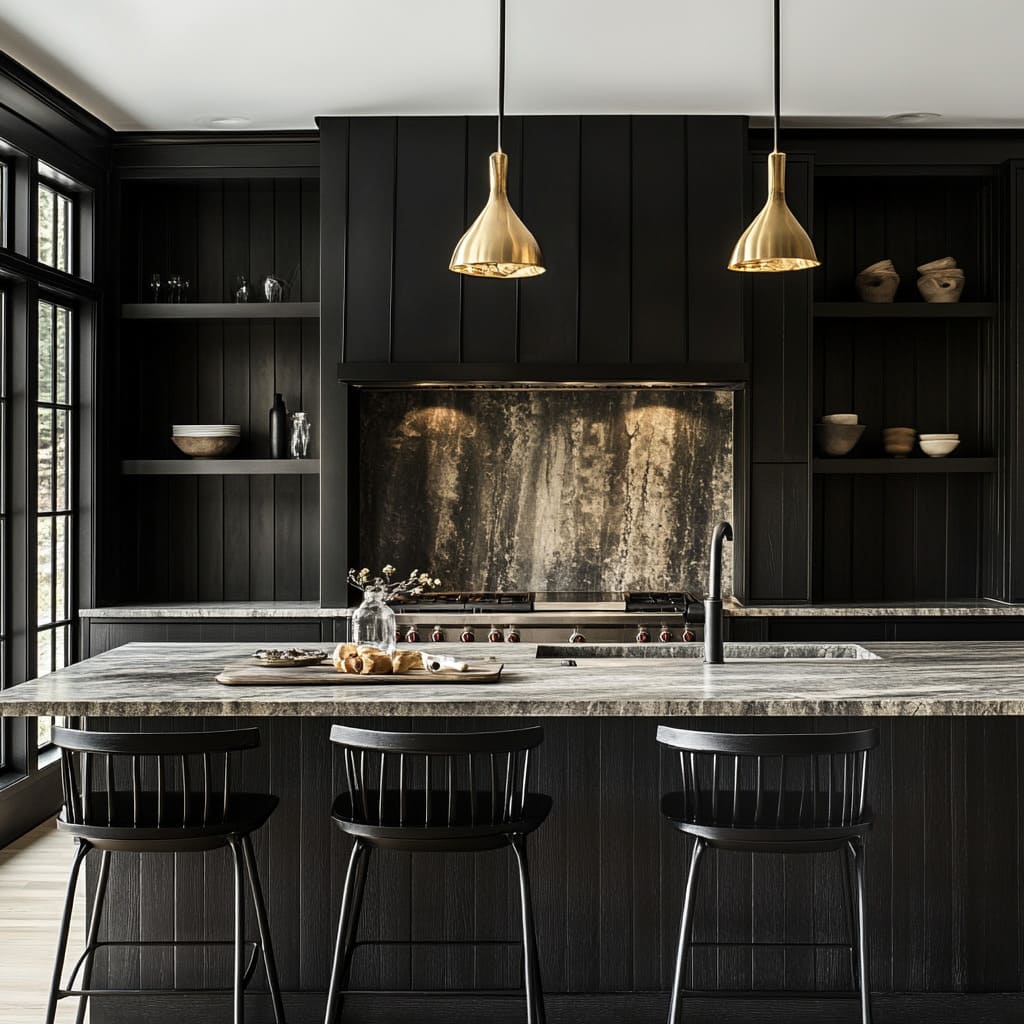
Plaster hood paired with a slab backsplash
This approach creates a soft sculptural center. The plaster-like hood provides volume, while the slab backsplash supplies the pattern moment through veining.
The key visual trick is restraint: the hood shape stays simple and quiet so the slab can carry motion without competing shapes. In the two-island layout, the slab backsplash can become the primary art-like plane, and a slim wood shelf breaks the height to keep the wall from feeling too tall.
In the clean symmetry kitchens, the slab backsplash can make the hood silhouette feel crisp and architectural.
Backsplash: full-height slab surfaces can replace small tile grids to keep the wall modern and continuous.
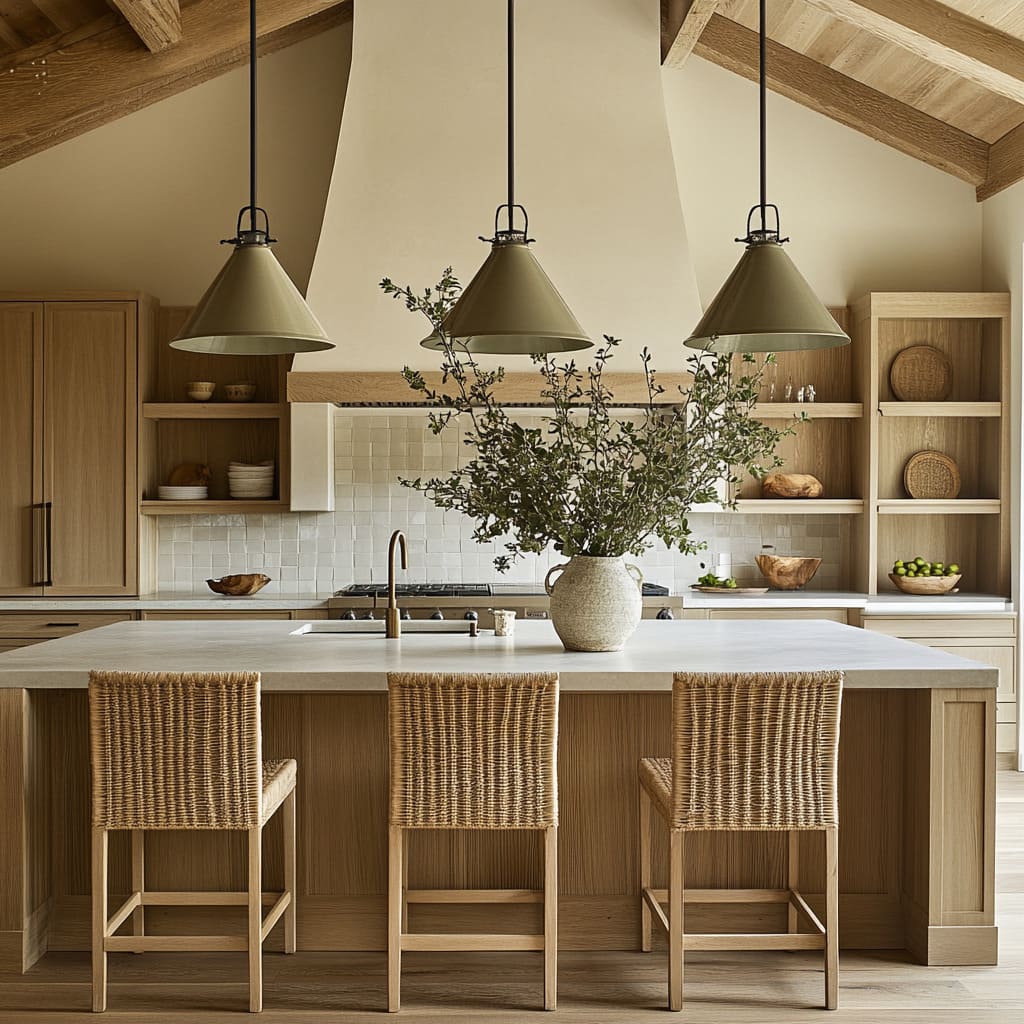
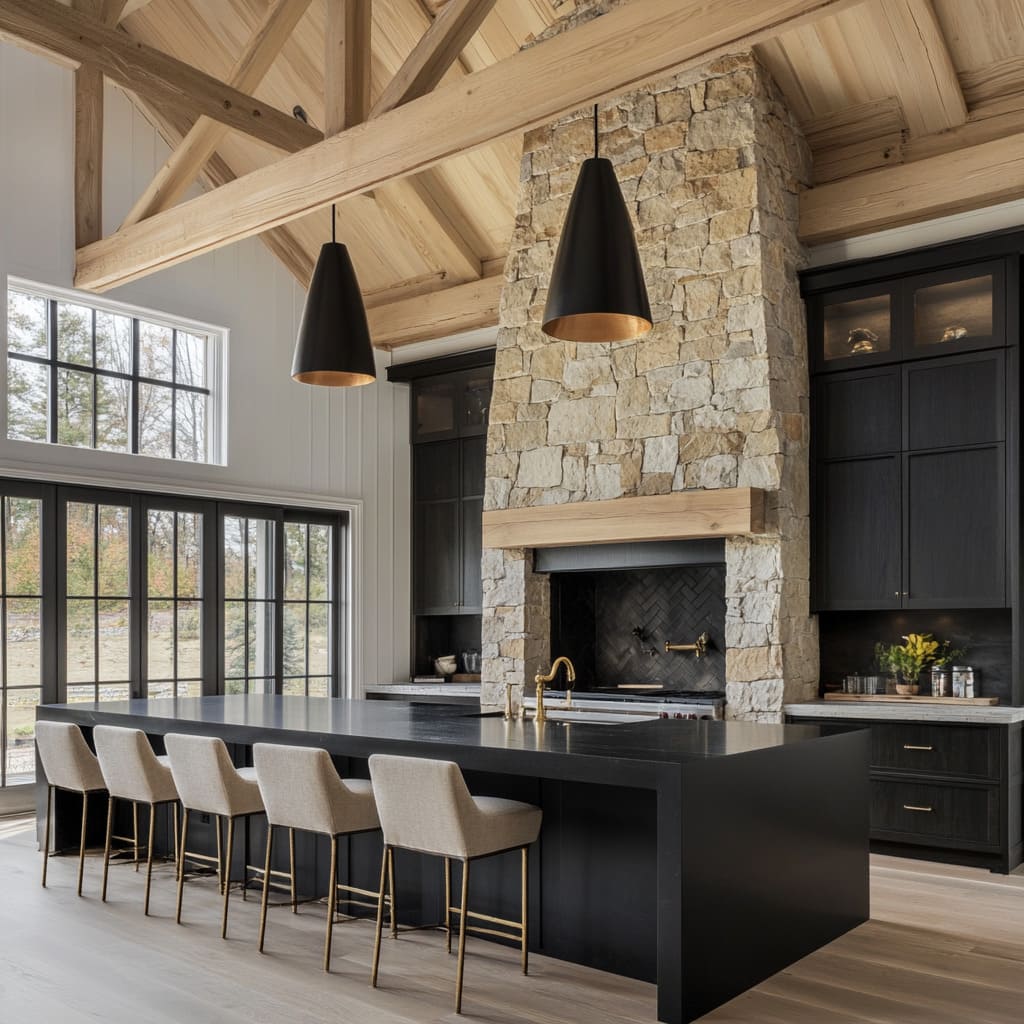
Stone chimney or hearth wall
Here, the stone mass is the room’s backbone. The cooking zone often sits inside a recessed niche so the functional mess area becomes a contained shadow box.
Inside the recess, the backsplash frequently switches to a darker, tighter texture (herringbone tile or horizontally textured dark surface) because it’s visually protected by the niche framing and because it handles splatter-prone areas while looking deliberate. A wood mantel line often breaks the height and adds a warm horizontal band.
Backsplash: contained dark texture in the niche can add detail without covering the whole room in pattern.
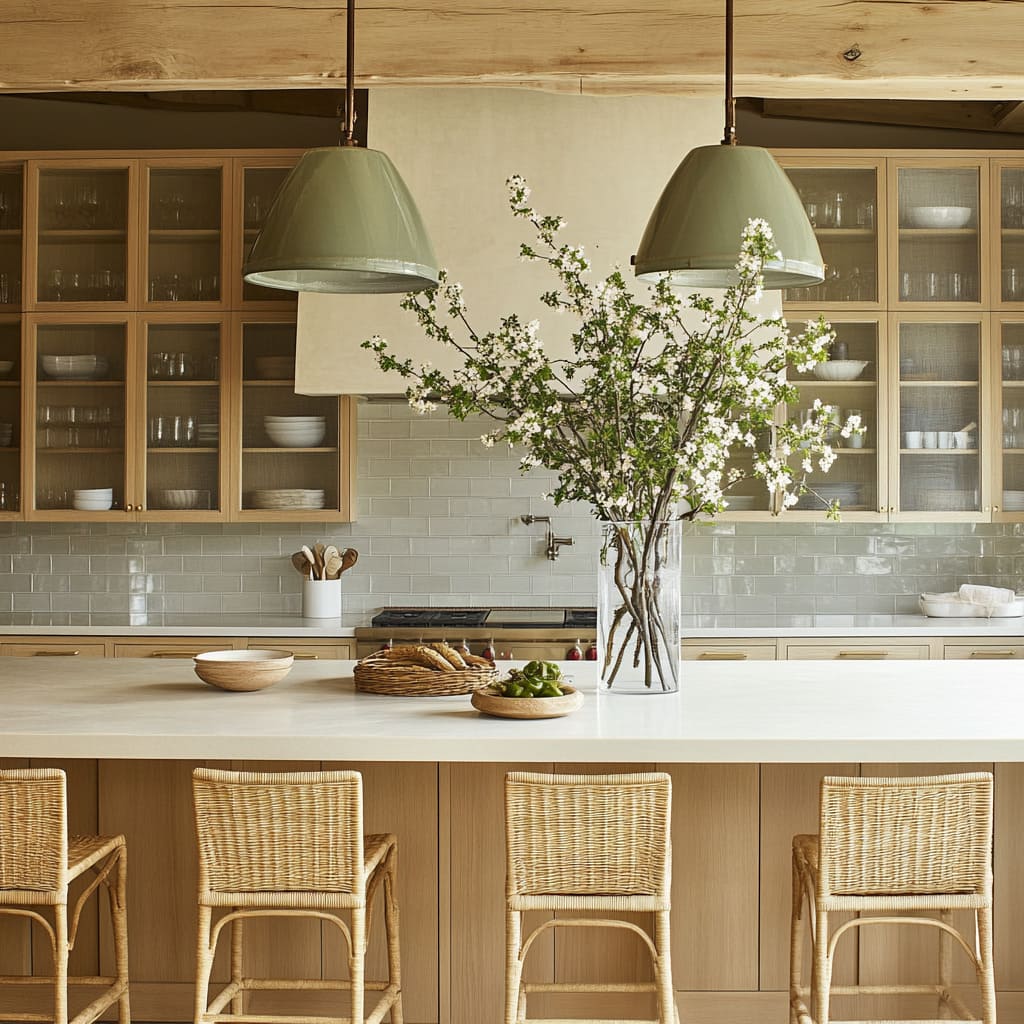
Metal hood as the hero object
Metal hoods can act like jewelry at architectural scale in modern farmhouse-style kitchens. Brass, bronze, copper, or stainless changes the mood: stainless feels professional and clean, warm brass reads boutique and refined, patinated copper looks earthy and artisanal.
Because the hood is already a focal object, the backsplash needs to support it. That usually means slab stone with soft movement, or stone-on-stone compositions where the hood and backing share a family so the wall feels carved and cohesive.
Backsplash: slabs work well because they keep the wall calm and let the metal surface variation do the visual work.
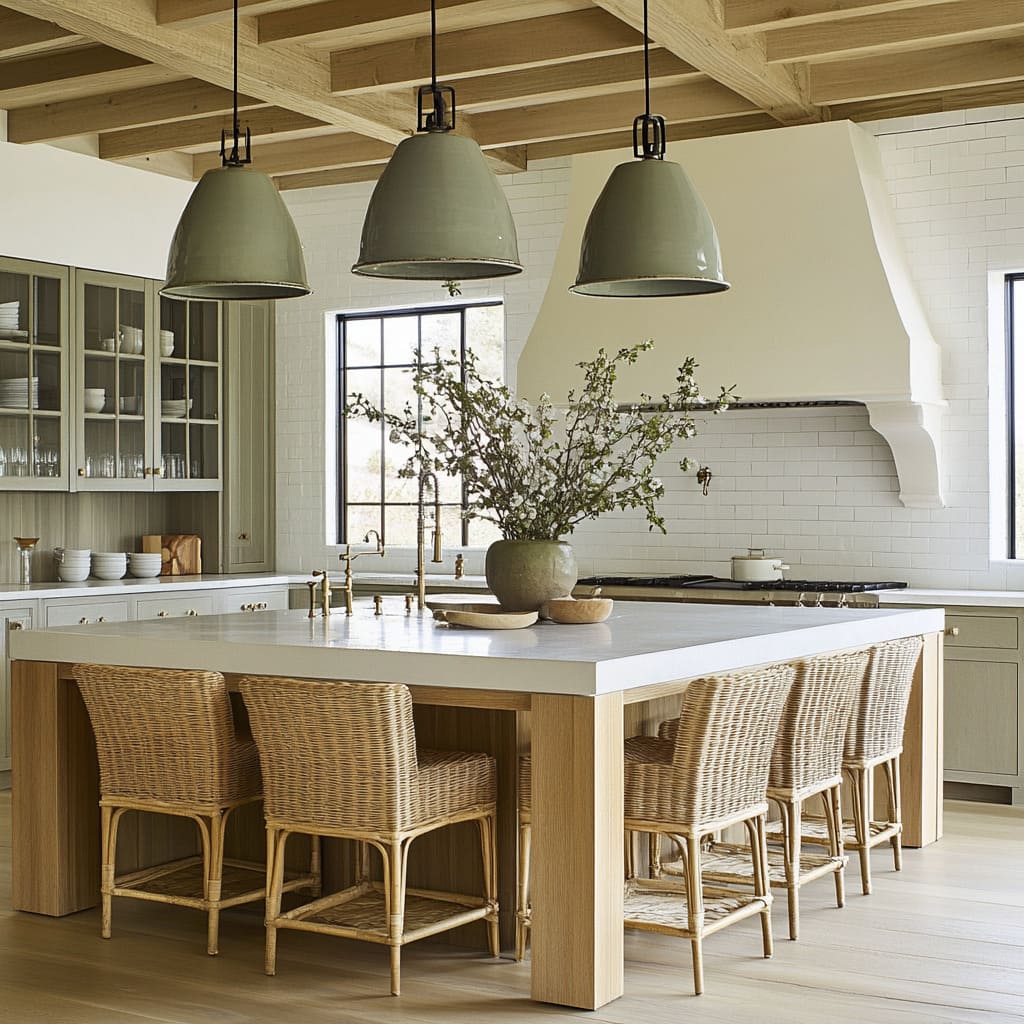
Finish kits
A modern farmhouse kitchen tends to look coherent when materials arrive as a kit: a small number of finishes that repeat in multiple zones, then stop. For simplicity, it can be considered as a few consistent kits.
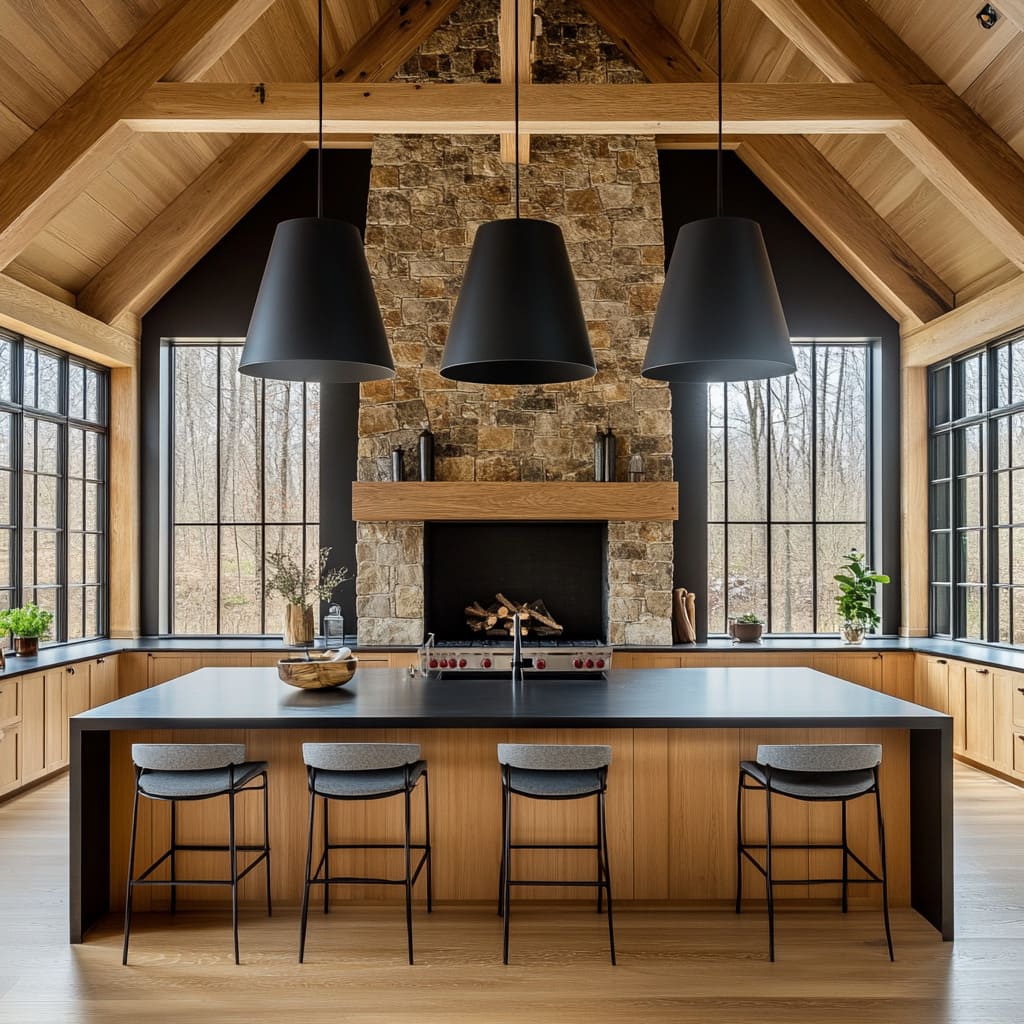
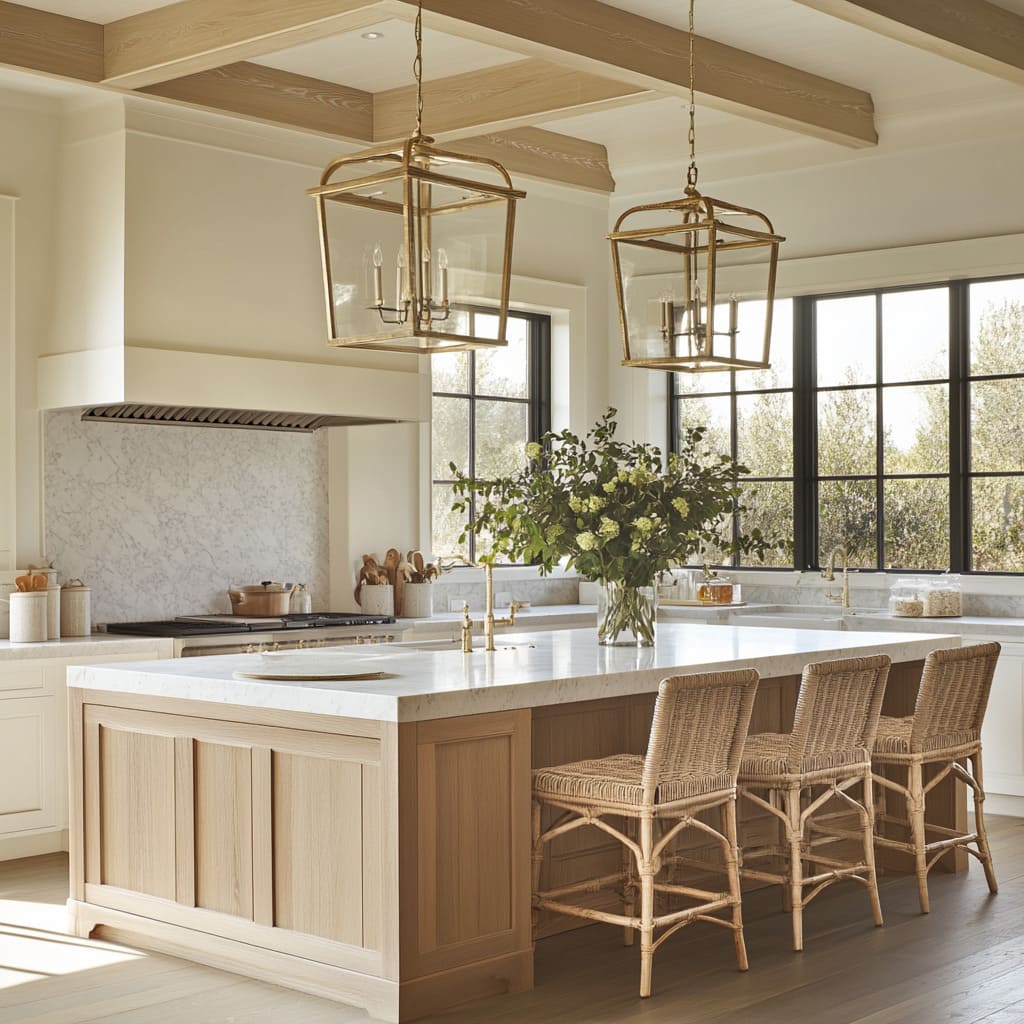
Warm oak + black window grid + bold veined waterfall stone
These ideas are based on oak as the warmth base, black as the structural outline (windows, stools, pendants, faucet), and a dramatic stone as the main pattern. The stone can appear twice—on the island waterfall and as a slab backsplash—so the room reads curated rather than mixed.
In the brighter versions, the matte-black hood can become the graphic counterweight to the windows while slab stone keeps the background calm. Brass can join the kit as the hero object, while glass globes soften the heaviness of stone and metal.
Visual effect: strong contrast with a grounded, architectural feel; the stone becomes the art, black provides crisp edges, oak prevents the palette from feeling cold.
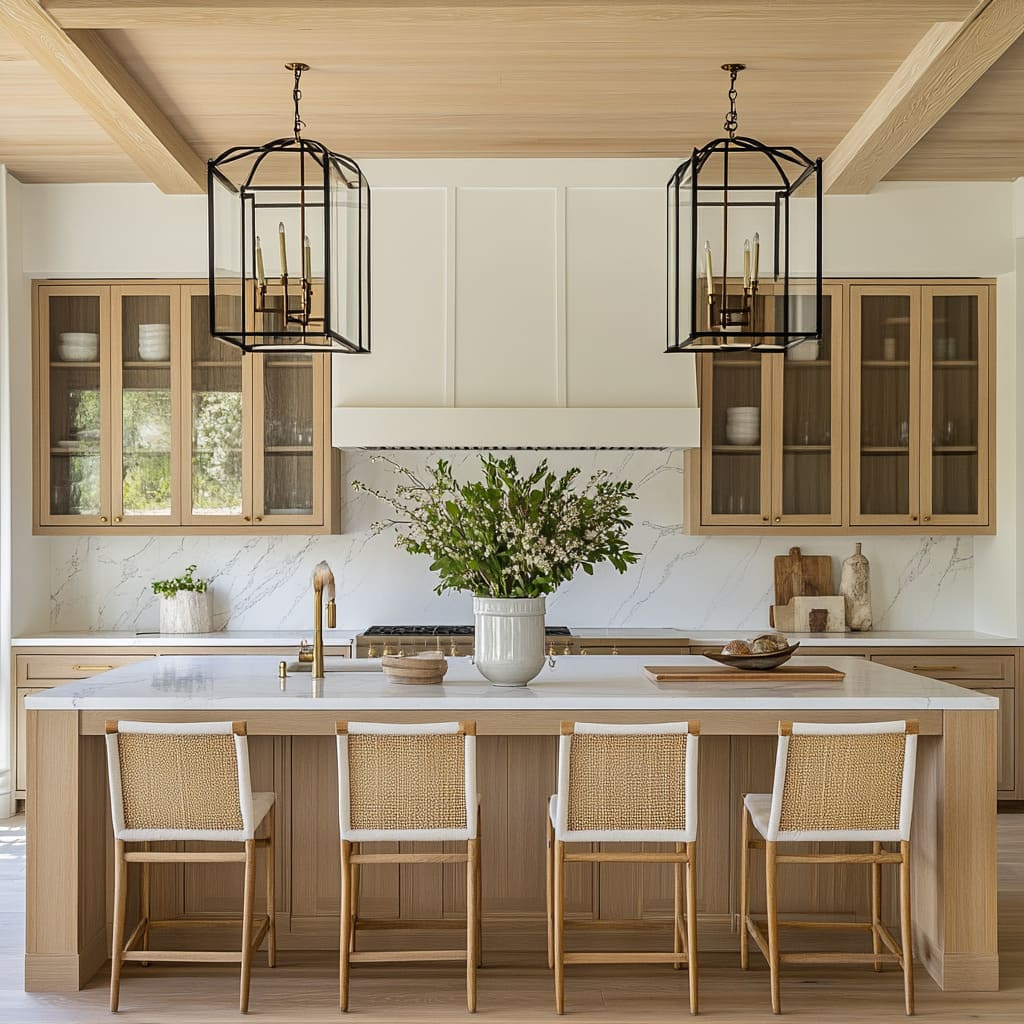
Sage/green cabinets + black accents + white stone
These ideas create softness through paint while staying current through black linework and controlled stone. The green usually sits in a muted family (sage or green-gray), paired with white counters, white or slab-like backsplash surfaces, and black fixtures that keep the palette from drifting into pastel.
Pendant scale becomes crucial here: oversized black domes or large white drums can act as mid-layer structure under beams. Green also can show up in pendants, proving the color can live in different zones while the wood and stone remain the foundation.
Visual effect: warm and welcoming, with crisp outlines; the black accents behave like thin ink lines that sharpen soft paint and pale stone.
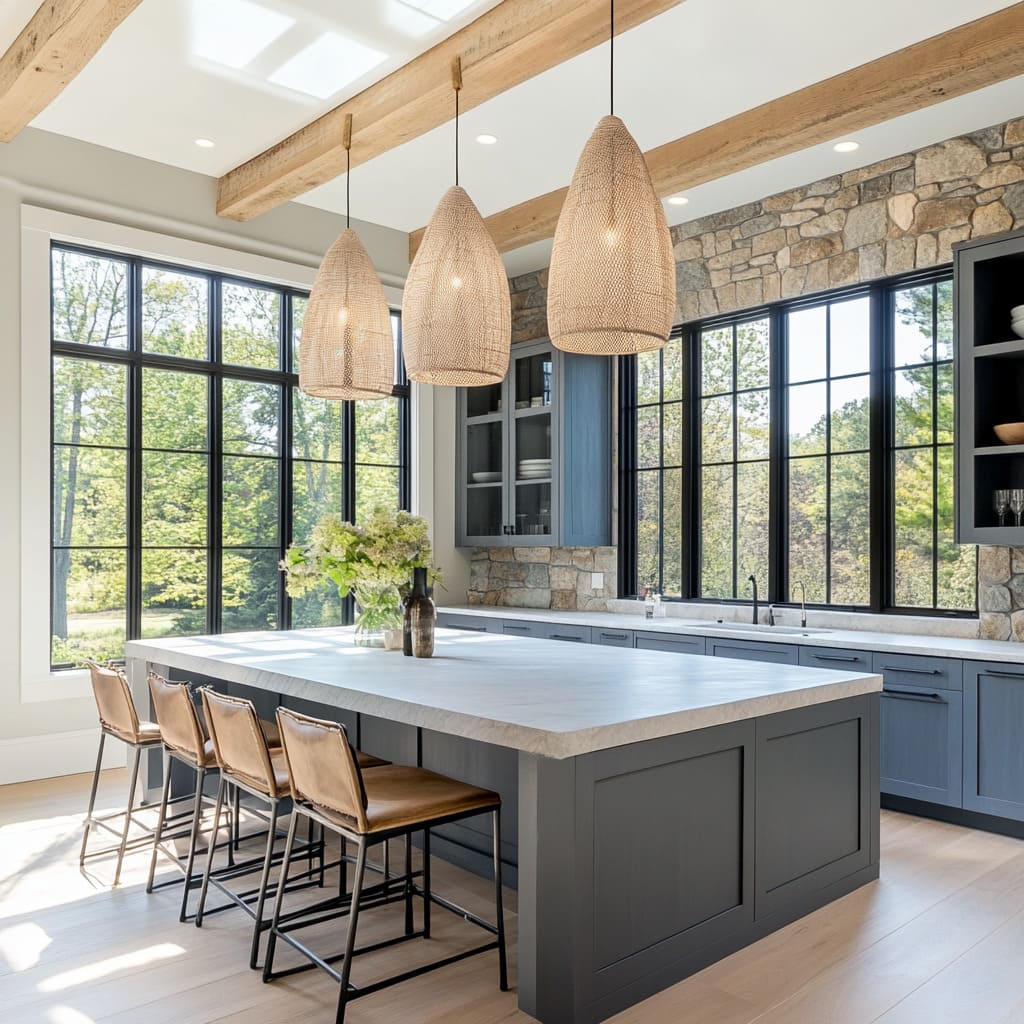
Blue-gray cabinets + stone wall + woven pendants
These design ideas work through a balanced temperature mix: cool cabinetry, warm fiber pendants, and rugged stone as the texture anchor. The black grid windows and hood bring structure, preventing the stone wall from pushing the room into lodge territory.
The island can shift to a wood top or a thick pale slab so the center doesn’t become overly dark. Woven pendants can be scaled large to claim the island zone in rooms with tall glazing and heavy beams.
Visual effect: relaxed but structured; the stone wall provides depth, woven forms soften the hard lines, and the blue-gray acts as a calm mid-tone buffer.
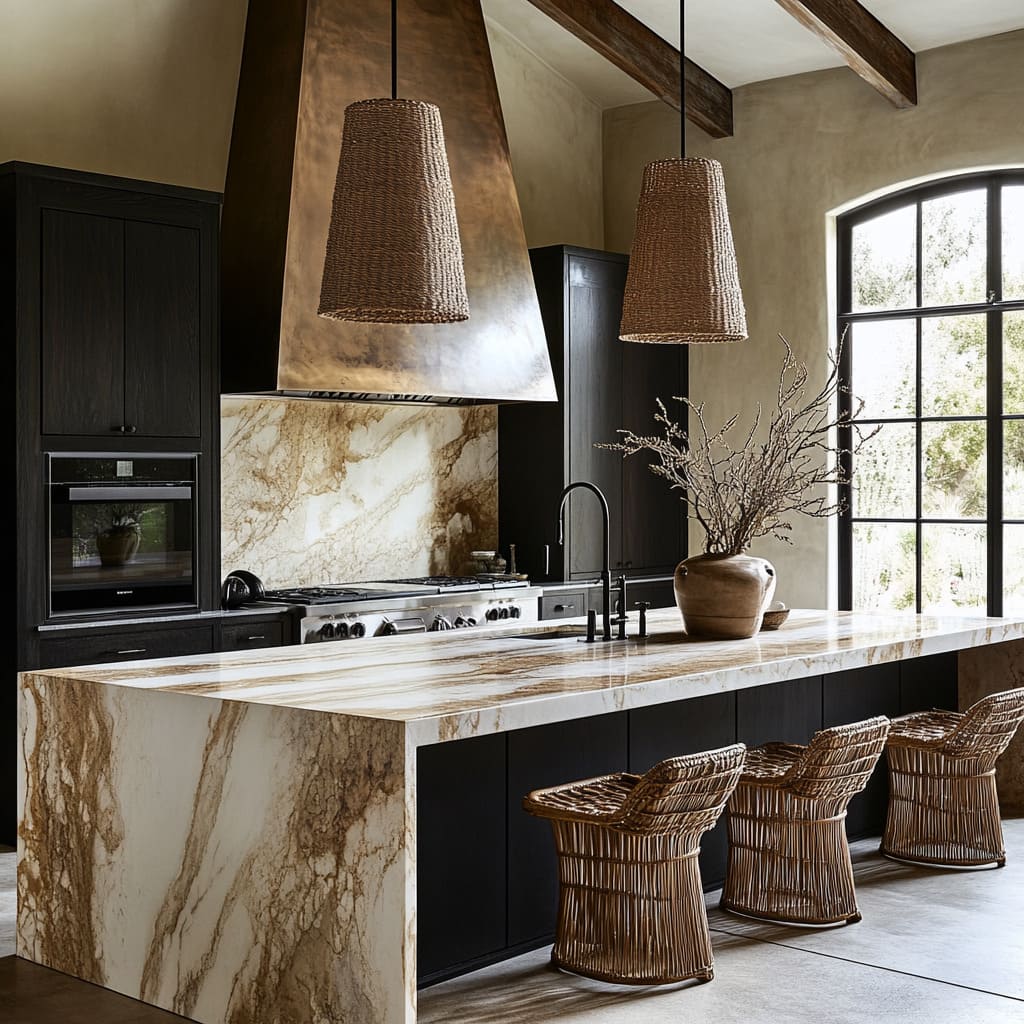
Black cabinetry + warm metal + stone center
These ideas creates a tailored, dramatic mood through dark vertical surfaces while keeping function readable through lighter stone planes and warm metal highlights. Stone can be the central monument with a chimney mass, a slab hood wall, or a stone-on-stone range stack.
Warm metal can be used as small repeated sparks: brass pot filler, brass faucet, brass pendant details, or a patinated hood that becomes the main focal object. Woven seating and woven pendants can serve as the craft note that keeps the room farmhouse-friendly without adding decorative clutter.
Visual effect: gallery-like and grounded; the dark envelope frames the room, stone supplies natural pattern, and warm metal adds controlled highlights.
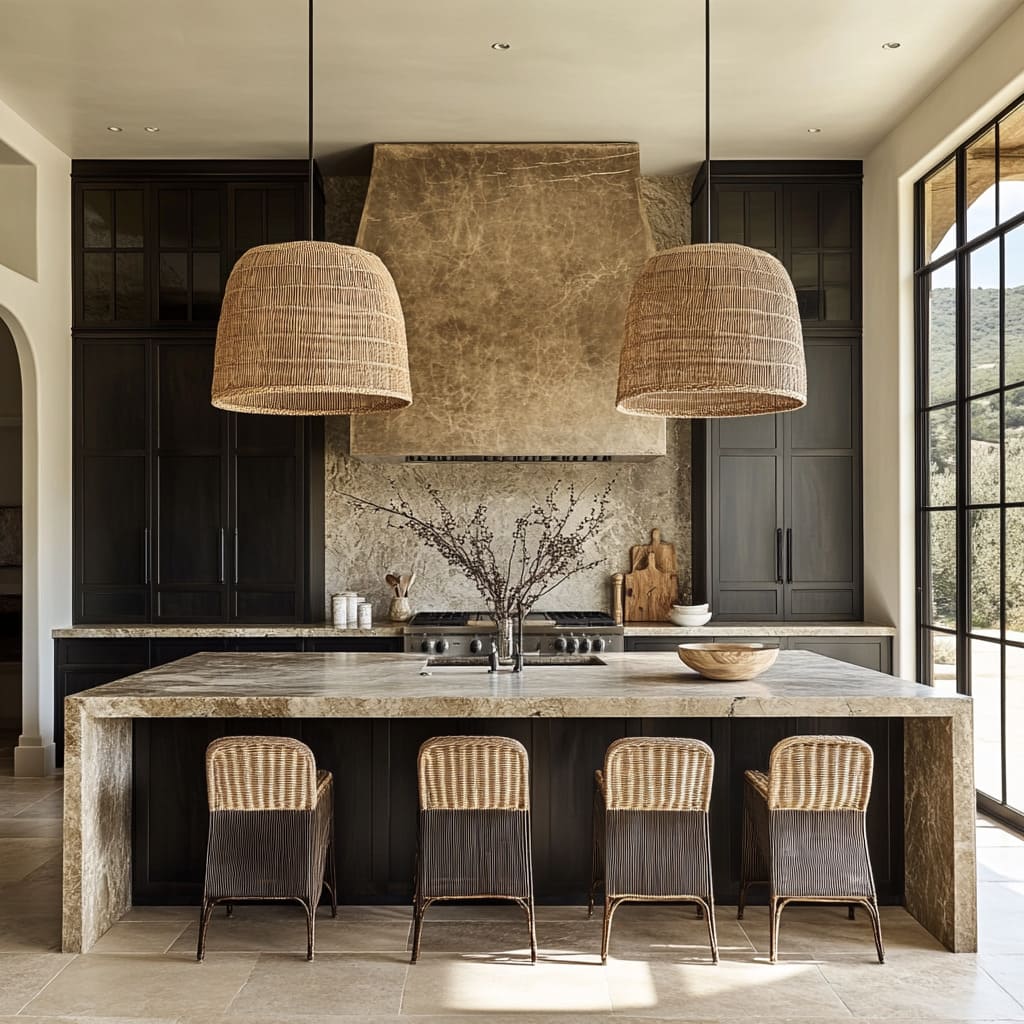
Closing logic
A modern farmhouse kitchen tends to feel resolved when the room reads as a few large, intentional moves working together, instead of many small decorative ones competing for attention. The cooking wall supplies the vertical identity—hood, chimney mass, or a stone-and-slab center stack—while the island supplies the horizontal weight that stabilizes the plan.
Once those two anchors are clear, everything else can stay disciplined: one wood family for warmth, one stone family for the major planes, black used as linework (windows, lighting outlines, faucets), and a limited warm metal note repeated in a few precise spots. That tight finish set makes even dramatic elements—full-height glazing, heavy beams, bold veining, oversized pendants—feel related rather than stacked.
What changes from kitchen to kitchen is the mood, not the underlying structure. Brighter rooms keep the stone calm and let daylight and the window grid carry the pattern; darker rooms use black cabinetry as a framing device so the stone work planes and the cooking-wall stage stay readable.
Slab backsplashes and waterfall islands bring continuity by reducing breaks and grout lines, so the wall and island behave like clean, continuous surfaces instead of patched assemblies. Ceiling rhythm does similar work above: trusses, coffers, or slats give the upper volume a clear order, and pendant scale fills the middle height so the room has a complete vertical stack from structure to task surface.
Even the lived-in layer stays architectural: glass-front cabinets, recessed niches, and contained shelving pockets provide depth and daily storage without turning counters into display ledges.
In the end, the modern farmhouse kitchens that feel current are the ones where hierarchy stays obvious at a glance: one center axis or balanced framing, one dominant texture zone (stone wall, slab field, or dark envelope), and one softer craft layer (woven seating, cane, leather) placed at seat height to keep the room human. With that hierarchy in place, the space can stay practical—clear work surfaces, controlled styling, storage doing the heavy lifting—while still reading as a composed interior where the architecture and a few well-chosen surfaces carry the visual impact.
Related Posts
Harmony Home Design brings 10+ years of residential interior design experience to the ideas shared here. We publish design concepts, layout thinking, and practical styling notes.