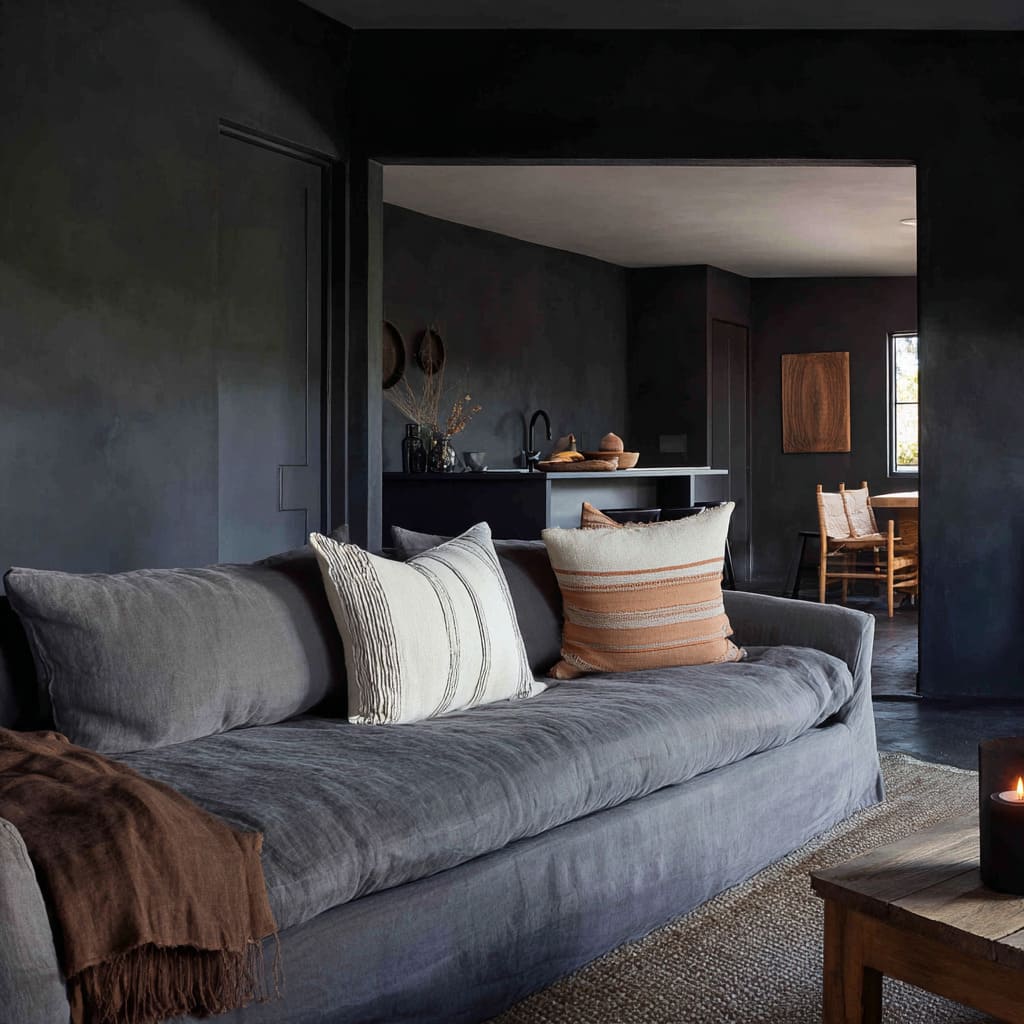
One of the most unusual aspects of modern dark boho living room design ideas is how darkness is treated as a background temperature rather than a statement color. There are several different families of dark:
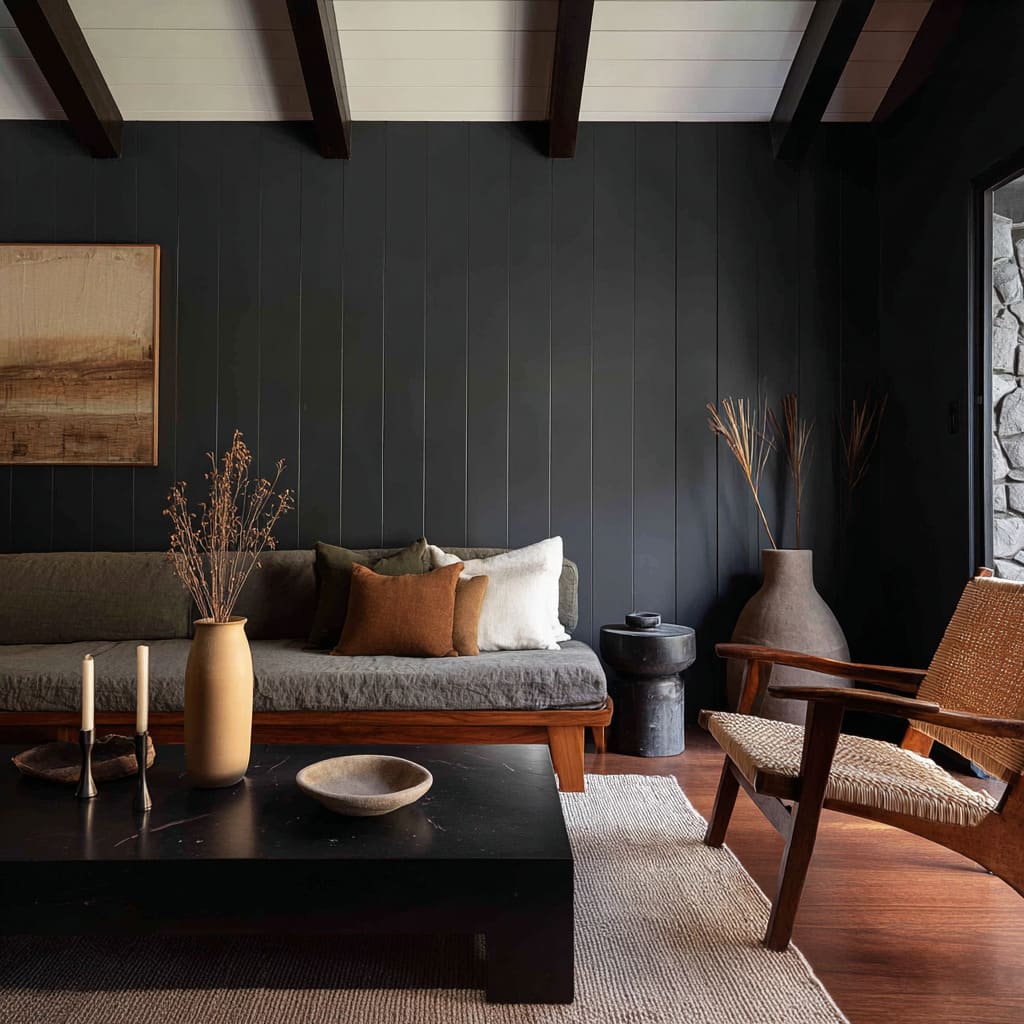
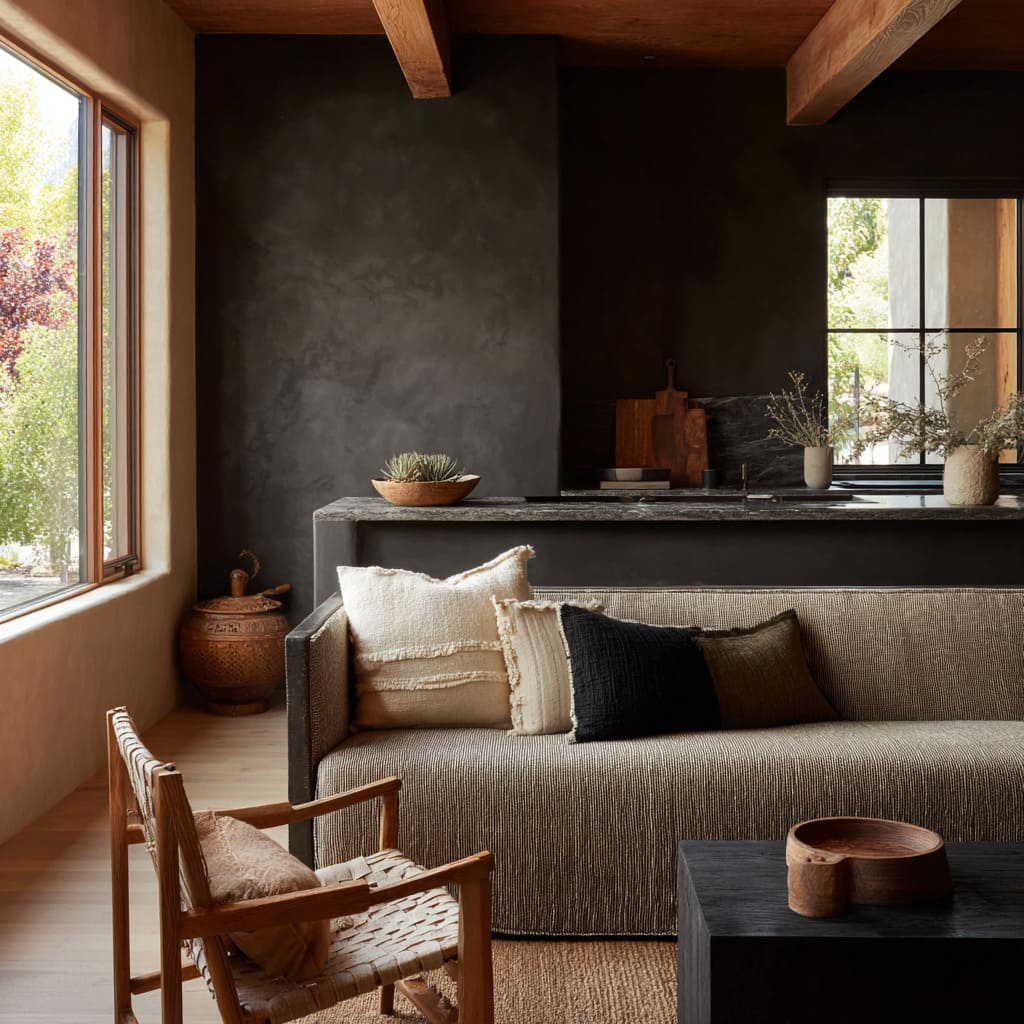
- Graphite and charcoal plaster (graphite envelope, deep slate walls, graphite kitchen/living rooms).
- Dark clay and cocoa tones that lean toward brown (dark clay walls, soft clay-brown walls, deep brown-gray).
- Olive-charcoal and slate hybrids that sit between green and gray.

All of them can share three things:
- Matte, light-absorbing surfaces – walls are never glossy. This softens reflections and keeps highlights small and calm.
- Cloudy or veined textures – plaster and clay walls almost always have smoky shifts and faint patchiness instead of solid color. This replaces pattern with micro-variation.
- Mid-tone depth rather than pure black – even the “charcoal” is often slightly warm or slightly green. That small shift prevents the room from feeling severe.
Darkness can be used as insulation for texture. It hides joints, sharp edges, and clutter, so the eye focuses on textiles, pottery, and wood grain instead of corners and hardware.
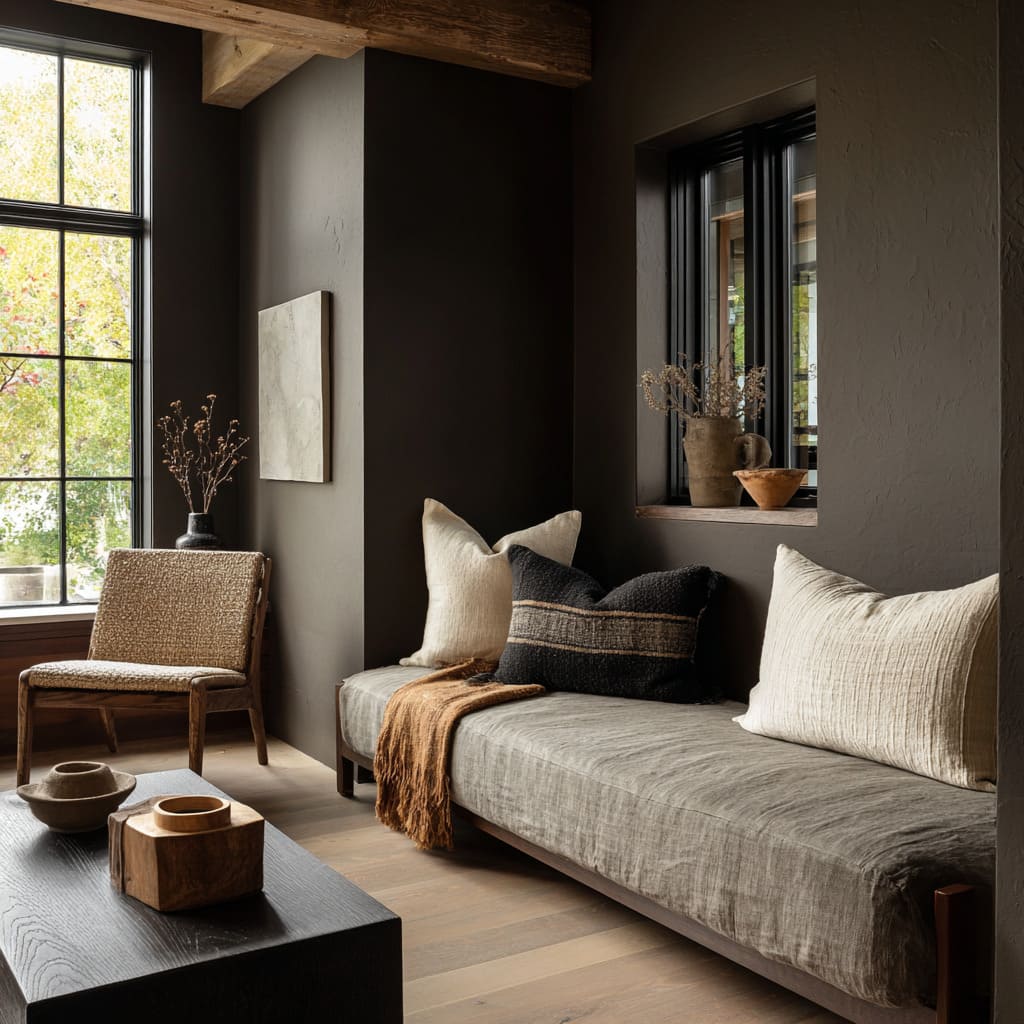
The Hidden Role of Mid-Tones: Clay, Cocoa, Slate, Olive
Such dark boho ideas rarely flip straight from black to white. They live in a string of mid-tones that act as emotional moderators:
- Soft clay-brown walls that sit between deep hues and sunlit neutrals.
- Deep slate walls that feel like a charcoal–clay hybrid.
- Olive-charcoal walls that sit between a moody gray and an earthy green.
- Warm gray clay walls that bridge concrete coolness and brown warmth.
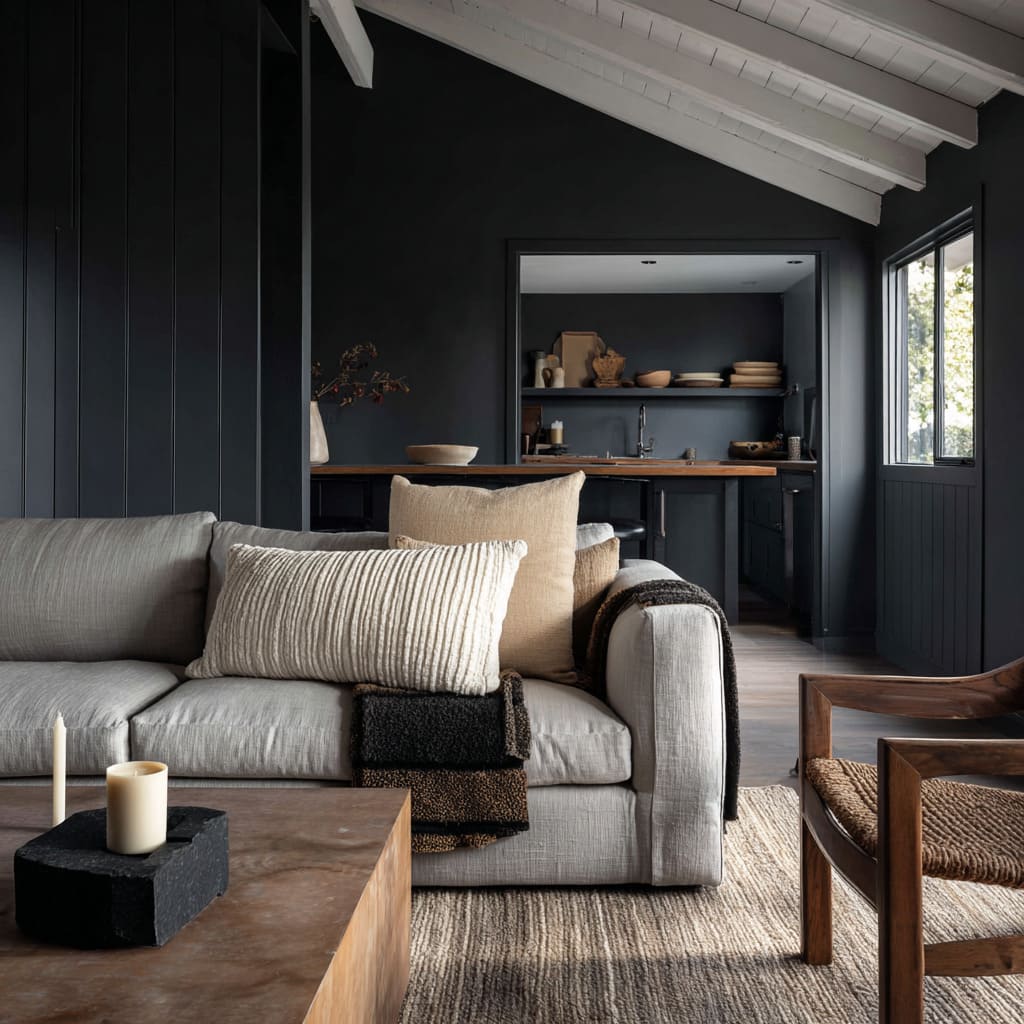
These colors do three subtle jobs:
- Fuse warm and cool elements
A slate or clay wall can hold both pale gray linen and caramel pillows without looking chopped into zones. The wall tone literally “glues” them together. - Allow darkness in small rooms
Instead of a pure black wall, the designer can use a clay or olive charcoal that keeps shadow but carries a hint of warmth. This lets corner nooks and compact living spaces feel cocoon-like rather than oppressive. - Shift mood with light
In daylight, olive-charcoal shows its green side, relating to outdoor foliage. In shadow, it slides closer to graphite, supporting the moody feel. Darkness here is responsive, not fixed.
This mid-tone strategy is one of the strongest fingerprints of very modern dark boho: the palette is deep, but rarely absolute.
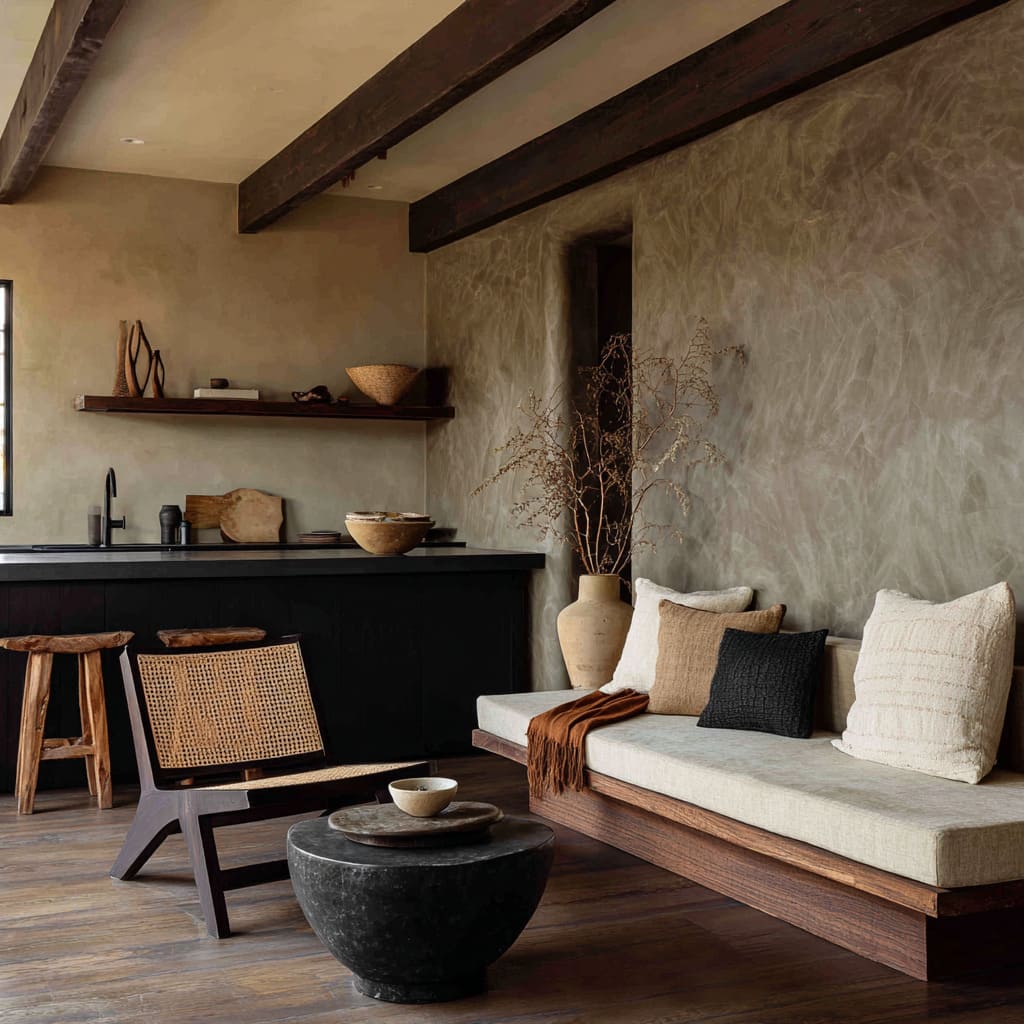
Vertical and Horizontal Structure: How Lines Quietly Control the Room
An easily missed tactic is the conversation between verticals and horizontals.
Vertical Systems
- Charcoal panel walls with subtle grooves.
- Tall plaster walls treated as monolithic slabs.
- Dry stems, palm leaves, and branches that shoot upward.
- Slanted white ceilings and exposed beams drawing the eye up.
These vertical elements:
- Add a quiet rhythm without pattern.
- Stretch the room’s height even when tones are dark.
- Give a sense of order that keeps boho elements from feeling scattered.

Horizontal Systems
- Long built-in benches and daybed-style sofas.
- Low, blocky coffee tables.
- Thick floating timber shelves (sometimes double-layered).
- Kitchen ledges that read as part of the living room composition.
Horizontals do the opposite of verticals:
- They stabilize the visual field.
- They give the eye a place to rest.
- They act as display rails for pottery, books, and small sculptures.
Every modern stylish scheme builds a grid of sorts, but it’s disguised by natural materials. Dark ribbed walls + floating shelves + long benches form an underlying framework that lets soft, relaxed objects look intentional rather than messy.
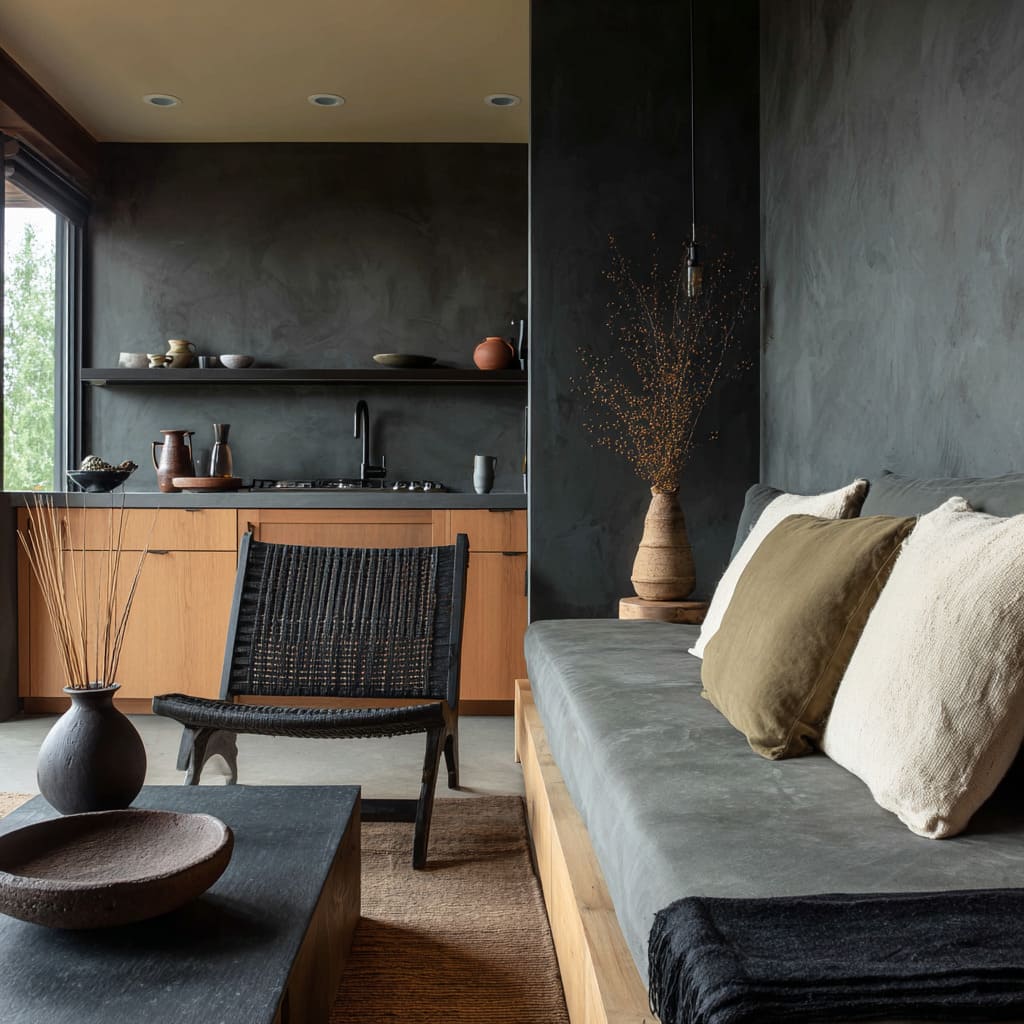
Sofas and Benches as Architecture, Not Just Seating
In many of boho living room concepts, seating behaves like a continuation of the architecture:
- Built-in benches with continuous cushions (dark clay walls, deep gray clay walls, corner nook, dark clay + floating shelf).
- Bench-sofas on light timber frames with thick, straight cushions.
- Oversized charcoal sofas that sit low and linear, like a padded platform.
What’s special here:
- Seating completes the wall, not just sits in front of it.
When a bench merges with the wall or wraps into a corner, the room stops feeling like furniture in a box and starts feeling like a carved-out cavity meant for sitting. - Cushion density is tuned to the mood.
- Firm, architectural bench cushions in deep graphite rooms support the minimalist mood.
- Soft, slouchy linen cushions in graphite envelopes or slate-wrapped rooms emphasize comfort, but still work with the structured backdrop.
- Wrinkles and slouch are intentional.
Slightly underfilled cushions and linen with visible creasing are used repeatedly. This is not carelessness; it’s a strategy to stop the dark palette from feeling stiff. Soft disorder at the textile level is what makes the dark structure humane.
These ideas quietly say: the most important “boho” move is not a macramé piece; it’s how the seat feels like part of the entire design.
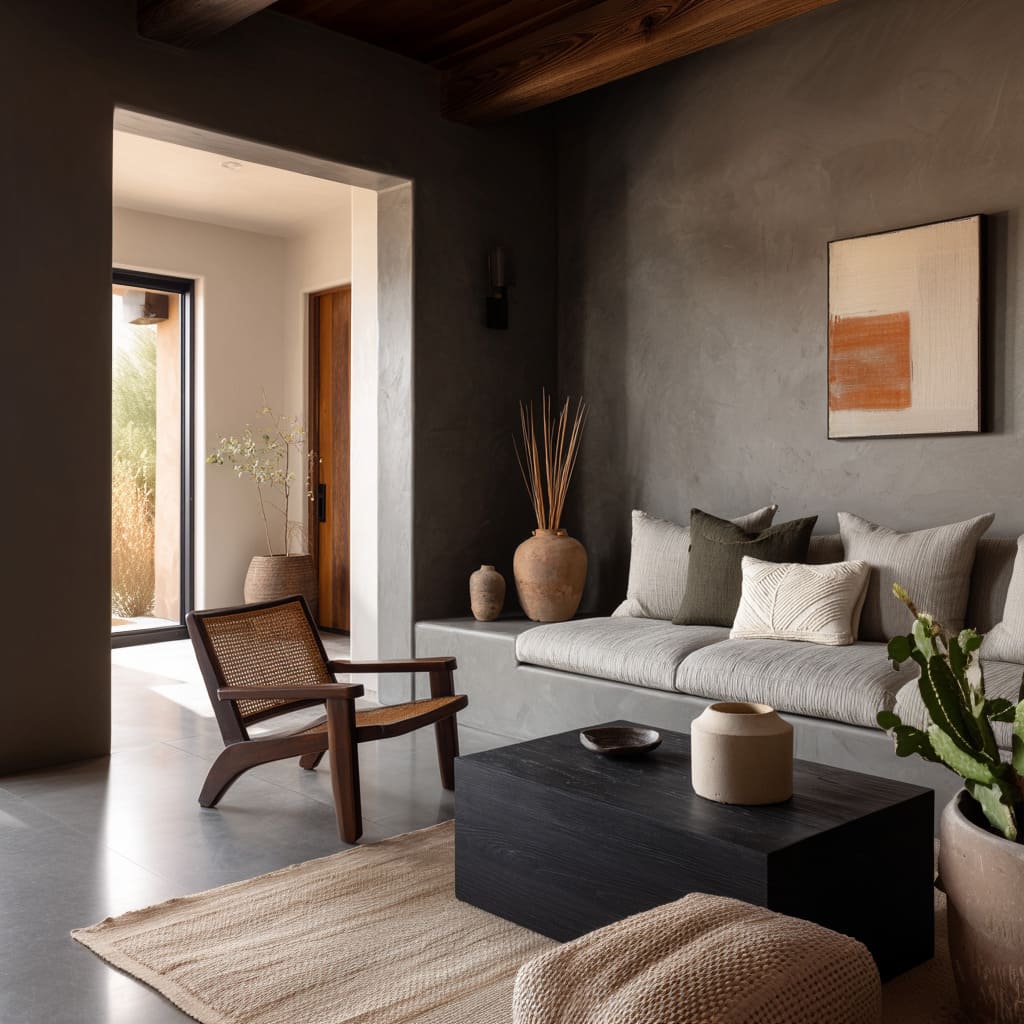
Textiles: Micro-Gradients Instead of Printed Patterns
Another idea: almost no bold patterns. Instead, texture and micro-shifts in color carry the entire textile story.
Look closely at the pillow lineups and throws:
- Sequences such as: white → oatmeal → caramel → charcoal.
- Sofas: pale gray base + black pillow + rust pillow + caramel pillow.
- Throws: mottled browns, knitted textures, ribbed creams, and soft stripes.
Subtle but important strategies:
- Horizontal gradients on the sofa
Pillows can be often arranged so that the tonal sequence flows from light to dark. This creates a slow color change from one end of the sofa to the other. The sofa becomes a soft horizon line inside the dark shell. - Texture differentiation instead of pattern differentiation
One pillow can have thick ribs, another is brushed smooth, another is nubby or stitched. The variety is tactile rather than graphic. With dark walls absorbing visual noise, this texture-first approach reads clearly. - Throws as “weight markers”
Dark or ginger-brown throws are draped at one side to add visual mass. They connect the sofa to heavier elements in the room (coffee table, wall, shadow), making the seat feel grounded rather than floating in light.
The advanced design thinking here: removing pattern, then reintroducing complexity through micro-variations in tone and texture. That’s how the design can stay calm yet layered.
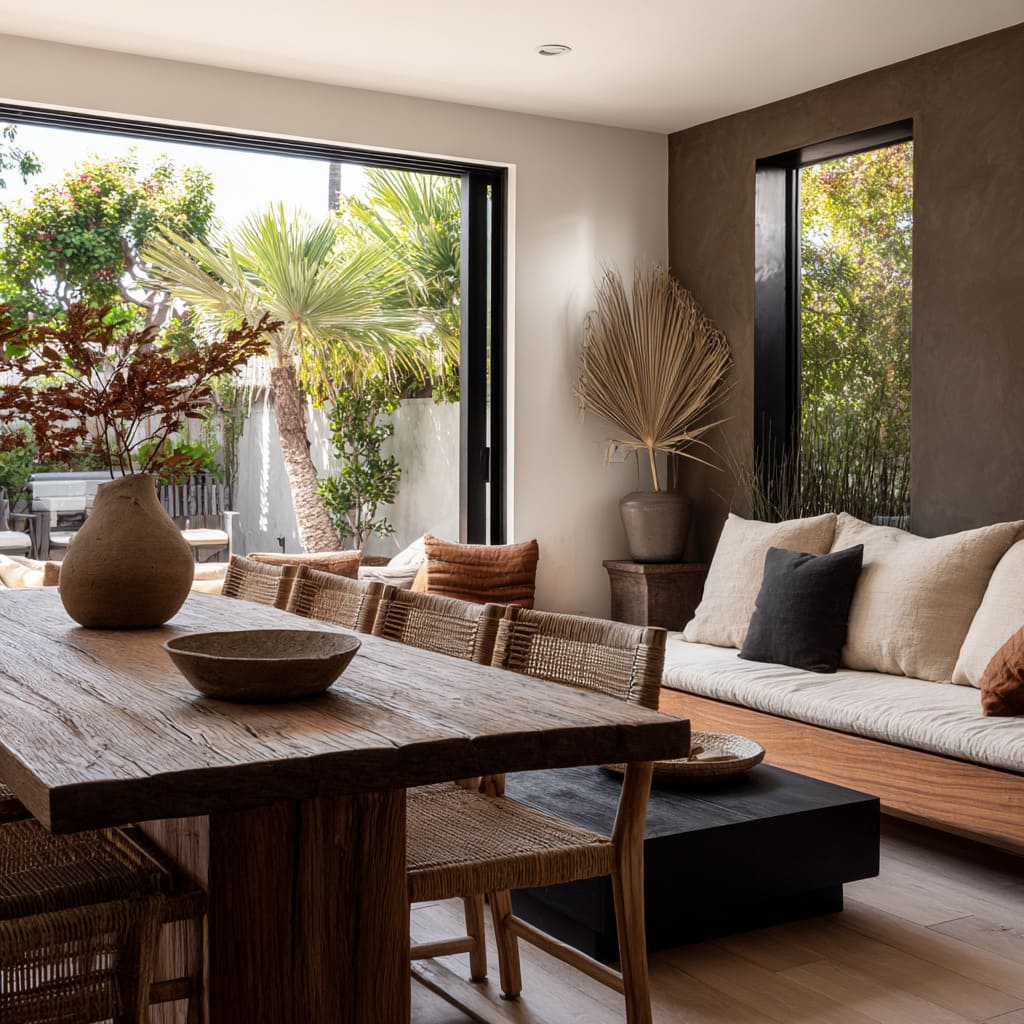
Coffee Tables and Blocks: How Mass is Used as a Visual Anchor
In dark modern living room designs, coffee tables behave almost like stone anchors:
- Deep charcoal cubes with faint grain.
- Long dark wood slabs with cracked, rugged grain.
- Blocky tables with stone- or concrete-like finishes.
- Circular black tables with matte volume.
They share several roles:
- Anchor point for the entire palette
With walls, large sofas, and shelves all playing in mid-to-deep tones, the coffee table becomes the densest element. It pulls the eye downward and gives weight to the sitting area. - Stage for tiny, soft objects
On top of these heavy tables sit light ceramic bowls, candles, small wooden cups. The contrast between the block and the delicate object is a carefully repeated motif: hard base, soft accent. - Shape contrast
Sharp rectangular tables are paired with round bowls; circular tables carry slightly irregular ceramics. The tension between rigid and soft outlines is a quiet, consistent tool to keep the design interesting without loud décor.
These pieces are not simply “tables”; they can be central counterweights that keep a very relaxed textile story from drifting into visual lightness.
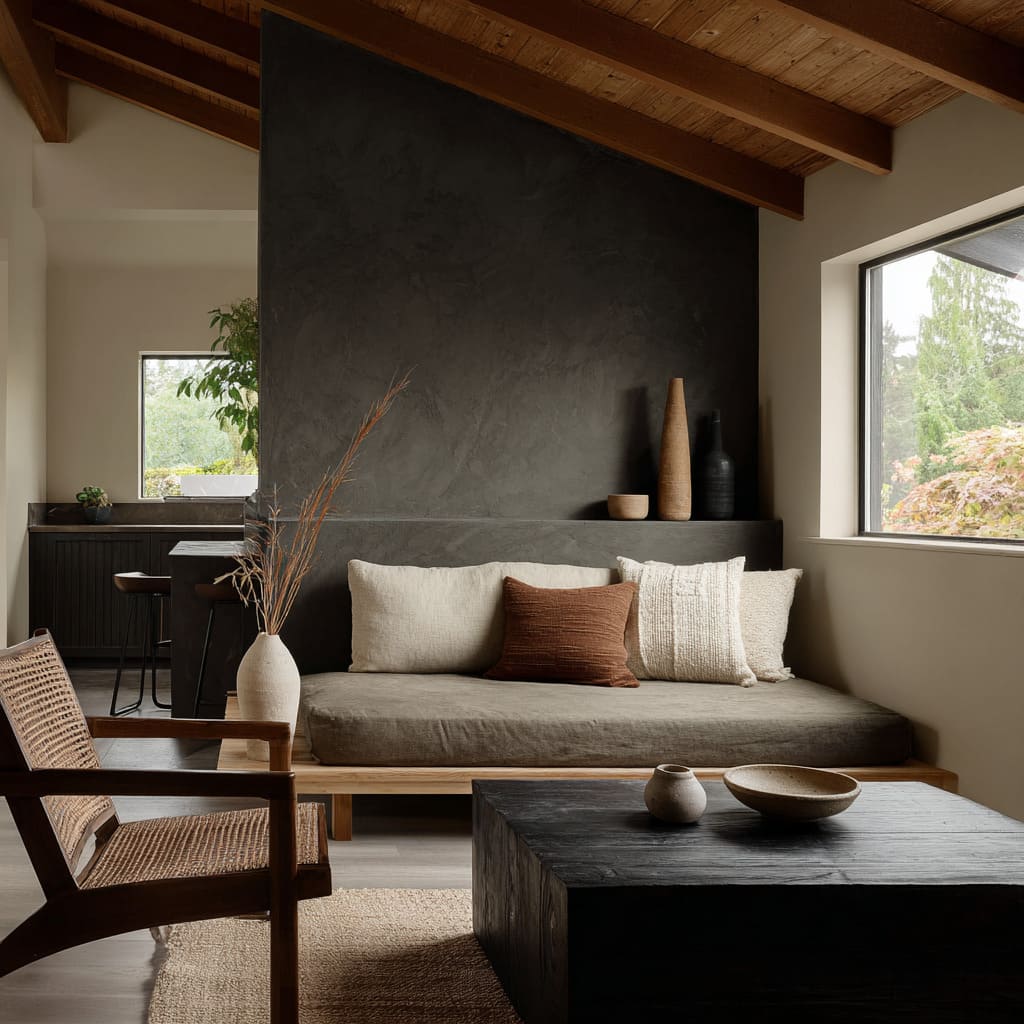
Woven Chairs and Cane: The Breathing Spaces in a Heavy Palette
One of the strongest, less obvious threads is the role of woven seating:
- Cane lounge chairs with timber frames.
- Black woven chairs with tight patterns.
- Honey-toned woven dining chairs that link dining and living zones.
- Open cane chairs that sit near dark walls or benches.
Their function is more than add boho texture:
- Visual permeability
The open weaving lets light through. Against dark walls and heavy tables, these chairs act like visual vents, preventing the room from becoming optically dense. - Bridges between tones
- Light cane connects pale sofas to dark walls.
- Black woven seats connect charcoal surfaces to natural timber elements.
- Softening geometry
Chairs can be angled slightly, not aligned perfectly with the bench or wall. That small tilt is a quiet signal of informality, stopping the space from feeling staged.
Woven pieces here are not accessories; they are the pressure-release mechanism of the whole composition.
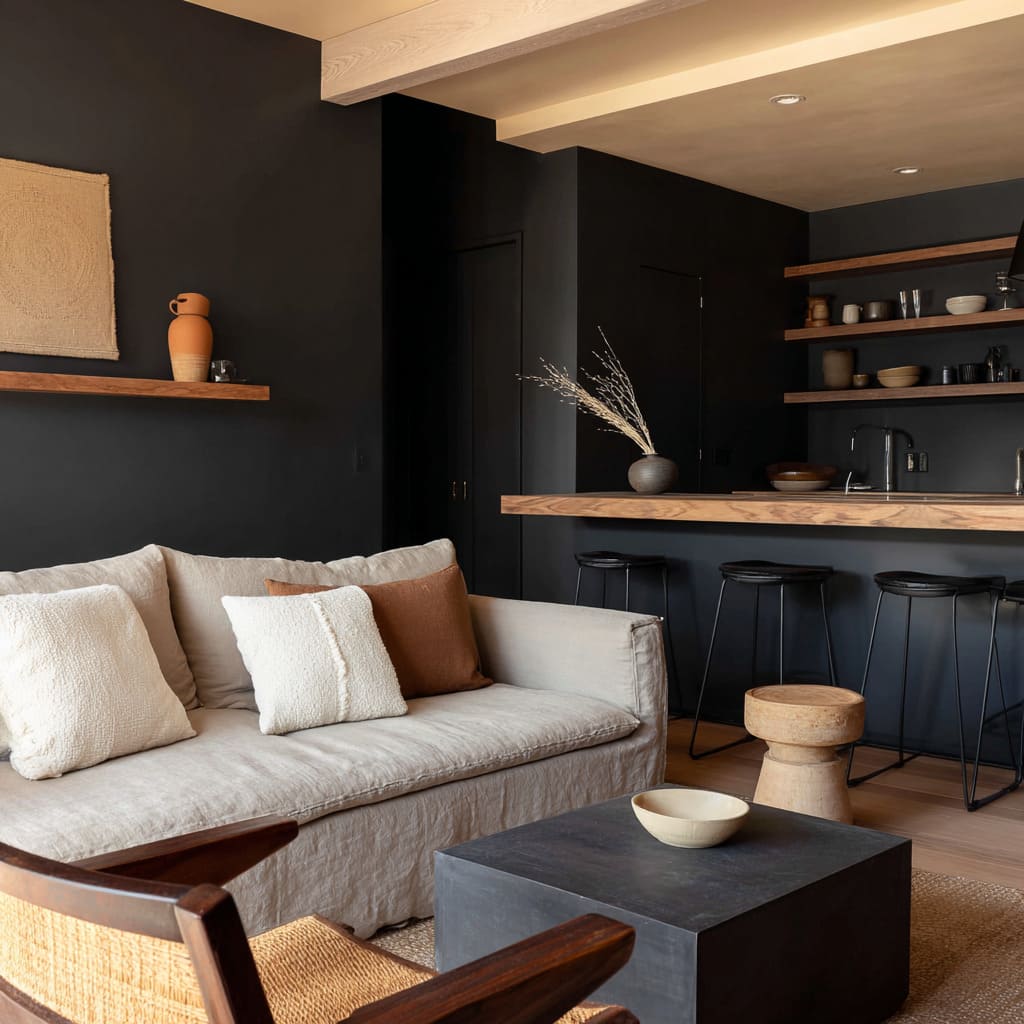
Pottery and Botanicals as Silent Sculptures
A major boho cliché is overflowing plants. Modern boho ideas do something more refined: botanicals and ceramics act as sculptural punctuation marks.
Repeated patterns:
- Dried palm leaves in minimalist pots.
- Tall branches in clay or terracotta vases.
- Reed-like stems in oversized earthen vessels.
- Small clusters of matte bowls and bottles on shelves and tables.
Key observations:
- Almost everything is dry, not lush.
Instead of green jungle, dried leaves and branches can be used. This keeps the color palette contained (warm browns, off-whites, muted greens) and matches the dryness of clay walls and linen fabrics. - Vertical punctuation in horizontal compositions
Long benches, shelves, and tables run horizontally; tall vases and stems shoot up in front of or beside them. These elements are the commas and exclamation marks in a mostly horizontal sentence. - Botanical “echoes” between spaces
A dried palm leaf in the seating area may be mirrored by branches in the dining area or kitchen ledge. This repetition ties separate zones into a single visual story.
The result: nature is present in shape and texture more than in fresh color, which is a clever way to keep the palette moody without losing organic life.
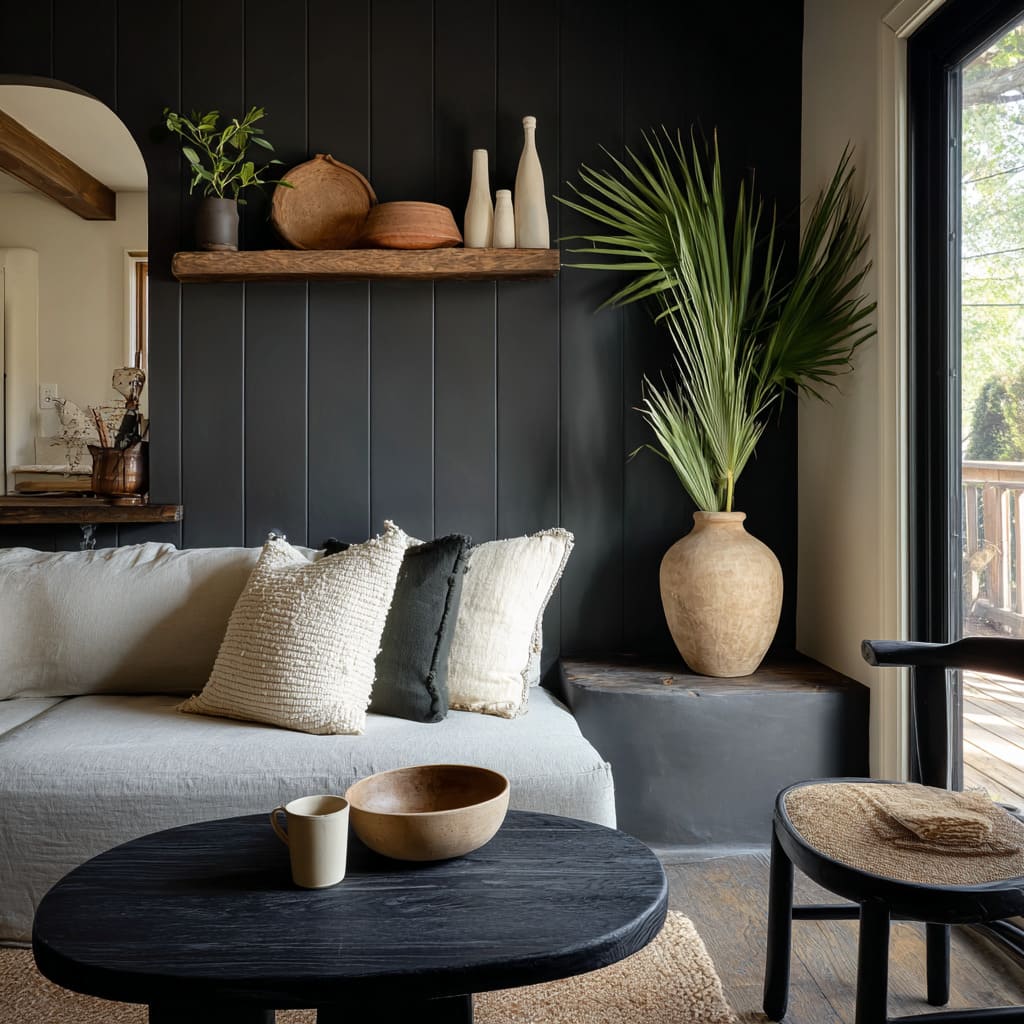
Shelves, Ledges, and the Use of Empty Space
Floating timber shelves, kitchen ledges, and built-in recesses are options for many concepts. Their real importance is how they handle negative space.
Patterns to notice:
- Thick, rustic shelves against charcoal or clay walls.
- Double rows of shelves that form a visual band.
- Ledges that run behind sofas as both console and display plane.
- Minimal, widely spaced objects: a few bowls, a vessel, a small framed piece.
Why this matters:
- Shelves as horizon lines
Against dark vertical walls, warm timber shelves act like horizon lines, breaking up height and calming the eye. - Empty space as deliberate content
Instead of filling every inch, objects are spaced so that gaps become part of the design. These blank intervals make each piece feel important and keep the room from slipping into cluttered boho territory. - Linking living room and kitchen
In open layouts, similar shelves appear in both zones, or the same wood tone repeats: living room shelf → kitchen shelf → bar counter. This creates visual continuity without needing matching furniture.
This is where the dark boho designs feel especially “modern”: boho is expressed through a few strong objects and lots of air around them.
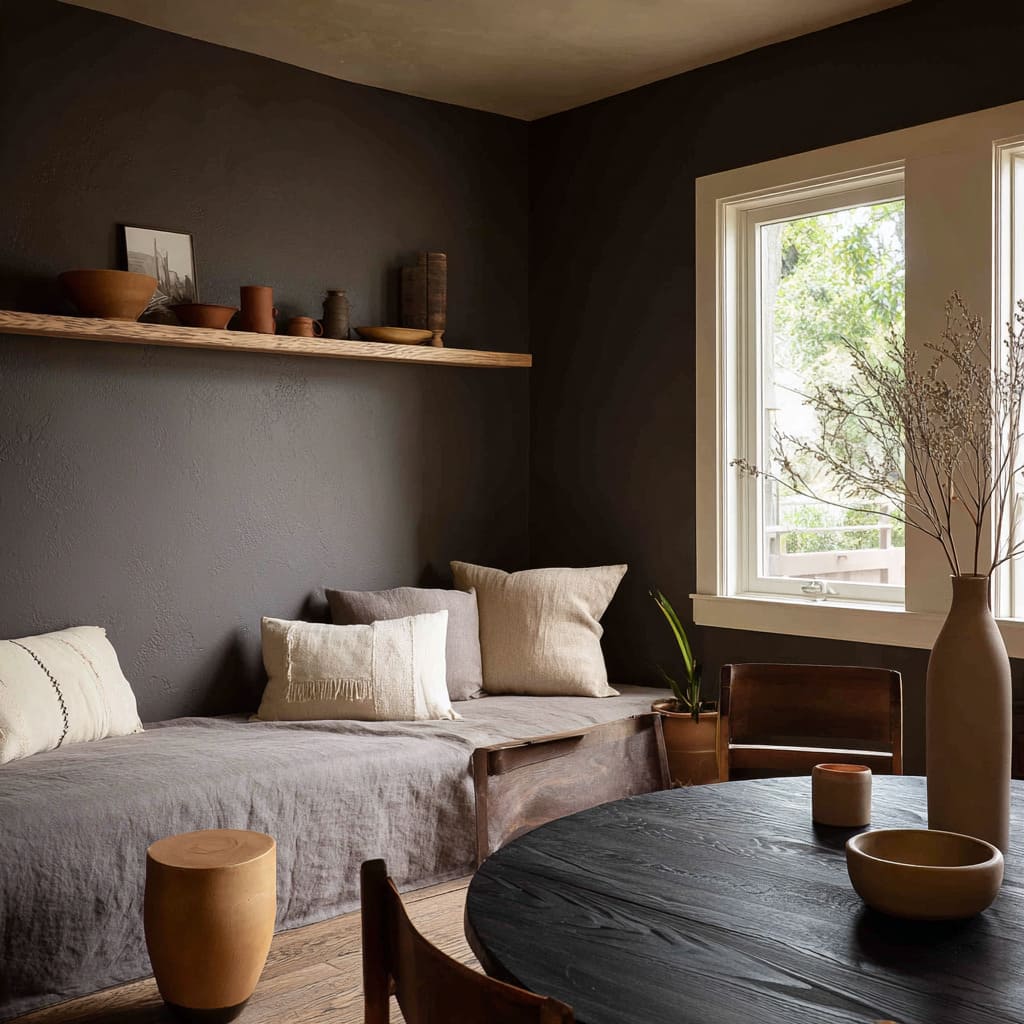
Light, Shadow, and Framed Views as Active Design Tools
The way light is handled here goes beyond bright vs dim. Shadow, direction, and view framing are actively used as design elements.
Some popular moves:
- Slanted white ceilings with exposed beams
These surfaces catch daylight and bounce it softly into the darker parts of the room, keeping the lower dark envelope from feeling compressed. - Windows treated as living art
Exterior greenery is often framed by dark trim, so the outside view looks like a moving artwork. The interior palette is built to sit comfortably under that green, not compete with it. - Adjacent bright kitchens
Dark boho living room designs often open into paler, light-filled kitchens. That shift in brightness creates built-in contrast: living room feels like a retreat; kitchen feels active and open. - Corner nooks with selective sunlight
A dark corner with one small window and a bench becomes a tiny light-and-shadow theater, highlighting pottery and textiles in slow gradients.
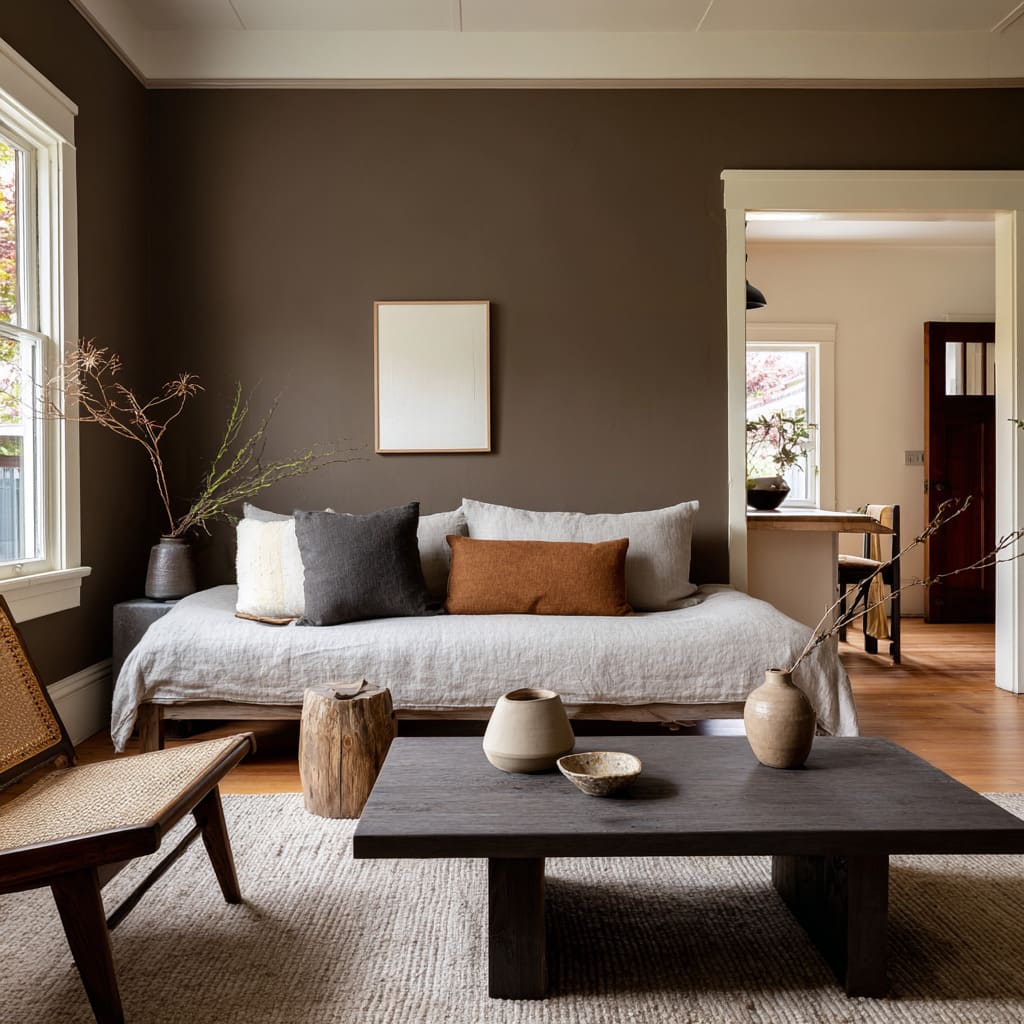
Such ideas can be designed as scenes that change through the day. Plaster ripples, ribbed fabrics, and cane weaving only show their full character when light rakes over them.
That sensitivity to light is what pushes these concepts far beyond “dark paint plus boho pillows. ”.
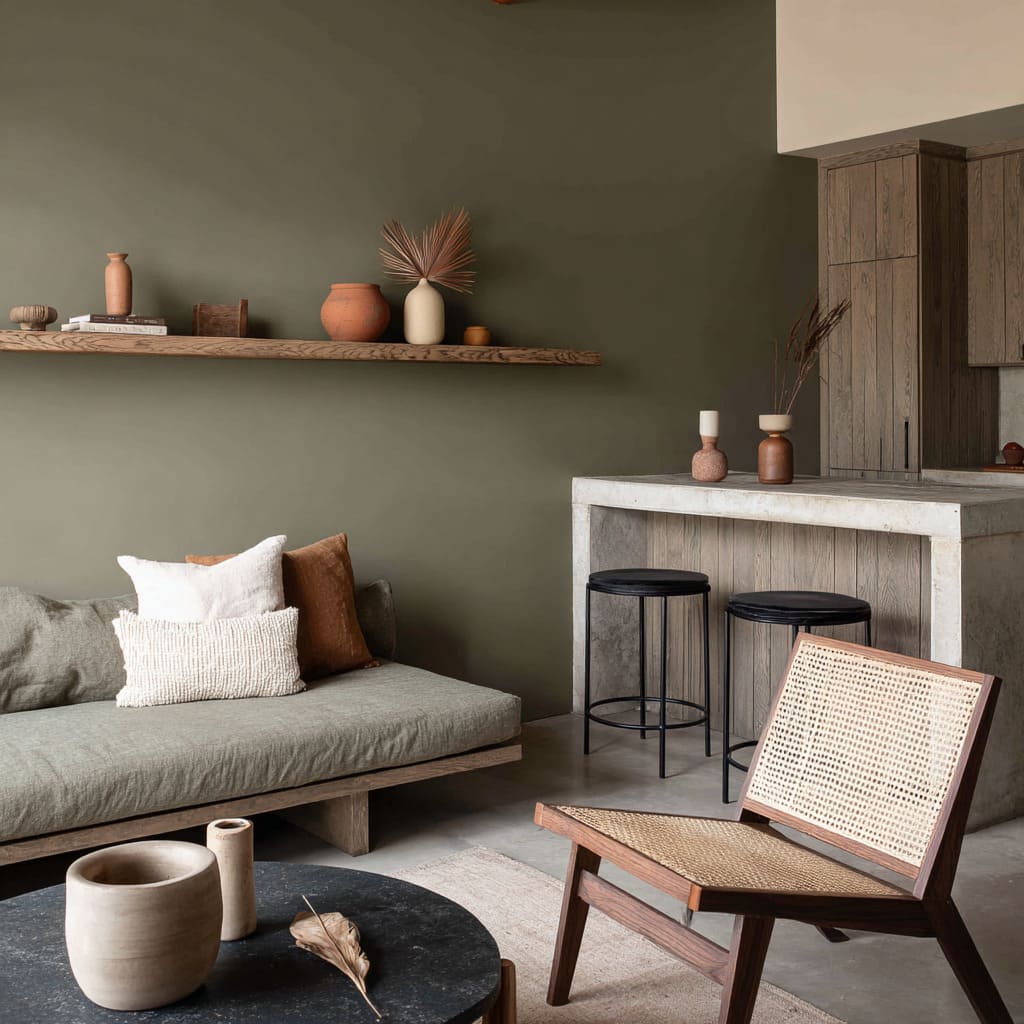
Spatial Types: Nooks, Open Layouts, and Indoor–Outdoor Flow
Dark boho here works in several layout types, and each type uses darkness differently.
Corner Nooks and Bench Cavities
- Dark clay or brown walls wrapping benches.
- One or two windows framing greenery.
- Low coffee blocks and close-range seating.
These feel like retreat pockets—spaces for a single person or a small conversation. Darkness tightens the space on purpose.
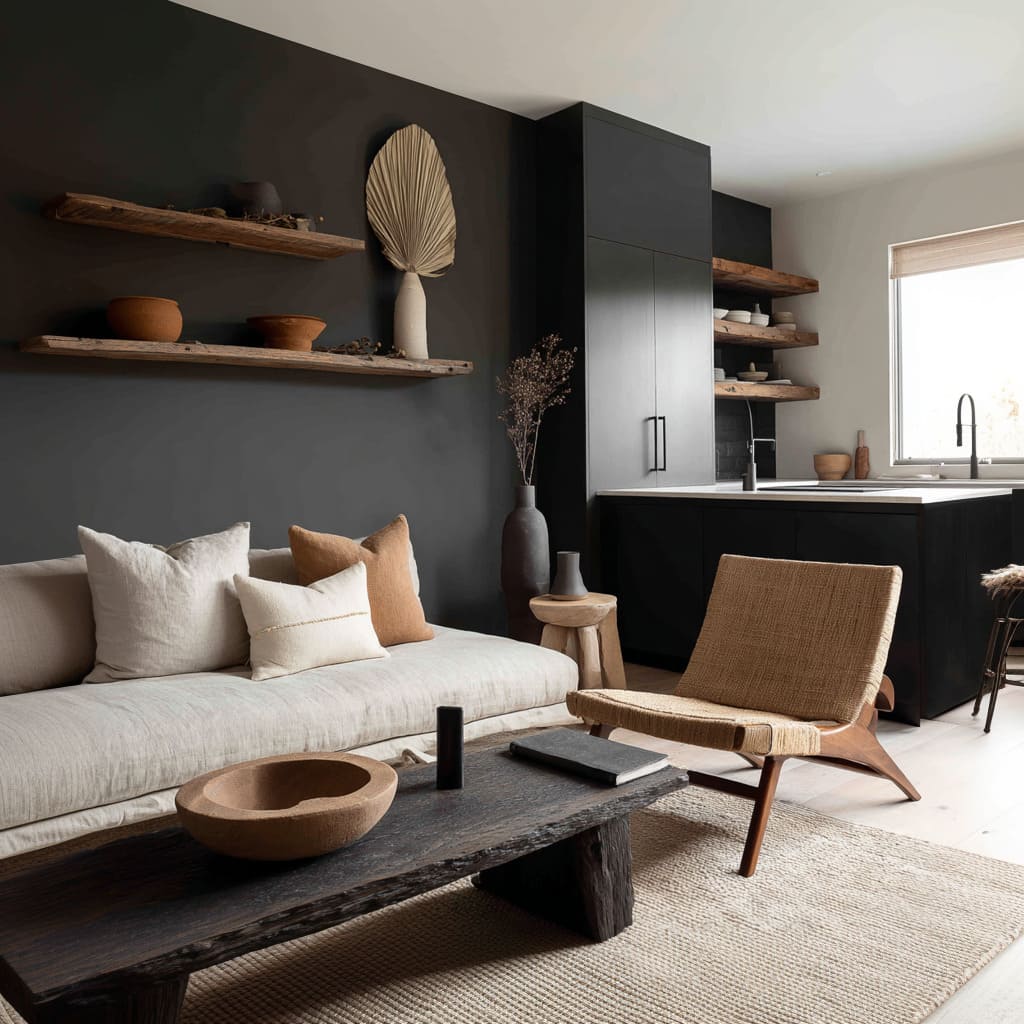
Open Living–Kitchen Layouts
- Graphite or slate walls continuing into the kitchen.
- Sofas aligned with kitchen openings, so you see both at once.
- Floating shelves and pottery bridging zones.
Here, darkness is the background continuity that ties two functions together, while light cabinetry or counters prevent the whole space from feeling heavy.
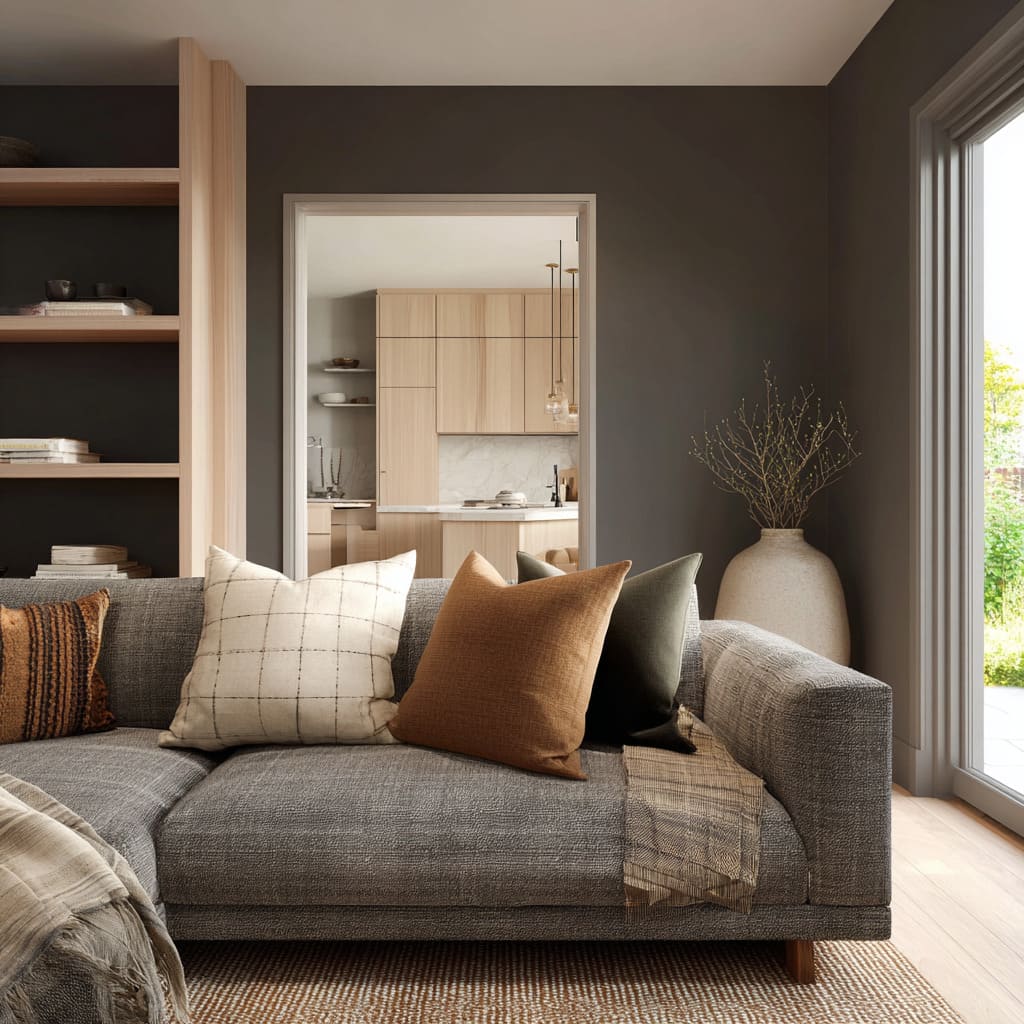
Indoor–Outdoor Blends
- Large windows or doors with dark frames.
- Dark interior walls paired with bright outdoor greens.
- Woven dining chairs and rugged tables linking interior boho with garden or desert textures.
These ideas rely on a contrast between interior shadow and exterior brightness. The dark palette inside allows greenery and sky to feel more vivid without adding bright colors indoors.
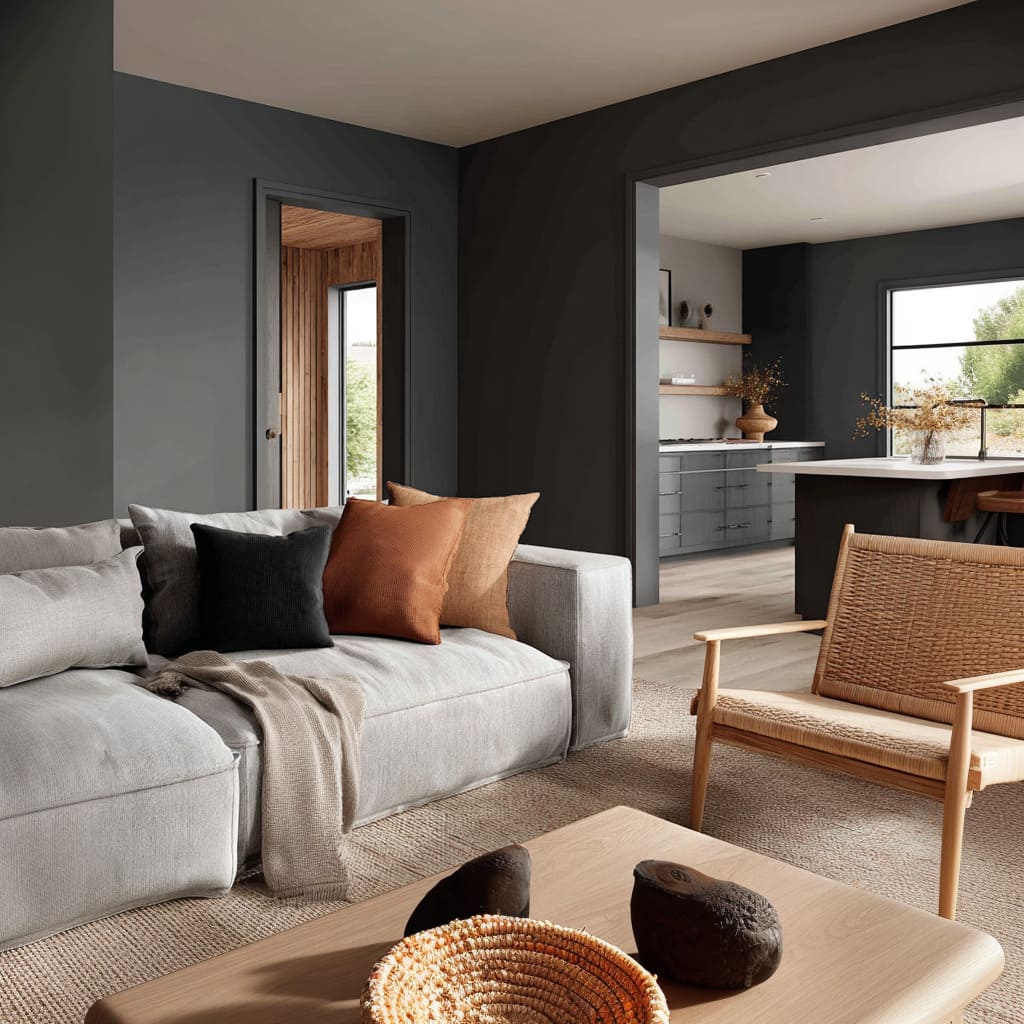
Color Micro-Strategies: Rust, Caramel, Olive, Camel
A small set of accent colors can be used in many designs:
- Rust and burnt orange.
- Caramel and camel.
- Olive and mossy green.
- Ginger and soft sand.
They can be used sparingly but very intentionally:
- Rust and burnt orange
Often in a single pillow or throw. This ties to timber ceilings, terracotta pottery, or the warmth of clay walls. It’s a tiny ember of color in a sea of neutrals. - Caramel and camel
These equidistant tones sit between pale linens and dark walls. They’re usually used to bridge white or cream pillows with black or charcoal pieces. - Olive and moss
These tones connect interior textiles to outdoor foliage or to olive-charcoal walls. They appear in pillows more than in large surfaces. - Ginger and sand
These show up as throws or striped cushions and often relate to wooden furniture grain or dried botanicals.
So while the palette looks simple at first glance, the real sophistication is in how micro-accents are tuned to connect specific materials to each other—wall to wood, sofa to greenery, pottery to ceiling.
Emotional Atmosphere: Quiet, Grounded, Slightly Raw
Finally, what kind of feeling do all these strategies produce?
- The darkness is calming rather than theatrical.
- The materials feel dry, fibrous, and honest: linen, cane, clay, raw timber.
- Shapes are simple, often blocky, but softened by textiles and light.
- Decoration is sparse but meaningful—every bowl and branch has a function in the composition.
The emotional message is “slow, grounded comfort with a modern backbone. ”
Not playful boho.
Not glossy luxury. Not brutal minimalism.
The space feels:
- Serious enough for focus and quiet evenings.
- Soft enough for lounging on a sofa that slumps slightly.
- Natural enough that a dried branch in a clay vase feels like enough “decoration.”
Short Wrap-Up
Taken together, there is a very particular approach to dark boho:
- Darkness is used as a soft frame that hides unimportant details and lets texture speak.
- Mid-tone clays, slates, and olive charcoals do the subtle work of holding warm and cool elements together.
- Benches, shelves, and coffee blocks form a hidden grid that organizes all the relaxed textiles and boho accents.
- Woven chairs, dried botanicals, and pottery act as breathing gaps and sculptural punctuation.
- Light, shadow, and framed views are treated as core design tools, not afterthoughts.
The result is a family of rooms where shade, texture, and quiet objects carry the design more than any single bold feature. That is the real sophistication inside such very modern dark boho living room designs.
Related Posts
Harmony Home Design brings 10+ years of residential interior design experience to the ideas shared here. We publish design concepts, layout thinking, and practical styling notes.