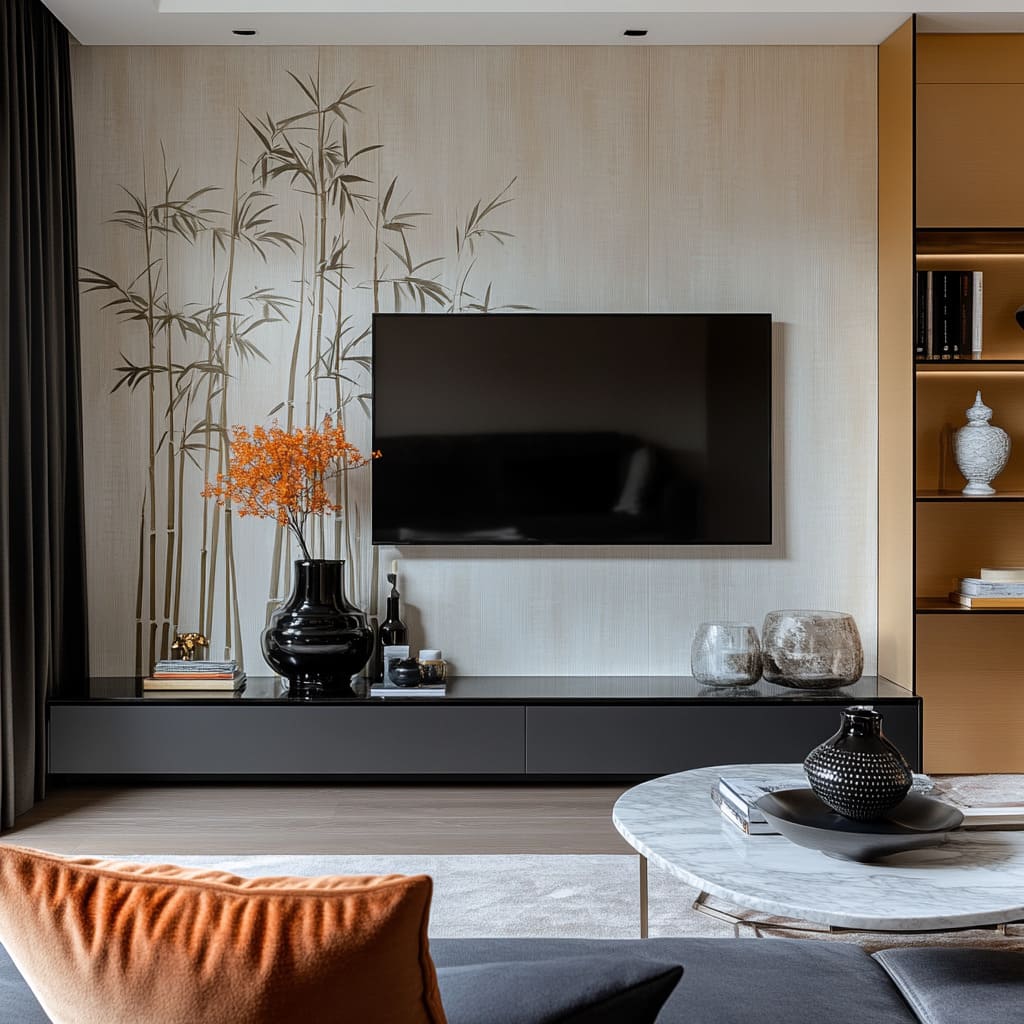
In many eco-style TV wall design ideas for living room settings, the most consistent visual logic is that the wall reads as a calm natural composition first, and the screen reads second. The eco character usually comes from surfaces that behave like earth, fiber, and stone: matte plaster-like fields, soft mineral staining, wood tones that feel sun-warmed, and a small set of objects that look tactile rather than shiny.
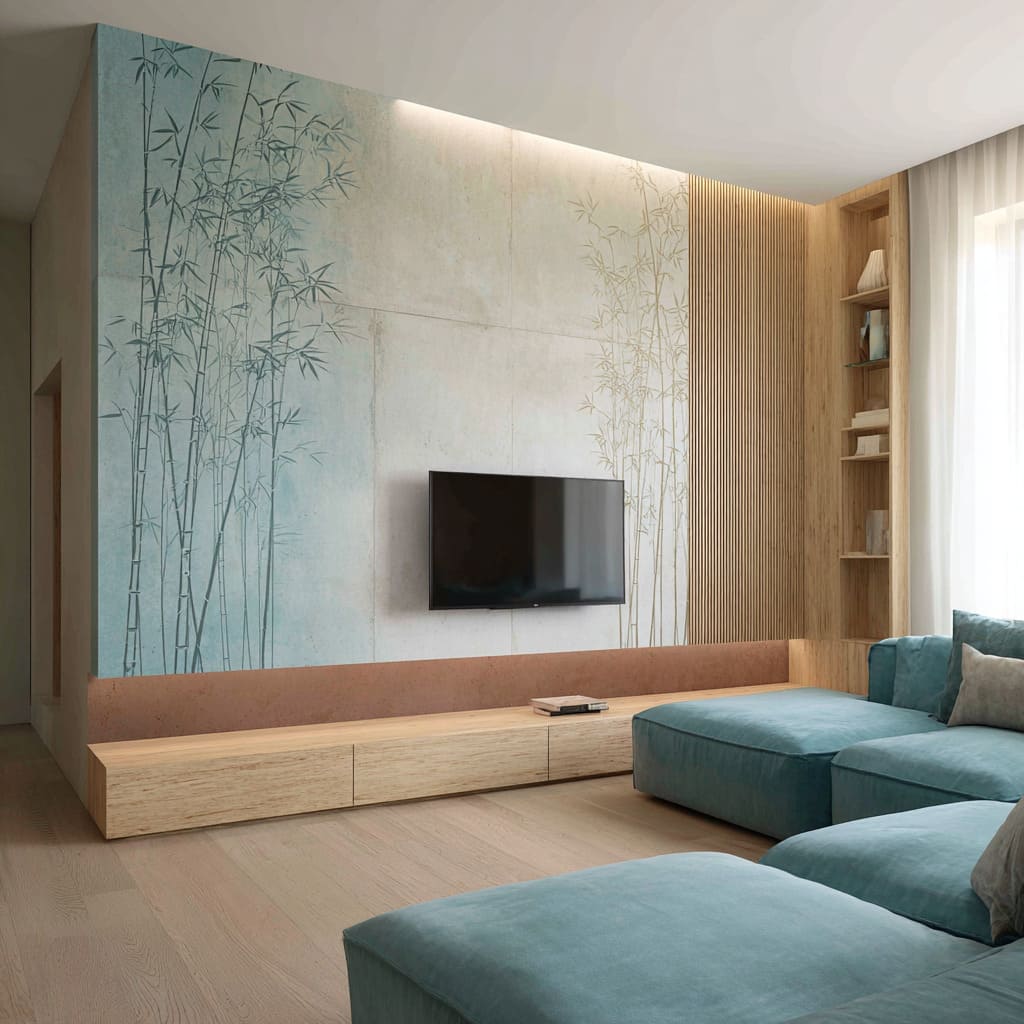
A high-end eco look often relies on four quiet systems working together:
- Matte mineral background: finishes that feel like clay plaster, limewash, brushed plaster, or a grasscloth-like texture. This is the backbone of many textured plaster TV feature wall with bamboo looks because it holds the black rectangle without harsh glare.
- Nature expressed as rhythm: bamboo or birch linework, reeds, canes, or thin vertical ribbing that reads like a natural tempo rather than a loud illustration. This shows up in many bamboo mural TV wall background compositions.
- A controlled value ladder: the wall stays mid-toned, the linework stays softer than the screen, and the TV remains the deepest black. This is a key reason minimalist eco TV wall background design can feel calm.
- Few, dense, grounded accents: pottery-like silhouettes, paper stacks, woven fiber, and airy branches. The room reads like a curated material collage rather than a themed display.
This kind of organic modern TV wall design tends to feel quiet not because it is empty, but because detail is placed in the surface and in micro-contrast rather than in lots of objects.
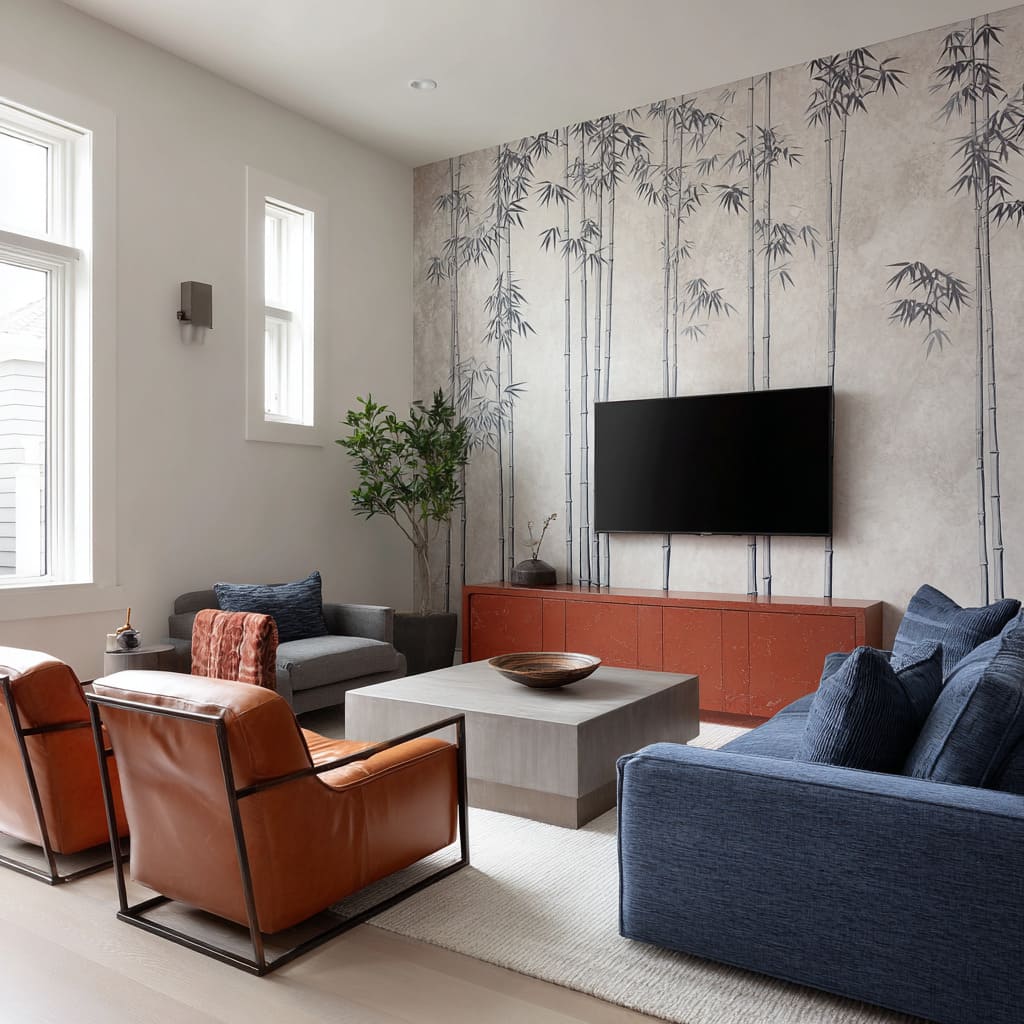
A map of eco-style TV wall looks and the visual effects they create
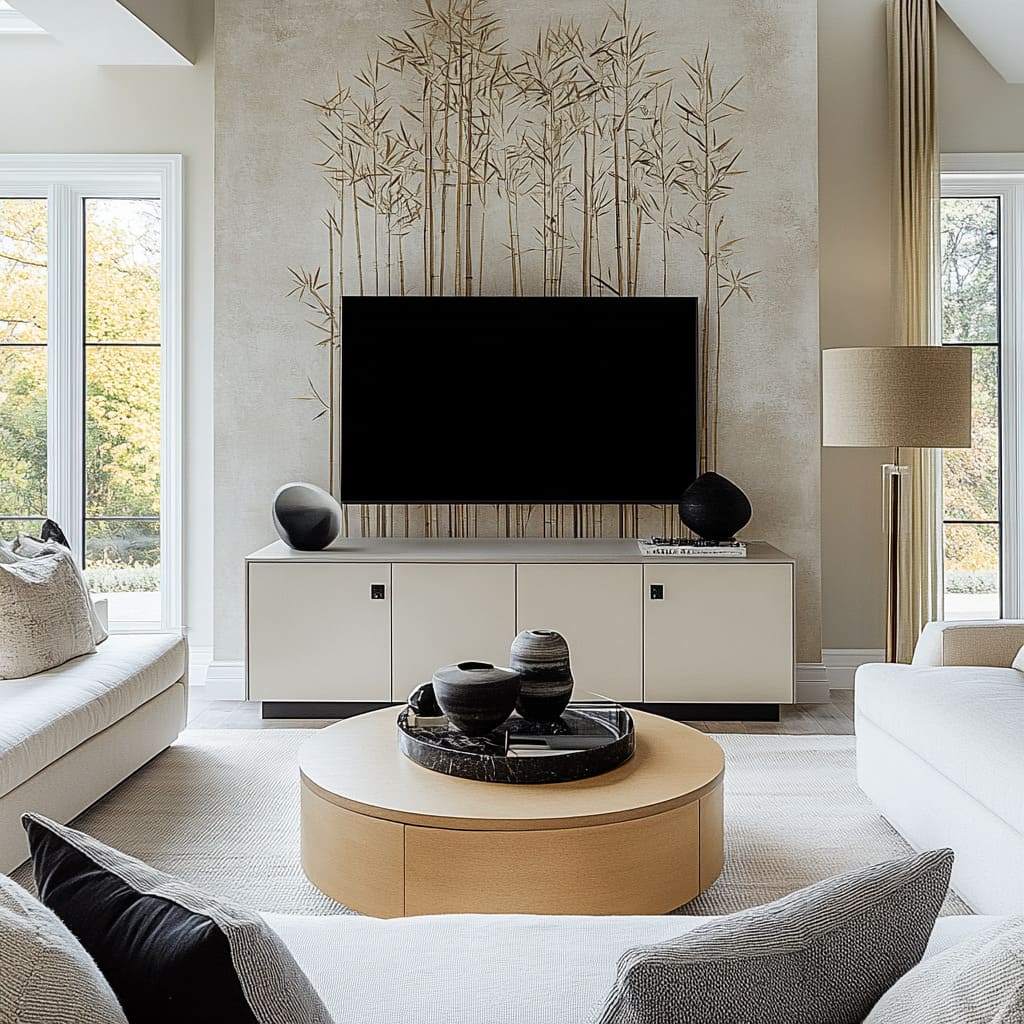
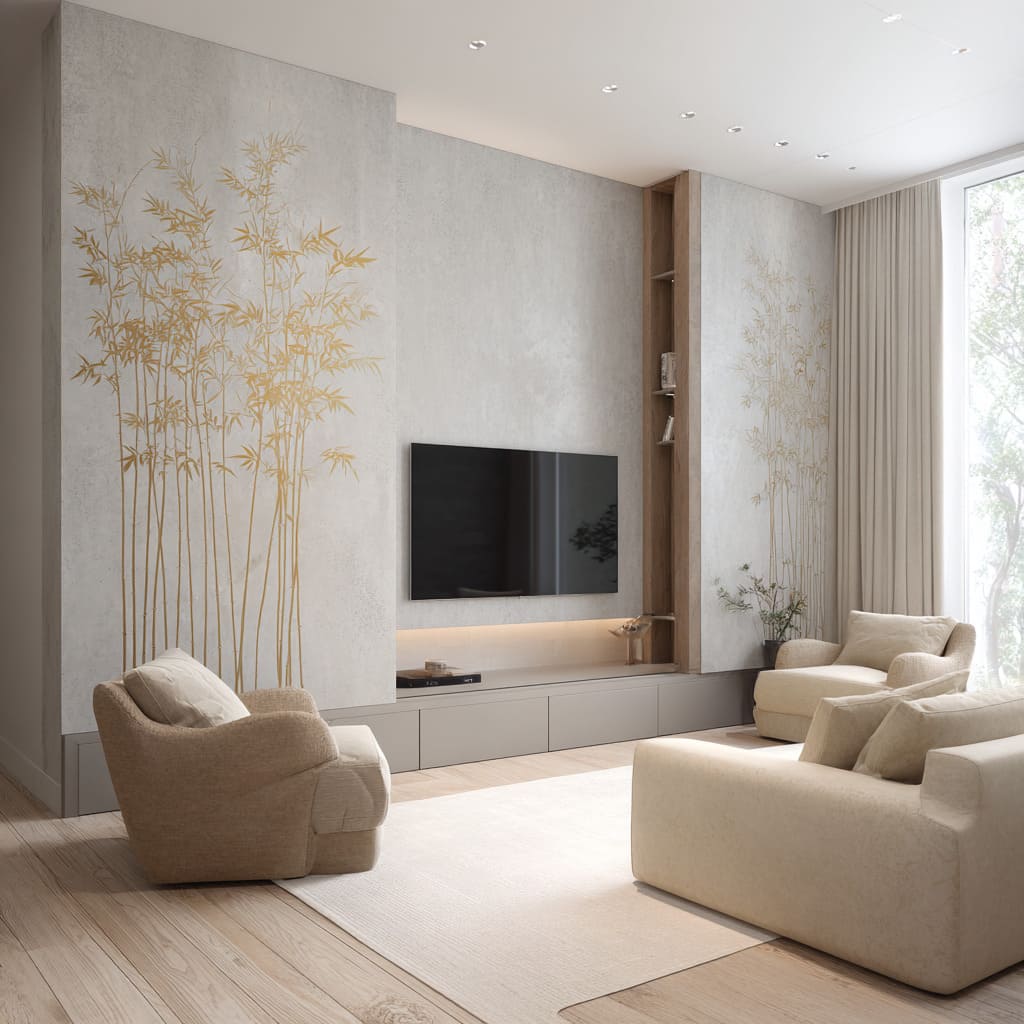
Airy bamboo canopy that behaves like calm wall art
An interesting look in bamboo accent wall behind TV styling is a canopy idea: the wall carries the nature energy above the screen, and the area around the screen stays calmer. This creates a ceiling-like softness, as if the wall has a light natural roof line, while the TV remains crisp and readable.
The result often reads as Japandi eco TV wall design: restrained, airy, and edited.
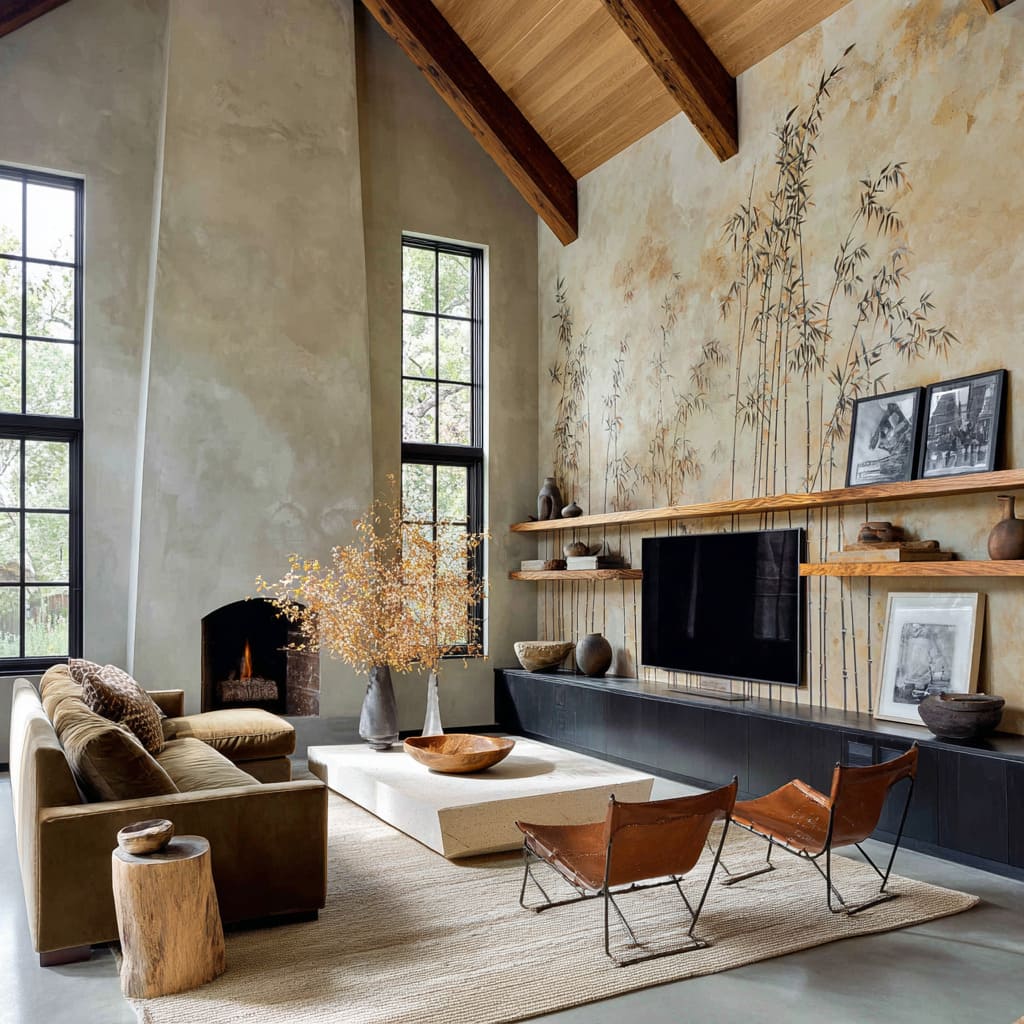
Dark earth palette with bamboo acting like a quiet screen
Eco style sometimes shifts into a deeper, evening mood through charcoal and greige tones, while still holding the “natural” message through matte surfaces and botanical rhythm. This creates a dark moody eco TV wall look where black elements feel like stone or still water rather than glam contrast.
In this mood, the wall design often balances weight off-center using one vertical rhythm zone (poles, ribbing, slats) and an airy botanical counter-note (dry branches, thin stems).
Plant + painted plant blended into one calm scene
One more eco strategy is making a living element behave like a continuation of the wall’s nature language. Instead of treating greenery as a separate decoration, the plant silhouette often repeats the same line quality as the mural or ribbed texture: fine stems, scattered leaves, and airy spacing.
This creates an indoor/outdoor calm that fits eco living room TV wall decor ideas without visual noise.
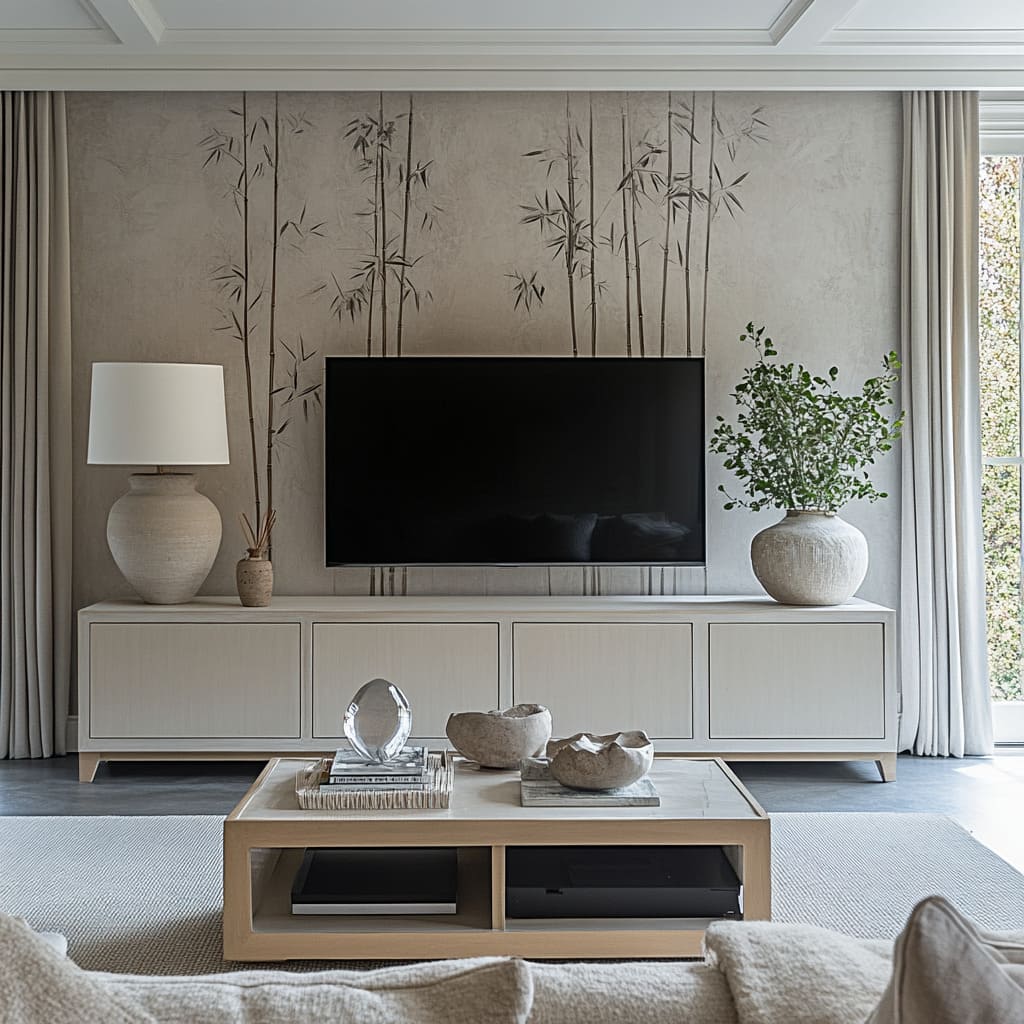
Bold bamboo shadow layer framed by warm fiber drapery
Another modern eco look can be achieved by using stronger, darker bamboo marks on a textured mid-tone background, so the mural reads like a shadow layer instead of an illustration. Warm drapery in straw/tan tones often frames the wall and repeats the same vertical calm in fabric form.
This pairing creates a “nature echo” effect: mural verticals + curtain verticals + a calm base console.
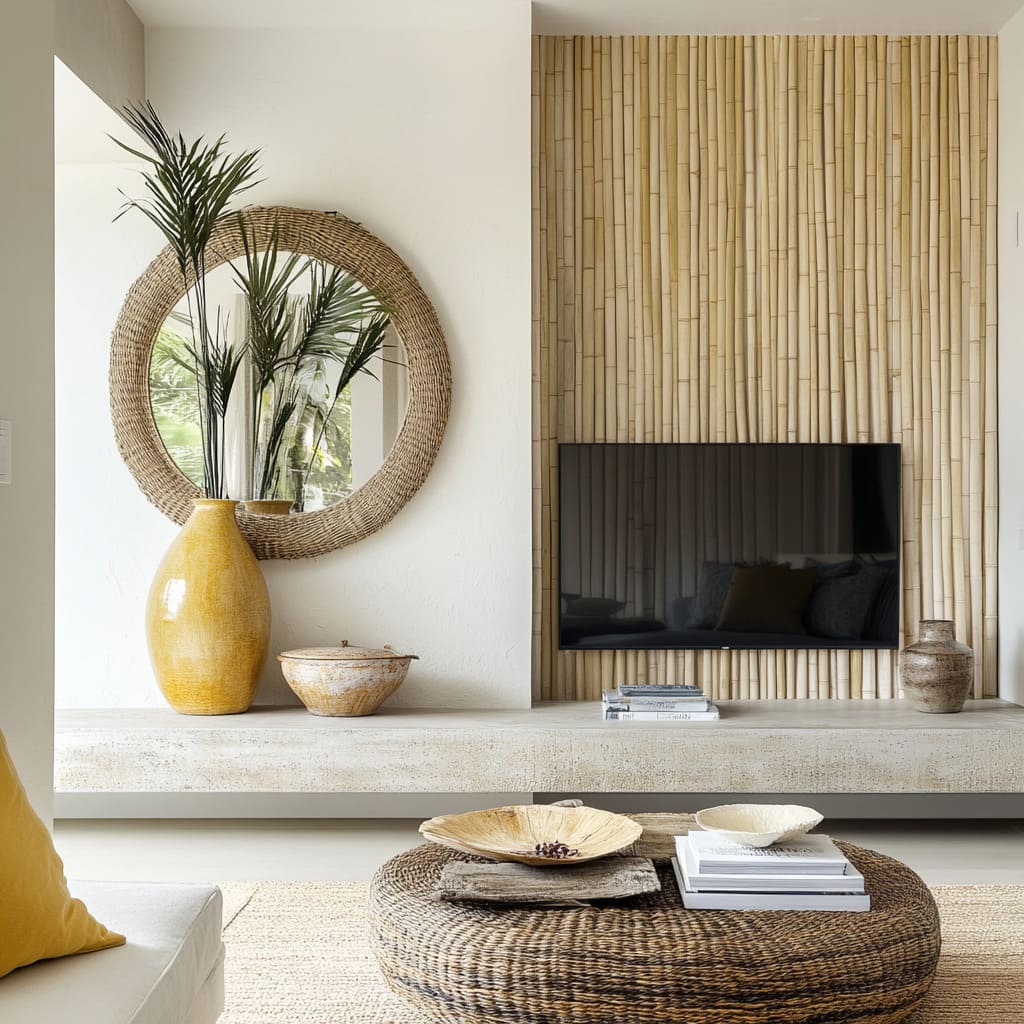
Bamboo cladding as a quiet texture field, paired with woven fiber
In more literal eco expressions, the wall itself can become the material story: vertical bamboo canes or bamboo-like cladding reads as a breathable natural plane. A frequent partner is woven fiber (round mirrors, ottomans, baskets) so the room gets two nature rhythms: straight verticals and braided circular texture.
This can naturally appear in coastal modern eco TV wall rooms where texture replaces color.
Soft sanctuary niche with arch shapes and warm backlight
A “sanctuary niche” version of eco-style treats the TV zone like a sheltered recess. Arches soften the composition, and warm backlighting adds atmosphere without extra decor.
Bamboo rhythm often appears inside shelving zones as a backdrop layer, so depth is built as: glow behind + vertical texture + objects in front. This reads as an arched niche TV wall design with a hotel-suite calm, often adjacent to warm minimalist TV wall decor language.
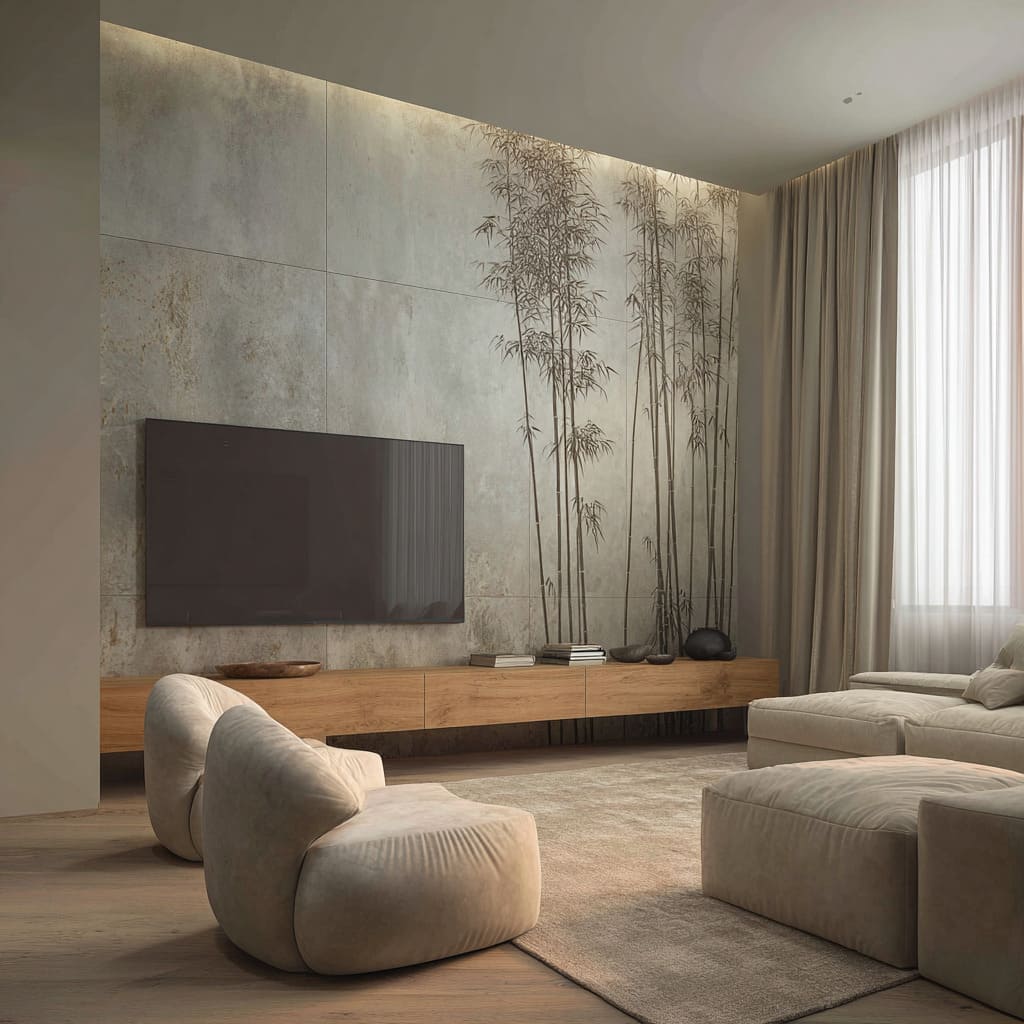
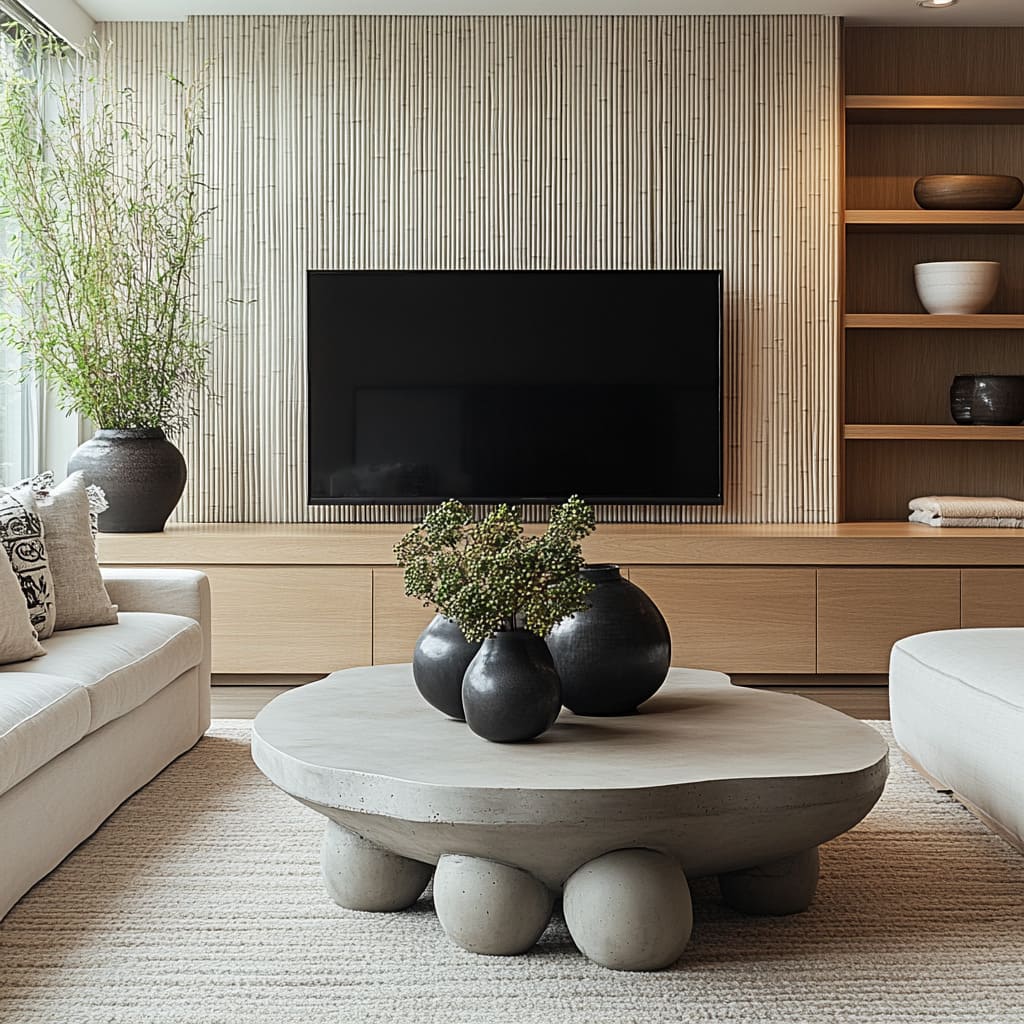
Micro-rhythm reed wall with pale wood calm and stone-like furniture forms
Eco style can look most refined when nature is implied through micro-rhythm rather than motifs. Very fine vertical lines (reeds, narrow ribbing, thin slats) can read almost like neutral fabric from far away, then reveal texture up close.
This is common in wood slat TV wall with bamboo adjacent zones, and in modern organic TV wall design where furniture shapes echo geology (rounded supports, stone slabs, pebble forms).
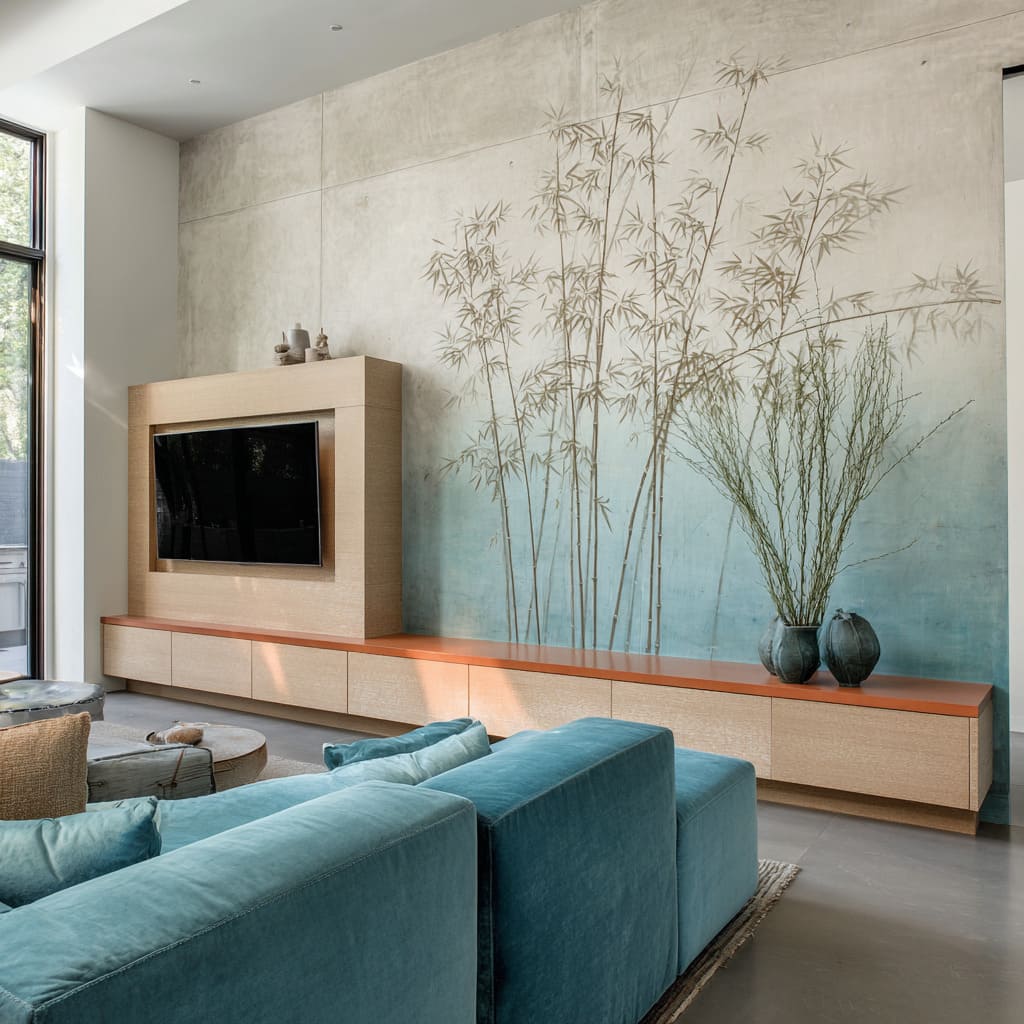
Stone-panel landscape wall with misty linework and a long wood shoreline
Another idea is using large panel seams as a quiet geological grid (calm rectangles, faint joins) paired with thin bamboo linework placed off-center. A long, low wood console then behaves like a shoreline band that stabilizes the vertical nature rhythm.
This is common in stone panel TV wall design and wabi sabi TV wall design moods, where quiet imperfection in tone is treated as atmosphere.
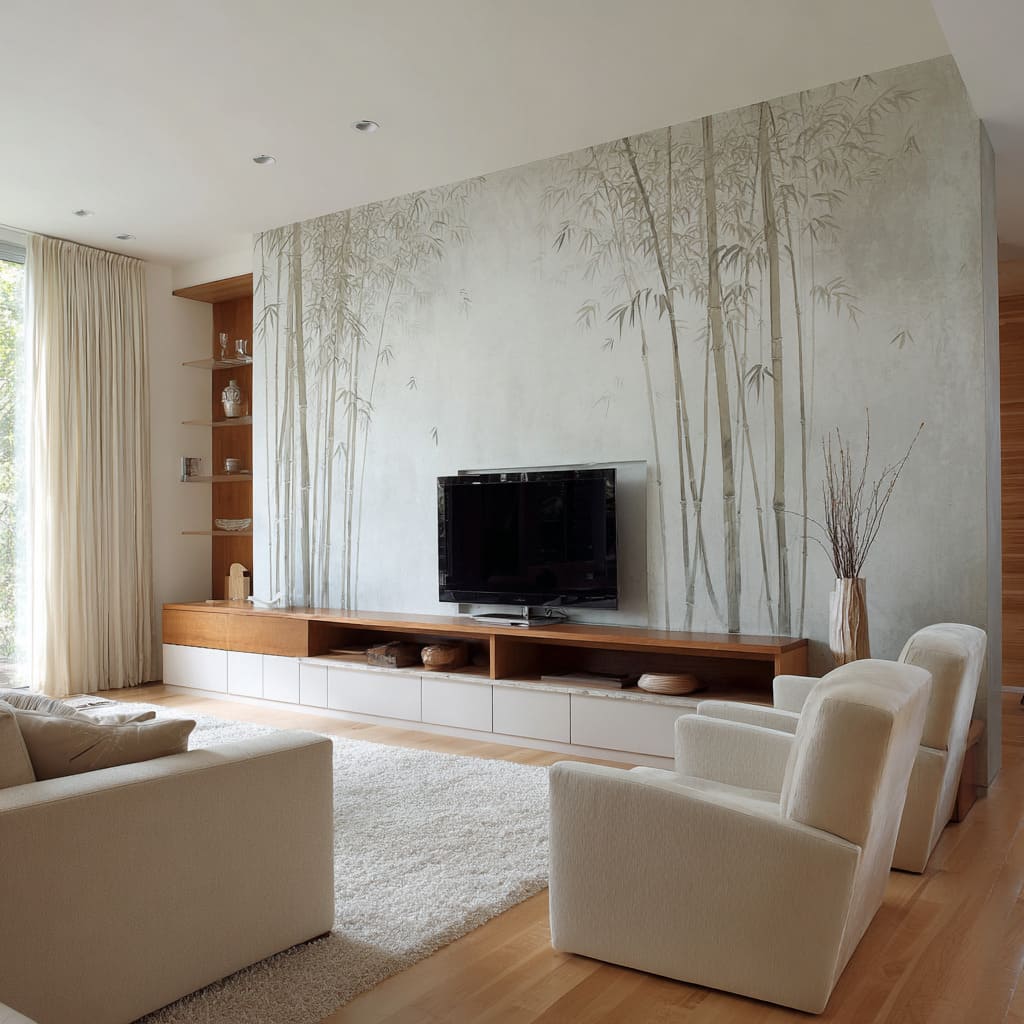
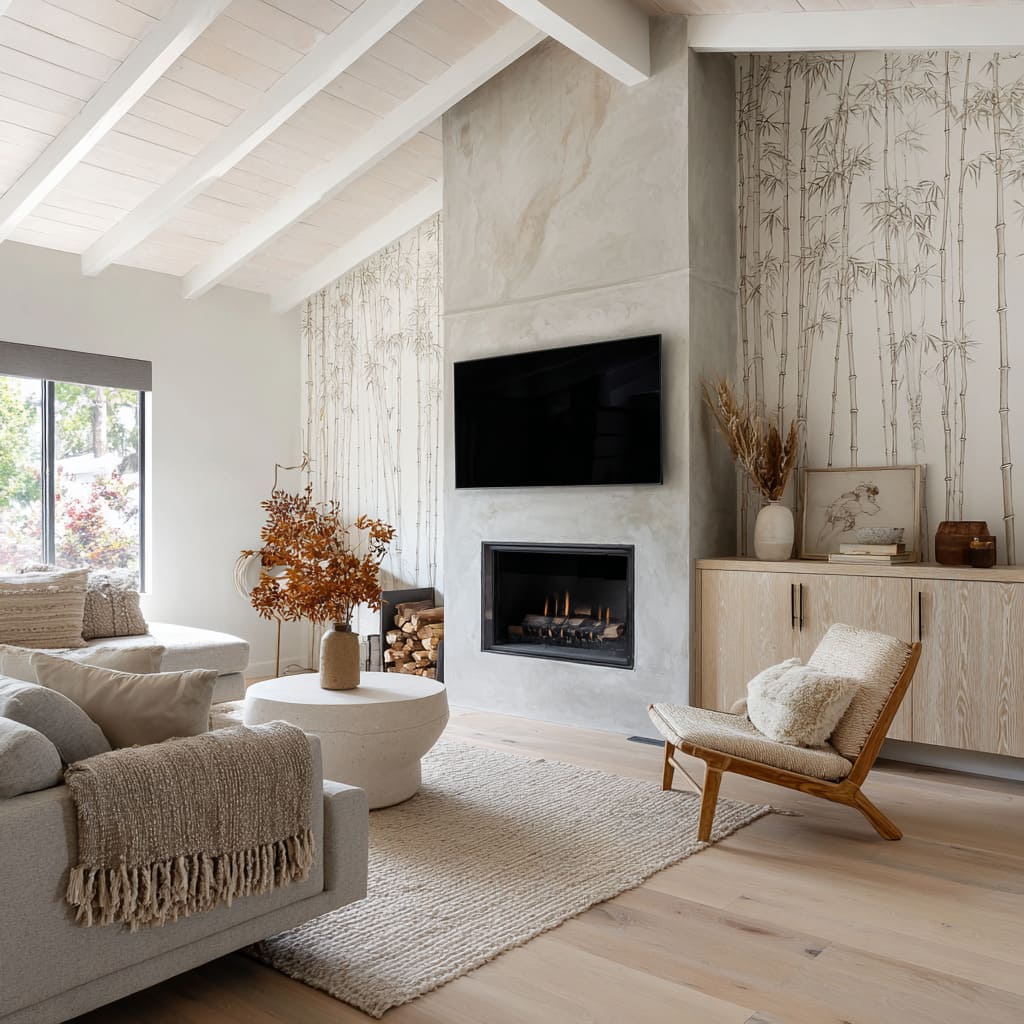
TV + fireplace eco wall with Scandinavian softness and Japandi linework
In combined TV-and-fireplace layouts, eco-style often relies on a wide plaster-like chimney mass that “houses” both rectangles (fire opening + TV) inside a calm mineral plane. The surrounding walls may carry faint linework panels, and the room leans on textiles and pale timber rhythm to soften the tech geometry.
This reads as Scandinavian Japandi TV fireplace wall design: pale, quiet, and material-led.
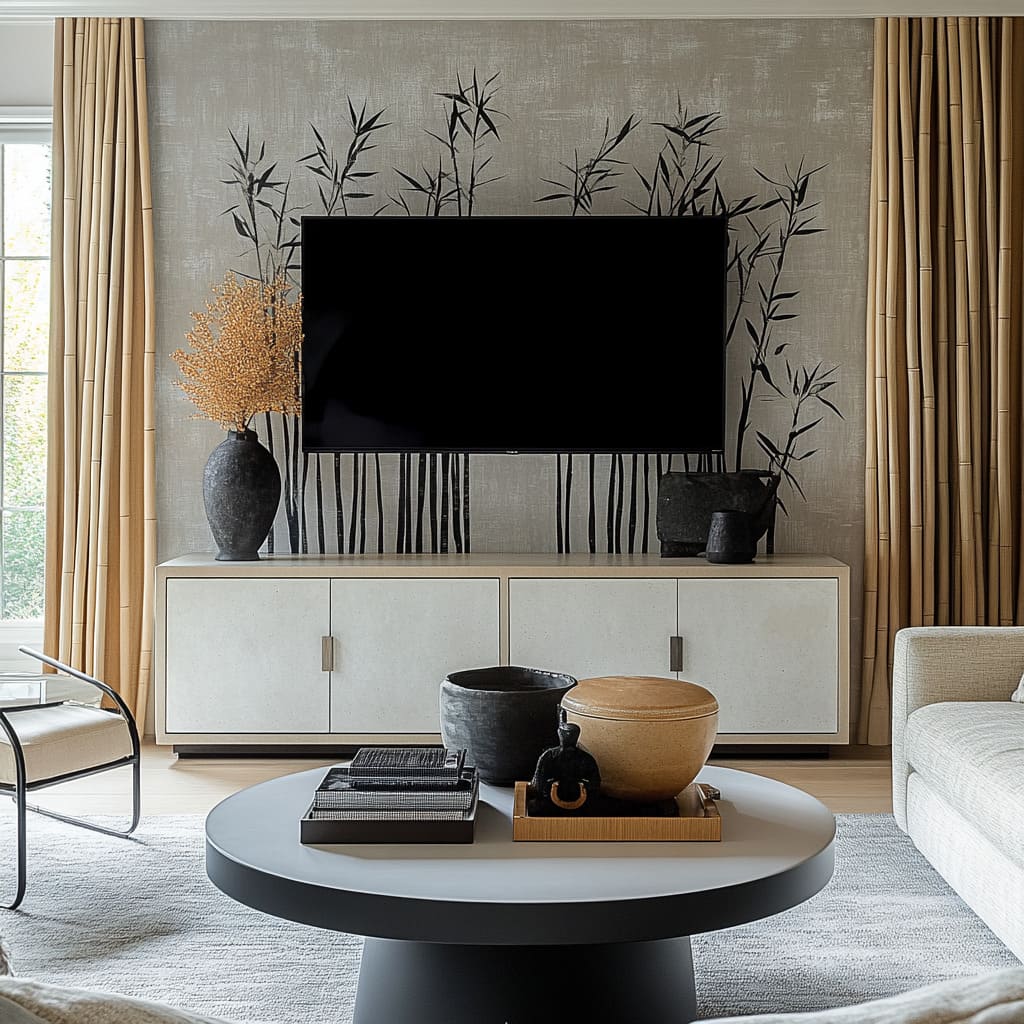
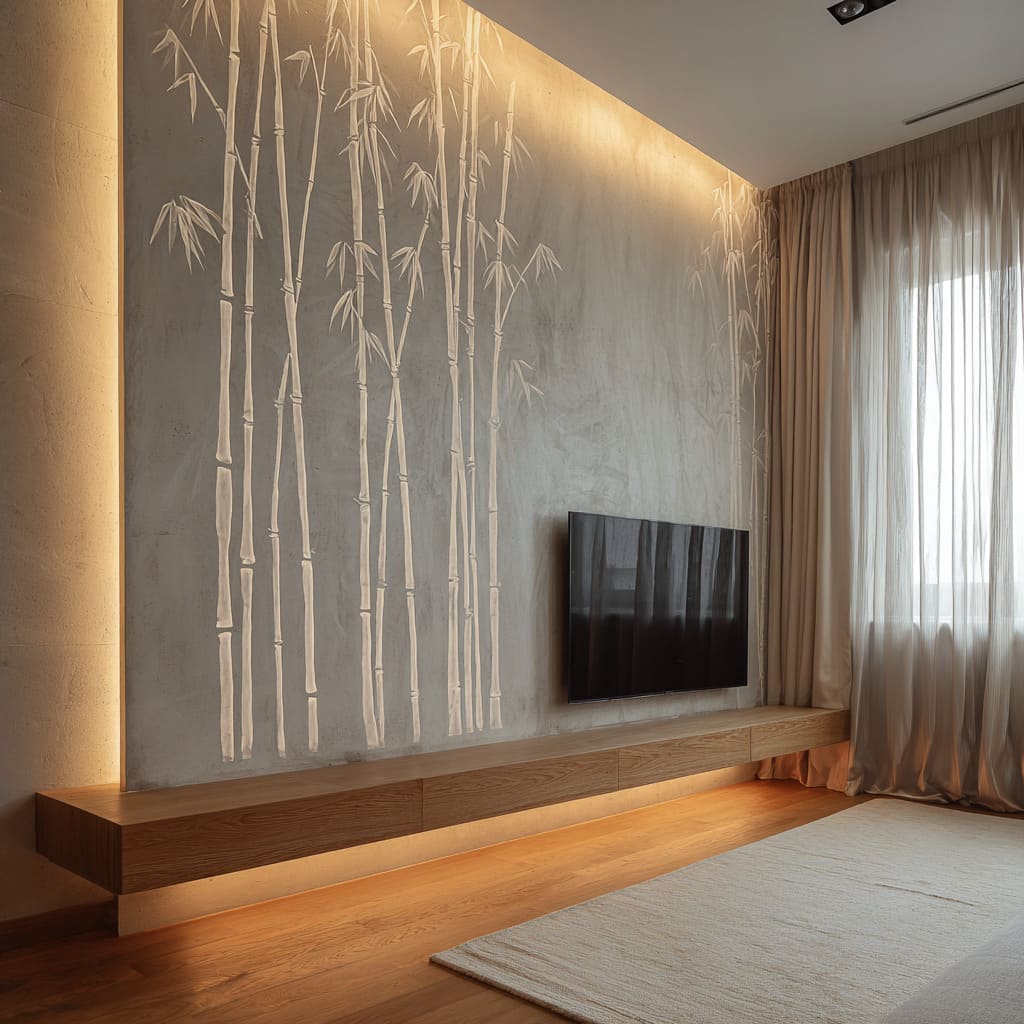
Light-grazed bamboo that reads like carved atmosphere
Eco walls can become more dramatic without losing calm by turning light into the main “decoration. ” Grazing light at the ceiling line or a warm underglow at the console can make bamboo marks feel like relief, catching a soft halo.
This supports eco style TV wall lighting ideas where the wall carries mood through surface movement instead of object density.
The deeper interior design strategies behind the eco-style effect
The wall “hosts” the screen
In eco TV wall background ideas, the wall can behave like a complete composition that can hold a black rectangle without fighting it. This usually happens when the background is not bright white and not glossy, but instead sits in a soft mineral mid-tone.
The screen then reads as a controlled dark insert rather than a harsh cutout.
Density gradients create a “clearing” where the screen sits
A frequent non-obvious strategy is density editing: linework or texture is heavier where atmosphere is desired (often at edges, upper zones, or one side), and it thins near the TV zone. The effect is that the TV appears placed into a calm pocket instead of being stuck onto pattern.
This often works in bamboo mural TV wall design ideas and birch mural TV wall background approaches.
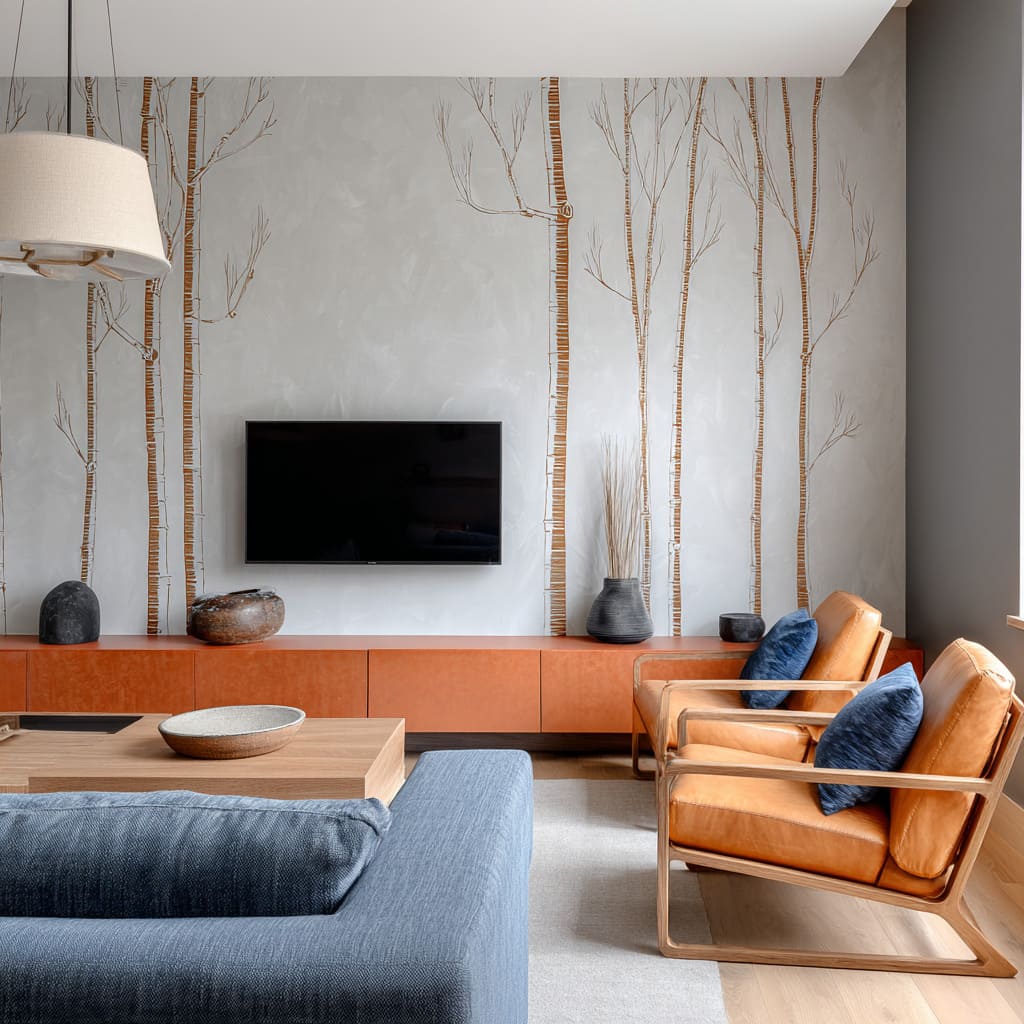
Line families are orchestrated: vertical rhythm, horizontal calm, organic branching
Eco TV walls often feel stable because they balance three line languages:
- Vertical tempo: bamboo, reeds, ribbing, cane cladding, curtain folds
- Horizontal “horizon”: long low console, ledge, bench, or storage band
- Organic branching: airy twigs, dried botanicals, fine stems, light silhouettes
The TV becomes the only strict rectangle, while everything else either repeats rhythm or softens it. This is why minimal Japandi TV wall design can carry a large screen without looking harsh.
Object styling acts as material echo, not decoration
In eco-style TV wall decor, the objects typically repeat the wall’s material story in small, dense silhouettes:
- rounded pottery that reads like fired clay or stone
- paper stacks that bring matte fiber texture
- glass used sparingly as an “air note” so darker palettes still feel light
- one warm pigment accent (ochre, rust, clay-red) used as a controlled natural note
This supports eco style TV console decor that feels grounded rather than busy.
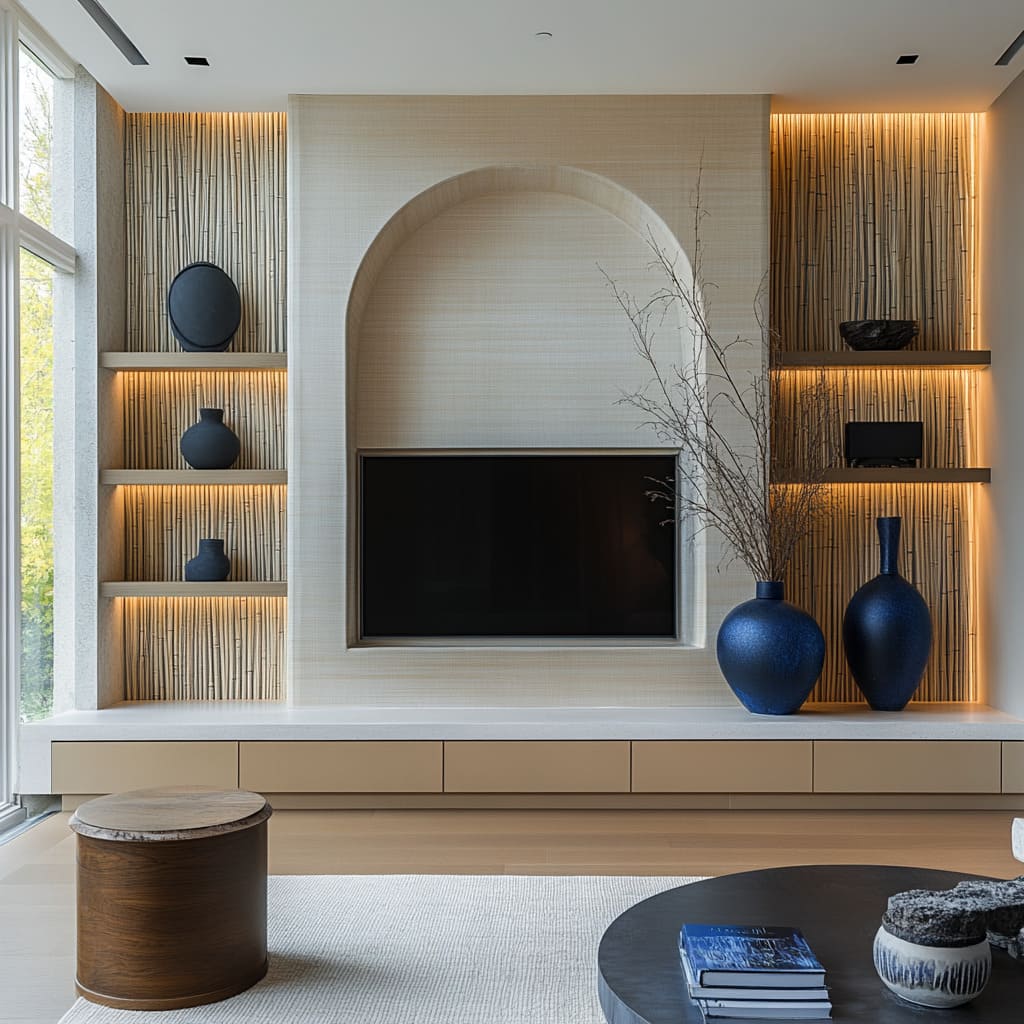
Depth comes from light behavior instead of lots of accessories
A stylish eco strategy is replacing object quantity with depth layers:
- warm backlight behind shelving texture
- grazing light that reveals plaster movement
- underglow that visually lifts a wood console
- filtered daylight through sheers that behaves like a soft material
This is why eco style TV wall with LED backlight can feel calm when the glow reads atmospheric rather than bright.
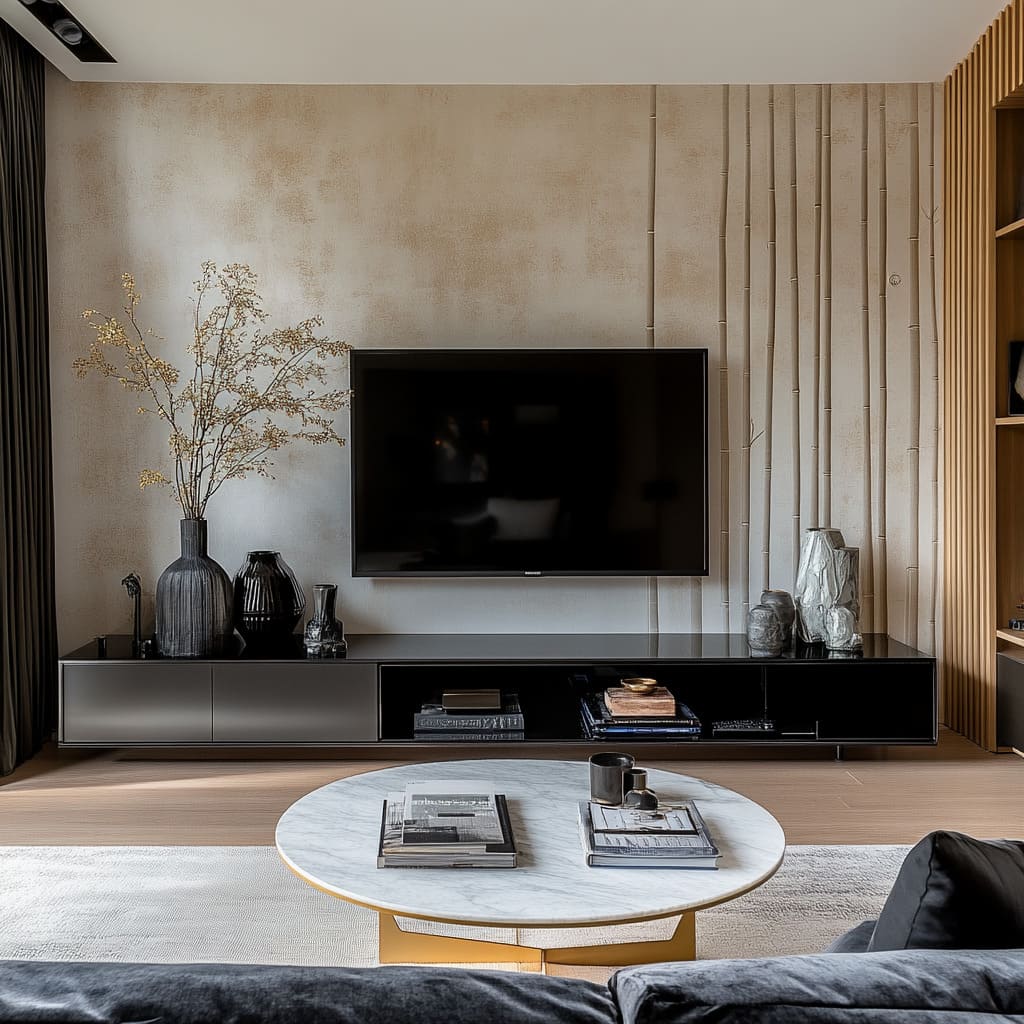
Greenery vs drawn nature is blended so the room reads like one scene
A refined eco outcome often appears when a real element continues the wall language:
- living greenery chosen for a fine, airy silhouette that matches linework
- dried branches that repeat vertical rhythm without leafy bulk
- woven fiber that reinforces the natural story through touch cues
- drapery that repeats the mural’s vertical calm in fabric form
This supports organic modern living room TV wall decor where the wall, furniture, and accents feel connected rather than layered randomly.
Four popular eco-style outcomes (and what holds them together)
Morning mist eco
Cooler tones, pale panels, low-contrast linework, and filtered daylight create misty bamboo TV wall energy. The screen reads as a calm dark note in an airy field.
Dusk shadow eco
Mid-tone textured backgrounds and darker bamboo marks create a shadow-layer effect, often balanced by warm fiber tones and pottery. This forms a cozy earth tone TV wall design mood.
Material-first eco
Bamboo cladding, reed rhythm, woven fiber, and stone-like furniture forms shift the room toward tactile surface storytelling. The TV feels secondary to the material plane in bamboo texture TV wall design.
Sanctuary eco
Arches, niches, warm glow, disciplined emptiness, and slow rhythm create a sheltered calm. The TV reads as a contained insert inside an arched niche eco TV wall design.
Conclusion
Eco-style TV wall design tends to feel high-end when the screen is treated as one calm dark note inside a larger natural composition. Matte mineral textures, edited bamboo or birch rhythm, and a long low “horizon” console create balance, while pottery, woven fiber, and airy botanicals add depth without visual noise.
The result is a living room TV zone design that reads quiet, grounded, and atmosphere-led, with nature suggested through surface, light, and restraint rather than themed decoration.
Related Posts
Harmony Home Design brings 10+ years of residential interior design experience to the ideas shared here. We publish design concepts, layout thinking, and practical styling notes.