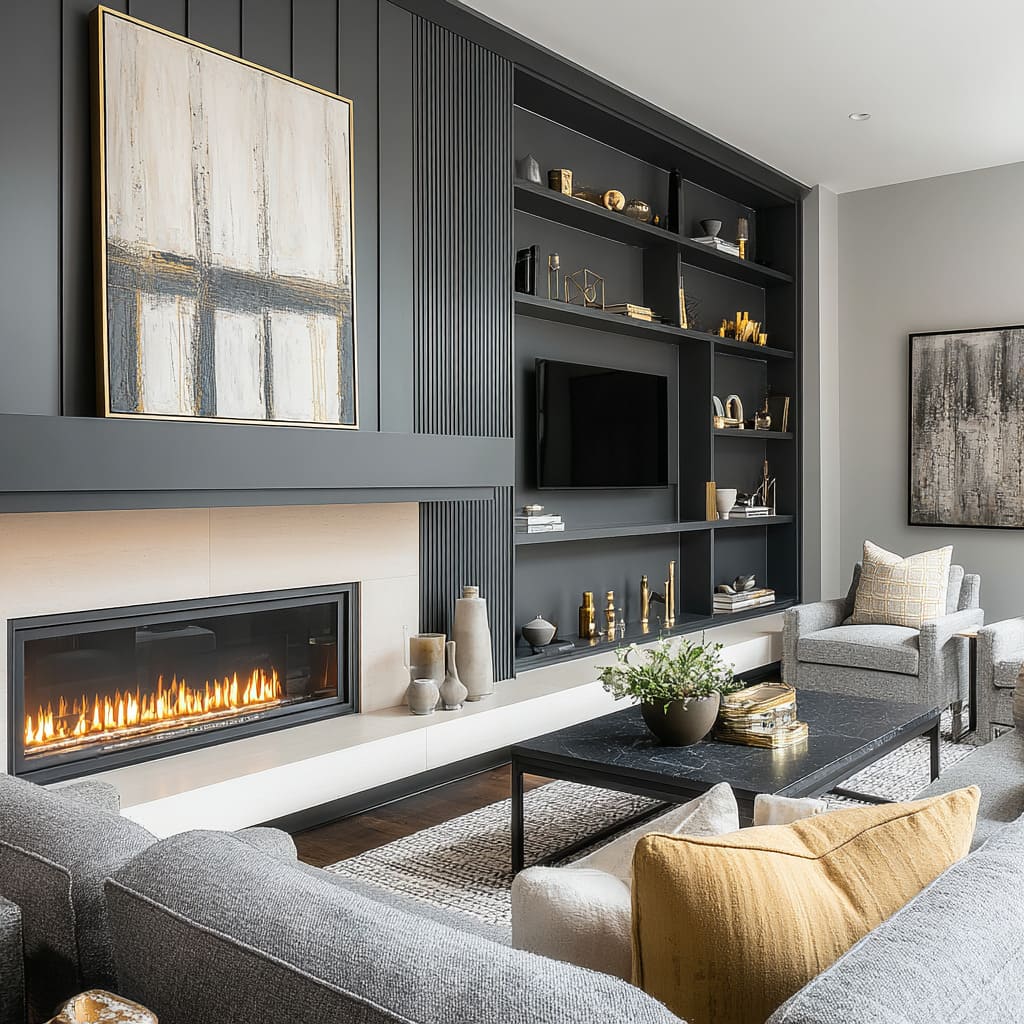
In many contemporary living room designs, the fireplace wall stops behaving like a background and starts behaving like a single organizing surface: a place where texture, contrast, lighting mood, and the TV relationship are resolved in one controlled composition. The strongest modern fireplace wall decorating ideas tend to feel “finished” even with minimal accessories, because the wall itself carries the visual work through surface hierarchy, quiet alignment, and carefully rationed warmth.
Texture hierarchy as a calm way to add complexity
A frequent high-level strategy in modern fireplace feature wall ideas is treating texture as a ranked system, not a theme. Instead of scattering “interest” everywhere, the wall assigns different texture behaviors to different zones so the eye can read complexity without feeling clutter.
A. The three-level texture ladder: rough / ribbed / flat
A common composition uses three distinct texture “volumes” that stay stable in their roles:
- Irregular relief (stacked stone, split-face limestone, rugged courses) creates natural variation and a sense of lived material.
- Tight ribbing or fluting (vertical grooves, micro-slat fields, reeded paneling) creates controlled shadow and a refined rhythm.
- Flat planes (smooth cabinetry fronts, large quiet panels, long seamless bases) give visual silence so the textured areas can breathe.
This rough–ribbed–flat structure often explains why a living room can look layered even with a minimal coffee table setup: the wall already provides the variation people usually try to add with extra objects.
B. Containment: why mixed textures look composed rather than busy
A subtle but powerful move is containing each texture inside a clear boundary—tall rectangles, framed fields, or defined blocks. In modern stone fireplace wall design with TV, this containment keeps textures from “spreading” visually, which helps the wall read as intentional architecture rather than a collage of competing finishes.
C. Scale-shift repetition: unity without copy-paste matching
Many contemporary fireplace media wall designs repeat ribbing more than once (often on the TV backing and again on base cabinetry), but the repetition feels refined because the rib scale changes:
- Fine ribbing up high reads soft and atmospheric, almost textile-like from a distance.
- Thicker ribs down low read tactile and grounded.
That scale shift creates internal consistency while still giving hierarchy.
Solving the “TV as a foreign object” look
A recurring challenge in modern fireplace wall with TV design is the TV’s glossy black rectangle. Several strategies consistently reduce the “stuck-on screen” feeling without disguising the TV.
A. A rhythmic back field that dilutes the TV’s outline dominance
Vertical ribbing behind the TV works as a visual filter: the eye continues to read the wall’s micro-shadow rhythm around the screen, so the TV stops being the only strong graphic element. This is why fluted panel fireplace wall design and ribbed TV zones tend to look calmer than a TV mounted on flat paint.
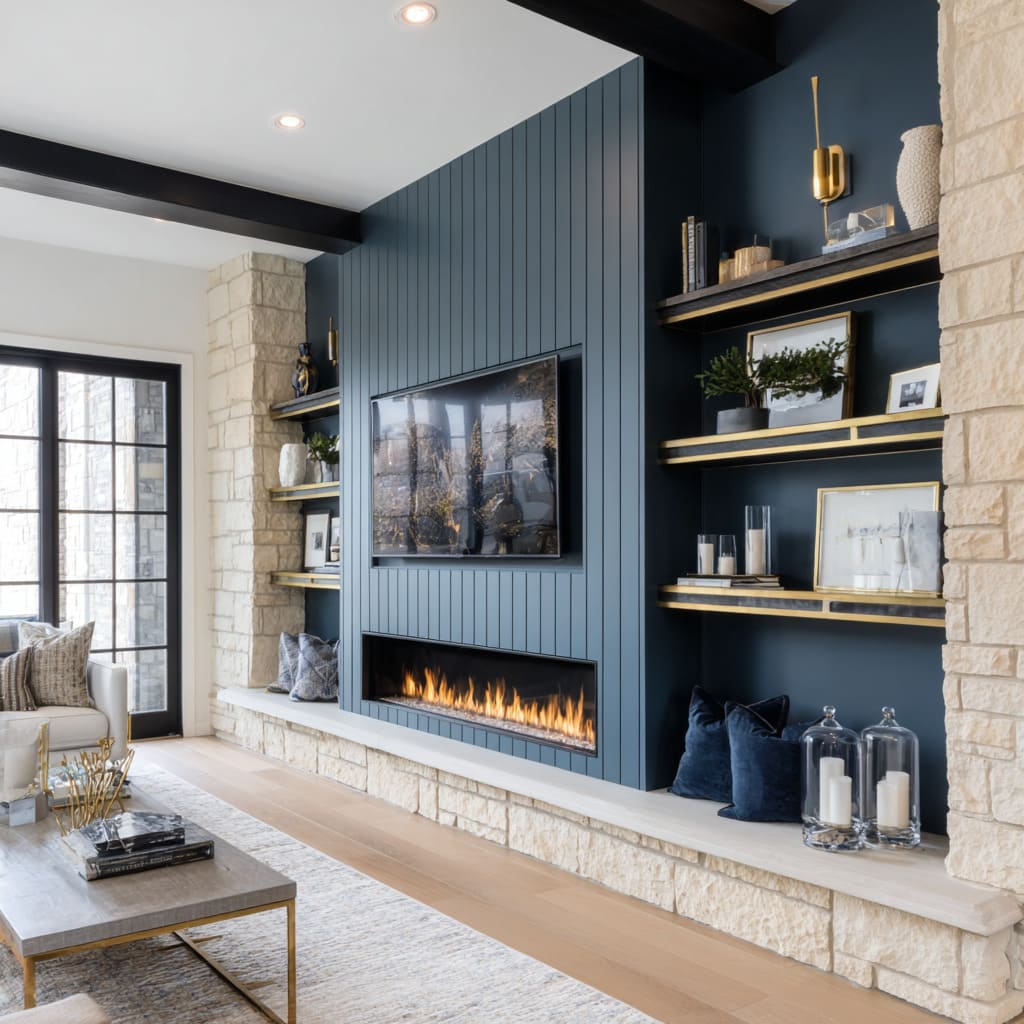
B. Framing the screen as an insert
Thin metallic trims, tight collars, or defined recess edges can turn the TV into an intentional insert rather than a device pasted on a surface. This often appears in stone fireplace wall with TV concepts where the wall behaves like a gallery mount: a calm field with crisp “cut-in” elements.
C. Dark recess blending: the “off mode” advantage
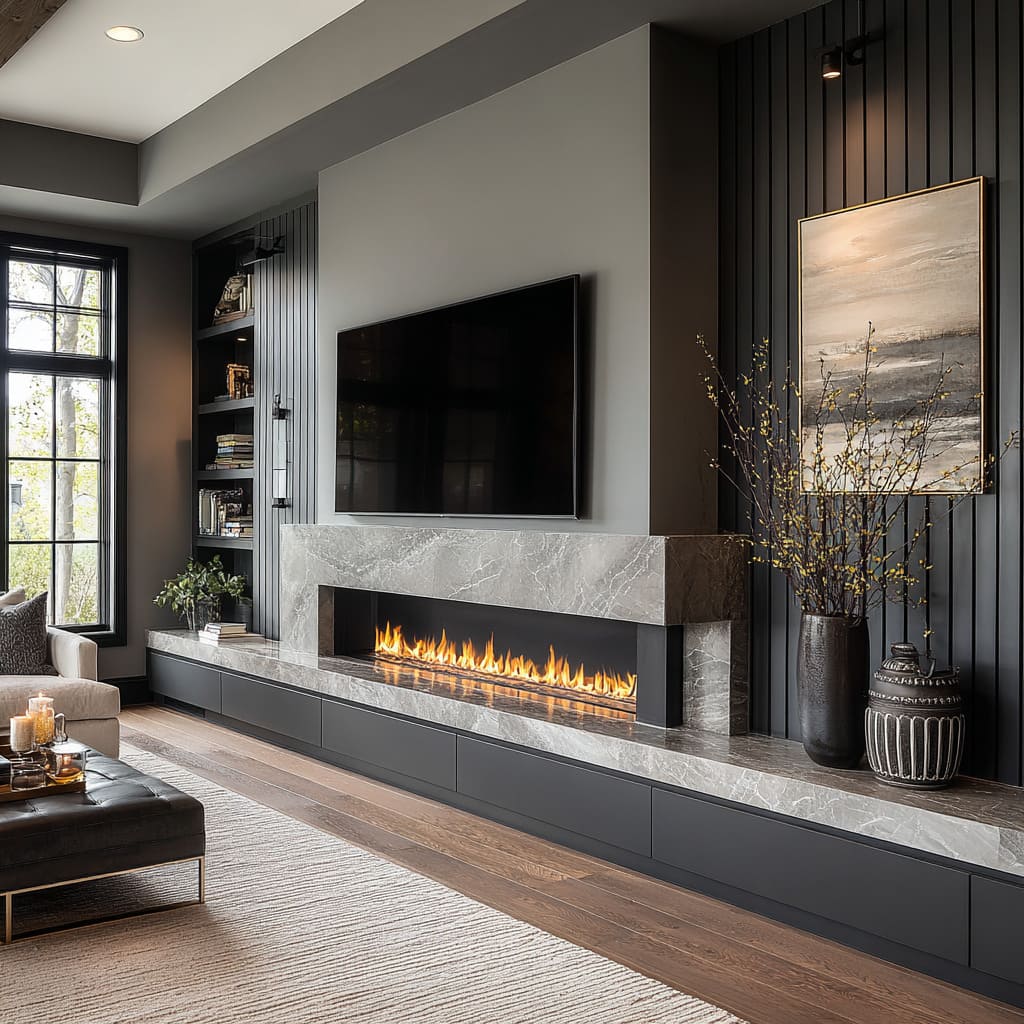
When the TV sits inside a darker recessed area (a niche, a shelving box, or a charcoal surround), the screen blends when off. The TV becomes part of a larger void system—one of several black cuts—rather than the lone black object.
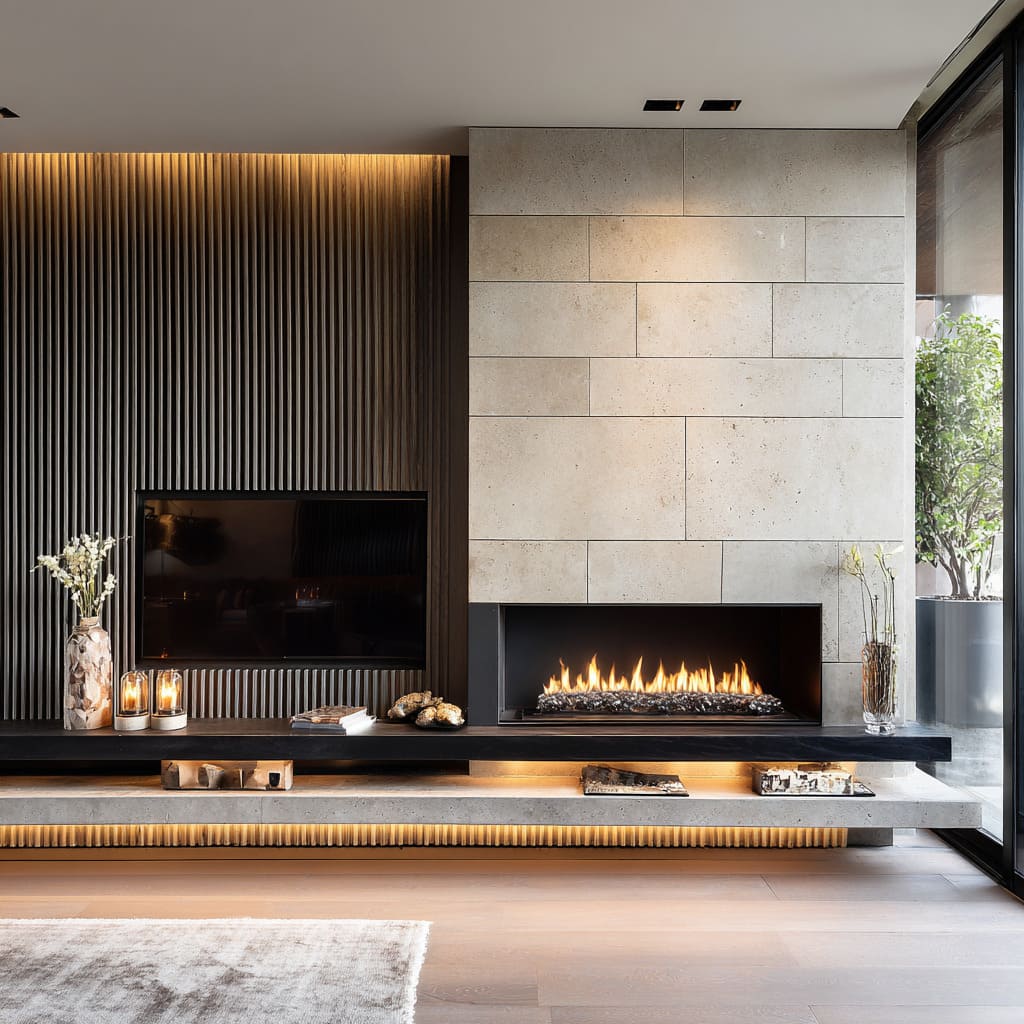
The linear flame as typography: underline, seam, and controlled warmth
Many modern wall designs treat flame as a graphic line rather than a traditional hearth focal point. This is especially common in linear fireplace wall design ideas and minimalist compositions.
A. A long thin fire slot turns flame into a visual underline
A slim fire opening behaves like a drawn line that anchors the whole composition. It can feel precise enough to “edit” rough stone into something that reads curated, because the fire opening becomes a clean cut that disciplines the texture around it.
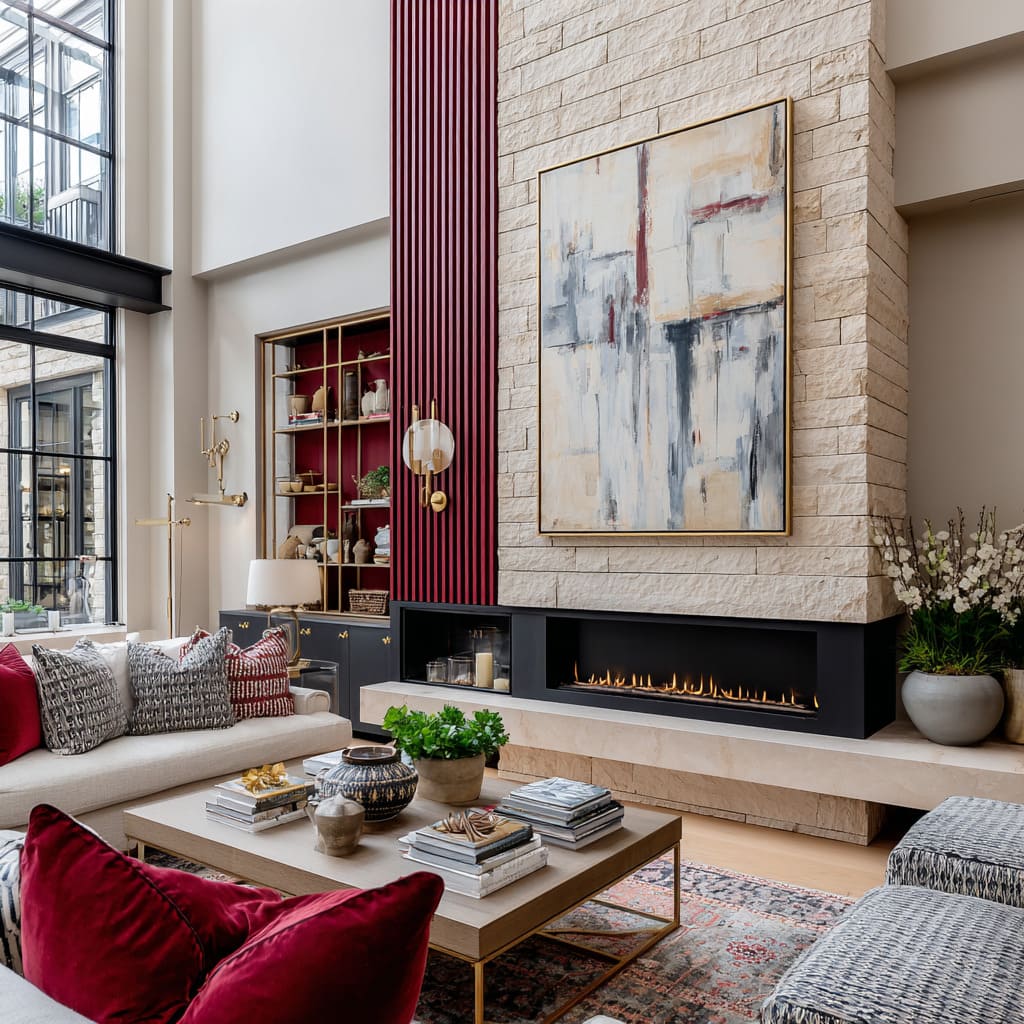
B. Off-center flame placement creates quiet motion
Moving the flame slightly off-center or tucking it to one side can create a gentle directional pull. The wall reads composed, not symmetrical, and the warmth feels like it belongs to the room rather than acting as a stage centerpiece.
C. Two warmth behaviors: flicker + steady glow
A stylish mood trick in modern fireplace wall decor is pairing flame with a second, calmer warmth layer:
- Flicker warmth from the flame line
- Steady warmth from underglow at the base, warm grazing light, or soft ambient lamps nearby
This pairing can make a cool stone-and-charcoal palette feel welcoming without needing extra color.
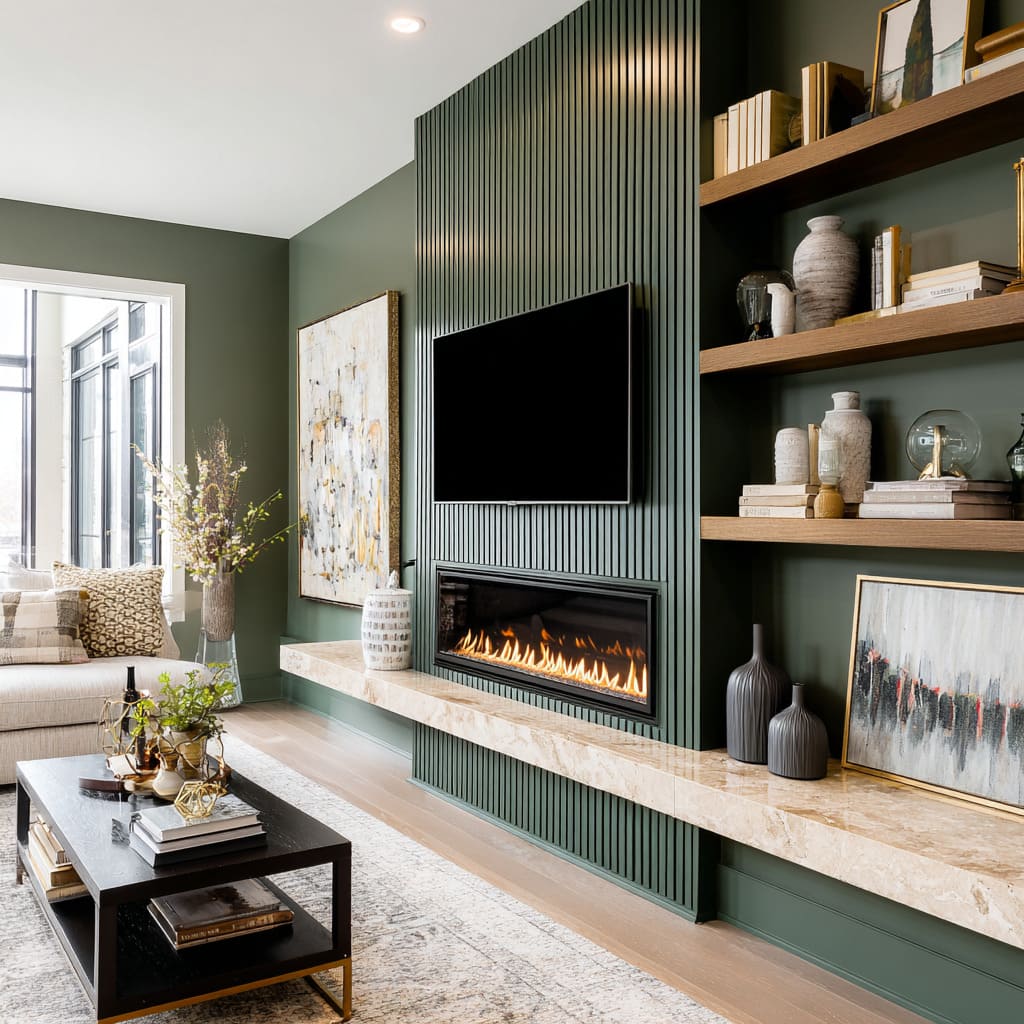
Baselines and pause bars: the long horizontal line that unifies everything
A modern fireplace wall design often becomes coherent because of one long horizontal element that behaves like a visual baseline: a bench-like hearth, a continuous ledge, or a stone runway band.
A. The baseline as a widening tool
In floor-to-ceiling fireplace wall ideas, a long hearth line can visually widen a tall feature so it feels grounded rather than tower-like. The wall gains stability even when the vertical element is dominant.
B. The pause bar between competing rhythms
A continuous ledge can act like a “pause” that prevents strong vertical ribbing from overwhelming the wall. It also creates a deliberate separation between the TV field and the lower storage zone, which helps the composition read in layers rather than as one busy block.
C. Pale surround runway against a dark field
A pale stone band around a linear fire opening often functions as a brightness buffer. It prevents the fire from becoming a dark hole and makes the flame read sharper and cleaner—an approach often used in charcoal panel fireplace wall schemes.
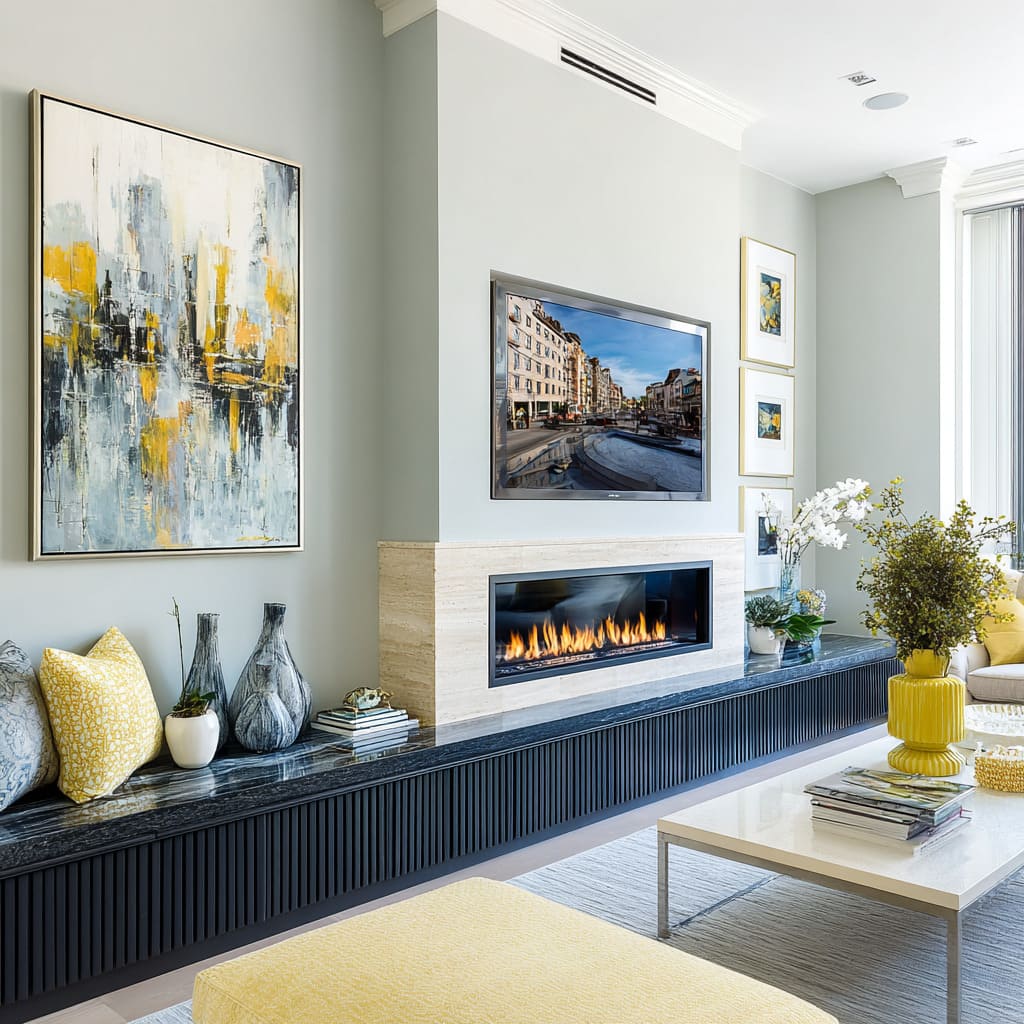
Two depth types: micro-depth and macro-depth
Many highly composed wall designs feel rich because they deliver depth at two distinct scales.
- Micro-depth: fluting, reeding, tight slats, subtle shadow texture
- Macro-depth: projecting stone volumes, thick portal frames, mantle blocks, tower masses
This is a major difference between a wall that feels textured and a wall that feels architectural. Slatted fireplace wall design paired with a large stone mass often reads calm but substantial because the eye experiences depth in two registers at once.
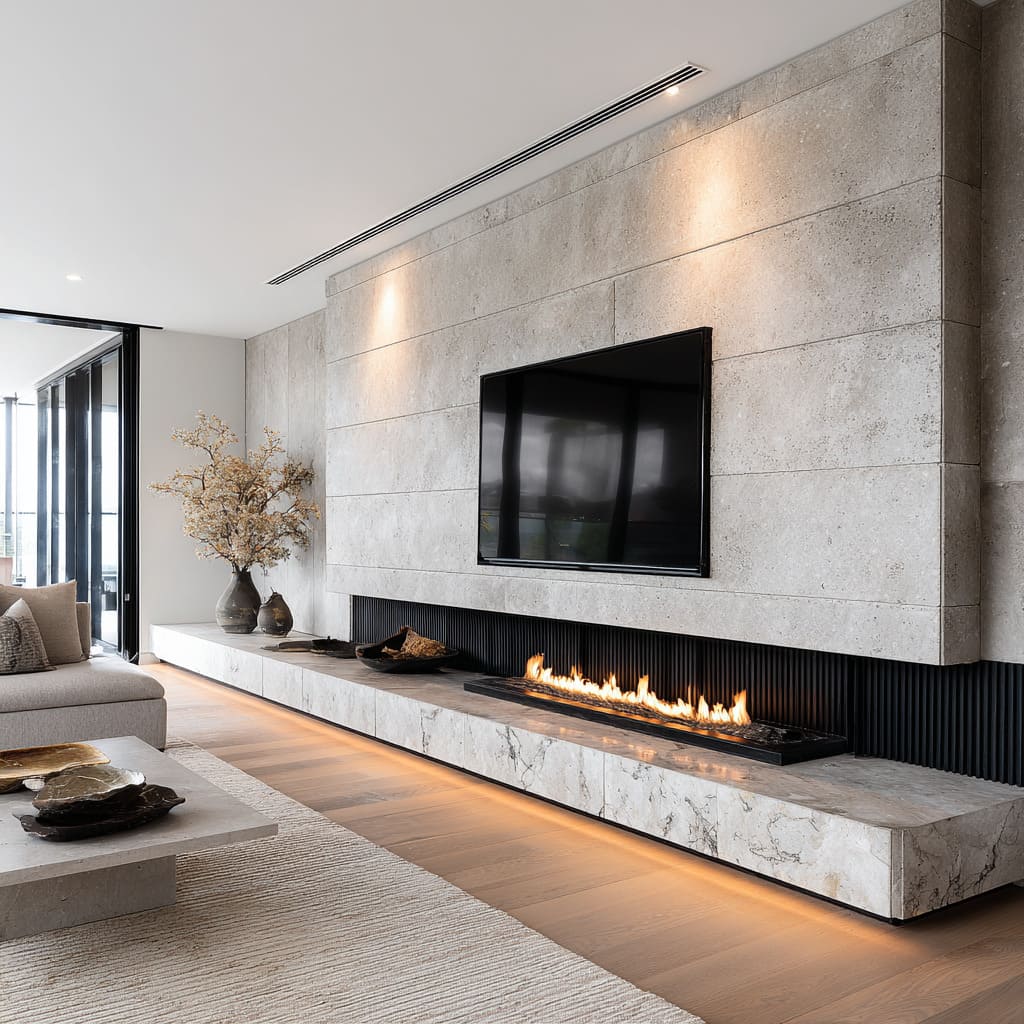
Edge quality contrast as a quiet marker of high-end design
Another consistent strategy is mixing different edge characters so the wall doesn’t feel monotone:
- Broken stone edges that feel natural
- Crisp black rectangles that feel exact
- Thin metallic lines that read as highlights
- Soft textile outlines in the seating area that blur and soften the scene
This variety makes the wall feel considered because the eye keeps switching between sharp and soft, heavy and light.
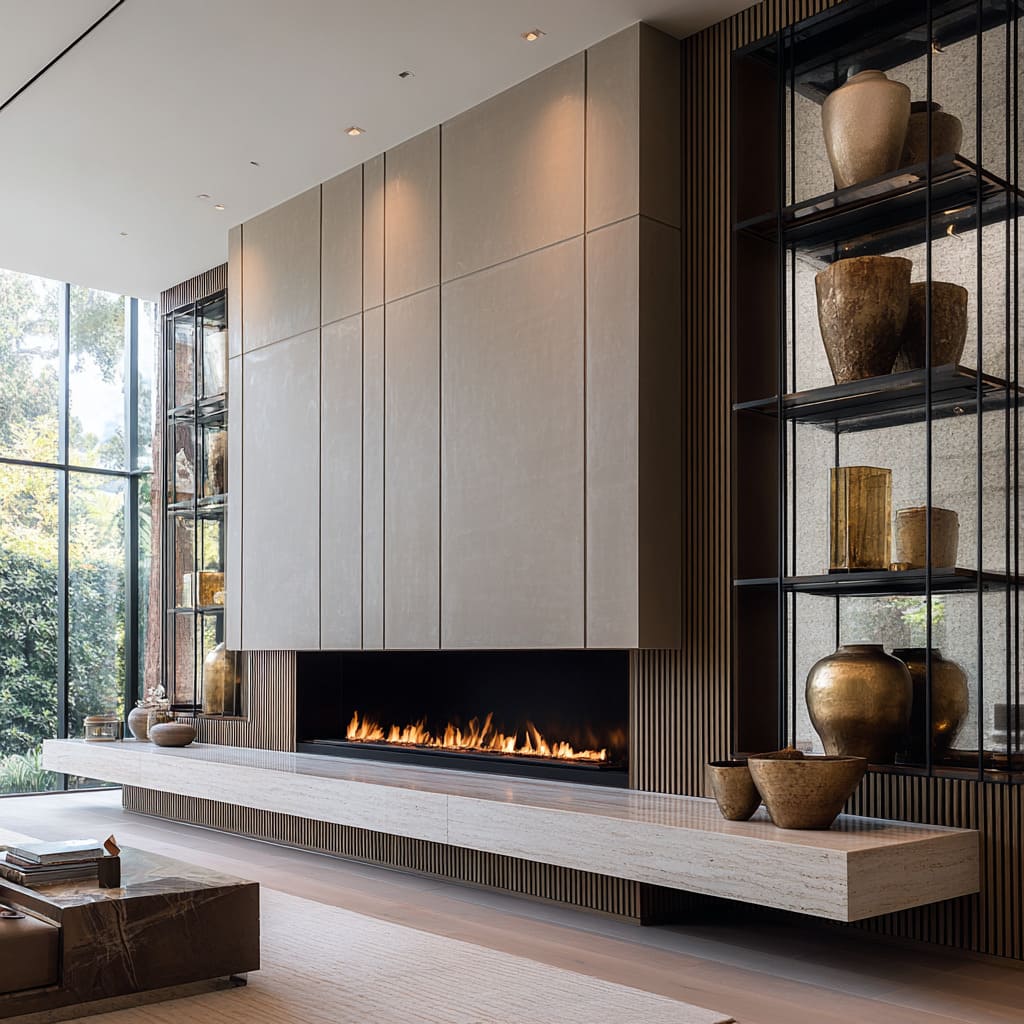
Metal accents as warmth translators
In modern fireplace wall styling, metal is often used in small doses to distribute warmth through the composition without adding obvious color.
A. Thin warm lines that behave like controlled highlights
Brass reveal lines, shelf lips, slim sconces, and narrow frames read as tiny sunlight hits. They echo flame warmth in a restrained way, which can keep deep greens, blues, or charcoal walls from feeling heavy.
B. Frames as a stabilizing axis
A thin gold frame on artwork can create a centered “gallery axis” above textured stone. This helps stone read refined rather than rustic, especially in modern classic spaces where the room envelope stays pale and quiet.
C. Cool metals for “soft glamour” palettes
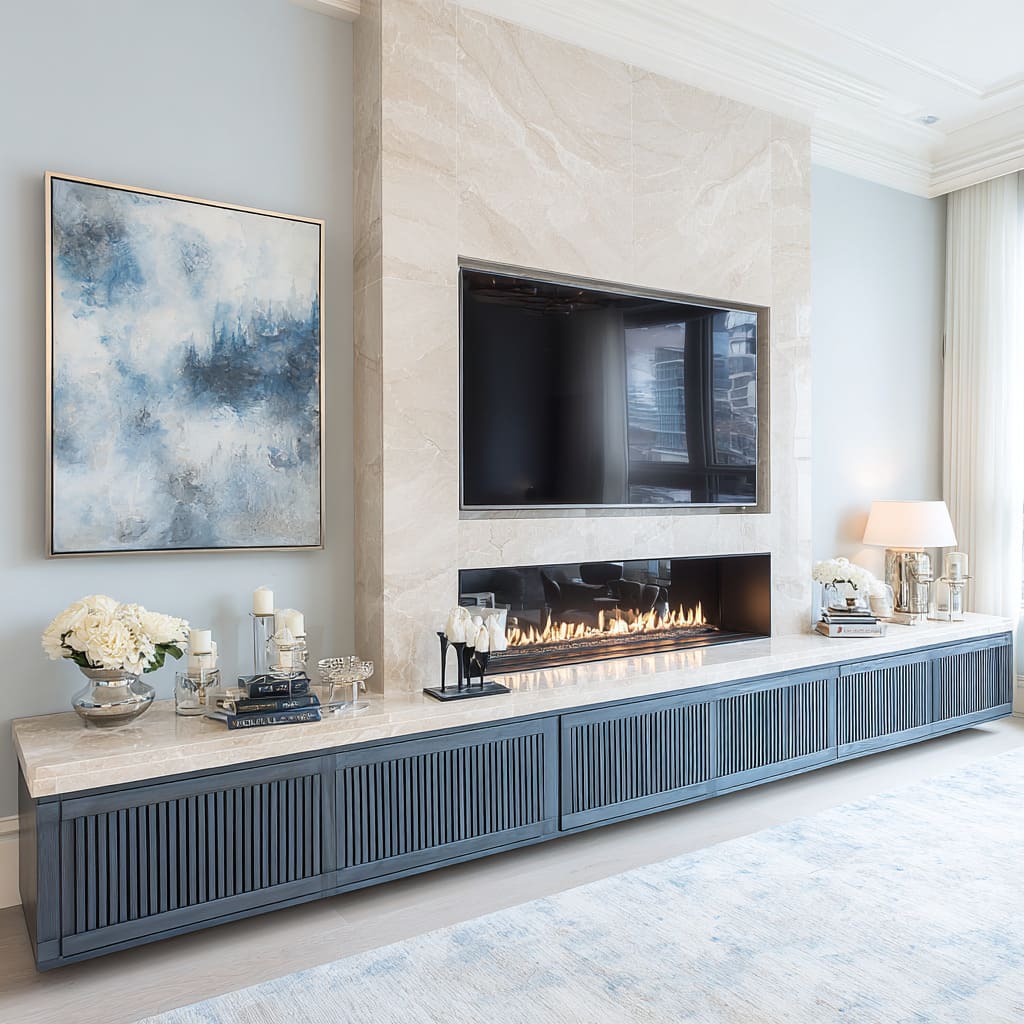
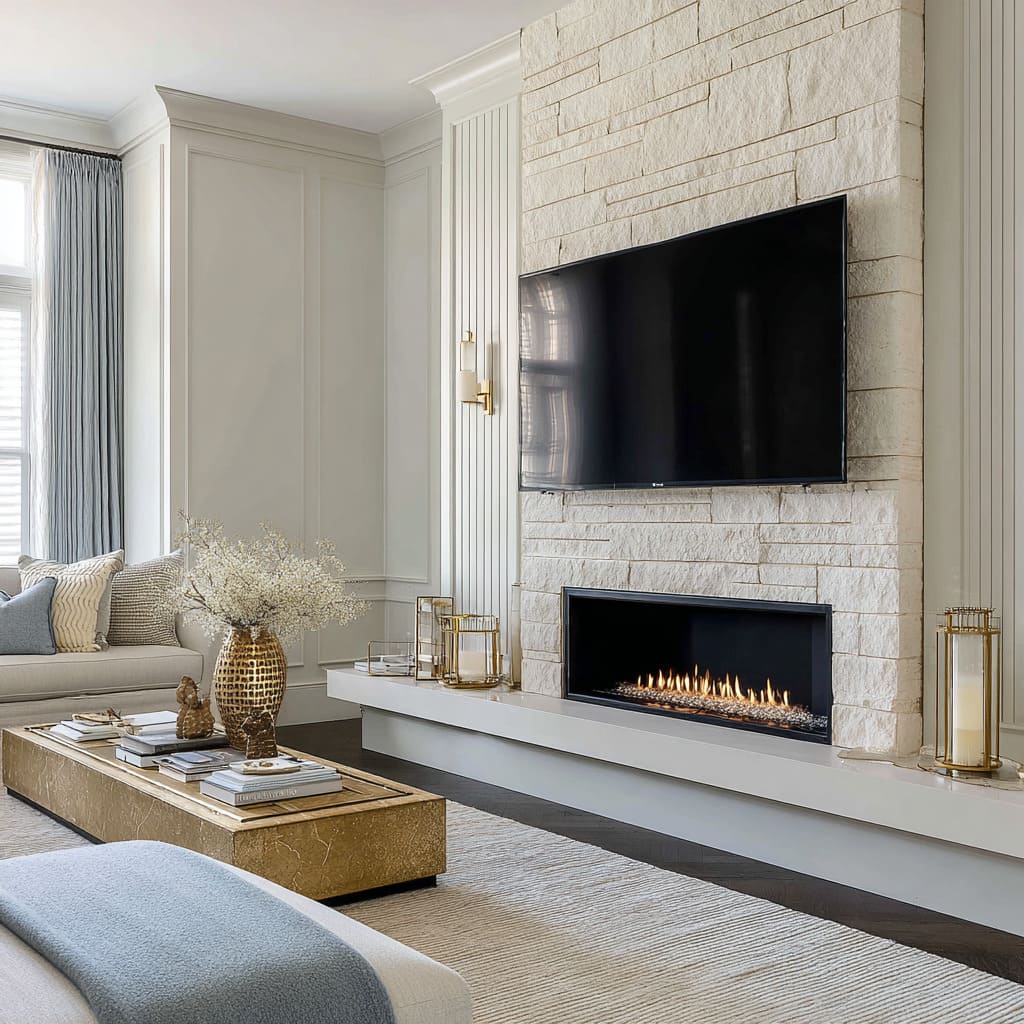
In brighter schemes—cream stone, muted blue-gray bases, glossy surfaces—cool metals (chrome/silver) reinforce brightness and reflection. The result is a polished mood where light movement replaces strong pattern.
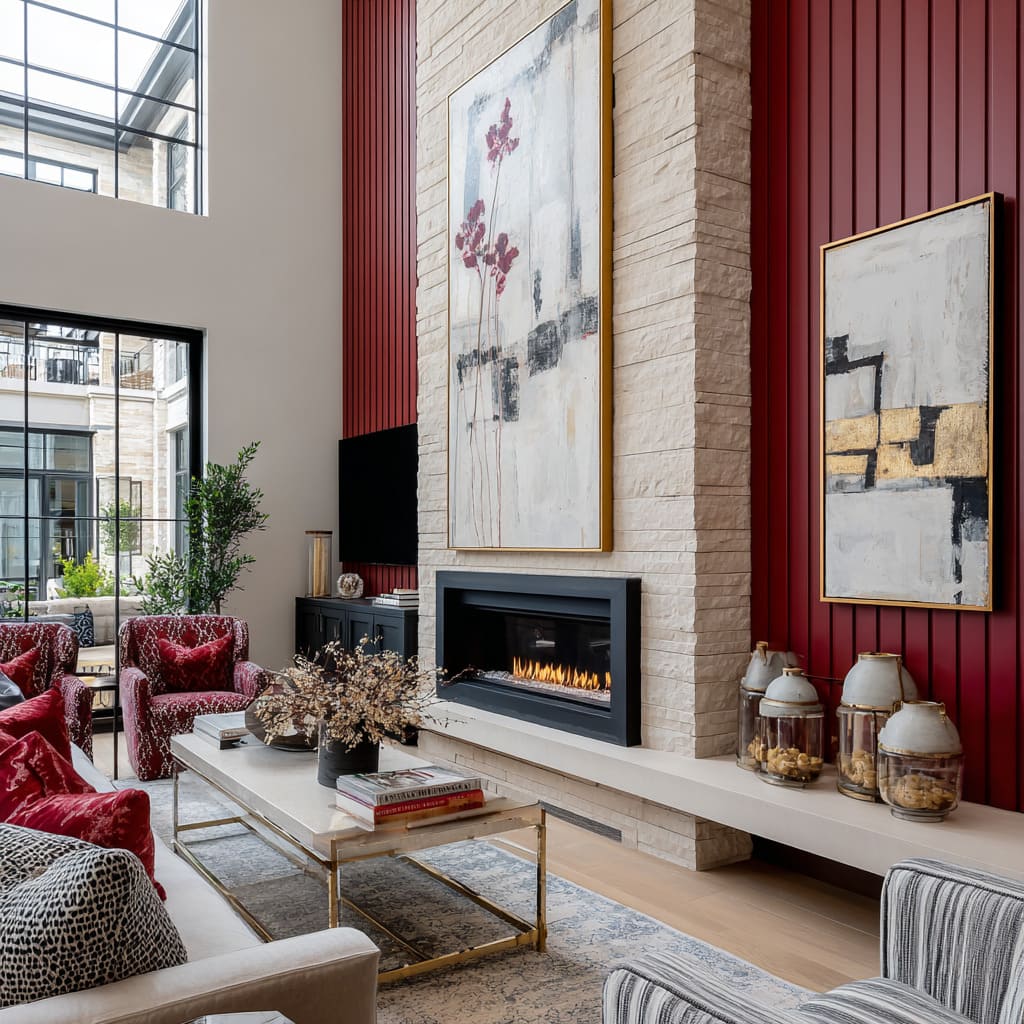
Reflection stacking: visual movement without busy pattern
Fireplace wall designs can stay visually active through layered reflectivity, even in a very calm palette:
- A polished top reflecting silhouettes of objects
- Firebox glass reflecting the flame line
- TV glass reflecting windows and daylight changes
This stacked reflectivity creates a subtle sense of shift through the day, which can make minimalist fireplace wall ideas feel lively without adding extra accessories.
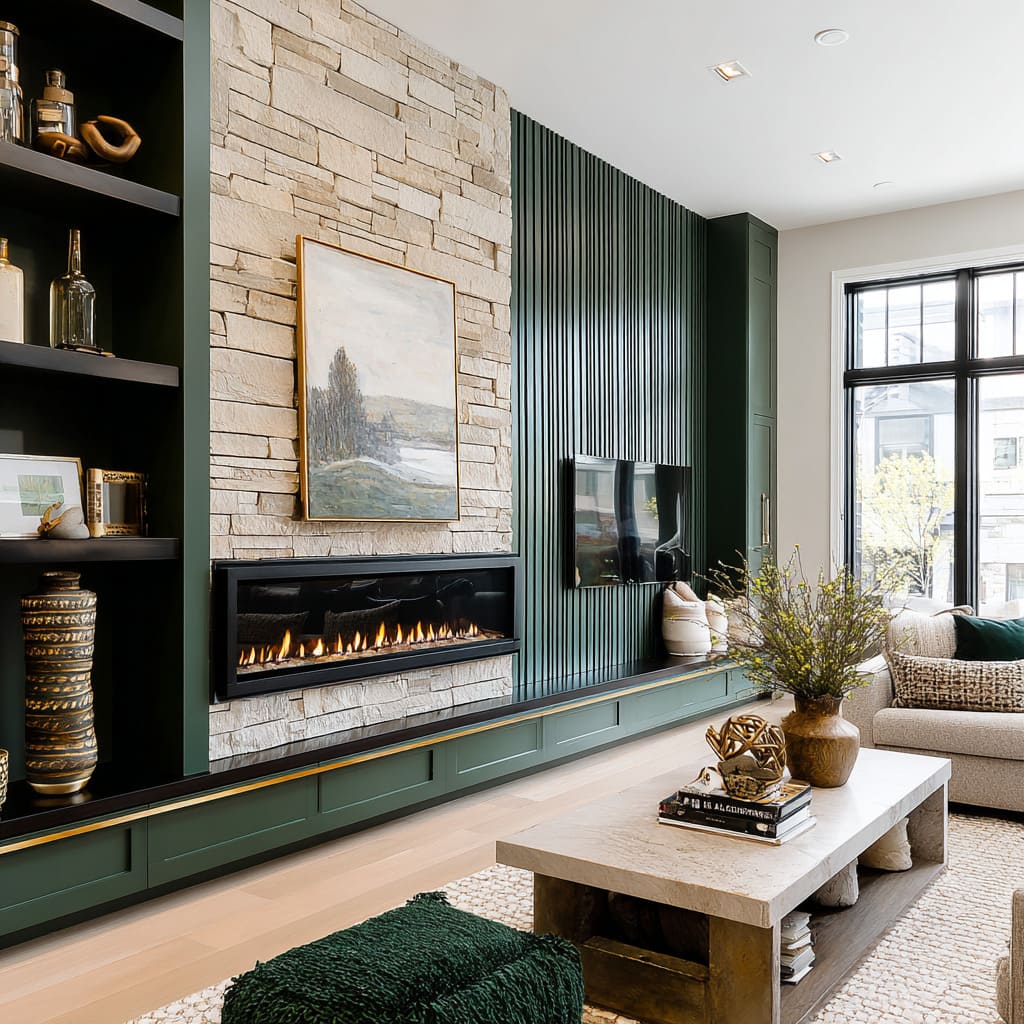
Built-in shelving as a “shadow reservoir” and clutter sink
In many contemporary fireplace media wall ideas, shelving behaves less like storage and more like a controlled zone for visual density.
A. Dark niches that absorb visual noise
A deeper-toned shelf pocket can swallow small objects and reduce the need for tabletop clutter. The wall stays calm because the busy content has a defined place.
B. Weight gradients that prevent top-heavy shelves
A common styling rhythm keeps shelving balanced: lighter or reflective pieces higher, heavier ceramics lower, with deliberate gaps. The gaps matter because they let the wall’s large shapes remain readable.
C. Small metallic “spark points” instead of large statements
Tiny gold pieces placed at different heights can create a gentle dotted rhythm that echoes fire warmth without competing with the flame or the TV.
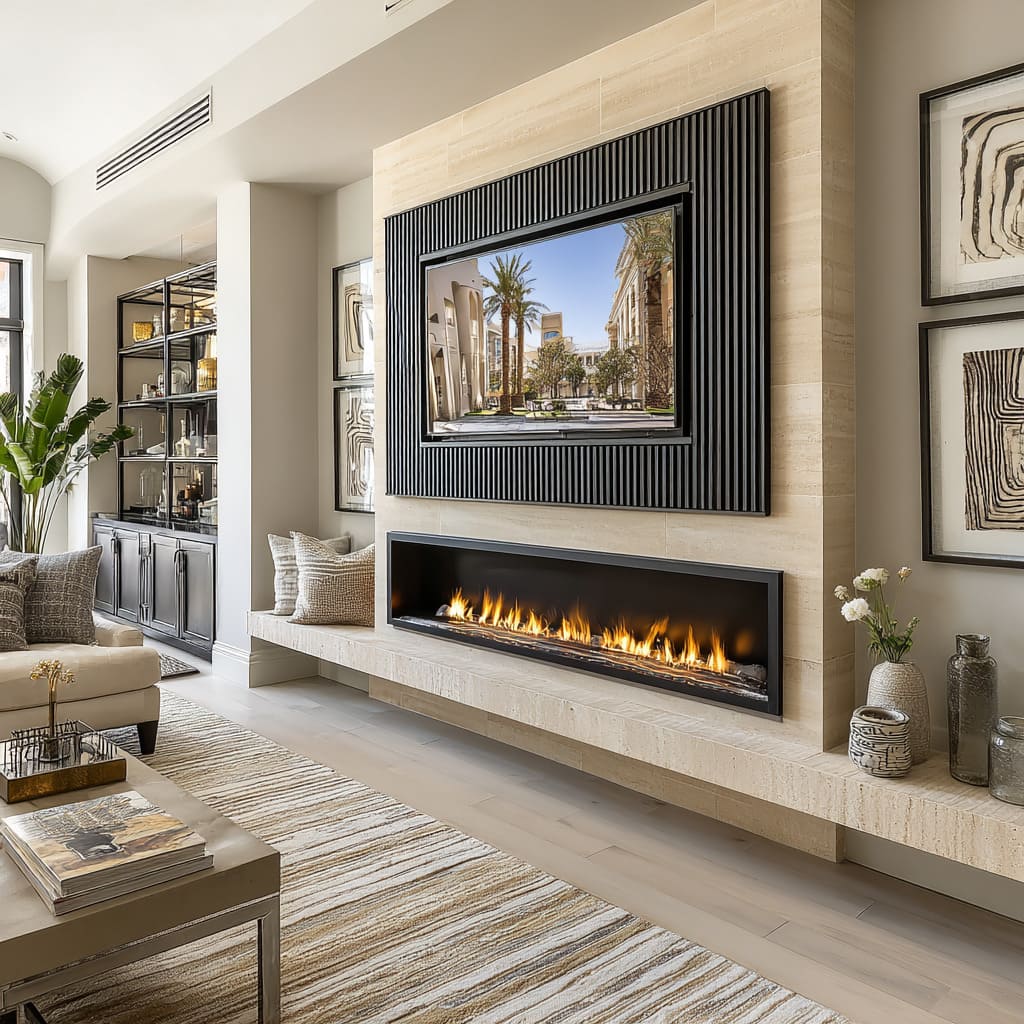
Color used as a structural connector
In modern fireplace wall design looks, color often behaves like a connector between zones rather than a loud statement.
A. Deep green and charcoal as controlled visual weight
Dark ribbing can anchor a room and give the wall depth, especially when the rest of the room stays light. Small warm bridges—subtle brass lines, warm wood notes, or repeated dark trim—help the dark feature feel integrated.
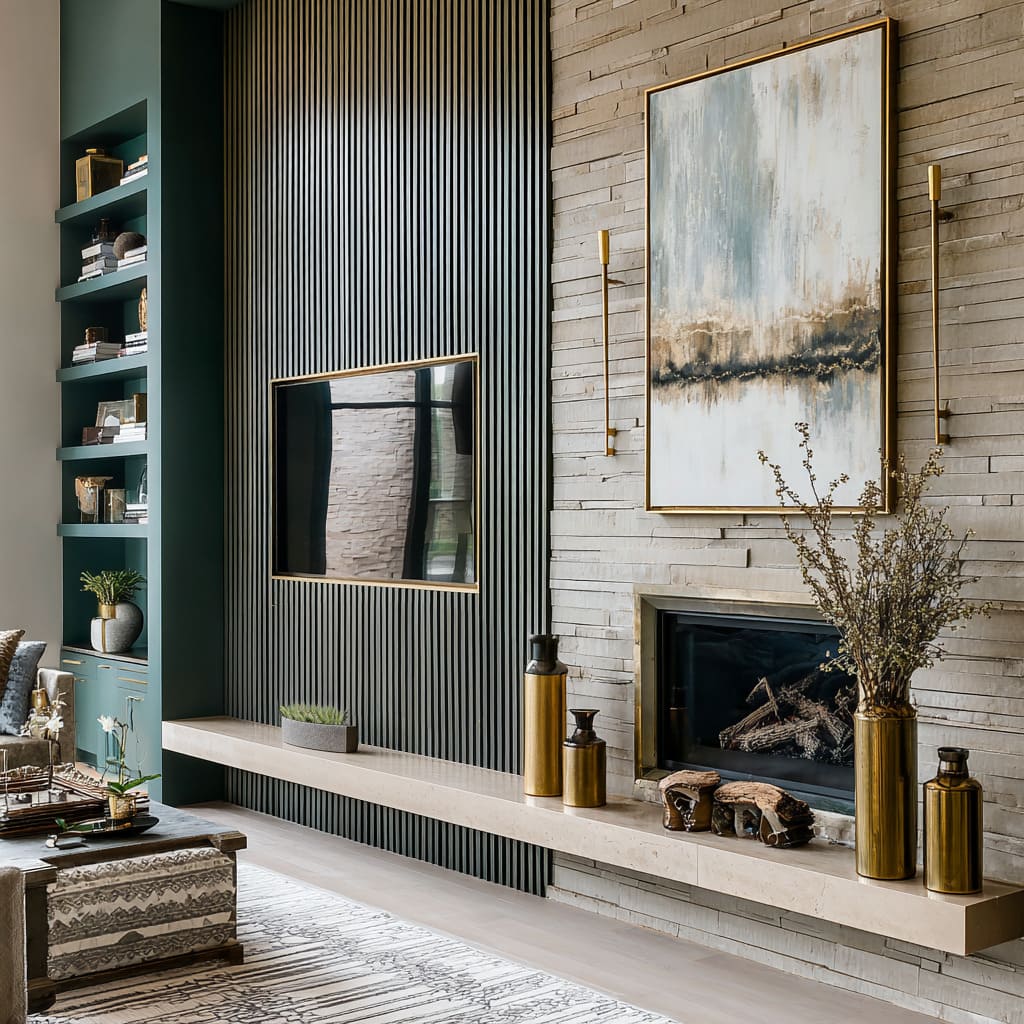
B. Yellow as a refined warmth distributor
Soft yellow accents in art and textiles can translate the fire’s warmth into the seating zone without becoming orange or red. This keeps the room fresh while still feeling warm.
C. Wine-red as height control in double-height rooms
Wine-red vertical fields can function like stage curtains: their role is to hold the room’s height and add mood through proportion. Pale stone stays as the calm center mass, and black inserts keep the composition modern and crisp—an approach often seen in double height fireplace wall design.
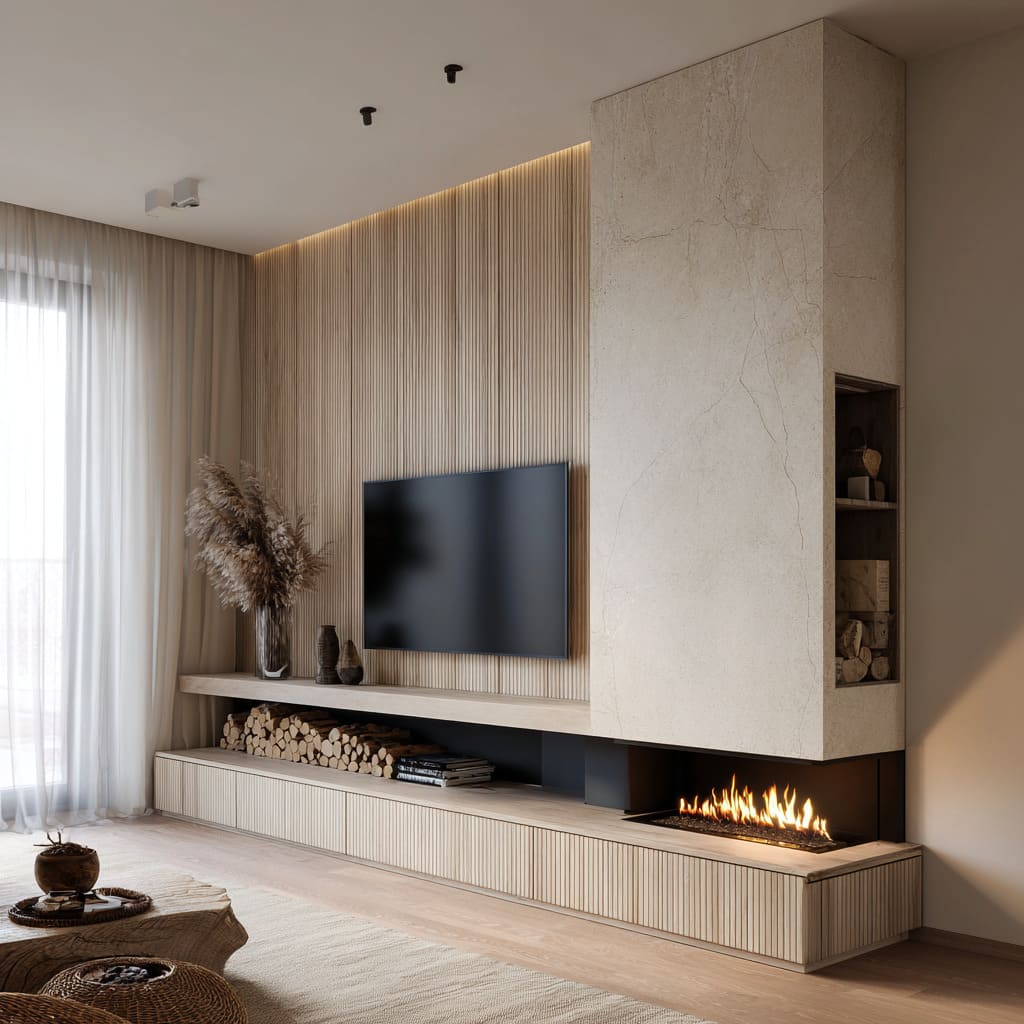
The monolith look: luxury signaled by restraint and scale
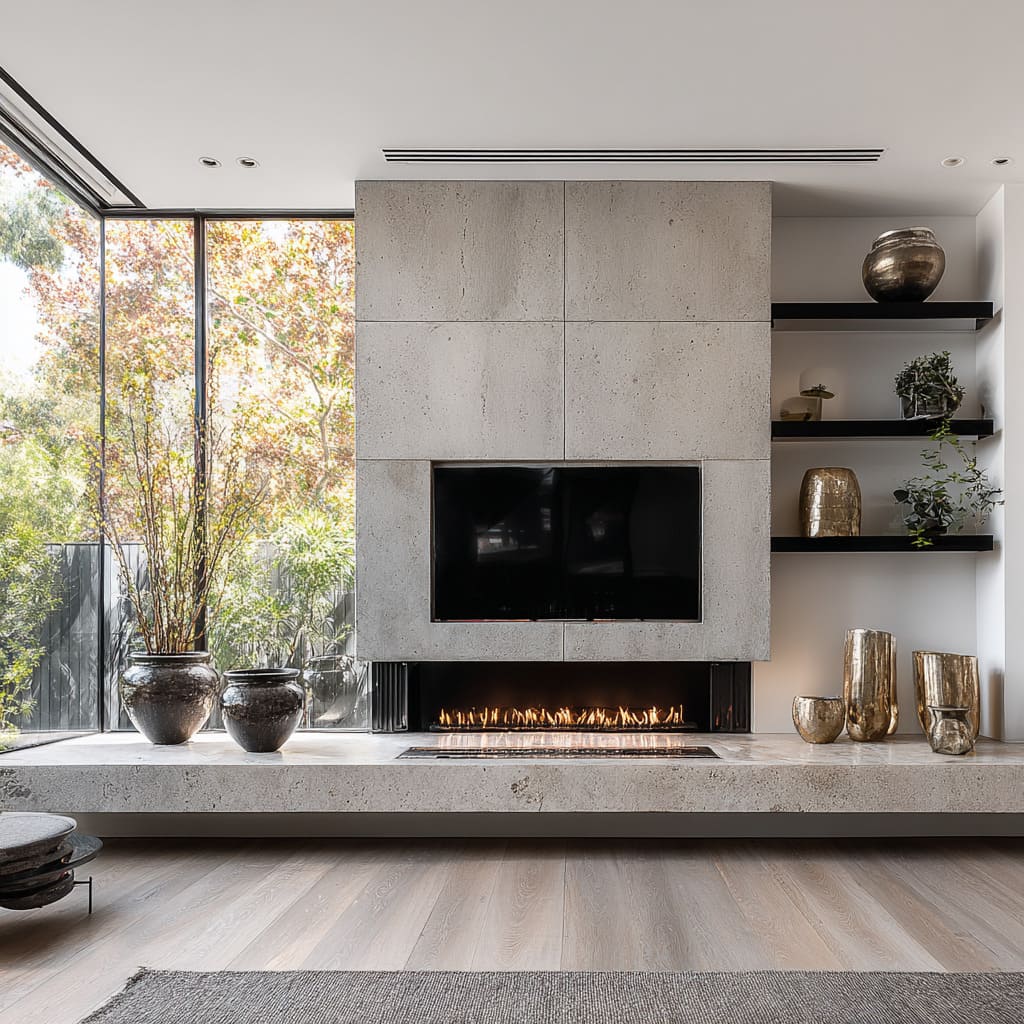
Some modern styles aim for a monolithic wall—large panel grids, concrete-like planes, broad calm fields. The visual character comes from emptiness and proportion, not ornament.
In such schemes, the flame is frequently a thin life-line inside a big calm surface, while warmth arrives through a small set of controlled elements: a few metallic vessels, a single branch silhouette, rounded planters, and daylight/greenery acting as the main “pattern” in the scene. This is common in minimalist fireplace wall with TV compositions and modern concrete grid feature walls.
A visual taxonomy of modern fireplace wall looks
These decorating strategies tend to cluster into clear look families, each with a distinct effect:
- Three-texture hierarchy walls (stacked stone + ribbed field + calm base)
Effect: complexity that still reads calm. - Library-style fireplace media walls (TV rhythm field + shelving bands + seam fire line)
Effect: built-in coherence, curated reading zones. - Soft plane + stone mass walls (micro-depth slats with a macro stone block)
Effect: quiet tension and architectural weight. - Pale envelope with black graphic inserts (quiet room, bold rectangles)
Effect: gallery-like clarity. - Charcoal panel grid walls with a pale stone runway
Effect: one edited composition spanning art, flame, and TV. - Split duet walls (dark ribs paired with pale slab stone)
Effect: contrast that stays ordered, often enhanced by warm grazing light. - Soft sage or light green-gray shells with a dark ribbed horizon base
Effect: airy mood with grounded structure. - Tall drama walls for volume (wine-red vertical fields + pale stone tower + black band)
Effect: lounge mood built from proportion rather than clutter. - Travertine portal fireplace walls (stone frame + black ribbed TV collar + long flame slot)
Effect: resort-like calm; sun-warmed stone with crisp black inserts. - Soft glamour fireplace walls (cream slab + fluted muted base + reflection layers)
Effect: brightness and expense through sheen control. - Dark modern walls with a thick stone mantle block
Effect: flame feels embedded and sculptural. - Blue paneled core with stone bookends and brass shelf lines
Effect: classic structure with crisp highlight rhythm. - Concrete grid monolith walls with black voids
Effect: serene architecture where the view and light carry the atmosphere. - Floating runway base walls with underglow
Effect: heavy materials appear lighter through shadow and glow.
The shared strategy: letting the wall do the decorating
Across many modern fireplace wall design ideas, the strongest results come from treating the wall as a single composition system: surfaces assigned roles, black inserts handled as intentional cuts, one continuous baseline keeping everything readable, and warmth distributed through small controlled echoes (metals, glow, selective color repetition).
Related Posts
Harmony Home Design brings 10+ years of residential interior design experience to the ideas shared here. We publish design concepts, layout thinking, and practical styling notes.