Black and white rarely behave as simple opposite tones. They take on functions, acting as structure, atmosphere, rhythm, or quiet outlines, and this is especially clear when studying the most refined black and white living room decorating ideas.
Black usually becomes the anchor—the force that holds the composition, frames the TV, supports sculptural objects, and maps the geometry of the wall. It appears in ribbed wall panels that turn darkness into a field of repeating shadows, in deep-set niches that create a visual pause, and in stone-like backdrops with fine white veining that soften what could otherwise feel heavy.
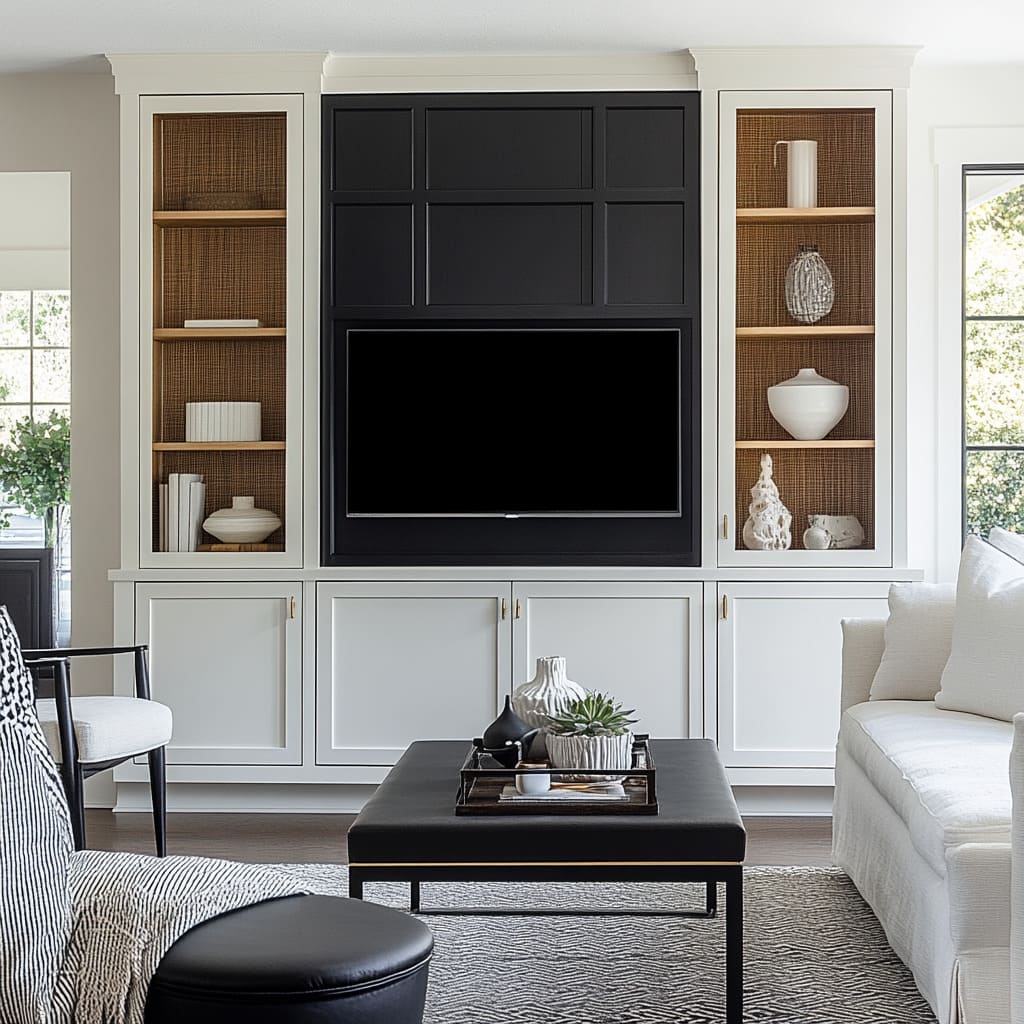
White, in turn, becomes margin and brightness. It is used as a wide visual border around the dark center of a media wall, as paneling that captures daylight, as cabinetry that provides volume without visual weight, and as the surrounding envelope that lets black stay grounded.
The two tones also create psychological roles: black stabilizes a room’s gravity, while white creates the air around it. As a result, the palette becomes less about high contrast and more about the way the eye moves from core to periphery, from strong shapes to soft planes.
The scene becomes structured and calm because every dark surface is buffered by white or warm neutrals, forming a steady, readable rhythm rather than a stark palette.
Texture as the Silent Pattern: How Surfaces Replace Print
One of the most striking qualities is the reliance on texture instead of graphic pattern. Visual interest never depends on prints, stripes, or busy motifs; instead, micro-shadows created by fluting, ribbing, painted brick, rattan, or woven rugs take over the role of pattern entirely.
In many of the strongest decorating ideas for black and white living rooms, the main visual story occurs in the surfaces behind the TV: narrow vertical ribs read like frozen waves; slender horizontal boards behave like a calm linear field; matte brick in white behaves like chalk lines when hit with daylight; fine textured plaster seems to hold soft shadows; woven back panels inside shelves add the feeling of natural grain.
These textures serve three purposes. First, they introduce rhythm at close range while keeping the overall palette quiet.
Second, they prevent the light tone from feeling flat or clinical. Third, they soften the darkness—especially when the black surface has ribbing, fibers, or veining—so that the room feels inviting, not severe.
Texture also repeats subtly in furniture: woven chair sides, jute rugs, ribbed vases, soft upholstery with faint grain. In this approach, the room’s pattern is the shifting play of light across small grooves, knots, fibers, and stone lines.
The palette stays minimal, but the space feels layered.
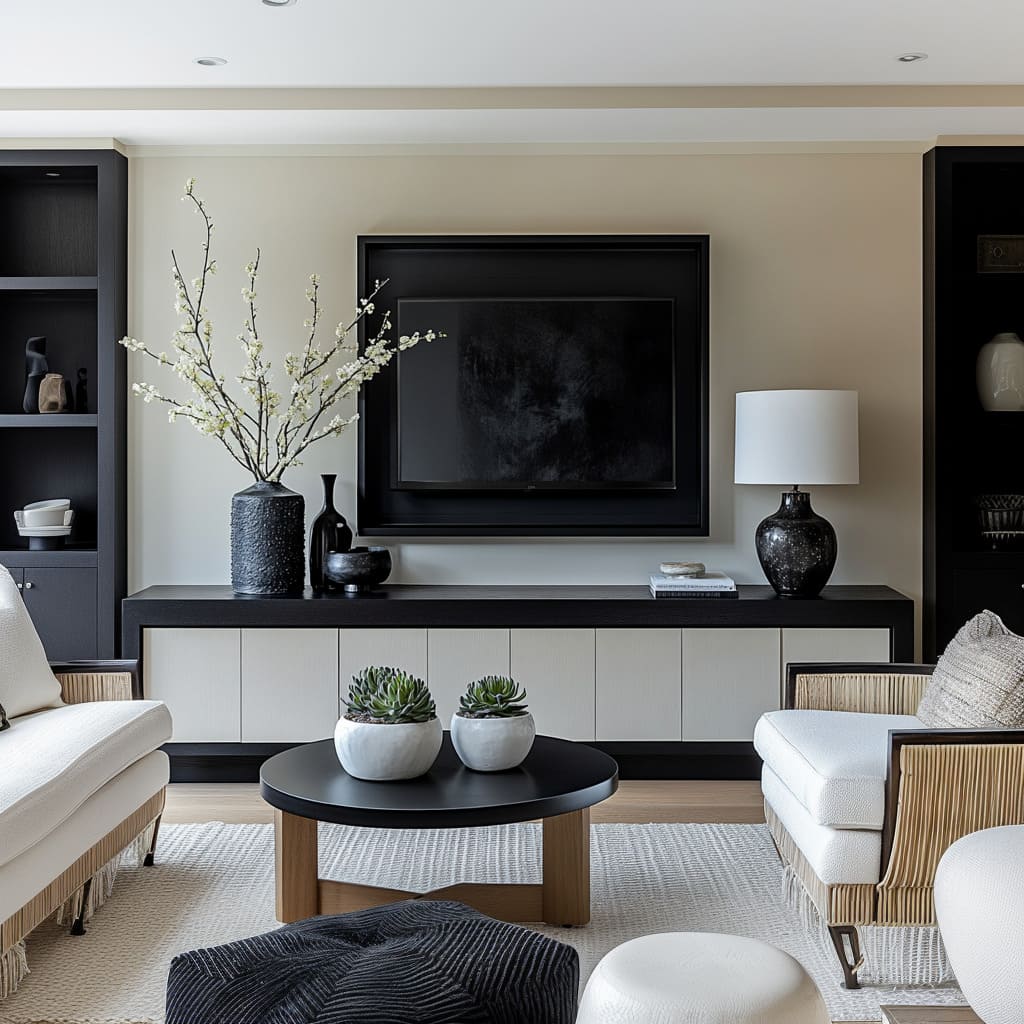
Compositional Geometry: Lines, Circles, Arches
Such interiors treat geometry as a type of visual language. Rectangles and grids form the base structure, while circles and soft curves bring balance and reduce rigidity.
Many black white living room decorating ideas rely on linear systems—vertical panels, horizontal shiplap, gridded cabinet fronts, rectangular shadow boxes—because these shapes organize the scene around the TV wall. But whenever the linear structure becomes strong, the room introduces a curved counterpoint: a round coffee table softens a tall panel wall; a split black-and-white disk becomes a sculptural focal point against fine vertical grooves; a large arched niche creates a soft bowl for the TV; a ribbed round vase adds a cloud-like form beneath a geometric cabinet.
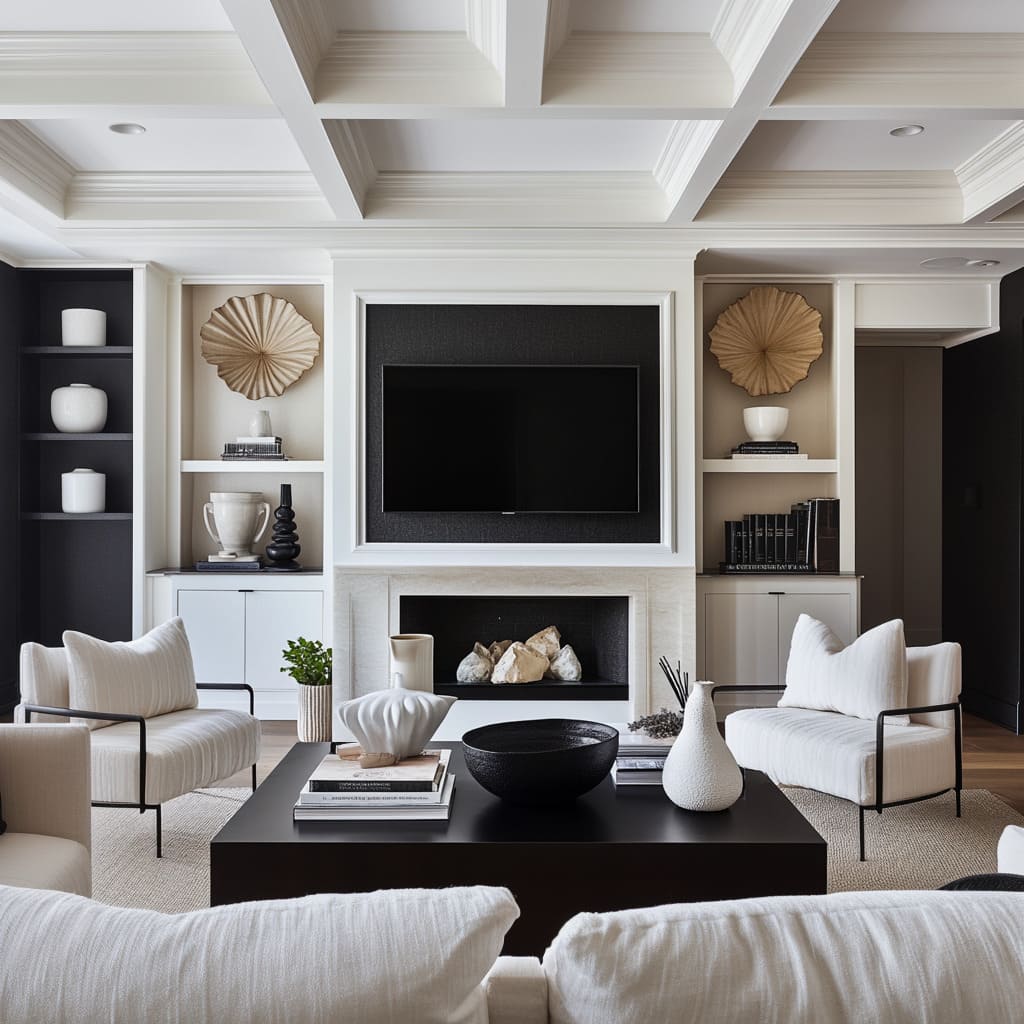
These curved elements are not decorative filler. They act as visual brakes, slowing the pace of repeated lines and giving the eye a place to rest.
Even furniture participates: chairs with gentle arm curvature echo the softness of an arch, cylindrical tables repeat circular wall art, and organic pottery pieces break the strictness of gridded shelving. This creates a layered expression where geometry becomes emotional language—lines structure the room, while curves soften it.
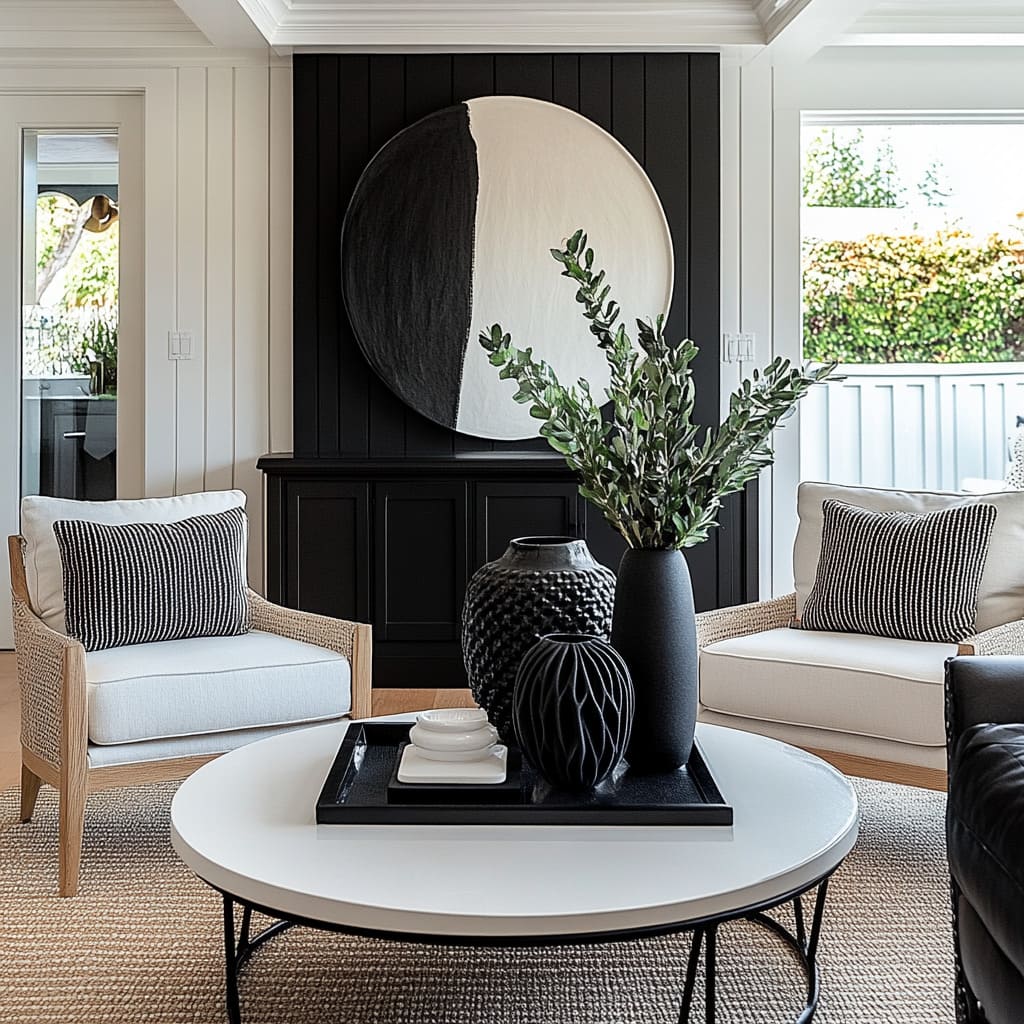
Warm Neutrals as the Third Tone
A quiet but crucial ingredient appears: warm neutrals such as straw, sand, pale beige, caramel leather, or woven natural fibers. Even though the projects are monochrome at first glance, nearly all rely on what might be called the buffer color to soften transitions.
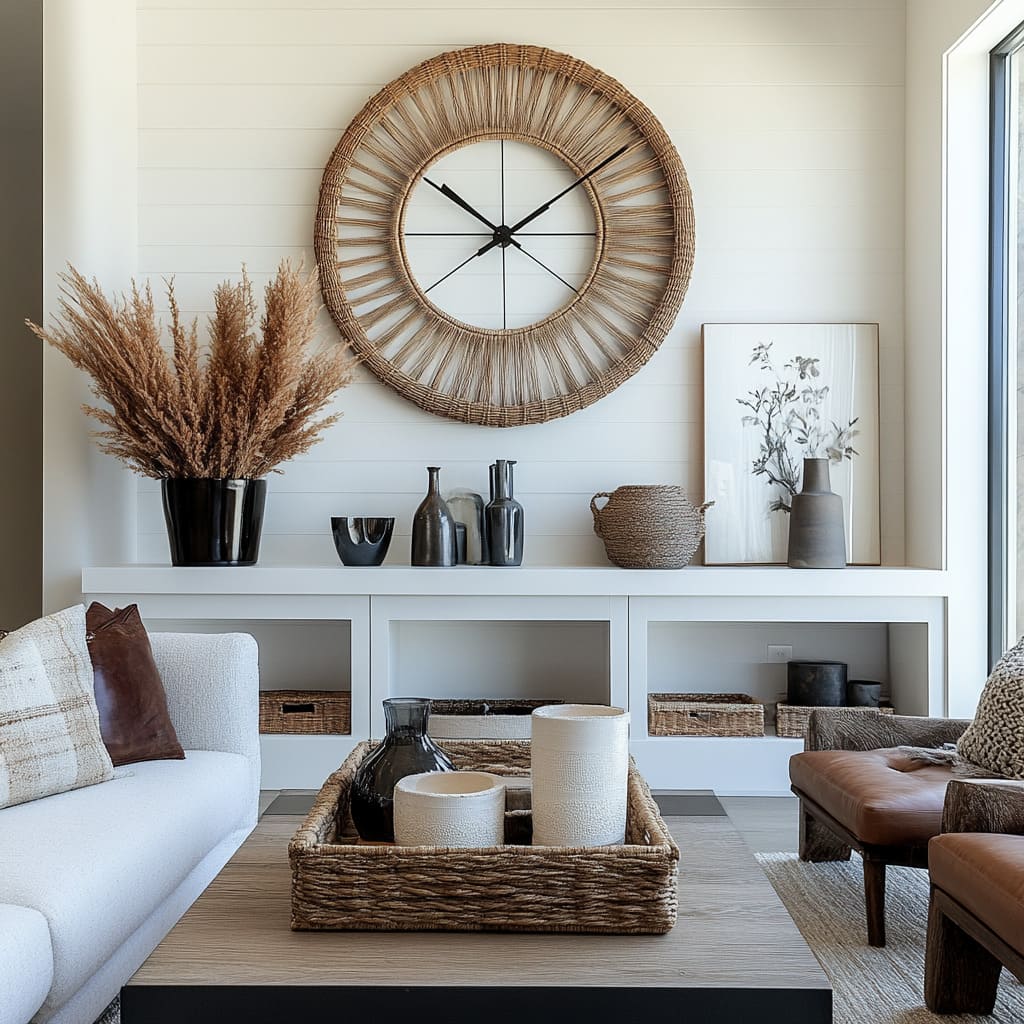
In the richest living room decor ideas in black and white, this warm note appears in woven baskets under consoles, pale wood shelves within dark niches, rattan clocks against white planking, soft caramel tonalities on leather seats, driftwood on trays, and stone fireplace surrounds in muted beige.
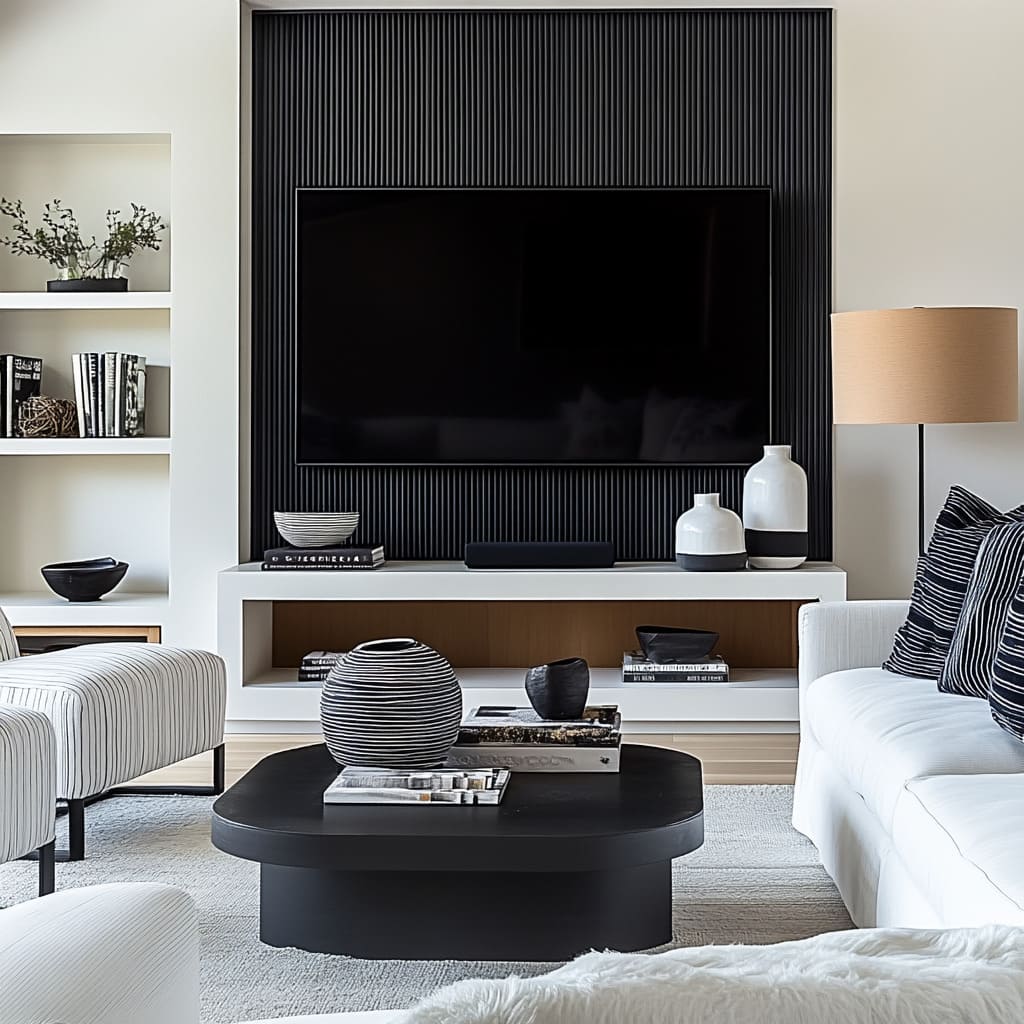
These touches do not interrupt the palette; they stabilize it. They sit right between the visual extremes—neither bright nor dark—and keep the transitions from feeling abrupt.
They also sketch out the sensory layer of the room: the sandy woven surfaces feel touchable, the leather notes feel grounded, and the pale stone feels calm. These materials operate quietly but decisively, giving the room visual temperature.
Without them, the palette would become pure contrast; with them, it becomes atmospheric, like a monochrome photograph with the warmth of sunlight.
Media Walls as Set Pieces
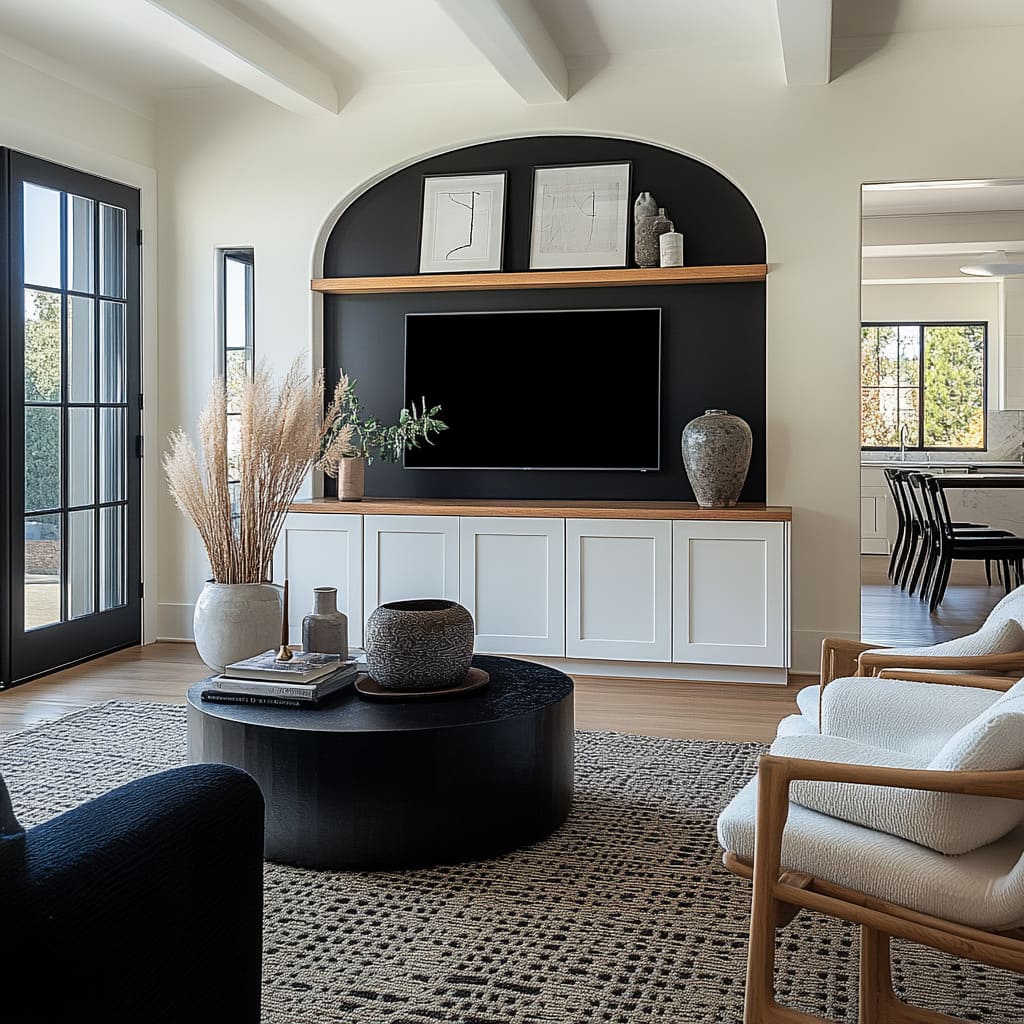
One of the most advanced strategies visible is the transformation of functional elements into visual objects. Instead of hiding the TV or emphasizing it, the room absorbs it into a larger composition so that the screen reads as one shape inside a structured arrangement.
This reveals much about how refined black and white living room furniture decorating ideas operate. For example, when a TV sits in the lower part of a tall black grid, the extra black space above reduces its perceived size.
When a TV blends into a deep black ribbed panel, the screen surface becomes part of a larger field of shadow. When the TV sits in a white recess, the niche becomes the dominant form, and the screen becomes one dark rectangle inside a brighter frame.
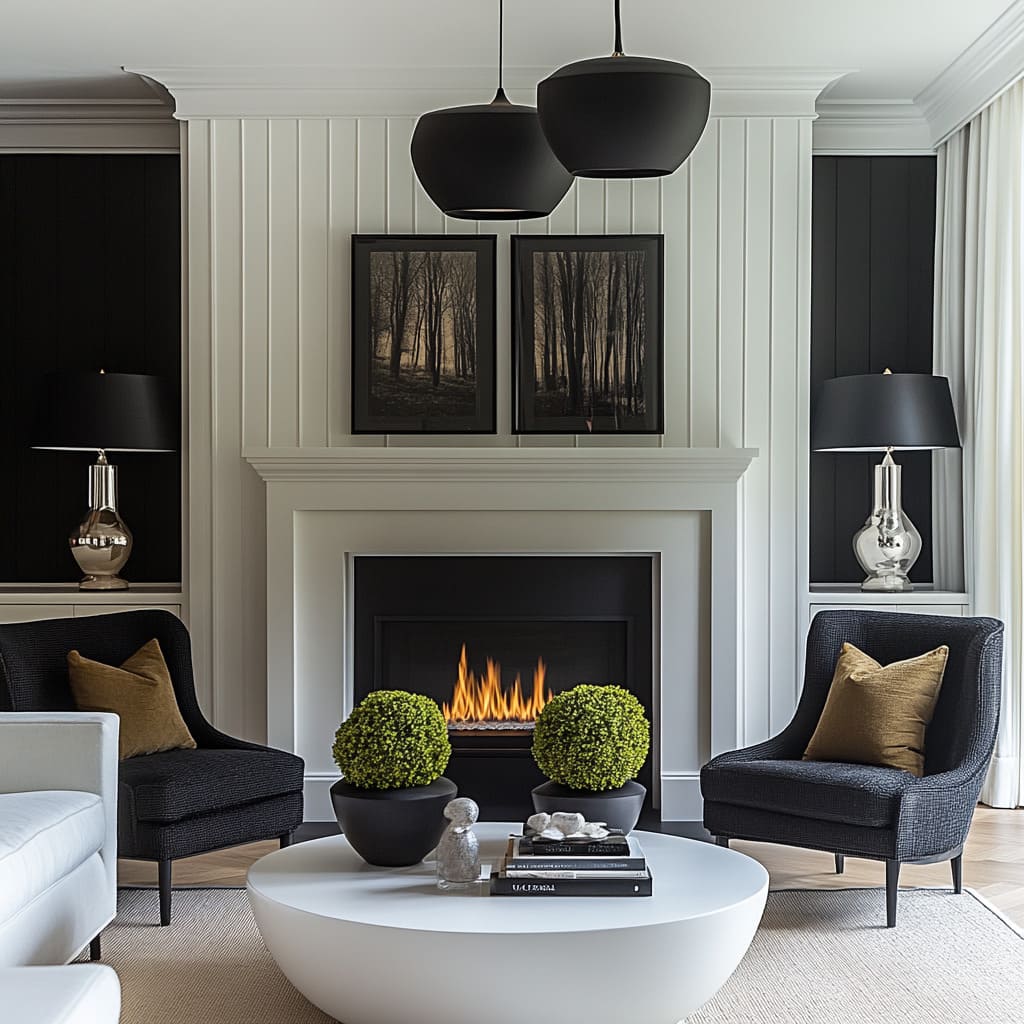
Fireplaces behave similarly: some are framed in pale slatted surfaces that create a spine; others sit inside stone-lined recesses with sculptural rock displays; others play as black voids within layered paneling. In all cases, the element that normally controls a room is visually demoted.
The wall becomes the star; the TV or fireplace becomes a supporting shape.
Shelf and Tabletop Styling
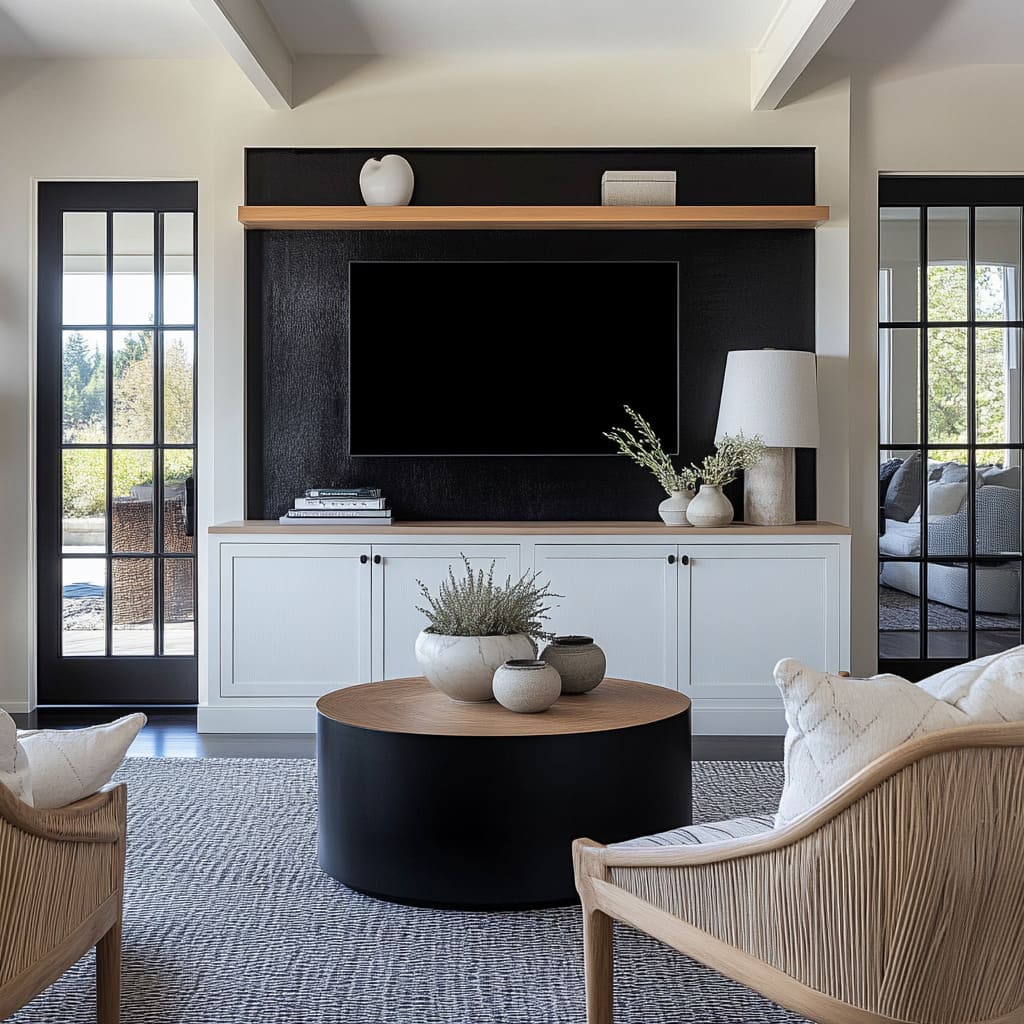
Shelves, consoles, and coffee tables often reveal a shared visual tactic: the decoration is never dense, but it is never empty. Instead, carefully measured spacing defines the structure of the composition.
Many of the strongest decorating ideas for black and white living rooms use shelf styling that behaves like a visual sentence—objects form words separated by space, and this spacing is what gives the styling clarity.
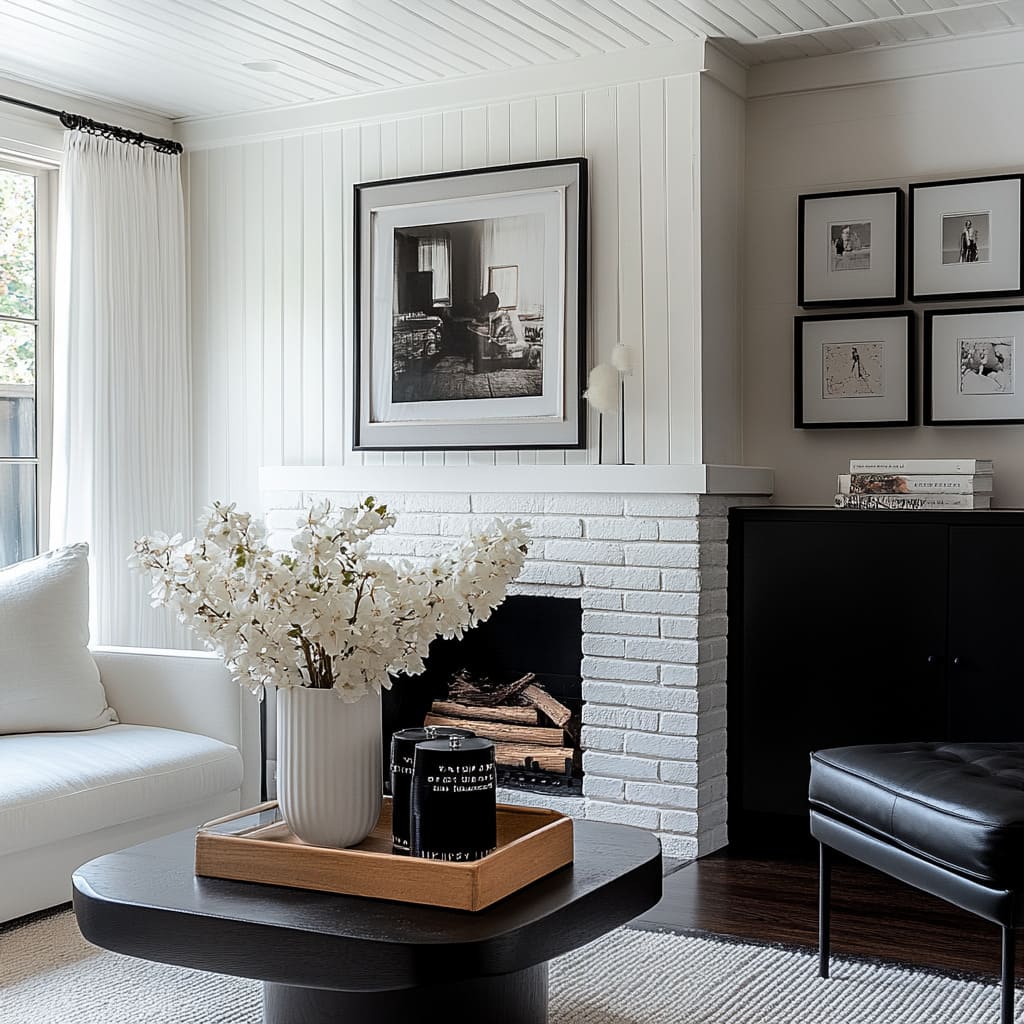
Thin shelves sit in front of woven niches so the texture stays visible; pottery pieces are arranged by volume progression rather than color; leaning frames create casual tension against strict lines; baskets in open cubbies are coordinated but not identical; and trays on coffee tables act as boundaries so objects do not visually scatter. The tabletop scenes often include ribbed vases, matte bowls, branches, candles, sculptural vessels, and small books arranged with attention to height.
The negative space around these pieces matters as much as the objects themselves. This strategy ensures that every area reads as intentional, with no clutter, but also no empty zones that feel lifeless.
Mood Directions Within a Single Palette
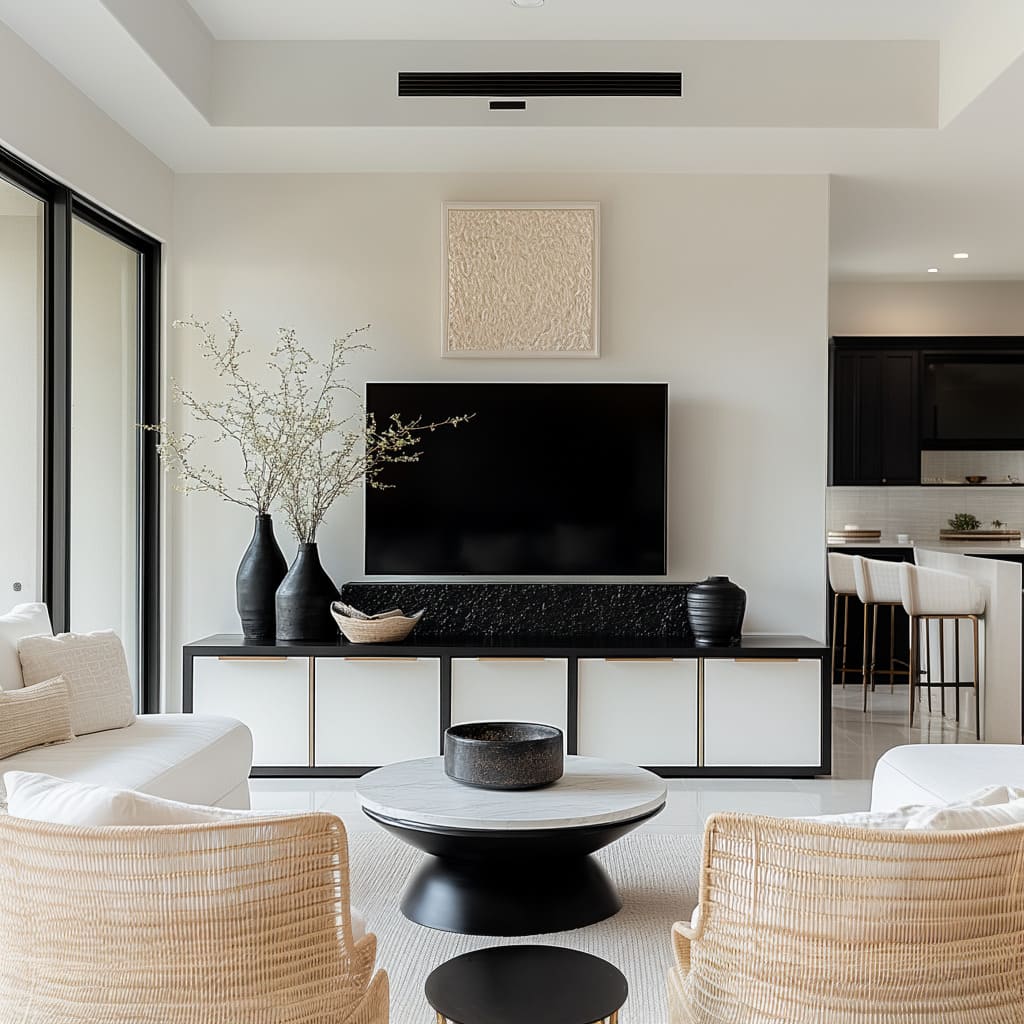
Even with the same palette, different approaches can deliver different character profiles. Some feel like monochrome galleries, others like relaxed coastal retreats, others like softened industrial lofts.
What distinguishes one mood from another is the combination of texture, shape, warmth, and density. In gallery-inspired concepts, the palette appears controlled and sculptural: black ribs, stone veining, pleated fan objects, circular artworks, and matte ceramics combine into a composed still-life scaled up to room size.

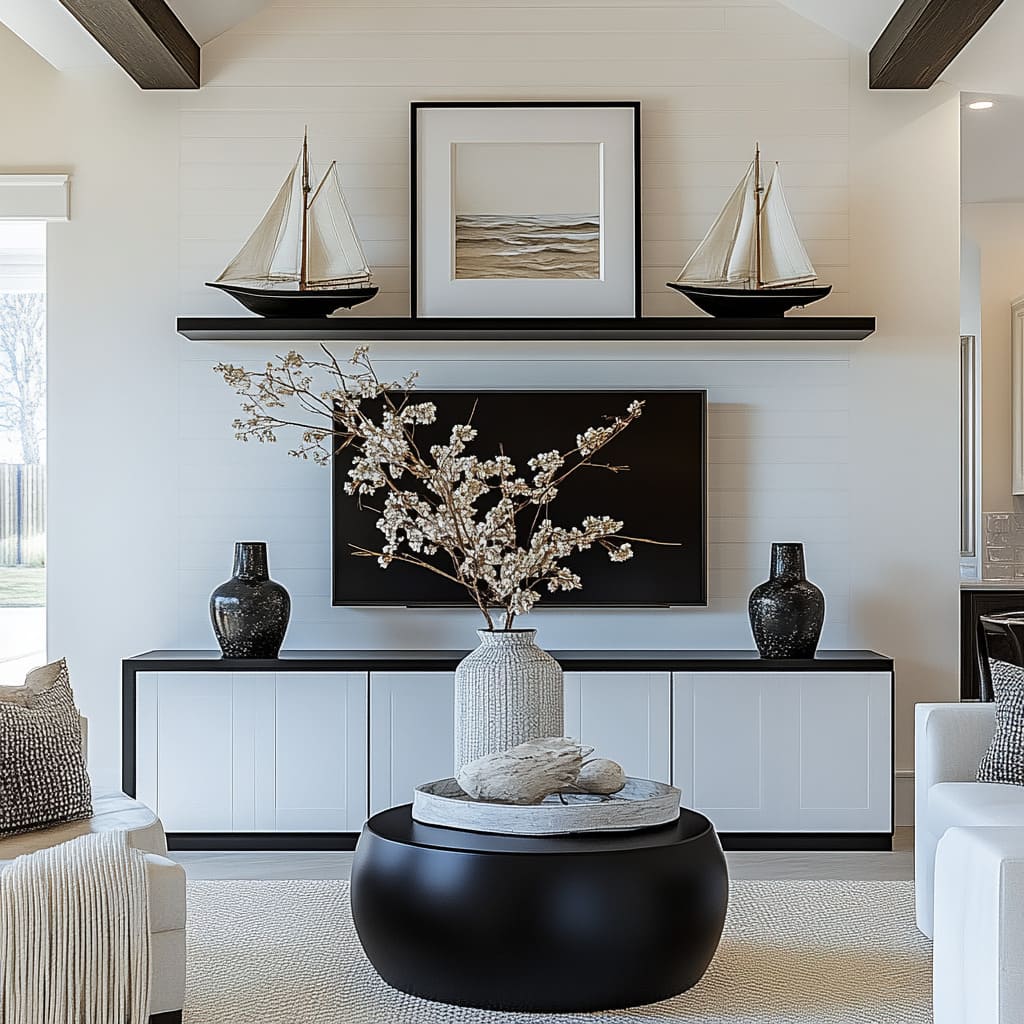
In coastal-toned spaces, the presence of horizontal boards, rattan, straw hues, pale blossoms, or carved driftwood shifts the mood toward breeziness while keeping the palette calm. In slightly industrial versions, thin black metal frames, concrete floors, and exposed ducts blend surprisingly well with soft furniture in white and sand tones.
These variations demonstrate that black and white living room decorating ideas can feel serene, dramatic, warm, or airy depending on which materials are chosen and how much softness is introduced. The palette becomes emotional rather than simply visual.
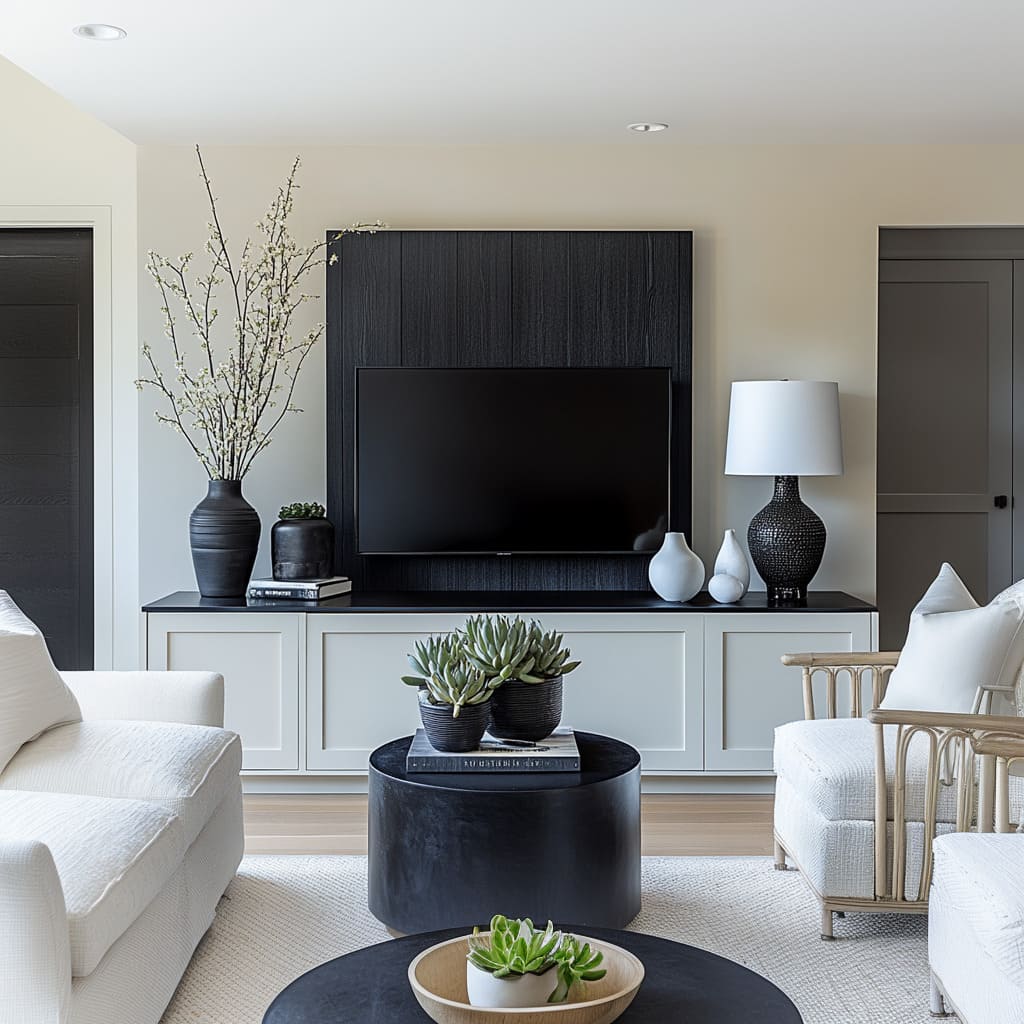
Organic Elements for Strong Contrast
Greenery, branches, blossoms, and dried grasses can appear in highly strategic ways. Their role is not only decorative but compositional: organic shapes interrupt strict geometry, add irregular movement, and create instant visual relief in a palette defined by sharp lines.
A tall vase of thin branches breaks the vertical rhythm behind a TV; soft blossoms form a mist-like cloud in front of matte black surfaces; dried plumes brush against an arch, emphasizing the curve; green topiary spheres sit on white tables and create volume where everything else is planar.

These natural forms also serve as small emotion markers: they add life to dark corners, keep black niches from feeling heavy, and introduce asymmetry where the architecture is symmetrical. They are used lightly—never large indoor trees or dense plant clusters—to keep the palette crisp.
As a result, they become punctuation marks rather than themes, giving the room a sense of light movement and fine detail. This approach supports the subtler qualities of living room decor ideas in black and white, where the palette stays controlled but the atmosphere never feels static.
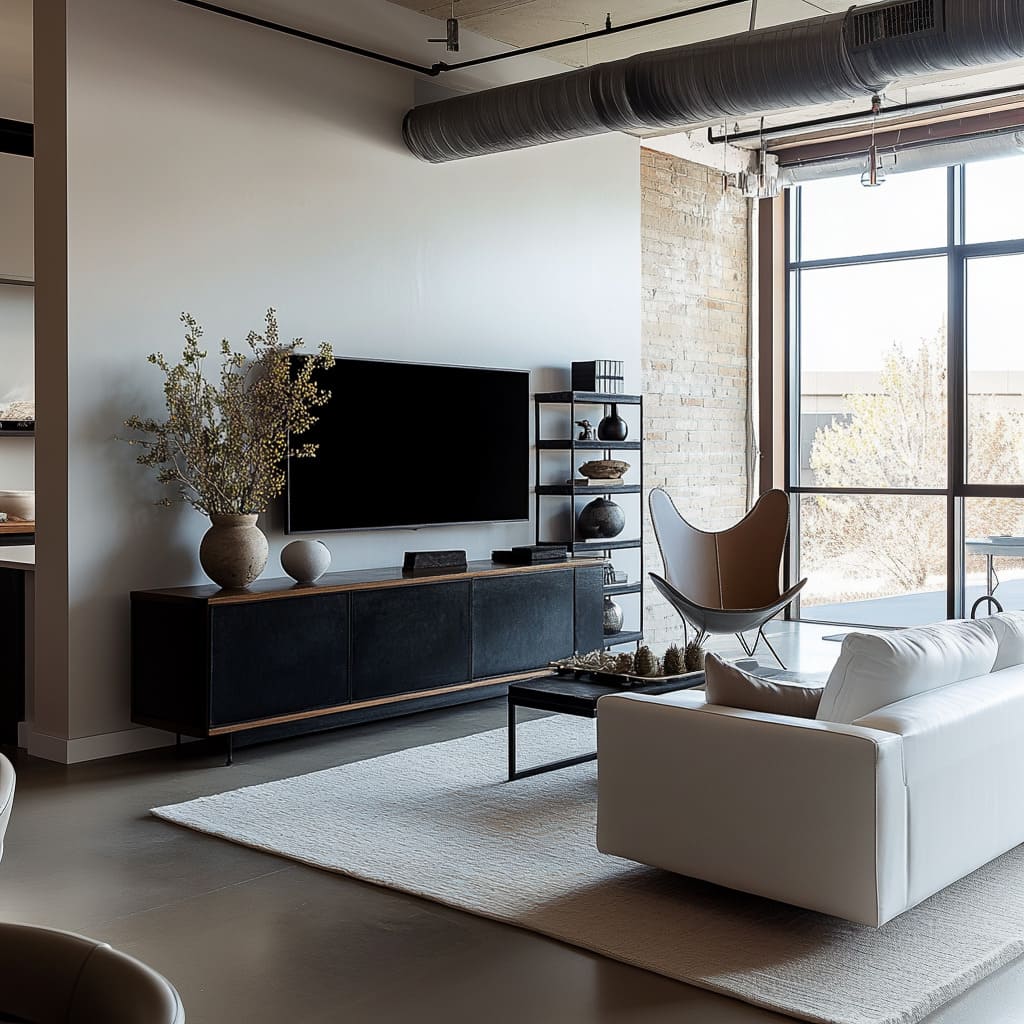
The Visual Logic of Balance
Many designs establish symmetry—matching vases on each side of a TV, repeated shelves, paired sconces, centered artwork—and then deliberately interrupt it to avoid stiffness. A wooden vase leans slightly off center on a shelf, a group of objects favors one side of a coffee table, or one vertical niche holds a lighter-toned piece than the other.
These subtle shifts keep the design approachable. The arrangement also uses generous spatial breathing.
Spaces between furniture pieces are not minimal; instead, the room opens up around the central table, allowing shapes to stand on their own. The result is a calm spatial rhythm where dark and light elements do not compete but support one another.
This breathing room is one of the most defining qualities of refined black and white living room decorating ideas—the palette is strong, but the atmosphere remains quiet because nothing is crowded.
Related Posts

Harmony Home Design brings 10+ years of residential interior design experience to the ideas shared here. We publish design concepts, layout thinking, and practical styling notes.